
At our favorite grocery store in Lisbon there was an entire wall of Panettone, in distinctive paper boxes, in sizes ranging from tiny to one that would feed an army battalion. This is a testament to both the Portuguese love for Panettone and also the sheer variety of Panettone available. Panettone is a yeast-based Christmas sweet bread from Milan, Italy – traditionally it had pieces of citrus and nuts – however there are other varieties with chocolate or even cream filling. Panettone’s particularly light and fluffy texture is the result of a complicated proofing process (similar to Sourdough bread). Though it originated in Italy, Panettone has flown way past the Italian (and European) borders and is readily available in the US and in South America.
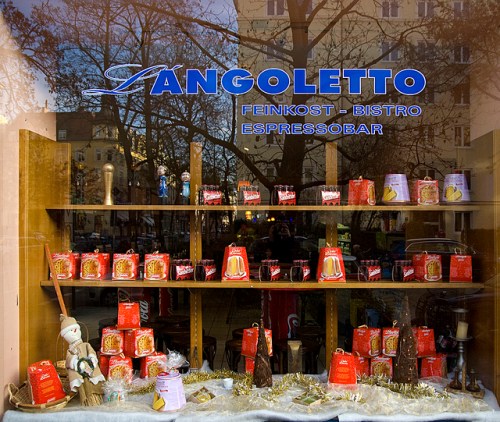
A variety of Panettone for sale in Munich
The origin of Panettone is probably the Roman Empire, but I was surprised to learn that it only became commercially available in the 1920s. Needless to say, it wouldn’t be an Italian Christmas or New Year without some Panettone. The large size Panettone is a lot for one person to handle, so sharing it with family and friends is probably a good idea (M swears by eating it the next day as toast with butter and cinnamon, or you could make a bread pudding). We’ve never tried making Panettone, though these miniature cranberry Panettones seem to be more manageable. Recipe Roll and King Arthur flour have recipes for a classic Panettone, and Sur Le Table even has Panettone baking molds in traditional parchment.


 Eating The World
Pingback: Colomba Pasquale / Colomba di Pasqua Italian Easter dove bread | Eating The World
Pingback: Italy’s Christmas Breads: Pandoro vs. Panettone | Eating The World