[Via Craft] 93 year old Clara Cannucciari lived through the Great Depression, and now, courtesy of her grandson, also has a cooking show on YouTube. Great Depression Cooking with Clara is a fun and charming show, that is unfortunately especially relevant today. Clara was a 1st generation American, whose parents immigrated to Chicago from Sicily. She reminds me a lot of my (L) own grandma, who pretty much shares the same story!
Friday Foodie Link: Great Depression Cooking
Filed under Links
A Quick Bite At: Alliance Bakery
Alliance Bakery
1736 Division St.
Chicago, IL
Tucked away in a vintage shop in a rapidly gentrifying stretch of Division, Alliance Bakery has been churning out classic cakes, cookies and pastries for over 80 years. The windows are lined with fantastically detailed (and sometimes absurd) custom cakes in the shape of hats, purses and multi-tiered wedding confections. For a smaller bite, the giant cookies are fantastic as are the perfectly-iced cupcakes. Along with a selection of European pastries, Intelligentsia coffee is brewed, and wide selection of bread is ready to take home. On a nice day, outdoor patio seating is prime. Alliance has recently expanded into the storefont next door, making a whole room dedicated to air-conditioned and wi-fi. If you want to people watch, you can nosh in the picture window on pink upholstered chairs, under the watch of the distinctive neon sign.
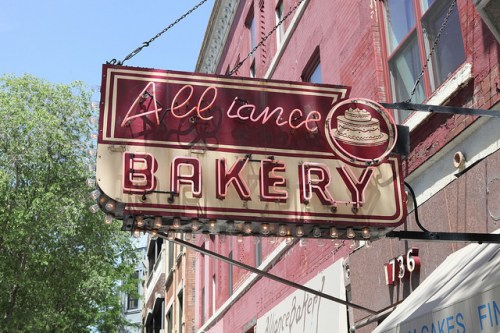
Alliance Bakery sign by Sam Howzit
Filed under Reviews
Follow ETW on Twitter!
 That’s right. We’re on Twitter now. You can follow us at “EatingTheWorld.” We’ll be updating all of our most succinct foodie thoughts!
Filed under Note
FTC: Mint Mischief Potato Chips
 The potato chip is definitely transnational. Since its invention in Saratoga Springs, NY in the 1850s, the humble potato chip has gained popularity across the world. Needless to say, as it has gone global, it’s picked up some pretty interesting taste combinations. The latest interesting twist on the plain old potato chip comes from India, and the multinational company, Lay’s.
These potato chips from India are called Mint Mischief and feature mint, lime and jalapeño flavors. They were brought back by a colleague of mine who recently went to India for a wedding. I was expecting the chips to be fairly spicy, but there is only a hint of heat. These chips were conundrum to my American palate, since Mint is usually associated with sweet and not savory (except mint jelly with lamb, I guess). If the mint had been substituted for cilantro, a more familiar Latin flavor probably would have registered. But in the end, I really enjoyed the mint mischief chips and their unique flavor combination. I don’t know where to get them in Chicago, so if you have a friend who is going to the subcontinent, ask them to stock up!
 [Flickr Photo from Dw33by]
Filed under Finer Things Club
Friday Foodie Link: Eco-Pasta?
Apparently, according to the New York Times testers (and Lidia Bastianich), you can get just as good of results by using less water than recommenced to boil pasta. I think I do this already – 4 quarts seems like so much!
Filed under Links
Fat Tuesday Around the World!
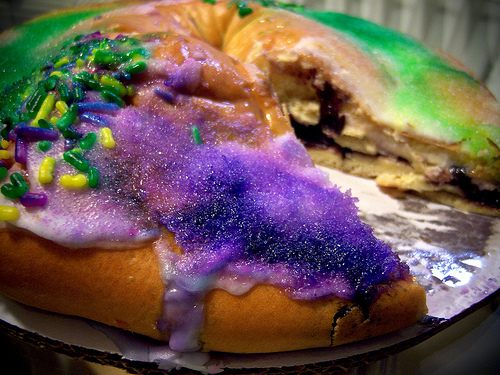
It’s not called Fat Tuesday for no reason. Shrove Tuesday, the last day before Lent begins, is a traditional day of feasting. Naturally, in the US the focus is on Creole and Cajun Mardi Gras foods due to the big way that New Orleans celebrates the holiday. For an awesome intro, Epicurious has a new guide on Cajun and Creole food, because as we learned, there is a difference. If you’re feeling especially festive (or hungry) Chow has a recipe for King Cake (Galette des Rois – seen below) and Gumbo Pages has a history and recipe of the ubiquitous Muffaletta.
However, in addition to the Nawlins Mardi Gras we know and love, there are some other pretty great food traditions, such as Paczki Day in Chicago. Paczkis (pronounced poonch-key) are filled doughnuts and are traditionally consumed in areas with high Polish populations. On the other side of the pond, the tradition in England is to have Shrove Tuesday Pancakes (is it a coincidence that IHOP has free pancakes today?). In Sweden, the day is called Fettisdagen, and a traditional pastry of semolina wheat called Semla is consumed. Basically every country or community that celebrates Easter has their own Mardi Gras food traditions, and they all sound pretty delicious to us!
Filed under Holidays, World Eats
Friday Foodie Link: A New Molcajete

It was L’s birthday this week, and as one of her presents, M got her a molcajete. Isn’t it cute? A Molcajete is a traditional Mexican kitchen implement made from volcanic rock. So they’re pretty much awesome volcanic mortar and pestles used for making a variety of salsas and moles. They often come with animal faces, and the volcanic rock is said to impart some mysteriously delicious extra flavor into any sauce made in the molcajete.
But this was not just any model, apparently this molcajete has even been vetted by Rick Bayless himself, who praised its smooth surface. We were excited to try our molcajete out – but before using it we had to season it. To accomplish this, we first rinsed it thoroughly, ground dried rice into it, and finally pulverized a mixture of garlic, sea salt and cumin seeds. Now the molcajete is ready for business, and it will only improve with age. Look for some recipes soon.
Filed under Reviews
Friday Foodie Links: Chicago Restaurant Week
Chicago Restaurant Week is coming the 20-27th. Some Chicago favorites like Cafe Spiaggia, Naha and Frontera Grill are offering $22 3-course lunches and $32 3-course dinners. Menu Pages Chicago and the Time Out Chicago blog break down some best bets. Don’t forget to make reservations!
The Salinas (salt marshes) of Portugal
 The New York Times has a fascinating article on how salt is made the traditional way in Portugal. Artisinal salt makers using salt marshes called salinas are reviving centuries-old traditions, as most salt-making goes large-scale and commercial.
Filed under Links
Recipe Friday: Xnipec
M has been on a spicy pepper kick recently, so we decided to find an outlet for the habanero peppers he acquired last week. After some online sleuthing, we found the perfect low-stress recipe: Xnipec (prounced shnee-peck) is a spicy tomato-habanero salsa originating from the Yucatan. Given the mild flavors of most cuisine from the region, one may be surprised at how popular the incredibly spicy habanero pepper is there. But the habanero gives more than just heat – it has a nice citrus, sweet, tropical flavor that goes great with chicken, fish, steak, salsas, or most anything else. This recipe takes the much recommended caution of delicately removing the habanero seed pods and interior white vein to remove most of the heat. For spicier salsa, use greener, less-ripened habaneros. Fully ripened orange ones are fruitier, but more mild. Here’s the recipe, courtesy of the culinary wizardry of Rick Bayless:
Ingredients (Makes 2 cups):
1 small red onion
2 tablespoons fresh-squeezed lime juice
10 ounces ripe tomatoes
6 radishes
1/2 whole habanero chile – or more (we used 1 whole)
12 large fresh cilantro sprigs
1/2 teaspoon salt
Chop the onion very finely, using a knife (don’t use a food processor), and scoop it into a strainer; rinse under cold water. Shake as much of the water off as possible, then transfer to a small bowl and stir in the juice. Set aside.
Core the tomatoes, then cut in half crosswise; squeeze out the seeds. Finely dice the tomatoes (about 1/4 inch cubes). Scoop into a bowl.
Slice the radishes 1/16-inch thick, then chop into matchsticks or small dice. Add to the tomatoes.
Punt on a pair of rubber gloves. Carefully cut out and discard the habanero’s seed pod, then mince the flesh into tiny bits and add to the tomatoes.
Bunch up the cilantro sprigs, and, with a very sharp knife, slice them 1/16-inch thick, stems and all, working from the leafy end toward the stems.
Combine radishes, chile, and chopped cilantro with the tomato mixture; stir in the onion and juice mixture. Taste and season with salt.
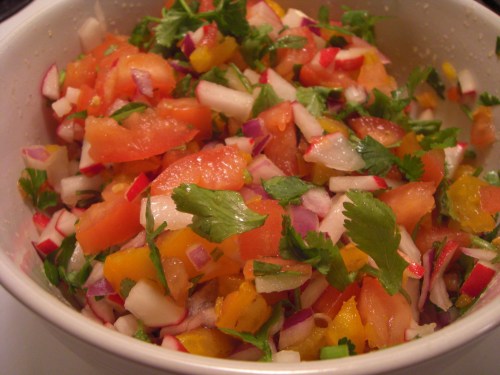 The Eaters used both red and yellow tomatoes, and bumped up the amount of habanero. Don’t be nervous about doing that – with a discarded seed pod and vein, habaneros have just the right amount of spice to let their tropical flavors shine through. Our main concern with this dish was the amount of onions, but rinsing them under water for a minute or so takes off most of the onion flavor and allows them to absorb the habanero, cilantro, and lime juice. Same with the radishes.
All in all, we thought this was great. It is quick, cheap, easy, comes out very colorful and fresh, and goes great with just about anything. We originally ate it alone as a salsa with some tortillas, and used another batch over grilled chile-rubbed chicken on a bed of rice. Great there too. We will definitely be making more of it.
Filed under Recipes
A Brazilian Corner in Berkeley: Brazil Cafe
 Brazil Cafe
1983 Shattuck Ave
Berkeley, CA
I had a lunch break for my conference at UC-Berkeley – what to do? Downtown Berkeley is overrun with Asian fare, southern and eastern, but I was looking for something more esoteric. A quick call back to L at our home base, some internet research, and a leisurely walk later I found myself staring across Shattuck Avenue in Berkeley toward a parking lot wedged inside an office park – a parking lot home to Berkeley’s most colorful eatery, Brazil Cafe. One look at the small, festive stall and I knew this was going to be a good meal, and judging by the selections on the surfboard-menu, my hunch was right.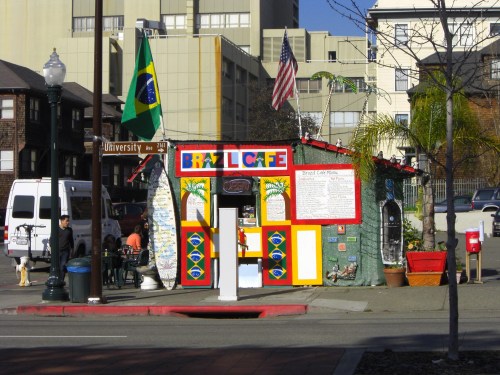
I walked right up to the counter, and before I even had a chance to order, the unemotional but efficient owner was shoving a toothpick of tri-tip steak toward my face – her speciality. Tri-tip is a special cut of meat, a little more marbled than other steaks and extra juicy, which at Brazil Cafe gets thrown on a sandwich and combined with a rich and flavorful green garlic sauce. “I’ll have that.” Along with a mango smoothie. A combination which, as it turned out, was one of the special student combos – all for $7.95.
I got a number and picked a seat out back, amidst the jamming sounds of contemporary Brazilian samba and photos of American tourists at Ipanema Beach. The wait for the food was short, so I was ready to dive in to my sandwich – and what a sandwich it was. The thin paper sandwich tray was clearly ill-designed to contain the massive tri-tip, a problem which I set out to rectify by scarfing it down. I was pretty hungry. And you have to be to come here, the juicy, lightly marbled meat, thick bread, and rich, flavorful garlic sauce make for a filling, messy, and tasty meal. The sauce makes the sandwich (as many sauces do), and I was frankly surprised by its heaviness and strong garlic flavor (not that anyone is complaining about too much garlic). Good as it was, the mango smoothie really hit the spot by balancing out the sandwich flavors with a nice, sweet, fruity, and really fresh finish to the lunch. All in all, it was one of those meals you could tell was all fresh ingredients used right on the spot, and given Brazil Cafe’s parking lot real estate, that was pretty surprising. So kudos to the owner (a Brazilian native – I could tell by her accent) for giving Berkeley a great, filling, fun lunch spot, particularly one that gets Brazil out of the all-steakhouse-all-the-time reputation it seems to have Stateside.
Filed under Reviews
FTC: Aero Bars
 International candy is so wonderfully random and varied, you can’t help but love it. At the top of my list of fun international candies from my youth has to be Aero, made by Nestle. Aero is a UK creation, and was first made by the Rowntree Mackintosh company in 1935 (Nestle bought Rowntree Mackintosh in 1988). Above all else, Aero is a novelty bar, and not some extraordinarily fine bittersweet chocolate.
The novelty, in this case, is that Aero bars have a bubbly, aerated chocolate filling, which creates a pretty unique texture. Tellingly, the tagline of Aero is “have you felt the bubbles melt?”If you cut the bars open you can really see the bubbly interior – check it out below. Though we searched the web for how the bubbles in Aero form, it seems to be a closely guarded and much-speculated secret. Aero bars also come in dark chocolate and mint varieties – check out the awesome green color below! Aero is available at Cost Plus infrequently, and any respectable British Market. 
Filed under Finer Things Club
Friday Foodie Link: Obama Food-o-Rama
We’re not going to lie – we love Obama food news – so we were overjoyed when we found Obama Foodorama, a site dedicated to everything Obama-foodie related. Being from Chicago, we are doubly excited, since Obama seems to be maintaining his Chicago foodie roots – especially given that he recently brought the chef from Chicago restaurants Avec and Blackbird, Sam Kass, to Washington.
Filed under Links
A Taste of Cuba in the Chicago Loop at Cafecito
 Cafecito
26 East Congress Pkwy
Chicago, IL
Upon entering Cafecito we had our first sign that it was a hidden gem – directly ahead of us in line was a pack of Chicago Police officers. If there are 8+ police officers in a place at 5 PM on a Saturday, we figure the food has to at least be decent. Cafecito’s laid-back and colorful ambiance welcomed us in right away, and other than the cops, the place was populated by international teens and 20-somethings checking their e-mail – not surprising since Cafecito is connected to a hostel!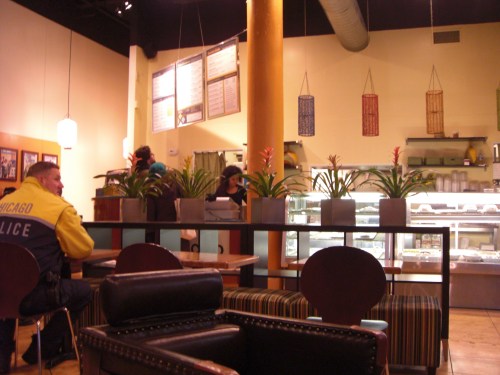
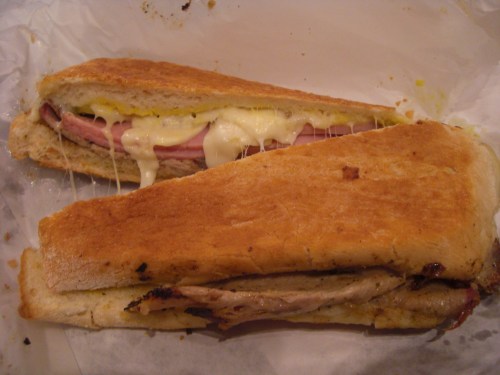
Cafecito focuses on reasonably-priced pressed sandwiches which are akin to paninis. However unlike paninis, Cuban-style sandwiches are pressed on a plancha grill – and have no grill marks. Cafecito’s most famous offering is their Cubano sandwich, recently rated as Time Out as the best in all of Chicago, which is no small feat. So naturally, when first visiting Cafecito, the Cubano was the sandwich of choice for most of our party. The hefty Cubano ($4.99) consists of the classic combination of roast pork, ham, swiss cheese mustard and pickles. The sandwich comes served on a pressed Gonnella roll (a Chicago touch). The flavors all melded together perfectly but the real standout was the juicy and tender roast pork. We can definitely see why this Cubano has won so much acclaim – our party practically inhaled the sandwiches. Though the Cubano appeared to be the most popular option – Cafecito has other sandwiches are worth noting. We can recommend two sandwiches with an excellent house-made Chimmichurri sauce – the chicken breast sandwich ($5.49) and the Choripan ($5.49) with Spanish chorizo.
We finished off the meal with some great, strong Cuban espresso with sugar $1.29 and hot chocolate ($1.99) which was good to take on a cold day to warm up. Cafecito also boasts a dessert counter full of miniature cakes and pasties, however it was pretty much empty buy the time we arrived. We are happy we found Cafecito – it’s a perfect lunch or dinner spot in the south loop – and will be a new go-to whenever we decide to hit the Art Institute. Or we just might make an extra trip or two for the Cubano.
Filed under Reviews
Happy Lunar New Year
 January 26th marked the ushering in of the year of the Ox. As with any holiday worth celebrating, there is some awesome food involved in Chinese New Year celebrations. In honor of the new year here are some fun and delicious links.
- The BBC highlights a range of traditional regional Chinese New Years dishes.
- Epicurious takes on a transnational Lunar New Years menu.
- Philly chef Susanna Foo shares a story and some tasty recipes at Global Gourmet.
- And for the cheapskate – how to make some freestyle dumplings for less than 8 bucks.
Finer Things Club: Gjetost Cheese
 This Norwegian import, (pronounced “yet-oast”) is hands-down one of the most unusual and distinctive cheeses the eaters have ever sampled. Gjetost is actually known as Brunost (literally ‘brown cheese’) in Norway. If that weren’t confusing enough, Gjetost goes by a variety of names across Scandinavia (Sweden – mesost, and Denmark – myseost). Gjetost is made from goat and cows’ milk and whey, which is boiled to a caramel brown and a soft consistency. Due to this caramelization, the cheese has a sweet, burnt sugar taste. Gjetost is commonly served sliced very thinly on top of fruit or crackers. This unusual cheese is commonly available at Whole Foods and many specialty stores. The most common variety in the US is is Ski Queen, which is found in a distinctive red package, as seen below.
 flickr photo from [oknovokght]
Filed under Finer Things Club
Friday Foodie Links: One and Two Food Blogs
We’ve encountered a number of good food blogs recently that have the structure of linking two foods – sometimes expected combos (Chocolate and Vanilla) and sometimes not (Chocolate and Zucchini?). We thought we’d share some of our favorites.
- Vanille & Chocolate – A London-based blog full of delicious recipes and travel stories.
- Cannelle Et Vanille – Blog from a Basque expat, filled with lovely desserts.
- Canela y Comino – Delicious dispatches from M’s favorite culinary country – Peru!
- Chocolate and Zucchini – A rather famous blog detailing culinary adventures in Paris.
- Rice and Noodles – A minimalist blog with gorgeous food photos.
Beard Papa’s Japanese Cream puff empire
 Beard Papa’s
2399 Telegraph Avenue (this location closed, various others open throughout the US)
Berkeley, CA
I (M) was in Berkeley for an academic conference, and naturally decided to take advantage of some West Coast eats that we don’t have in the Midwest. One place L and I kept hearing about was Beard Papa’s, a Japanese creampuff outlet with locations all around the Pacific Rim and NYC/New Jersey. With their Berkeley location just opened, I knew I had to stop in for some tasty cream puffs after a long day of lectures.
For starters, the best thing about Beard Papa’s has to be its logo. The white bearded, yellow hatted, pipe-smoking Alaskan fisherman (?) makes little sense as a creampuff symbol, but maybe that’s why he works so well. Whatever the allusion is, it is definitely memorable (maybe his face looks like a creampuff? You be the judge.)

It was late in the day when I made it inside, and was concerned they wouldn’t have what I wanted – and I was right. The ordering process is pretty simple: pick a pastry type (regular, cookie, or eclair) and pick a filling (Belgian chocolate, vanilla, or coffee). The flavors change from week to week – these are the choices this location had on this particular day. Regardless, the cookie crust (my favorite!) was out, so I settled on regular pastry with chocolate insides.

My verdict on the worldwide craze that is Beard Papa’s? Just OK. I cannot say I have much to compare it to in terms of creampuffs, but the pastry tasted, well, like a pretty standard pastry crust with pretty good soft ice cream center. Not that there wasn’t enough – the puff was much larger than I expected (a relative deal for $2.49) and more or less exploded with chocolatey goodness when I bit into it. But I definitely was not blown away by the offerings – maybe it was just the growing pains of a new establishment? I would definitely try one again if the opportunity presented itself, but as of right now, I find it hard to legitimate the worldwide obsession around the puffs.
Filed under Reviews
The 2009 USA Presidential Inaugural Lunch
 So we’re watching the inauguration on TV right now – needless to say we’re loving it. So in honor of the inauguration here’s a special inaugural luncheon post. The inaugural luncheon is a White House tradition, dating back to 1897. The theme this year was to have foods inspired by the Lincoln era, presumably chosen because Lincoln is Obama’s political idol. The lunch, catered by Arlington, Virginia’s Design Cuisine, starts with a seafood stew, the main courses are herb roasted pheasant with wild rice stuffing and duck breast with sour cherry chutney. For dessert there is a apple-cinnamon sponge cake. There is even a PDF of all of the recipes at the White House site if you’d want to try them. MSNBC has the recipes in HTML format.
Filed under Note