Finding the Best Açaí in Rio de Janeiro: Pioneiro dos Sucos

Pioneiro dos Sucos
Av. Treze de Maio, 23
Rio de Janeiro

brazil

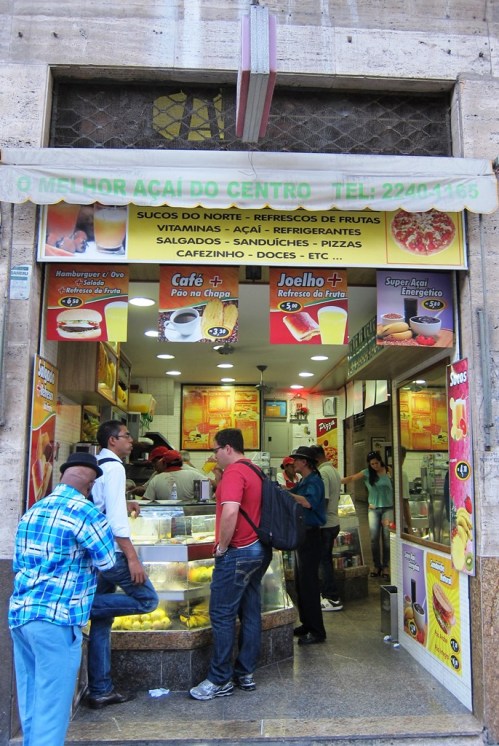
In the heart of Centro (our neck of the woods) we visited Pioneiro dos Sucos, which is a really basic, local, stand-up only açaí place, mentioned on Todo Rio. The juice bar always seemed to be full of locals and office workers so we figured it certainly would be worth a try. This type of simple stand-up juice bar is prolific in Centro. People go to these kinds of places to get a cafezinho or a juice and snack before/after work and at lunchtime. There are also sandwiches and more substantial items, but the majority of people just grab a snack and go.

Value: 5/5. Açaí was $5.80 for a 300 mL cup – with R$1 extra for granola. This was the cheapest price so far for a 300 mL cup in Rio. No complaints so far.

Pioneiro dos Sucos

Pioneiro dos Sucos in downtown Rio de Janeiro

Taste: 10/15. Pioneiro do Sucos had a nice açaí flavor with a generous mix of fruits (probably strawberries and blueberries).

Texture: 7/10. The açaí had a decent texture, but tended towards icy and a little grainy.

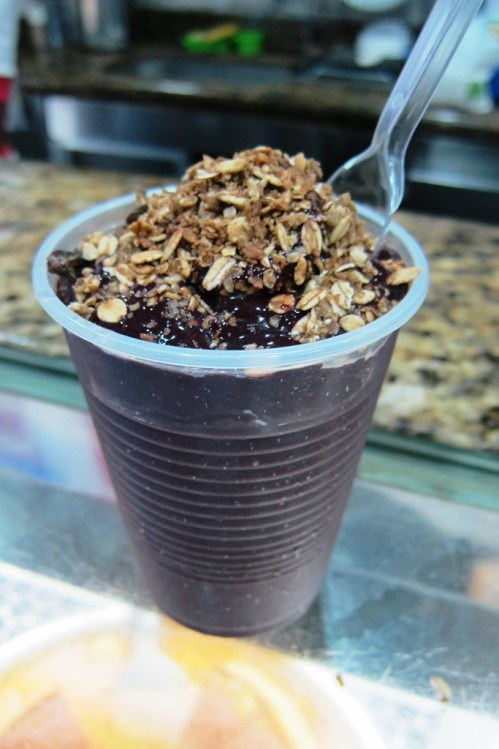
Granola: 0/5. This is where our visit screeched to a halt. Now this was definitely a basic type of place, so we went in with modified expectations. However, everything went sour when we found a small black bug (beetle-ish) in our cup of granola. Gross! We stopped eating the granola right there, hoping it was a fluke. We figured the bug could have flown in from the street. However, we then discovered a SECOND bug deep in our cup of granola. That was it for us.

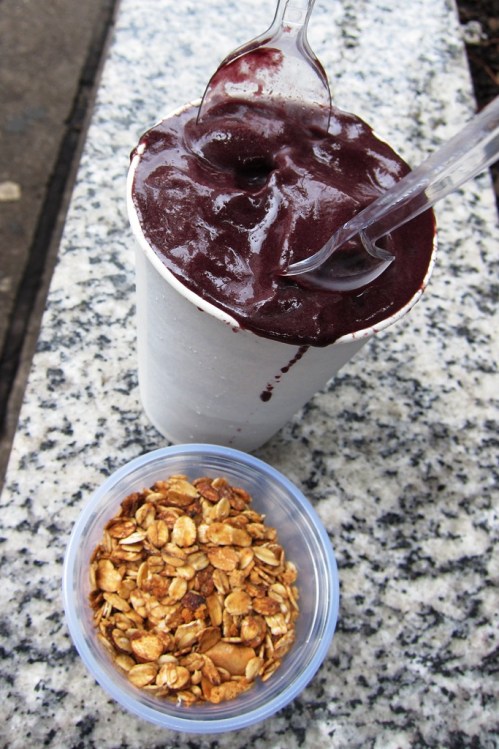
Pioneiro dos Sucos Acai

Pioneiro dos Sucos Açaí Cup

Extras: 0/5. So we were prepared for the lack of seating and bowls, and receiving no spoon, however the unclean atmosphere ruined the experience for us. Bugs in granola = bad vibes.

TOTAL: 22/40 – Probably best avoided.

Leave a comment

Filed under Reviews

Food for the Orixás in Salvador

On Saturday, we had the honor of being invited to the to the Ilê Axé Ijino Ilu Orossi, a temple (ilê axé) of candomblé nagô, an Afro-Brazilian religion closely related to the religious practices of the Yorùbá people of southwest Nigeria and Benin. The Saturday before Easter is one of the most important dates in the candomblé calendar: this day celebrates the new year with the Festa de Exu, a day-long celebration for Exu, the orixá (deity) of choices, pathways, and beginnings. At Orossi, the Festa de Exu is a lavish affair: a packed house, dressed all in white, dances and sings for six hours while navigating their way around spectacular offering altars and assemblages. Food and eating are important parts of the ceremony, and we were happy to take part!
???????????????????????????????

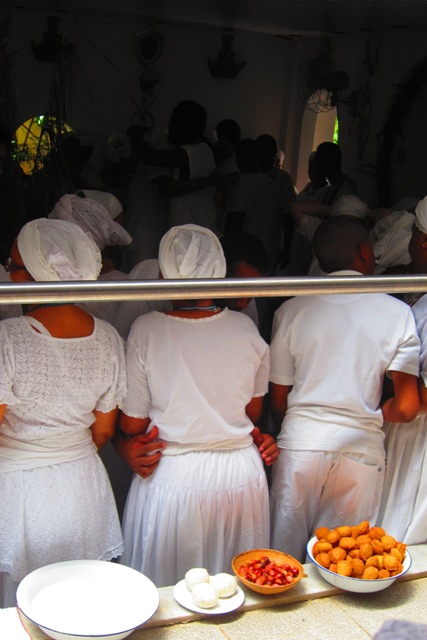
Two female initiates (ekedi) standing in front of offerings for Exu, including mini acarajé.

In a candomblé ceremony, it is just as important to feed your guests, and all attendees, as it is to feed the orixás. While Exu was very hungry on this day – he received extensive offerings of alcohol and meat – guests all received food as well, and enough to last us all day. Shortly after the first round of offerings to Exu, all guests seated in the audience section were invited to the main floor of the axé to receive a portion of abará, a dish resembling a tamale. Abará is a classic Afro-Brazilian dish and frequently used in candomblé  ceremonies as a food sacred to the orixás. It consists of bean curd mixed with dendê oil, wrapped in a banana leaf, and steamed (the same base as acarajé, the other classic Afro-Brazilian dish, but acarajé is fried instead of steamed). Abará, like acarajé, is very filling, and we had to force ourselves to finish just one by the time attendees came around to collect our used banana leaves.

???????????????????????????????

M’s unwrapped abará.

After everyone had eaten their abará, the ceremony entered its most exciting part. We once had a friend describe a candomblé ceremony as a party for all the gods where all the gods actually show up, and it’s true. On this day, three orixás arrived to interact with attendees and dance with initiates: Pomba Gira, a female version of Exu who loves to smoke and drink; Iemanjá, the orixá of the deep sea and motherhood; and Ogum, orixá of iron and war. After the orixás had come and gone, and while we were still full from our abará, two men brought out a huge metal pot of feijoada – more than enough to serve the fifty people in attendance with a bunch left over.

???????????????????????????????

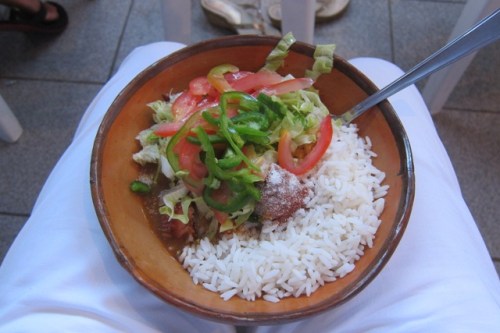
As always, guests were invited up first: we were given a decorated ceramic bowl, and then guided up to the ekedi who served us a heaping bowl of feijoada. That’s not all: out of nowhere appeared a buffet of accompaniments: rice, tomatoes, lettuce, green peppers, and pimenta malagueta: a sauce of flavored spices and famously hot malagueta peppers that is the classic accompaniment to any Bahian dish, but definitely not for the faint of heart. While we are not usually big fans of feijoada, this was excellent: beans, pork, and chicken cooked to perfection in a flavorful sauce, and the fresh veggie accompaniments and pimenta made for a very satisfying and filling meal. After six hours of exhausting singing and dancing, finishing off the feijoada put everyone into a food coma, and all the initiates in the house concluded the day by sleeping on the temple floor. A great end to a beautiful day of food and celebration for the orixás!
???????????????????????????????

M’s feijoada, complete with three spoonfuls of pimenta – apparently a record!

Leave a comment

Filed under World Eats

Finding the Best Açaí in Rio de Janeiro: Barraca do Pará

Barraca do Pará
Feira de São Cristóvão
Rio de Janeiro

brazil

We had our first experience with Northern-style açaí at Amazônia Soul in Ipanema, and we were hooked. When we visited the Feira de São Cristóvão, a fair full of Northeastern Brazilian culture, music and food, we were expecting carne-de-sol and other savory northern specialties, but somehow didn’t think about açaí.  However, we were overjoyed to stumble across Barraca do Pará in the labyrinthine Feira. As its name implies, this little restaurant specialized in cuisine from the northern Brazilian state of Pará, such as Tacacá or Vatapá, along with delicious Northern-style açaí. We actually visited this Barraca on two separate occasions and we were pleased by the quality and consistency each time.

BarracaPara

The state flag of Pará greets you at Barraca do Pará

Value: 0/5. Our heaping bowl was very generous for R$ 15.

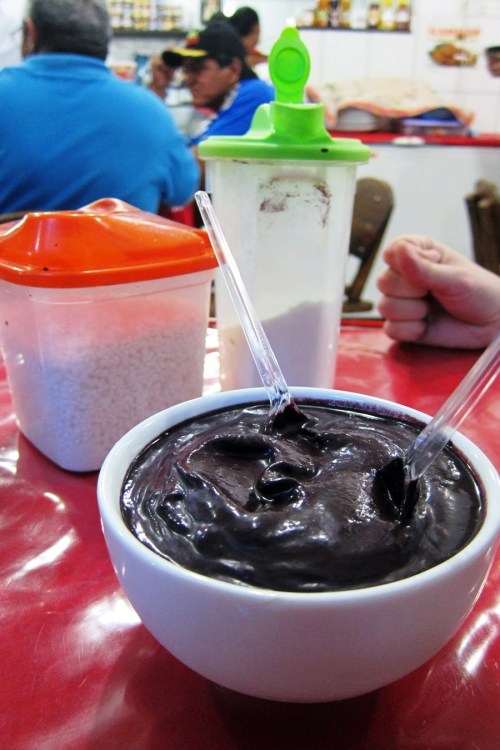
Taste: 14/15. Again, the açaí at Barraca do Pará had very strong flavor, similar to what we had at Amazônia Soul. This is pure açaí, with none of the fruit blend at Southern-style places. In order to get the desired sweetness, you were given a large tub of sugar, and you added your own amount. Regrettably, we never really reached the perfect sweetness level.

Acai at Barraca do Pará

Amazonian Acai at Barraca do Para – add your own tapioca and sugar

Texture: 10/10. The açaí had an amazing texture. Absolutely no melting, even when we got to the bottom of the bowl.

Granola: 5/5. Again, we opted for the tapioca as the açaí topping, which was excellent. We also loved that the tapioca came to the table in a giant pouring container, so you can add all you want.

Extras: 5/5. There was tons of seating, a full menu of Paraense cuisine, unlimited toppings and 2 spoons – we’re in love!

TOTAL: 34/40 –  A very good showing. This is our favorite Northern-style place yet.

Leave a comment

Filed under Reviews

Easter Treats from Portugal: Folar da Páscoa

portugalLoyal reader José, who previously introduced us to the Portuguese delicacy, Tripa, sent us some great information about typical Portuguese Easter cakes: Bolo da Páscoa and Folar. Bolo da Páscoa (literally translated to English as Easter Cake) is a simple, delicious cake, popular around Easter time in Portugal. However, even an even more unique Portuguese Easter delicacy is the Folar da Páscoa.

Folar da Pascoa

Folar da Pascoa by Zé Pinho

Folar (which has no English translation), basically a sweet yeast bread, varies from region to region, and could be classified into a few major varieties. The first kind, from the Algarve in Southern Portugal, is a very sweet cinnamon and anise-flavored bread, typically decorated with whole eggs colored with onion skins. This type of Folar also reminds us of classic Italian Easter Bread with its colorful whole-egg topping. The other type of Folar, from the North of Portugal, is a simpler bread which is less sweet than the Algarve version. Another version of Folar from the very north of Portugal, near Spain, called Folar de Trás-os-Montes, sometimes contains ham or bacon! Piglet in Portugal has a recipe from Central Portugal, and Portuguese Girl Cooks shares her grandparents’ version of the sweet variety of Folar. Tia Maria has a recipe for savory Folar.

Thanks for the tip, José!

Leave a comment

Filed under Holidays, Pastry Post-Poc, World Eats

Easter Bilbies in Australia

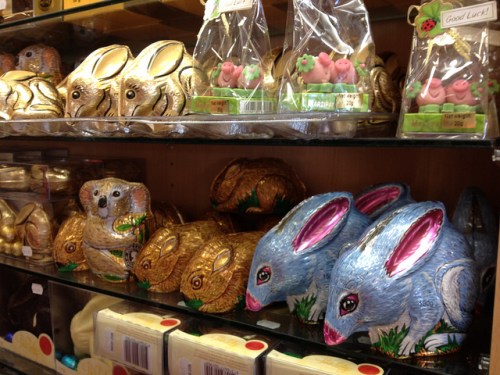
AustraliaIn the USA, Easter is associated in pop culture with rabbits and bunnies. However, in Australia, you are also likely to see a bilby alongside the bunnies. Bilbies are native, endagered Australian marsupials that have floppy ears and a long snout. Rabbits are considered an invasive species in Australia, so it makes sense that they might prefer Bilbies at Easter time. The campaign for the Easter Bilbies was popularized by the Foundation for Rabbit-Free Australia, and the concept has taken off since, with children’s books and chocolate Bilbies galore.
Easter Bilby

Easter Bilbies for sale in Australia – by Rose Holley

Leave a comment

Filed under Holidays

Back to Bahia!

After eleven weeks in Rio, we are heading back to Salvador da Bahia for two months! We spent a good chunk of early 2012 in Salvador, where we sampled all the local specialties from acarajé to moquecas, and we are ready for more. Stay tuned!

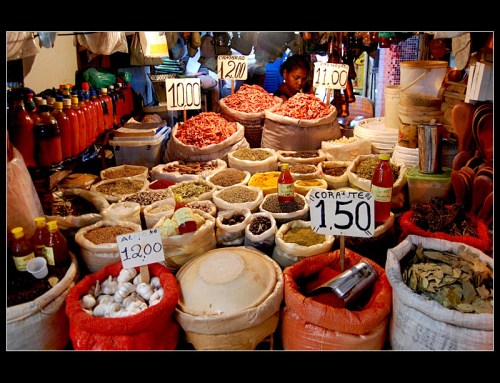
Spices and dried shrimp for sale at the Feira de São Joaquim in Salvador. via

Spices and dried shrimp for sale at the Feira de São Joaquim in Salvador. via Trekearth

Leave a comment

Filed under Reviews

Easter in Brazil: Ovos de Páscoa

brazil

We absolutely love Easter candy, a particular favorite being Reese’s Peanut Butter Eggs. However, in Brazil we have discovered a new Easter obsession that dwarfs Reese’s Eggs in every sense: giant chocolate eggs! In the US we have seen chocolate rabbits, chicks, and miniature eggs but the chocolate Ovos de Páscoa (Easter Eggs) in Brazil put them all to shame. We saw these big chocolate eggs all around town, including grocery stores, newsstands and chocolate shops (such as the chain Cacau Show).

ovo de pascoa

A large Ovo de Pascoa – filled with Ferrero Rocher truffles

In the grocery store, in preparation for Easter, trellises were set up and were completely covered with wrapped eggs from different brands. Sizes of the Ovos ranged from a few inches to over a foot tall – with some costing as much as US$50. These eggs are not just solid (or hollow) chocolate – they are filled with other chocolates or creams. For example, the egg in the photo above is stuffed with truffles. Check out some of these exotic Chocolate Easter Eggs varieties (in Portuguese, but the pictures say it all).

ovos de pascoa

A trellis of Ovos de Pascoa at Zona Sul Supermarket in Rio de Janeiro

2 Comments

Filed under Holidays, World Eats

Fanesca: Ecuadorian Easter Soup

ecuadorFanesca is a traditional Ecuadorian soup that is only eaten in the week before Easter. Fanesca is a heavy soup filled with vegetables and grains (lima beans, fava beans, lentils, corn, pumpkin, squash, quinoa, plantains and more), many of which are only regionally available in the Spring. I suspect Brazilian and Portuguese palates would appreciate this dish due to the inclusion of salted cod, which needs to be soaked for 24 hours to make the soup stockLaylita’s Recipes has a good history and recipe for FanescaCalvin Trillian has a longer story for the New Yorker about his experiences sampling Fanesca as a foreigner living in Cuenca, Ecuador

Being able to say anything I wanted to in Spanish before the moment had passed was what I’d been daydreaming about. I was thinking of the day when my response to a particularly good fanesca (the only kind of fanesca I’ve ever experienced) would no longer be limited to “delicious” or “very tasty, thank you.” I could envision myself pushing back from the table and making a statement to the waiter that was as complex as the dish itself—something like “I can’t take leave of this glorious establishment without saying, in utmost sincerity, that the fanesca I’ve just had the honor of consuming made my heart soar, or at least go pitter-patter, and I want to emphasize that each and every bean had a valiant role to play in what was, when all is said and done, a perfectly blended and modulated work of art.” In that daydream, the waiter is so impressed by my eloquence that he offers me seconds. I decline, with a short speech that reminds him of something he once read in a story by Jorge Luis Borges. [The New Yorker]

Typical Fanesca from Ecuador – Via Wikipedia

Leave a comment

Filed under Holidays

Collection of Charoset Recipes for Passover

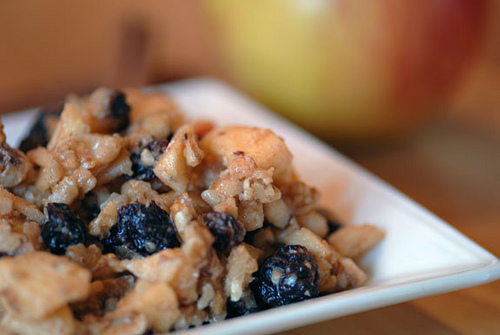
Happy Passover! We found a pretty nice collection of international recipes to put a spin on one of the essential elements of Passover Seder dinner: Charoset. Charoset is a paste made from fruit (often figs or apples), nuts, wine and honey. The exact content of charoset varies by region and tradition, for example, this Syrian version of charoset includes apricots!  Beyond switching up the ingredients, there are a million ways charoset can be altered and dressed up. Elana’s Pantry has a classic version of charoset with apples and walnuts (as depicted below), or check out these unique recipes for Afghan, Indian, Persian and Yemeni varieties. For something even more outside of the box, how about some Sephardic charoset truffles.

Charoset

Charoset By Elana’s Pantry

4 Comments

Filed under Holidays, World Eats

A Day in the Life of an Italian Deli in New York City

The Atlantic has a new short video that caught our eye about Walter Momentè, owner of the lunch-only Alidoro Deli in NYC. It’s fun and informative to watch how he preps for the day by sourcing fresh ingredients from all around the city. Looks like pretty good quality control – perhaps a lunch spot for our (or your) next NYC visit?

Leave a comment

March 22, 2013 · 10:29 AM

Finding the Best Açaí in Rio de Janeiro: Polis Sucos (updated)

Polis Sucos
Rua Maria Quitéria, 70
Rio de Janeiro, Brazil

brazilNow that we are back in Brasil our açaí quest has been renewed with full force. Though there were a variety of options for açaí in Salvador, Rio is really the place for the açaí-lover. There is a juice bar on nearly every corner, and some of the most famous açaí shops are located throughout the Zona Sul beach area. We did a little research beforehand, and compiled a list of açaí places to try. First on our list: Polis Sucos. Polis Sucos is one of the most popular places for juices and açaí in Rio; and the Ipanema location is the most famous.

PolisStore

You can spot the distinctive Polis Sucos corner store from blocks away, and when we approached the place was already full! The counter was stocked with fresh fruit, and the menu is appropriately composed of mainly fruit juices, smoothies (vitaminas and batidosand açaí blends. Polis Sucos is conveniently located right next to an Italian gelato place if you want to follow up on your açaí with another sweet treat …maybe next time. 

PolisSucos

Visit 1: Polis Sucos Batido (granola mixed in)

Value: 3/5 We got an açaí granola cup for R$11.50, for 500 ml.

Taste: 15/15. This açaí was easily one of the best we have had, anywhere in Brazil. It had great açaí flavor without being too sweet, with just the right amount of berries mixed in.

Texture: 9/10. Polis had an excellent, smooth texture that held up well, even with a little melting. We had previously ordered a batido – which meant the açaí was blended with granola, which had an excellent texture. We decided to try it this time non blended – and the texture was still great.

Polis Sucos

Visit 2: Polis Sucos, Not Blended

Granola: 5/5. The cup came with standard-issue granola (no extra charge), which came in a separate plastic cup.

Extras: 2/5. This was a mixed bag. In addition to the range of juices, there are other more savory option like sandwiches and hamburgers (cheesefrangocheddaregg, etc), so you are set for choice.  However, Polis Sucos is a popular place, and there is no seating, so prepare to stand, unless you can squeeze into one of the surrounding benches that are shared by Polis Sucos and the gelato place next door. There were also no bowls of – only cups.

TOTAL: 34/40 – Polis is our front-runner so far. We enjoyed our açaí at Polis, and it is definitely worth a trip if you are in Ipanema.

Leave a comment

Filed under Reviews

A Taste of India in Portugal: Popat Store

Popat Store
Centro Commerical Mouraria
Lisbon, Portugal

India Flag

We love cooking with Indian flavors back in Chicago, but we figured that we would not be able to find Indian spices in Lisbon – but we were wrong! Right in the heart of Lisbon, and accessible from the Martim Moniz metro stop is the Popat Store, a small Indian grocery store which will warm the hearts of any Indian food lover. You don’t even need to exit the metro station to find Popat Store, just follow the signs in the labyrinthine Martim Metro stop to the Centro Commerical Mouraria – which is even a more labyrinthine shopping mall of international delights.

???????????????????????????????

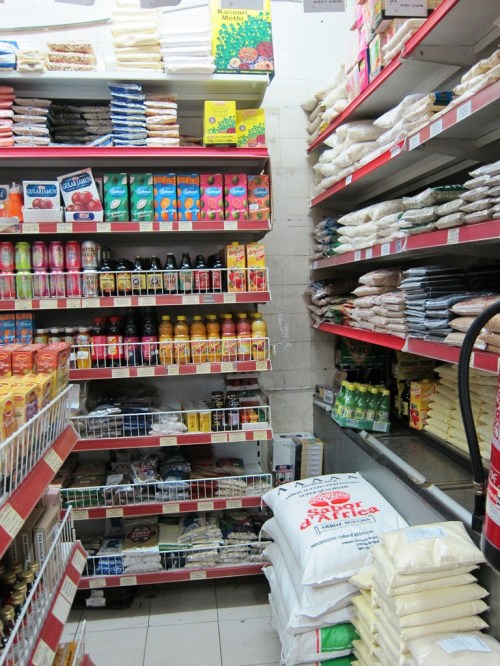
Popat store caters to those who want to cook from scratch, as well as those who would reheat frozen samosas. There are pre-packaged spice blends starting from just one euro, including a masala spice blend and tandoori spice rub. You can get bottled sauces for a few euros more, as well as coconut milk and other canned goods imported from India. For those wanting to make their own blend, you can also find fresh lemongrass, and every kind of spice in dried or powdered form. In addition, you can find over a dozen varieties of rice and all different kinds of grain in bulk.

???????????????????????????????

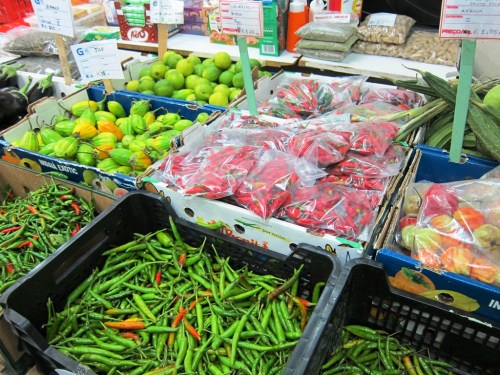
There is also a small fresh market in the front of the store with okra, tomatoes, Piri Piri and Habanero peppers. The coup d’etat however was that they had peanut butter! Peanut butter is particularly rare in Europe, and if you find any it is bound to come in a very small jar and to be particularly expensive. However, Popat Store’s variety was a huge jar of delicious natural peanut butter (which appeared to be imported from Amsterdam) for less than 3€. We bought some garlic naan, tandoori spice mix and peanut butter. After a visit to Popat Store, our kitchen was really starting to feel like home.

3 Comments

Filed under Reviews, World Eats

A Visit to Sicily on St. Joseph’s Day

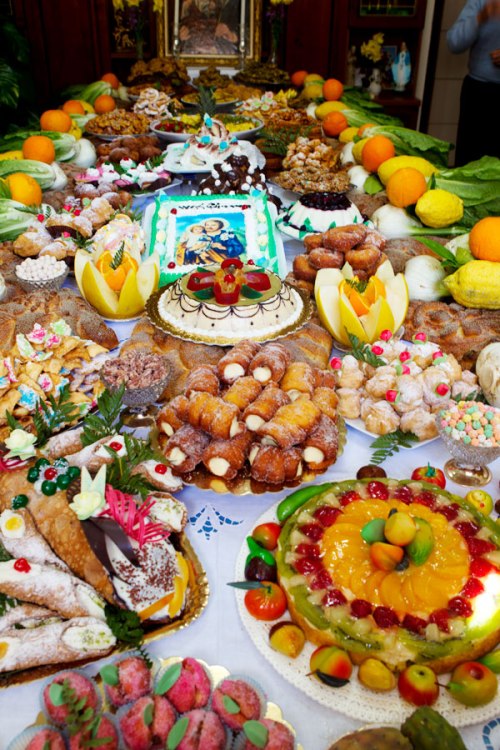
SicilySt. Joseph’s Day is one of our favorite food holidays. It is easy to see why: just look at the spread on the St. Joseph’s Day Table below. La Tartine Gourmand went to Sicily in 2012 during the Festa di San Giuseppe shared some amazing pictures of the food for St. Joseph’s Day they discovered there. The pictures are amazing, and help to give a real picture of what everyday Sicilian Cuisine is like. While we’re happy to be in Rio de Janeiro, we wish we could be in Sicily today!
St. Joseph's Day Table

St. Joseph’s/San Guiseppe  Day Table  in Sclafani Bagni, Sicily by La Tartinr Gourmand

2 Comments

Filed under Holidays, Links

Savory Zeppole for St. Joseph’s Day

ItalyWe have previously written about partaking in Sweet Zeppole for St. Joseph’s Day – one of our favorite holiday treat traditions. However, we were never even aware there was a savory variety of Zeppole. However, it seems that in the region of Calabria, savory Zeppole are a preferred option. Zeppole are basically fried dough fritters, so it make sense they could toe the sweet/savory line. Savory Zeppole can be made with anchovies or served plain. It seems like they would would probably go perfectly with another popular St. Joseph’s Day dish: Pasta con Sarde (with sardines).

Plain Zeppole

Plain Zeppole in Williamsburg, Brooklyn by Phil H

Leave a comment

Filed under Holidays, World Eats

Guinness Recipes for St. Patrick’s Day

IrelandThough Saint Patrick’s Day it is not widely celebrated in Rio (surprised?), we thought we’d share some festive recipes that all feature Guinnessa classic Irish beer for any day – but especially this one! Design Sponge has a recipe for Guinness chocolate cake which looks delicious.  Chocolate and Guinness seems to be a winning combo, which is repeated in Closet Cooking’s Guinness chocolate cheesecake. A final sweet recipe: Nigella’s Guinness gingerbread (even in March). For something savory, check out stout Macaroni and Cheese or Guinness and honey glazed pork loin. I wonder if they have Guinness at Zona Sul?

Guinness_Turtle

Leave a comment

Filed under Holidays, World Eats

Happy Pi (e) Day

Pie Drawing from Cakespy

Pie Drawing from Cakespy

Happy Pi Day everyone (3.14) – hope you get to celebrate with a nice piece of pie. We will be seeking one out in Rio de Janeiro – which is actually a somewhat difficult task. If we were home we would be making Sour Cherry PieChocolate Coconut Pie or Peanut Butter and Chocolate Chess Pie. What kind of pie is your favorite?

Leave a comment

Filed under Holidays, Note, Pastry Post-Poc

Pastry Post-Doc in Italy: Neapolitan Pastiera for Easter

ItalyThough some Southern Italian delicacies have made their ways to the American shores: Rum Baba, Cannoli, among others, we had not encountered Pastiera (also known as Pastiera di Grano) until our trip to Naples. Pastiera is especially associated with Easter (though we also found it in Pasticcerias in November). Pastiera was developed in modern times by a Neapolitan convent, but also has an older history related to pagan Springtime festivals (hence the inclusion of wheat and egg). Pastiera is composed of a pastry shell with a ricotta, wheat and egg filling, which may also be flavored with citrus or spices. Pastiera is unique – and in order to make it you need to prepare a special wheat mixture (unless you have access to prepared soaked wheat – which this recipe includes). While in Naples we saw large Pastiera pies even being sold in tins – perfect for every Easter table.

Pastiera in Naples

A slice of pastiera in Naples by Yuichi Sakuraba

2 Comments

Filed under Holidays, World Eats

Pantone Food Pairings

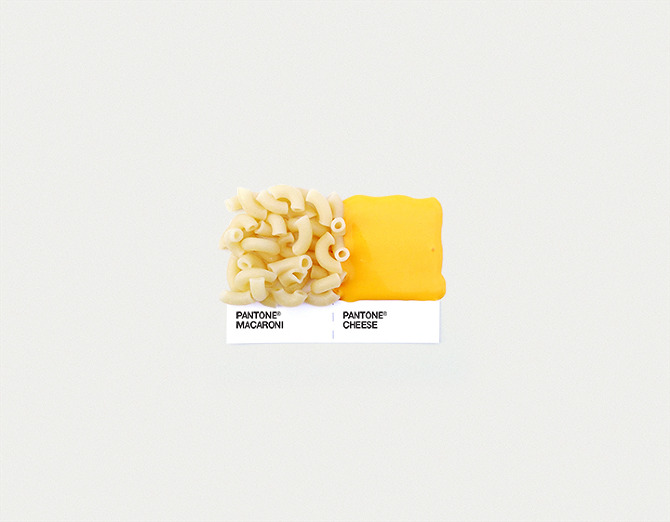
Here is a fun food link for your weekend: Pantone food pairings. Artist David Schwen creates mock Pantone chips using foods that make perfect combinations: salt and pepper, peanut butter and jelly, macaroni and cheese, etc. We have previously covered the intersection of food and the Panone Color Matching System here.

Image

Leave a comment

Filed under Design and Photography, Links

Finding the Best Açaí in Rio de Janeiro: Amazônia Soul

Amazônia Soul
Rua Teixeira de Melo, 37
Ipanema, Rio de Janeiro

brazil

So we consider ourselves at this point to be (sort of) açaí experts, but we were totally floored by our completely different experience at Amazônia Soul in Ipanema, right off of Praça General Osório. Northern açaí is completely different from its Southern variety since the emphasis is on pure açaí flavor. Amazônia Soul is a store concept from the northern state of Pará – and along with delicious Northern-style açaí – it also has a selection of typical Northern dishes including tacacá, crab and maniçoba and Nothern-style feijoada. Don’t forget to wash your meal down with a Guaraná Jesus – a popular regional soda brand. The store itself is very inviting – with a distinctive abstract frog mascot (we think it is a frog) and a little shop inside selling Amazonian products including jarred sweets, ceramics, stoneware and jewelry.

AmazoniaSoul

Value: 0/5 Our pequena small bowl was definitely less than 500 mL (we think it was 300 mL), and it was extremely expensive. Total: R$ 16. We had a little bit of sticker shock on this one.

Taste: 12/15. Amazônia Soul presented us with the purest açaí flavor yet. Northern style açaí is simply açaí and ice, instead of an açaí/berry/ice blend which we have come to learn is standard at most Zona Sul places. The taste of pure açaí is extremely strong, and not necessarily sweet, so it is typical to add your own sugar to the bowl. At Amazônia Soul you are given sugar packets to sweeten things up.

???????????????????????????????

Texture: 10/10. Perfectly smooth, this açaí did not melt at all. It also seemed like there was less ice in this formulation – which means less melting.

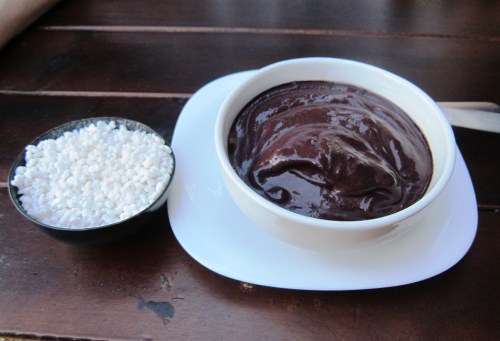
Granola: 5/5. In this case the topping was not granola at all – but a bowl of puffed tapioca – which is standard for Northern-style açaí. There was a surcharge for the toppings of $R 2. Though we think we prefer granola over tapioca, we felt we had to go for the authentic experience.

Extras: 5/5. There was a nice indoor seating area, along with wooden tables outside. A plus – we got two spoons on the first try.

TOTAL: 32/40 – Again the value hurt them, but there was a narrow lead.

1 Comment

Filed under Reviews

Mineira Cuisine in Mariana: Rancho Restaurante

Rancho Restarante 
Praca Gomes Freire, 108 – Centro
Mariana, Minas Gerais

brazilThough our first post from Ouro Preto was about a decidedly non-traditional pizza place in Ouro Preto, our second meal in Minas Gerais was much more traditional. Throughout its history, Minas Gerais was home to many gold/diamond mining booms (the name means “General Mines”), so it occupies a similar place in Brazilian lore as the “Wild West” does in the USA. However, unlike the chuckwagons on the Wild West, people are really into Mineira food in Brazil, and it is considered the classic kind of Brazilian “home cooking.” We were very curious to try some down-home Minerira food, so we were happy when we stumbled upon Rancho Restaurante (“The Ranch”) in Mariana – a small town outside of Ouro Preto.

???????????????????????????????

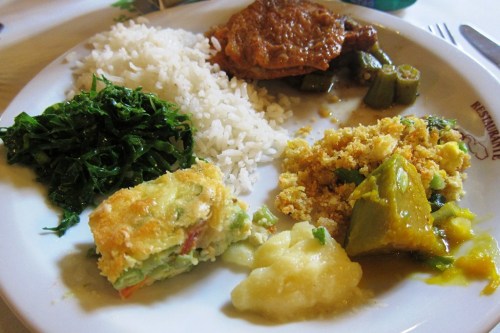
Rancho is done up in a sort of faux pioneering style – and it serves heaps of Mineira food in an all you can eat buffet (R$ 18 person). Mineira food is often traditionally cooked and served in stone vessels – and we were pleased to see the wood-burning buffet area full of stone pots of food. All of the Mineira favorites were on display: chicken and quiabo (okra), couve mineira (kale), tutu de feijão (bean and meat stew), roast pork, roast pumpkin, veggie omelettes, a variety of soups, sausage and rice, fish croquettes, farofa and spicy spaghetti with dende oilThere was also a small salad bar off to the side, though most of the offerings were slathered in mayo – save for a nice carrot salad. However, we have one major knock against the restaurant: no pão de queijo. Come on, this is unforgivable!

???????????????????????????????

We filled our plates twice with all of the food from the buffet, trying to sample as much as we could. Of our picks, the chicken and okra was a standout, it turned out to be one of our favorite preparations of okra, a veggie we usually find to be too gooey. The couve mineira (garlic-spiked kale) and stewed pumpkin were also delicious. The meal was a pretty stick-to-your ribs simple affair, something which characterizes Mineria cuisine, and it seemed to be a favorite among locals. After we arrived, Rancho gradually filled up with families and office workers on lunch break, and there was constantly a line for the buffet. Rancho was a great place for hearty Mineira cuisine with no frills, and gives you a taste of typical local fare with no touristy concessions.

???????????????????????????????

Leave a comment

Filed under Reviews