Category Archives: Pastry Post-Poc

Portuguese Pastry Post-Doc: Língua de gato

 One thing that makes a Post Doc in Portuguese Pastries difficult, but intriguing, is that most pastries are not labeled in Portuguese pastry cases, so you are always in for a bit of a surprise. Getting an assortment of sweets often involves a lot of pointing and asking “what is this called?” Case in point, what we dubbed “flat madeleines” at Cafe Versailles were in fact properly called Linguas-de-gato “Cat’s tongues”). Still, they basically tasted like a flat, buttery madeleine tea cake. The characteristic cat tongue shape is achieved by piping the batter onto a cookie sheet. Though homemade cats tongue cookies are usually simple ovals, the store-bought versions usually have more of figure-eight shape. There is also a chocolate with a cat tongue shape that goes by the same name, which is popular in Brazil.

The “cat tongue cookie” is also popular in France and Spain, as well as Latin America, where the cookie is known variously as “Langues de chat” or “Lenguas de gato.” The exact origins of the cookie are unclear, with Spain laying claim to them, and others crediting the French ladyfinger cookie as a predecessor. Despite their popularity in Portugal, they likely did not originate here. This simple recipe comes from Finland, showing the near-universal appeal of the cat tongue cookie.
Leave a comment

Filed under Pastry Post-Poc

Portuguese Pastry Post-Doc: Bolo de Arroz

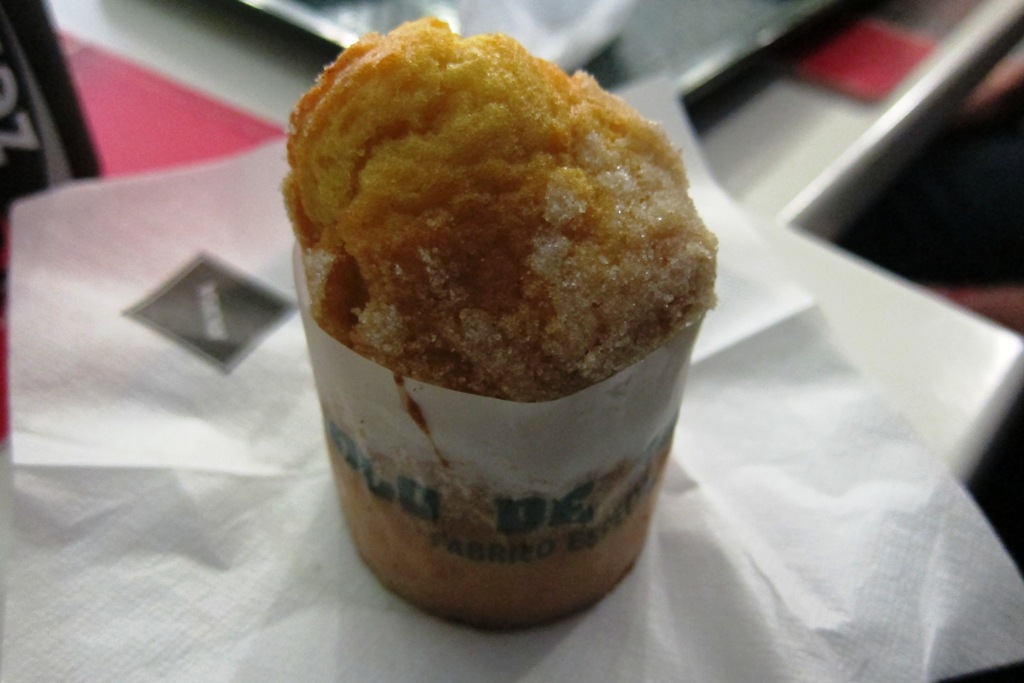
Today, for the first time we tried Bolo de Arroz – Portuguese rice muffins – another classic staple of the Portuguese bakery. We ducked into a small cafe to dodge the rain, and were super pleased to see these particular pastries on offer. Given the name, I was initially expecting these to have a mealy rice-pudding texture like arancine (don’t ask me why), but they were perfectly smooth and had a cake-like texture. The “rice” or arroz in the name just refers to rice flour. Instead of coming in a muffin liner, they are wrapped in little paper sheets that typically say “Bolo de Arroz (see photo below). The taste of a bolo de arroz is basically like an eggy cupcake, but with a hint of earthy rice flavor. Wordflux has a recipe for Bolo de Arroz, they don’t seem too difficult to make, the only special ingredient being rice flour. To add a little confusion, the Bolinho do Arroz, popular in Brazil, is a savory snack made from rice, like arancine.

1 Comment

Filed under Pastry Post-Poc

Portuguese Pastry Post-Doc: Wafysugar

What is sold in vending machines can tell you a lot about the culture of a country. Here in Portugal they sell waffles. When we first saw the “Wafysugar” in a subway vending machine, we did a double-take. It was the first time we had seen waffles in a vending machine, and waffles aren’t a popular breakfast food here, though they are pretty common in gelato shops. We love waffles and usually have them every weekend, thanks to a well-loved registry gift (sadly, our waffle iron is back across the Atlantic). Out of curiosity, and waffle withdrawal, we felt we had to try a Wafysugar after seeing them everyday in the subway. For one Euro, we figured it was worth a shot. The Wafysugar, billed as a “Gofre de Liege,” was about the size of a quarter of a Belgian waffle. Surprisingly, the ingredient list for the Wafysugar was not terribly long, containing mostly decipherable ingredients. It was a tad chewy, very sweet and though it did indeed taste like it came out of a vending machine, it was not entirely bad. Despite the relative palatability of the Wafysugar, we’ll leave the vending machine purchases to water and soda from now on.

Leave a comment

Filed under Pastry Post-Poc

Portuguese Pastry Post-Doc: Coffee from A Carioca

A Carioca
Rua da Misericórdia, 9
Lisbon, Portugal

Lisboetas loves coffee, and one of the best places to get fresh coffee beans in Lisbon is from A Carioca, a beautiful wood-paneled, art-deco store that is literally filled wall-to-wall with coffee beans, teas and candies. A Carioca is in the trendy-yet-historical Chiado neighborhood, near the most famous cafe in all of Lisbon, A Brasileira. You may note that both of these historic coffee venues have Brazil-themed names, a “Carioca” being an inhabitant of Rio de Janiero. Though Brazil is now the number one producer of coffee in the world, the coffee industry there did not take off until the 1930s.

You can get coffee beans at A Carioca by the gram in a variety of flavors – vanilla, hazelnut, chocolate – as well as single origin coffees and blends from all over South America, Asia and Africa. Note the very friendly-looking bright red coffee grinders (there is even a larger red coffee grinder in the front of the store). Despite looking like antiques, they are still put to use every day. In addition to coffee, A Carioca has sort of an old-time candy store feel, with glass jars of traditional penny candy. Tea is also on offer, including the only tea produced in Europe, Gorreana tea from the Azores.

Leave a comment

Filed under Coffee, Pastry Post-Poc

Portuguese Pastry Post-Doc: Pão de Deus

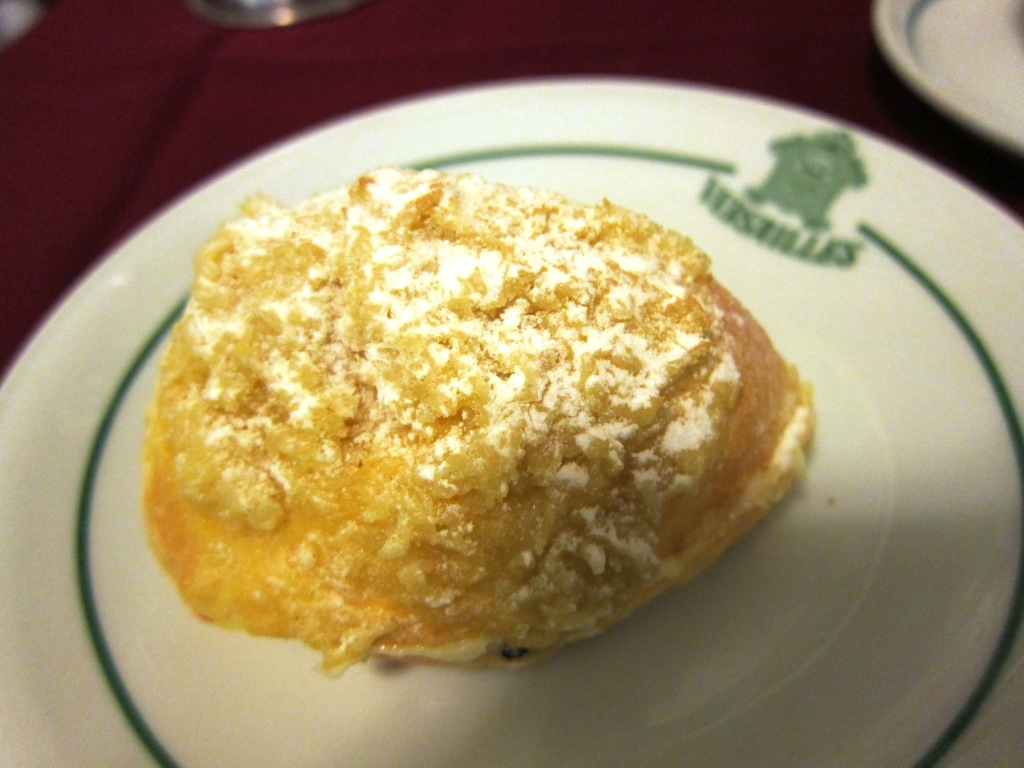
The pastries in Portugal are often  quite uniquely – almost poetically – named. Case in point – Pão de Deus – God’s bread.  Many of Portugal’s most iconic pastries originated in convents many centuries ago, perhaps accounting for the recurring religious allusions in pastry names. In appearance, Pão de Deus is somewhat more humble of a creation than its name implies. It is a sweet brioche roll with a topping of coconut and a shower of powdered sugar.  The coconut develops a gooey almost macaroon-like texture beneath the surface, and is pleasantly crispy on top. As seen below, the Pão de Deus we sampled from Pastelaria Versailles (review coming soon) came with a healthy slather of butter, and if you are feeling especially hungry you might even include some ham and cheese! Pão de Deus is a typical breakfast all across Portugal, though it is not very well known outside of the country. Home Gourmets has a recipe for Pão de Deus if you are feeling nostalgic for some Portuguese patisserie, or are looking to try it for the first time.

2 Comments

Filed under Pastry Post-Poc, World Eats

Portuguese Pastry Post-Doc

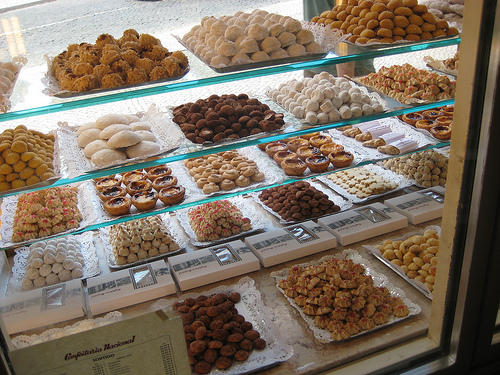
So ETW world HQ has been moved to Portugal for two more months, our second extended visit in the past year. The first time around, while we enjoyed the food, we were not blown away by Portuguese cuisine. However, we vowed to make our second visit more of a culinary success. In the first week alone, we have improved our food fortunes immensely by simply doing one thing: focusing on the pastries! Portugal is known for its pastries, many of which are found in elegant historical pastelarias or confeitarias. It all seems so simple in retrospect – the Portuguese are renowned for their varied pastries, cookies and cakes, many of which are impossibly rich and laden with eggs, butter and sugar – so why not focus on them? While I have written about Pasteis de Nata, the most iconic Portuguese pastry, Portugal has so much more to offer in the way of sweet treats. Since I (L) have recently finished my PhD, I am using these next two months as some much needed relaxation time. However, I can’t quite give up my researching ways, so I will be dedicating my research skills to Portuguese pastries. I call this new project my “Post-Doc in Portuguese Pastries,” and I promise I will leave no stone un-turned in my quest for the tastiest, most classic, most beautiful and iconic Portuguese desserts.

Pastries and Cookies at Confeitaria Nacional, Lisbon

Pastries and Cookies at Confeitaria Nacional, Lisbon

1 Comment

Filed under Note, Pastry Post-Poc

A World of Popovers: Poffertjes, Aebelskivers and Paniyaram

India FlagWhen we discovered Eggettes, a Hong Kong sweet we profiled previously, little did we know that there were similar popover confections present around the world (though we should have guessed). Ranging from India to Denmark, all of these treats are made in special pans with round indentations (as can be seen above). First up are poffertjes, mini-pancakes made with buckwheat flour that originated in the Netherlands in the 15th century. Kitchen butterfly has a recipe for poffertjes from Dutch Cooking Today (Kook ook Holland).

Aebelskivers

Aebelskivers in a pan.

Similar to poffertjes are ebelskivers / abelskivers / aebelskivers from Denmark, not surprising, given the proximity of the two countries. The recipes are quite similar, but an aebelskiver (or their pan, rather) is larger. For those ready to commit to the recipes: Fante’s Kitchen Shop in Philadelphia has both poffertje and aebelskiver pans, as does William-Sonoma. Also falling into this small-popover milieu are Paniyaram (seen above), an Indian snack that can be made sweet or savory. We think this serves as evidence that some things – like bite-sized carb-y snacks – are universal.

1 Comment

Filed under Pastry Post-Poc, World Eats