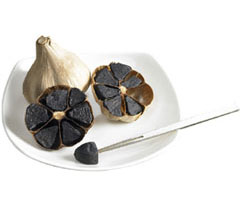
 I recently came across a new food that, while it looks kind of frightening, is pretty intriguing – black garlic! Black garlic is popular in China, Korea and Japan and is really just aged and fermented whole cloves of garlic. The flavor is more mellow than raw cloves with a bit of a tang. And it’s spreadable. Some Whole Foods stores sell black garlic, but you can get it online, too.
Category Archives: World Eats
What is Black Garlic?
Filed under World Eats
World Eats: Québécois Bagels
 I’ve heard from various native Québécois and visitors about Québéc’s long and storied Bagel Tradition. Being from Chicago, a city with no great claim to bagels like New York, I am less dubious of this claim as some New Yorkers are. However, when thinking of Francophone Québéc I don’t think of Bagels. However, Montreal-style bagels have a long history – brought by Eastern European immigrants in the early 20th century. Though they are like New York-style bagels, they differ in a few important ways: They are baked in Wood-fire ovens, have no added salt, and have added honey.
Some of Montreal’s favorite bagels are St. Viateur Bagels (1127 Av. Mont-Royal est) which has been turning out doughy goodness since 1957, and Fairmount Bagel (74 Fairmount West). A Canadian astronaut even requested that his favorite bagel be transported into space with him. So maybe the idea of the Québécois bagel is not so unusual.
Filed under World Eats
Mexico Trip: Moles

L and I love moles. A Spanish corruption of a Nahua word meaning simply “sauce,” today moles span varieties as diverse as guacamole (avocado sauce), chocolate moles (great on enchiladas) and a number of other varieties less common in the United States, but still popular and widespread in Mexico. My trip gave me a chance to sample a couple of mole dishes, as well as learn a little about the sauces and their relation to Mexican culture in general.
Cafe El Popular Restaurante
Avenida Cinco de Mayo 52
México, D.F., México
While in the historic center of Mexico City, I wandered into Cafe El Popular looking for a relatively quick and cheap lunch that would still give me a chance to have some solid Mexican cooking. El Popular looked like just such a place, packed to the brim with local patrons inside a large diner that seemed more out of the 1950s than Mexico’s modern megalopolis. When I arrived around noon, the menu still leaned toward the breakfast end of things, but I managed to find mole de pollo (Chicken mole) and the menu and quickly place my order.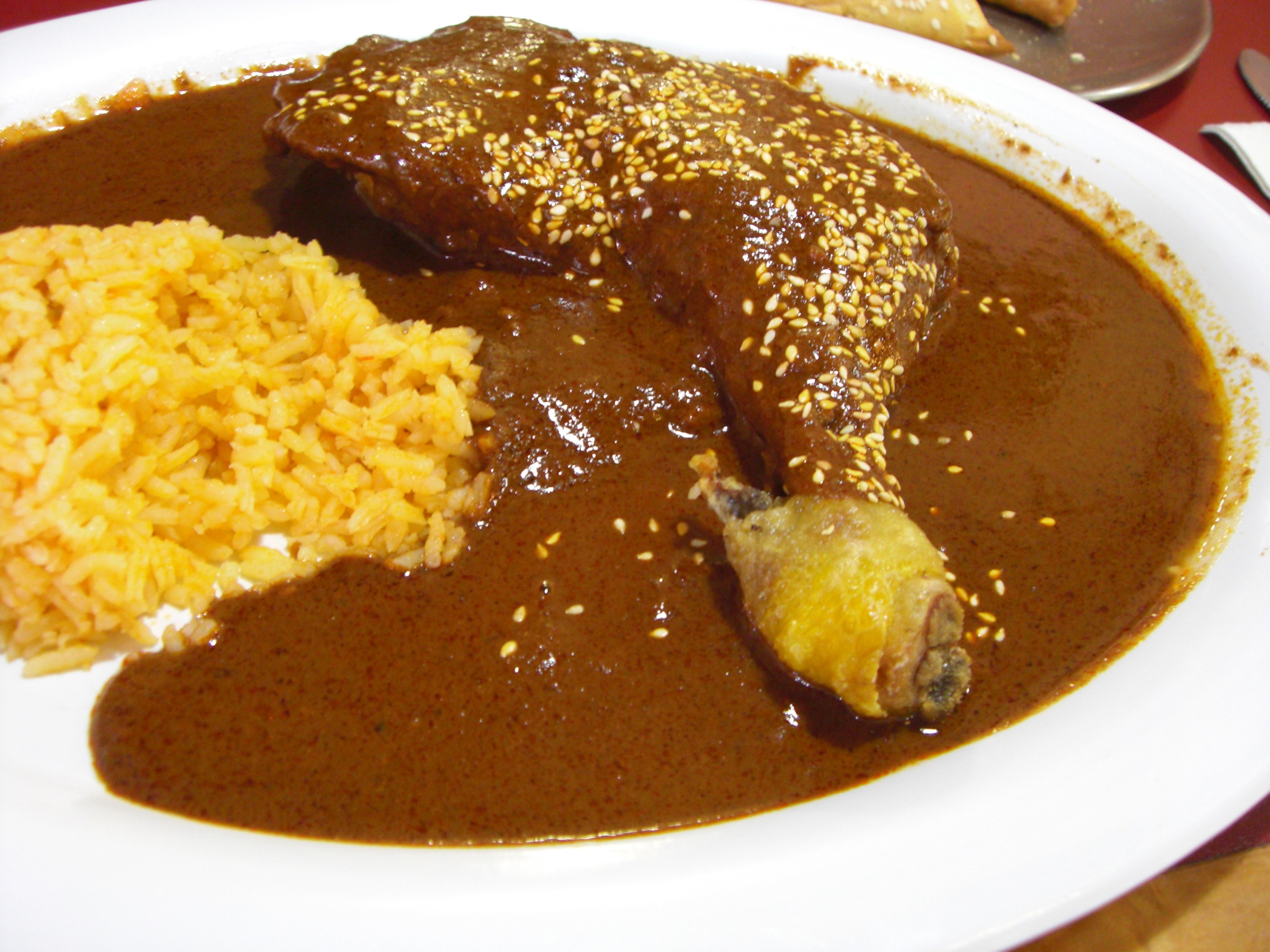
I had been to Mexico previously, and my trip then taught me that there is a reason the “mole” comes first in the dish’s name – the chicken is slathered in mole sauce. Not that I am complaining – smooth and chocolatey, mixing together with the rice and fall-off-the-bone chicken, a solid chocolate mole really can’t do anything wrong to a dish. Especially if it is the focal point. That being said, I did think El Popular’s addition of a copious amount of sesame seeds was a little strange, until I found the seeds being used in dishes across Mexico City. Maybe it is just a culinary fad, but I can’t say I am on board with this one. Overall, I left El Popular satisfied and eager for other moles – particularly ones that break the common chocolate-only stereotype we often find in the USA.
Restaurante Techinanco
Service Road, North of Pyramid of the Moon
Teotihuacán, Estado de México, México
The next day I went exploring in Teotihuacan, an ancient site outside of Mexico City so massive and pyramid-ridden that a few hours of walking completely wears you out. For sustenance, I made the mistake of trusting my Lonely Planet guide to direct me toward Restaurant Techinanco, which it recommended as  having the best food for miles around. The writers were correct about the food, but an hour of looking for the restaurant made me realize they were wrong about the location (it is directly behind, not next to, the Pyramid of the Moon at the north end of the site).
When I finally got to Techinanco (pronounced tetch-ee-non-co), I was the only patron in the restaurant. A quick glance around gave away a few of the restaurant’s secrets – the two mushroom posters at the far end (visible in the photo) leak some of the key ingredients in a number of Techinanco’s dishes. The plethora of masks on the far wall give off a far less touristy vibe than the surrounding establishments – and the effort saved goes directly into the food.
Techinanco’s menu was small, but I made a quick decision: chicken with mole huitlacoche (also spelled cuitlacoche), a green sauce made with mushrooms and maize (wild corn). The friendly owners must have made a pot of the sauce earler in the day, as my food was served almost immediately. And it was heavenly. I can’t really say what I imagined a mushroom / corn mole sauce would taste like, but this was not it. It was almost acidic, with a sharp bite that activated my tastebuds in all the right places, then finished smooth like a good homemade pasta sauce. The finishing taste only made you eat more, and while I filled up quickly during the meal, had I had more than a few pesos in my pocket I probably would have ordered seconds. To top it off, the chicken was grilled to perfection, holding just the right amount of natural juices to let the huitlacoche work its magic. If I am ever back in Teotihuacan, I will definitely make the effort to find Techinanco again (no thanks to the Lonely Planet mapmakers!)
All in all, Mexican food once again fails to disappoint. L and I have plans to try to make our own moles (possibly an upcoming Recipe Friday?) – perhaps we can try to create my new huitlacoche favorite. I doubt it can even approach Techinanco’s creations, however. If in the meantime anyone has any Chicago-area suggestions for some authentic Mexican regional moles, we would love to hear them!
Filed under Reviews, World Eats
April Fool’s Day in France: Poisson d’Avril

 In France, April 1st is a day of fun and pranks, much like April Fools. French festivities are known as Poisson d’Avril (April fish), where you are supposed to go around taping paper fish on the backs of friends and acquaintances. However, it is also a day for chocolate fish! These on the right are from Jean-Paul Hévin. The blog Paris Breakfasts has an extensive photo-essay of the wonderful fish-shaped tricks and treats in Paris this April 1st.
Filed under Holidays, World Eats
All About St. Joseph’s Day Food (especially Zeppole!)
 Following my post on St. Paddy’s day eats, I have to mention St. Joseph’s Day, a holiday in Italy
 which is accompanied by a delicious treat called the Zeppole. A zeppole is a fried donut-like pastry that is filled with jam or cream and topped with powdered sugar. They are traditionally made especially for St. Joseph’s Day. About.com has a simple recipe, as well as an extensive history of the humble zeppole.
St. Joseph’s Day (March 19) is one of the biggest holidays in Sicily (and some other parts of Southern Italy). Joseph is the patron saint of Sicily since people say that in the middle ages peasants prayed to him and he ended a drought. Now, in remembrance of this feat, some Sicilians create altars full of food and plenty in honor of the day. Fava beans, the crop St. Joseph saved, are popular, as are citrus fruits, which happen to be prolific in Sicily. The tradition has spread to places with large Sicilian immigrant populations, especially New Orleans. There is a lot of interesting history of Louisiana altars (like the one at right) at the Houston Institute for Culture.
This year, I found a list of places with “St. Joseph Tables” in Chicagoland in the Sun Times. I imagine it would be a cool experience to go to one.
Filed under Holidays, World Eats
The history of Corned Beef and Cabbage
 In honor of St. Patrick’s Day, here’s a little post about the quintessential St. Patty’s food – corned beef. So…What’s the deal with it? I always though it was an actual Irish dish, but, it turns out it is really more of an Irish-American creation. According to Wikipedia, while cabbage has long been a traditional Irish food, beef was substituted in America as a cheaper alternative to bacon, which was traditionally served in Ireland. The ‘corned’ in corned beef actually is an antiquated way to say “brined.” The dish itself dates back to 1621! If you really want to go for it, here’s a corned beef recipe from Food Network.

Corned Beef and Cabbage by Craig Dugas
Filed under Holidays, World Eats
What is…Welsh Rarebit?
 So what is it? Welsh rarebit is apparently a beloved Welsh sauce (served over toast), consisting of cheese, mustard and beer. Actually sounds pretty tasty! For a long time I though it was something akin to sweetbreads – innocuous sounding, but disgusting. According to Wikipedia, this bechamel-esque dish has a long and storied past, originally being called “Welsh Rabbit.” Ambrose Bierce even included ‘Rarebit,’ in The Devil’s Dictionary:
“RAREBIT n. A Welsh rabbit, in the speech of the humorless, who point out that it is not a rabbit. To whom it may be solemnly explained that the comestible known as toad in the hole is really not a toad, and that ris de veau à la financière is not the smile of a calf prepared after the recipe of a she banker.”
The New York Times has a tasty-sounding recipe, definitely worth a try in the near future, especially given the lack of British dishes in our repertoire.
Filed under Recipes, World Eats
What is…Pão de queijo?
While the eaters have never been to Brazil, we know two things – we like bread and we like cheese. A lot! We also like cooking new foods. We have a long queue of dishes we are excited to make eventually, and Pão de queijo (Cheese bread in Portuguese) has jumped right to the top. A typical snack food in Brazil and Bolivia, Paraguay and Argentina (where they are known as is known as chipás or cuñapés), these little pods of butter and cassava flour contain nothing but gooey cheese. We found a chipá recipe from fellow WordPresser Pip in the city that we are dying to try out. We will let you know how it goes.
Filed under Recipes, World Eats