Tag Archives: photography

Bahia’s Best Restaurants: Candomblé Houses

Bahia, a large state in northeastern Brazil, has long been one of our second homes. We have made multiple trips to the region over the past fifteen years, with our time in Bahia oscillating between research, tourism, and eating its distinctive cuisine. Heavily influenced by West African techniques and ingredients (especially palm oil), the cuisine of Bahia’s coastline utilizes manioc, coconut, tapioca, and the region’s variety of fruits, fish, and meats. Bahia’s gastronomy is deservedly heralded among the country’s diverse offerings, and in recent years, the state’s capital city of Salvador is being increasingly regarded as a gastronomic destination. Many new upscale restaurants have opened in the capital, especially in Pelourinho (the old historic center) and the beachside neighborhoods of Barra and Rio Vermelho. And just this year, Ori, one of the city’s finest dining spots, was named #52 on the list of Best Restaurants in Latin America. Yet very few tourists, and even many locals, never realize that some of the city’s best local food is served in off-the-beaten-path religious spaces. Even more surprising? It’s often free.
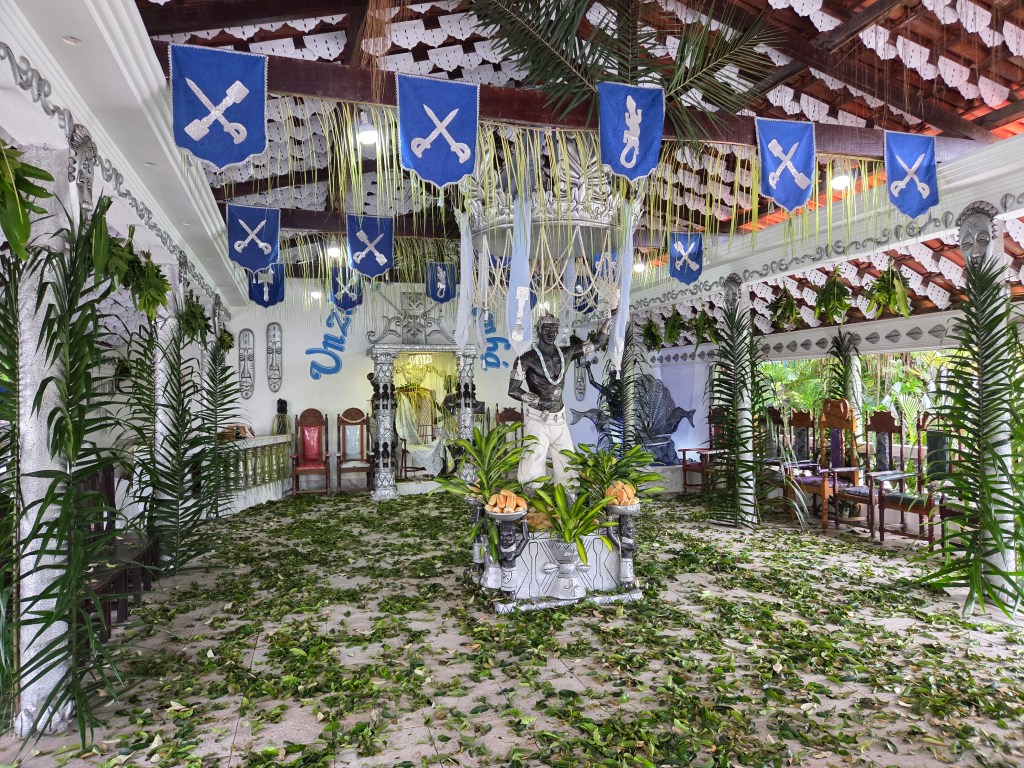
Ceremonial hall of the Terreiro de Lembá in Camaçari, Bahia, Brazil

Bahia is the historic origin point of Candomblé, an African-inspired religion that developed beginning in the nineteenth century. Candomblé is practiced in autonomous “houses” (called terreiros) that range from small homes to large complexes that can incorporate worship halls, museums, shrines, schools, and elaborate kitchens. Some of the most prominent and well-known Candomblé houses maintain well-cultivated social media presences and post the schedules of their ceremonies when they are open to the public. Candomblé ceremonies can be elaborate affairs, lasting four or five hours and incorporating dancing, music, singing, and stunning dress ensembles worn by the spirits. While ritual protocols can be elaborate, especially for outsiders – don’t wear dark colors, only take photos with permission, sit only in the chairs for visitors, and be sure to introduce yourself to the high priest before or after the ceremony – ceremonies can be surprisingly welcoming spaces. Indeed, it is part of the religion to create an atmosphere of acolhimento, a Portuguese term conveys a sense of easy, relaxed, and thorough welcoming.
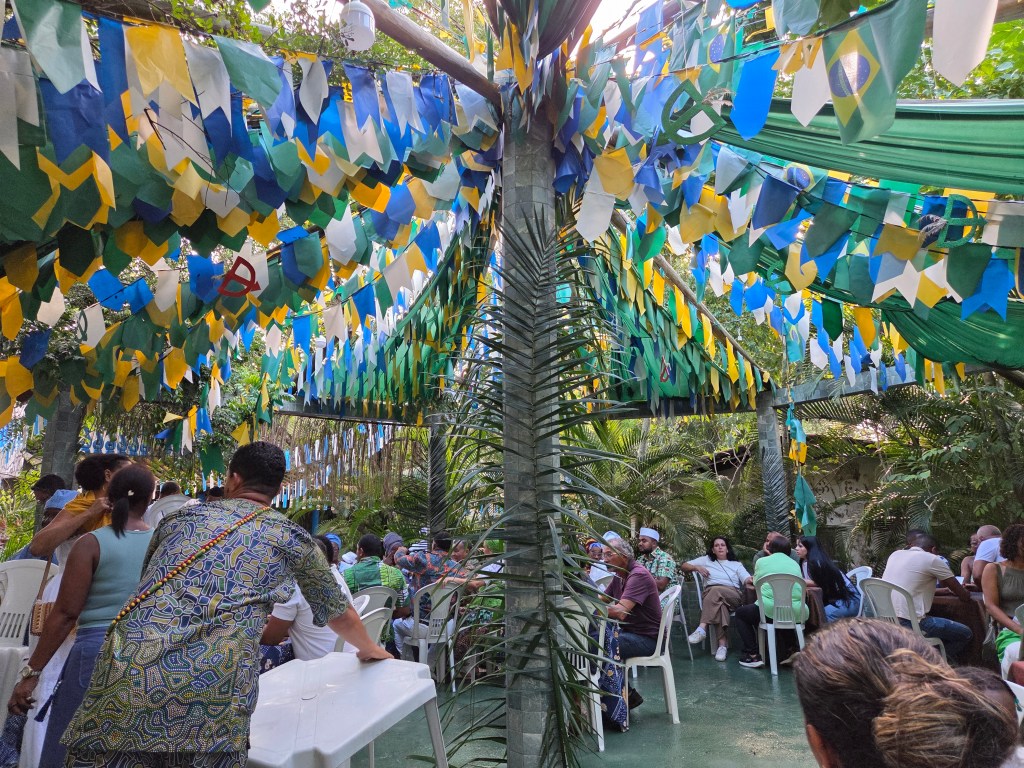
Outdoor eating / gathering space at the Terreiro de Lembá

In early June, M attended a Candomblé ceremony for the god Nikosi, a central African spirit of iron and warfare, at the Terreiro de Lembá, in Camaçari, a small city north of Salvador. Lembá is a spectacular site and sight: a complex of buildings and shrines amid verdant Atlantic rainforest. After entering, we were ushered to the area in front of the kitchen, where initiates of the house – dressed in white lace skirts and blouses and headwraps that are typical markers of female initiates to Candomblé – served slices of chocolate cake alongside lelê (a kind of coconut-and-corn sweet) and aipim. Aipim is the local name for a kind of sweet manioc that’s processed and mixed with a bit of sugar; it’s distinct from sour manioc (mandioca), which is used to make a flour called farofa that is served alongside, or on top of, most Brazilian stews and beans. Also on offer were two flavors of mingau: a slightly sweet, soupy drink made of tapioca and served warm.
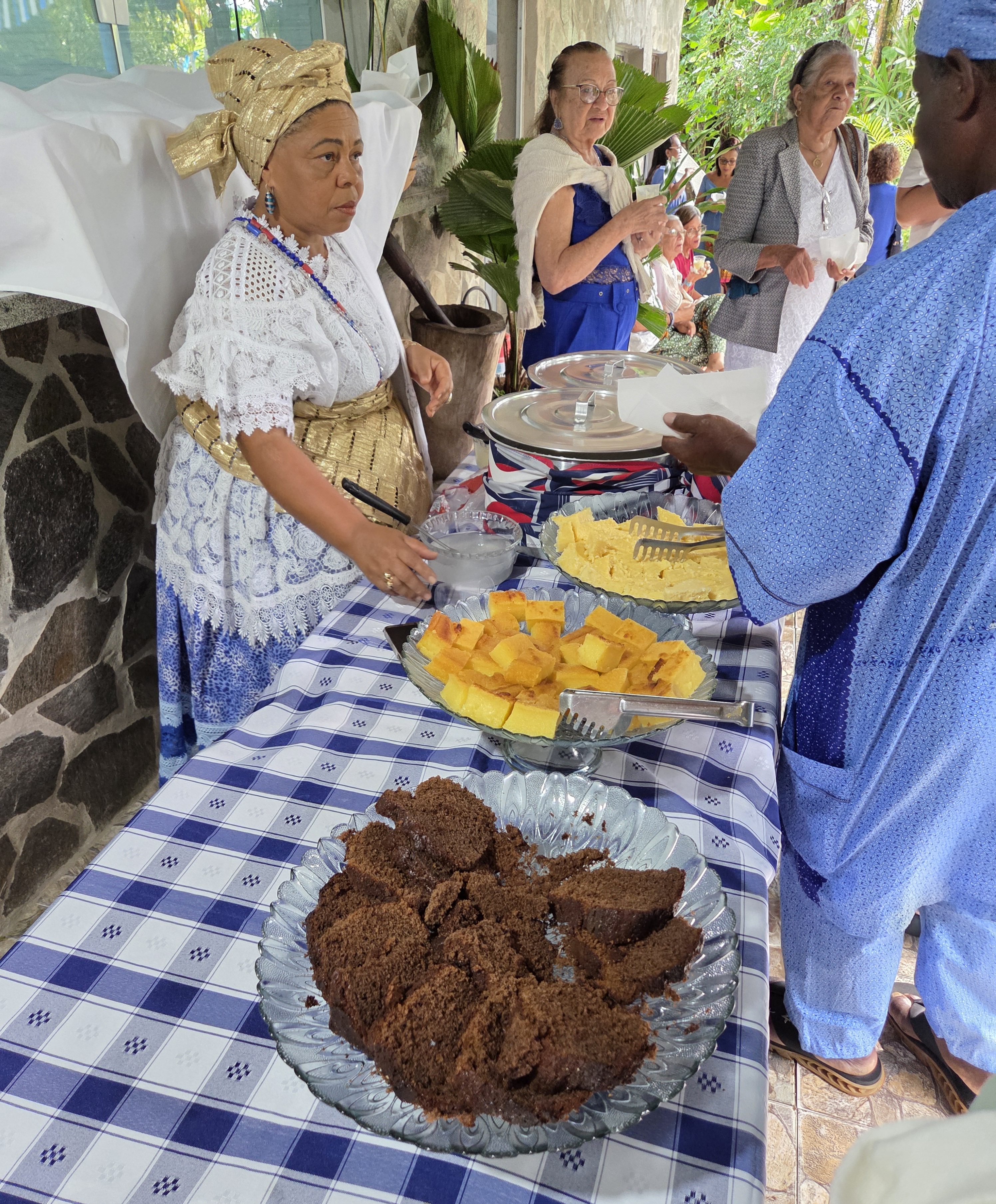
From bottom to top: Chocolate cake, aipim, lelê, and mingau

The ceremony began shortly after this welcoming snack, and lasted five hours: it was an elaborate, energetic, and visually sumptuous affair. Afterwards, all guests were asked to bring their chairs to an open area in the back, decorated with flags and surrounded by forest. Perhaps a hundred people had come, and all were treated to a hearty meal of feijoada: a classic Brazilian stew of beans and meat, served a slew of optional accompaniments: white rice; sliced tomatoes and cucumbers; the aforementioned farofa; and pimenta (a sauce of tomatoes mixed with spicy malalgueta peppers).
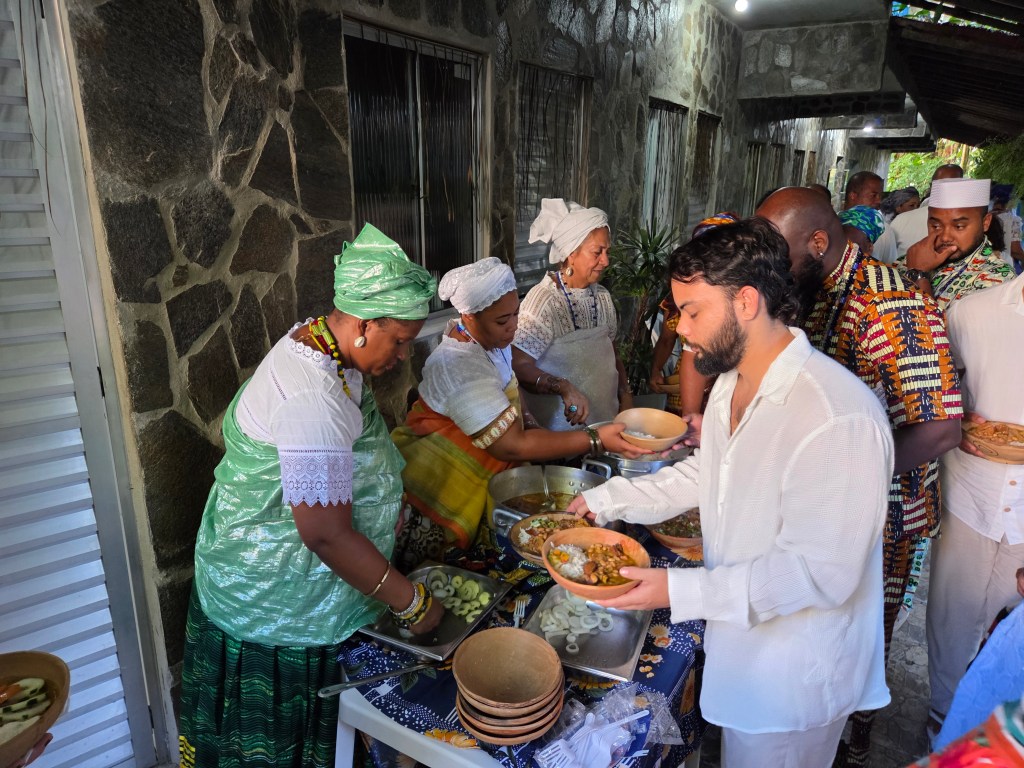
Initiates serve feijoada to guests at Terreiro de Lembá

Feijoada happens to be a food sacred to Nikosi (as well as his better-known Yoruba-based counterpart, Ogum). Each person got in line and was given a traditional clay bowls that had hand-painted geometric designs, while the women served each person in attendance their choices. Back at the tables, younger initiates attended to drink orders, bringing out waters, beers, and fruit punches; clearing tables; and quickly finding extra farofa when anyone requested it (like me).
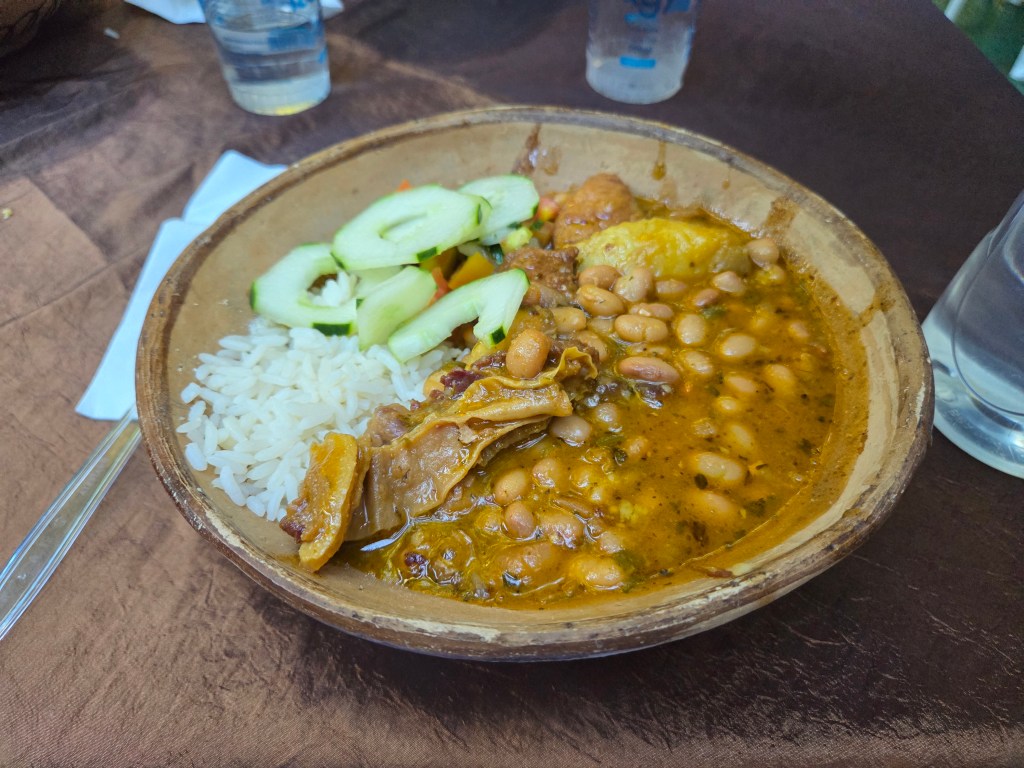
Feijoada, a hearty stew of beans and meat, served with white rice and sliced cucumbers

I’ve had a good number of feijoadas in my life, and this one could hold a candle to any of them: hearty, perfectly seasoned, alongside stellar rice. I went back for a second bowl without thinking about it. And then, before I left, the sweets came out, served table to table: aipim once again (happy to take seconds there too), and a little-known bolo de estudante (“Student’s Cake”) which, despite the name, is a croquette of shredded coconut mixed with tapioca starch, fried until it is crispy on the outside and soft on the inside, and rolled in sugar.
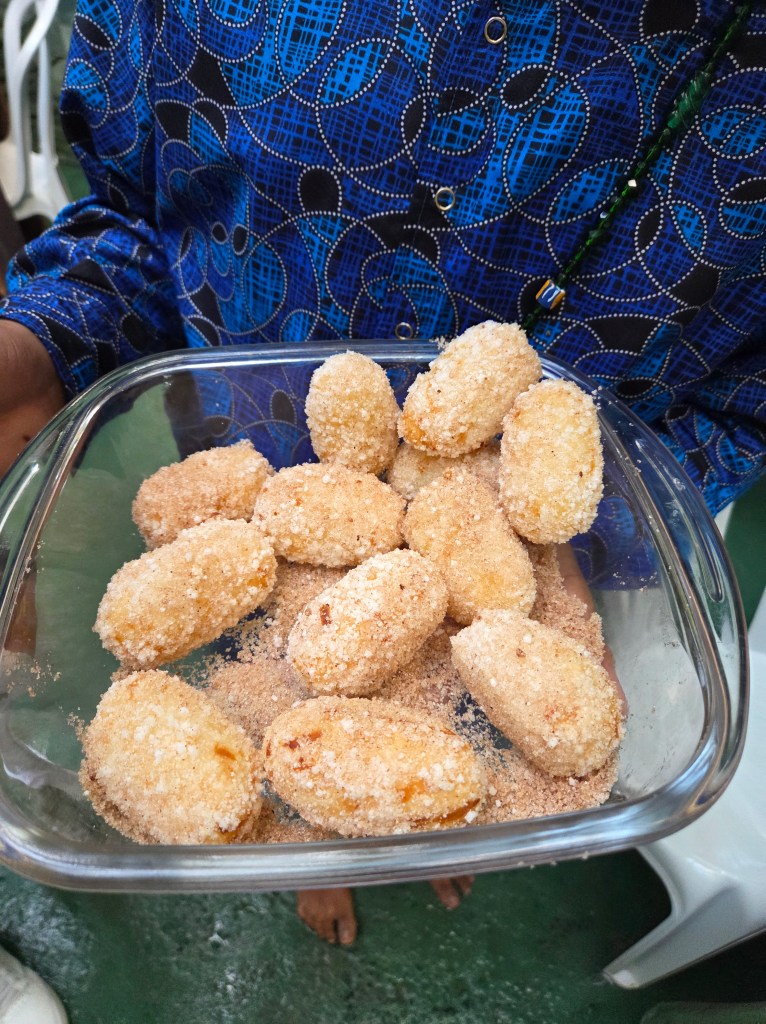
The bolo de estudante served at Terreiro de Lembá

Over the years, I have had many meals at Candomblé houses. I’ve had any number of Bahian classics: acarajé (a bean fritter fried in palm oil and stuffed with fillings), moqueca (a fish stew of palm oil and coconut milk), quiabado (stewed okra); as well as simpler meals of beans, rice, and a bit of meat. They are always made with love and a welcoming spirit; and while I always donate money to the houses, it has never been asked of me. That comes from a legacy: up until the mid-20th century, Candomblé was a heavily criminalized religion in Brazil, and in Bahia in particular, and it still required police permission to be practiced through the 1980s. Today, Candomblé houses are again facing politically- and religiously-motivated attacks – sometimes violent ones – from people who have never been to a temple or attended a ceremony. Terreiro de Lembá’s high priest (tata), the amiable and hardworking Ricardo Tavares, spoke as much at the ceremony. His message was to dispel stereotypes and myths about Candomblé and welcome in the wider community: please be welcome, please come here, please post photos so people know who we are. The sharing of food is evidence of this community spirit.
Leave a comment

Filed under World Eats

Representative Food Maps

Representative Food Maps

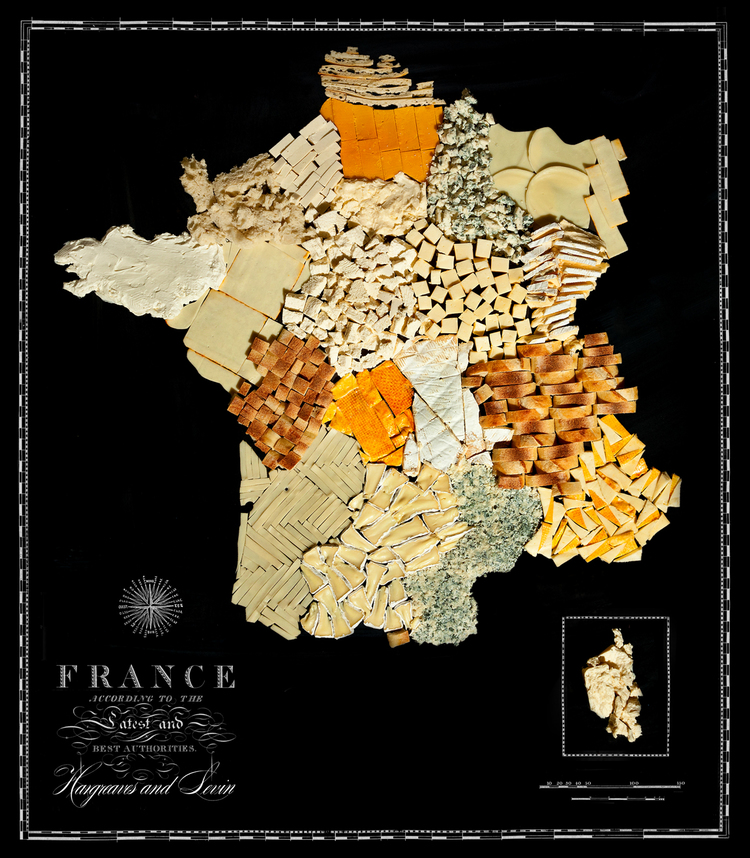
Thanks to our friend Marina for alerting us to this supremely appropriate linkHenry Hargreaves and Caitlin Levin are photographers that work with the themes of food and travel in creative ways, such as creating world maps made out of a representative food from that country. The US is represented by corn, China by noodles, and France by bread and cheese. Do you agree with the representative foods chosen?

Leave a comment

March 18, 2014 · 8:34 AM

(Food) Colors Organized Neatly by Emily Blincoe

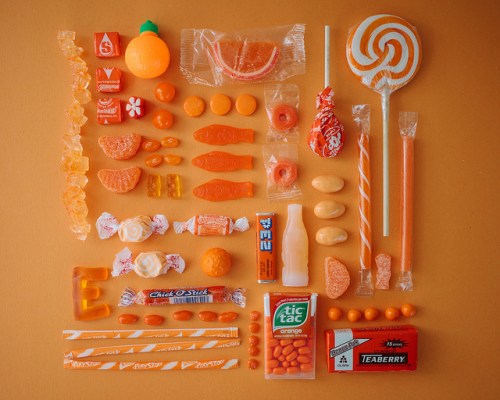
Photographer Emily Blincoe has an amazing photo series called “Colors Organized Neatly”. The title is pretty self-explanatory and the results are stunning. While she focuses on artful agglomerations of all kinds of objects, we are especially intrigued by her arrangements of food, including the pepper ensemble and candy below. Definitely check out her entire photoset for more creative shots of color-coordinated objects.

PepperColors

Pepper Party by Emily Blincoe

OrangeCandy

Orange Candy by Emily Blincoe

Leave a comment

Filed under Design and Photography

Jean-François Mallet’s “Take Away”: Global street food photography

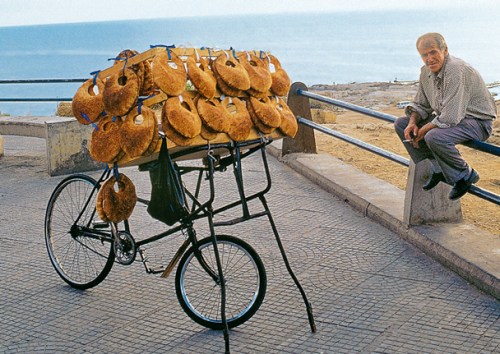
French photographer Jean-François Mallet has a lovely (somewhat) new book called “Take Away” which is an amazing chronicle of street food sellers and customers from all over the world. We were intrigued by his pictures of both familiar and new takes on street food. You can check out some more of Mallet’s food and travel photography on his portfolio site.

A mobile bread vendor in Beirut, Lebanon

A mobile bread vendor in Beirut, Lebanon by Jean-François Mallet

Leave a comment

Filed under Design and Photography, Links

Marcus Nilsson’s Travel Food Photography

I was first introduced to Marcus Nilsson’s photography by a feature in Swallow Magazine about food culture in Mexico City. Intrigued, I then went on the peruse some of his portfolio, and I love all of the travel food images. Here is a very small sample of some of his captivating photography from around the globe. A former chef, Nilsson talks to Fstoppers about his photography philosophy.

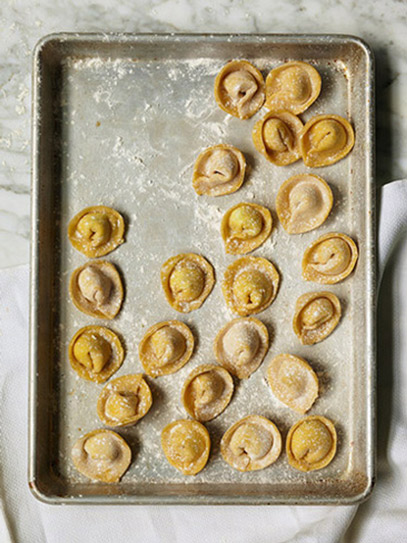
Marcus Nilsson: Parma

Marcus Nilsson: Parma

Marcus Nilsson: Marrakesh

Marcus Nilsson: Marrakesh

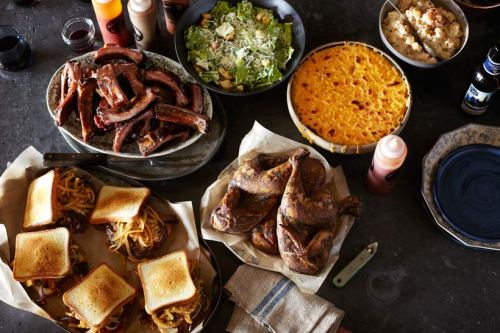
Marcus Nilsson: Detroit

Marcus Nilsson: Detroit

Marcus Nilsson: Mexico City

Marcus Nilsson: Mexico City

Nilsson: Spain

Marcus Nilsson: Spain

Leave a comment

Filed under Design and Photography, Links

The Best of Grandmothers’ Food Around the World

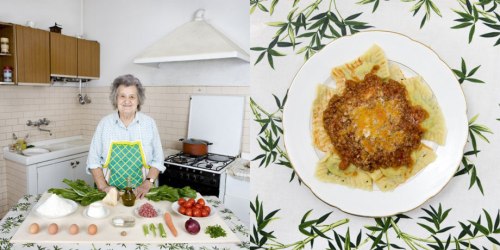
In honor of Mother’s Day: Gabriele Galimberti’s photo series “Delicatessen with Love” focuses on food that Grandmothers make all around the world. The photo series was born from a conversation with his own Italian grandmother, who was worried about what he would eat when photographing around the world.

Marisa Batini, 80 years old – Castiglion Fiorentino, Italy

Marisa Batini – Castiglion Fiorentino, Italy (The photographer’s Grandma)

“In that occasion I said to my grandma ‘You know, Grandma, there are many other grandmas around the world and most of them are really good cooks,” Galimberti wrote via email. “I’m going to meet them and ask them to cook for me so I can show you that you don’t have to be worried for me and the food that I will eat!’ This is the way my project was born!”

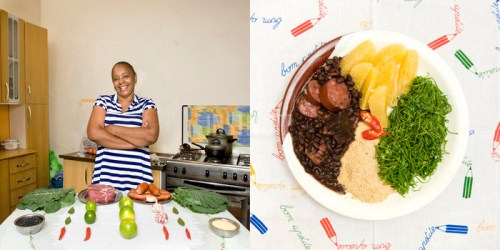
Ana Lucia Souza Pascoal, 53 years old – Rio de Janeiro, Brazil

Ana Lucia Souza Pascoal – Rio de Janeiro, Brazil

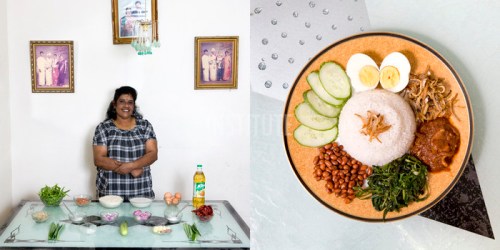
The Grandmas are from diverse locations ranging from Iceland to Fiji to Malawi. In each diptych, the featured Grandmother is pictured first with the ingredients to her signature dish, and then the completed dishes are shown. Some of the stories even come with recipes, including Ana Lucia Souza Pascoal’s Feijoada. You can see the whole 47-part photo series at Riverboom. You can also submit your own tribute to your Grandma’s cooking through the Twitter tag #grandmacooks.

Thilaga Vadhi, 55 years old - Kuala Lumpur, Malaysia

Thilaga Vadhi – Kuala Lumpur, Malaysia

Leave a comment

Filed under Links

What the World Eats – a photography series

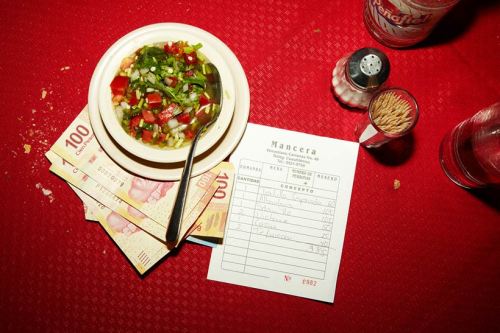
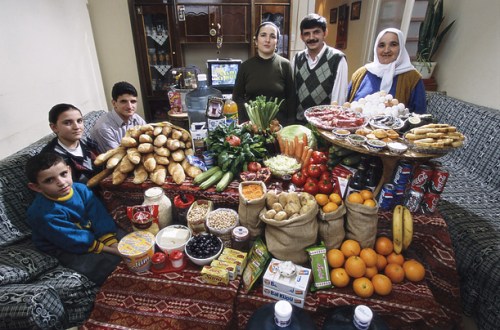
A fascinating set of photographs by Peter Menzel and Faith D’Aluisio have been making the rounds this week. The pair traveled around the world in 2007, photographing families displaying one week’s worth of food – a striking set of images now published in their book, Hungry Planet: What the World EatsYou can easily scroll through hi-res copies of some of the images on imgur, but it would be worth your while to slog through Menzel and D’Aluisio’s work in a series two galleries published by TIME in 2007 (galleries one, and two here, as well as a third gallery with other images from the book), since they feature information on each family’s location, weekly expenditures, and favorite meals, as well as the full set of 27 images (not all of which are on imgur).

J1g49ht

The Celik family of Istanbul. We’d like to stay with them!

As revealing as these photographs are, they raise as many questions about the relationship between class, nationality, ethnicity, and access to food; as well as the obvious representativeness of each family of their national origin (this is easily dealt with in the original book, but imgur leaves out all the identifying information so that each photo is just labeled with a country.) Interest and criticism aside, can we just say, can we have Menzel and D’Aluisio’s job? What lucky people to have so many families invite them into their homes – we’re sure they had many good meals come out of the project!

Leave a comment

Filed under Books

Food Photography by Richard Haughton

RichardHaughton

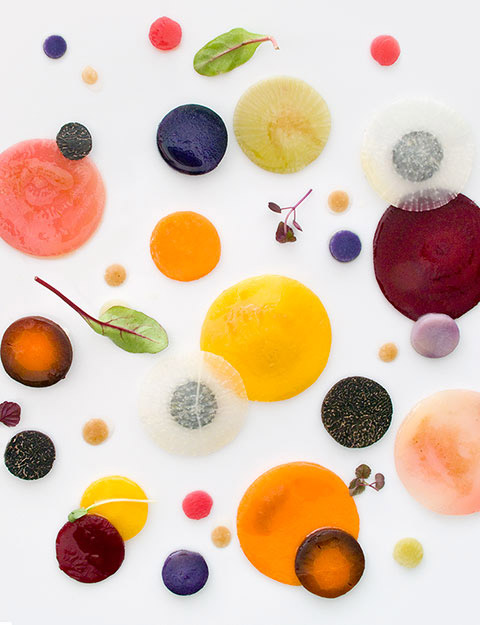
Root Vegetables with Truffle Vinaigrette, by Chef Eric Briffard, Le Cinq

London-based photographer Richard Haughton specializes in capturing dishes by some of the world’s most creative chefs. Feature Shoot has an interview with Haughton, where he describes his techniques.

Do you work with a stylist to create the images?
“I don’t, it’s not necessary with these kinds of chefs. I work directly with the chef, deciding the best visual point of view for a particular dish, the best kind of plate, the best presentation.”

Leave a comment

April 28, 2013 · 10:53 AM

Photographing the Cuban Kitchen

Cuban Kitchen

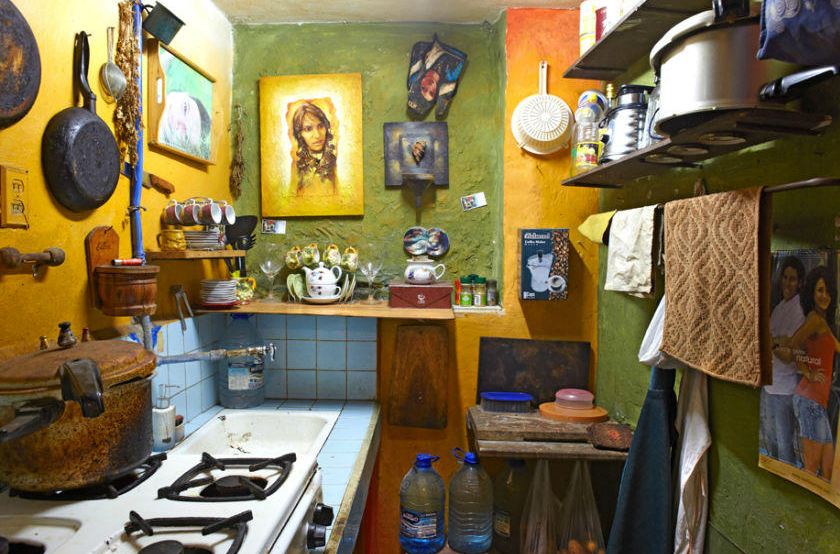
A kitchen in Havana – photograph by Ellen Silverman

Photographer Ellen Silverman did a wonderful photo series called “Spare Beauty: The Cuban Kitchen,” documenting kitchens around Havana, Cuba, and NPR did a short piece about the project. I’m definitely impressed by the ingenuity and personality of these kitchens. You can see the entire photo series on Silverman’s website.

2 Comments

Filed under Design and Photography

Food as Art: The Work of Robert Festino

The visual aspects of food are some of the most appealing to me – who could deny the awesome colors and textures. One art director that has caught my eye is Robert Festino, who does work for Bon Appetit. I found more information about his work through DesignWorkLife. Who could resist these colors?

Leave a comment

Filed under Design and Photography, Links, Note

Friday Foodie Links: Food Photo Sites

photgraze2

We love food, and we love photos. So what could be better than websites that feature nothing but food photos. Though there are many permutations of food photo blogs, our favorites are the constantly-updating grid-style sites that feature multiple pictures at a time. Our 3 favorite sites so far are: Photograzing, TasteSpotting, and FoodGawker . All these photos are user-submitted, which makes us believe maybe we can make some of these beautiful recipes ourselves. For now though…it’s fun to look.

Leave a comment

Filed under Design and Photography, Links