Category Archives: Holidays

Easter Bilbies in Australia

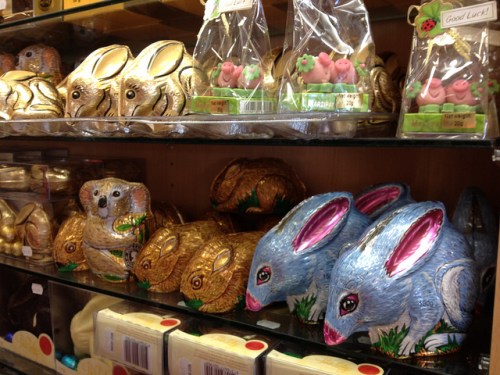
AustraliaIn the USA, Easter is associated in pop culture with rabbits and bunnies. However, in Australia, you are also likely to see a bilby alongside the bunnies. Bilbies are native, endagered Australian marsupials that have floppy ears and a long snout. Rabbits are considered an invasive species in Australia, so it makes sense that they might prefer Bilbies at Easter time. The campaign for the Easter Bilbies was popularized by the Foundation for Rabbit-Free Australia, and the concept has taken off since, with children’s books and chocolate Bilbies galore.

Easter Bilby

Easter Bilbies for sale in Australia – by Rose Holley

Leave a comment

Filed under Holidays

Easter in Brazil: Ovos de Páscoa

brazil

We absolutely love Easter candy, a particular favorite being Reese’s Peanut Butter Eggs. However, in Brazil we have discovered a new Easter obsession that dwarfs Reese’s Eggs in every sense: giant chocolate eggs! In the US we have seen chocolate rabbits, chicks, and miniature eggs but the chocolate Ovos de Páscoa (Easter Eggs) in Brazil put them all to shame. We saw these big chocolate eggs all around town, including grocery stores, newsstands and chocolate shops (such as the chain Cacau Show).

ovo de pascoa

A large Ovo de Pascoa – filled with Ferrero Rocher truffles

In the grocery store, in preparation for Easter, trellises were set up and were completely covered with wrapped eggs from different brands. Sizes of the Ovos ranged from a few inches to over a foot tall – with some costing as much as US$50. These eggs are not just solid (or hollow) chocolate – they are filled with other chocolates or creams. For example, the egg in the photo above is stuffed with truffles. Check out some of these exotic Chocolate Easter Eggs varieties (in Portuguese, but the pictures say it all).

ovos de pascoa

A trellis of Ovos de Pascoa at Zona Sul Supermarket in Rio de Janeiro

2 Comments

Filed under Holidays, World Eats

Fanesca: Ecuadorian Easter Soup

ecuadorFanesca is a traditional Ecuadorian soup that is only eaten in the week before Easter. Fanesca is a heavy soup filled with vegetables and grains (lima beans, fava beans, lentils, corn, pumpkin, squash, quinoa, plantains and more), many of which are only regionally available in the Spring. I suspect Brazilian and Portuguese palates would appreciate this dish due to the inclusion of salted cod, which needs to be soaked for 24 hours to make the soup stockLaylita’s Recipes has a good history and recipe for FanescaCalvin Trillian has a longer story for the New Yorker about his experiences sampling Fanesca as a foreigner living in Cuenca, Ecuador

Being able to say anything I wanted to in Spanish before the moment had passed was what I’d been daydreaming about. I was thinking of the day when my response to a particularly good fanesca (the only kind of fanesca I’ve ever experienced) would no longer be limited to “delicious” or “very tasty, thank you.” I could envision myself pushing back from the table and making a statement to the waiter that was as complex as the dish itself—something like “I can’t take leave of this glorious establishment without saying, in utmost sincerity, that the fanesca I’ve just had the honor of consuming made my heart soar, or at least go pitter-patter, and I want to emphasize that each and every bean had a valiant role to play in what was, when all is said and done, a perfectly blended and modulated work of art.” In that daydream, the waiter is so impressed by my eloquence that he offers me seconds. I decline, with a short speech that reminds him of something he once read in a story by Jorge Luis Borges. [The New Yorker]

Typical Fanesca from Ecuador – Via Wikipedia

Leave a comment

Filed under Holidays

Collection of Charoset Recipes for Passover

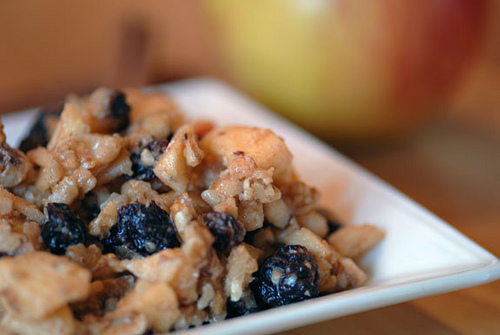
Happy Passover! We found a pretty nice collection of international recipes to put a spin on one of the essential elements of Passover Seder dinner: Charoset. Charoset is a paste made from fruit (often figs or apples), nuts, wine and honey. The exact content of charoset varies by region and tradition, for example, this Syrian version of charoset includes apricots!  Beyond switching up the ingredients, there are a million ways charoset can be altered and dressed up. Elana’s Pantry has a classic version of charoset with apples and walnuts (as depicted below), or check out these unique recipes for Afghan, Indian, Persian and Yemeni varieties. For something even more outside of the box, how about some Sephardic charoset truffles.

Charoset

Charoset By Elana’s Pantry

4 Comments

Filed under Holidays, World Eats

A Visit to Sicily on St. Joseph’s Day

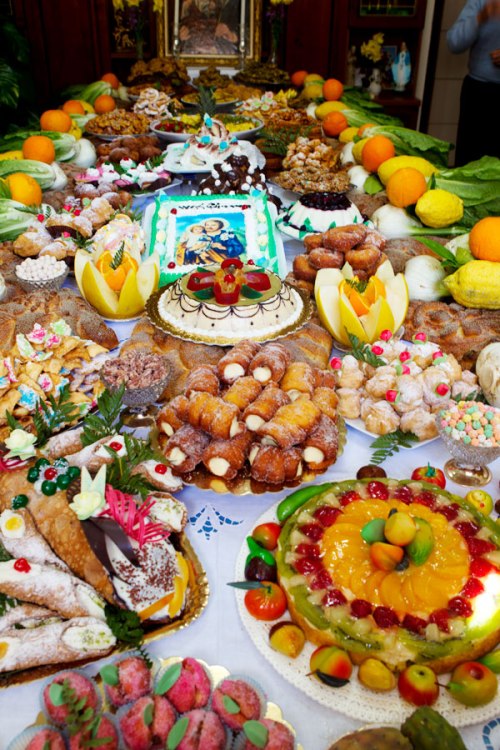
SicilySt. Joseph’s Day is one of our favorite food holidays. It is easy to see why: just look at the spread on the St. Joseph’s Day Table below. La Tartine Gourmand went to Sicily in 2012 during the Festa di San Giuseppe shared some amazing pictures of the food for St. Joseph’s Day they discovered there. The pictures are amazing, and help to give a real picture of what everyday Sicilian Cuisine is like. While we’re happy to be in Rio de Janeiro, we wish we could be in Sicily today!
St. Joseph's Day Table

St. Joseph’s/San Guiseppe  Day Table  in Sclafani Bagni, Sicily by La Tartinr Gourmand

2 Comments

Filed under Holidays, Links

Savory Zeppole for St. Joseph’s Day

ItalyWe have previously written about partaking in Sweet Zeppole for St. Joseph’s Day – one of our favorite holiday treat traditions. However, we were never even aware there was a savory variety of Zeppole. However, it seems that in the region of Calabria, savory Zeppole are a preferred option. Zeppole are basically fried dough fritters, so it make sense they could toe the sweet/savory line. Savory Zeppole can be made with anchovies or served plain. It seems like they would would probably go perfectly with another popular St. Joseph’s Day dish: Pasta con Sarde (with sardines).

Plain Zeppole

Plain Zeppole in Williamsburg, Brooklyn by Phil H

Leave a comment

Filed under Holidays, World Eats

Guinness Recipes for St. Patrick’s Day

IrelandThough Saint Patrick’s Day it is not widely celebrated in Rio (surprised?), we thought we’d share some festive recipes that all feature Guinnessa classic Irish beer for any day – but especially this one! Design Sponge has a recipe for Guinness chocolate cake which looks delicious.  Chocolate and Guinness seems to be a winning combo, which is repeated in Closet Cooking’s Guinness chocolate cheesecake. A final sweet recipe: Nigella’s Guinness gingerbread (even in March). For something savory, check out stout Macaroni and Cheese or Guinness and honey glazed pork loin. I wonder if they have Guinness at Zona Sul?

Guinness_Turtle

Leave a comment

Filed under Holidays, World Eats

Happy Pi (e) Day

Pie Drawing from Cakespy

Pie Drawing from Cakespy

Happy Pi Day everyone (3.14) – hope you get to celebrate with a nice piece of pie. We will be seeking one out in Rio de Janeiro – which is actually a somewhat difficult task. If we were home we would be making Sour Cherry PieChocolate Coconut Pie or Peanut Butter and Chocolate Chess Pie. What kind of pie is your favorite?

Leave a comment

Filed under Holidays, Note, Pastry Post-Poc

Pastry Post-Doc in Italy: Neapolitan Pastiera for Easter

ItalyThough some Southern Italian delicacies have made their ways to the American shores: Rum Baba, Cannoli, among others, we had not encountered Pastiera (also known as Pastiera di Grano) until our trip to Naples. Pastiera is especially associated with Easter (though we also found it in Pasticcerias in November). Pastiera was developed in modern times by a Neapolitan convent, but also has an older history related to pagan Springtime festivals (hence the inclusion of wheat and egg). Pastiera is composed of a pastry shell with a ricotta, wheat and egg filling, which may also be flavored with citrus or spices. Pastiera is unique – and in order to make it you need to prepare a special wheat mixture (unless you have access to prepared soaked wheat – which this recipe includes). While in Naples we saw large Pastiera pies even being sold in tins – perfect for every Easter table.

Pastiera in Naples

A slice of pastiera in Naples by Yuichi Sakuraba

2 Comments

Filed under Holidays, World Eats

Sweden: Semla for Tuesdays in Lent

sweden_flag Semla (or as it goes by many other names: fastlagsbulle, laskiaispulla, or fastelavnsbolle) is a Scandinavian pastry strongly associated with Lent in Finland, Denmark, Iceland and Sweden. Semlor (plural) used to be eaten on Shrove Tuesday/Mardi Gras, however, it is now eaten throughout Lent, especially on Tuesdays. Semla seems pretty easy to make – and consists of a cardamom flavored sweet roll filled with whipped cream and almond paste. During this time of year, all of the bakeries in Scandinavia stock semla, and it is the perfect snack to enjoy with your afternoon coffee break, or fika. For those outside of Northern Europe, Camilla’s Cravings has a recipe for Semla.

Semla

Semla by Erik Boralv

3 Comments

Filed under Coffee, Holidays

Vintage Food-Related Valentine’s Day Cards

Happy Valentine’s Day! Why not celebrate with some of these vintage food-related Valentines from the Vintage Valentine Museum: here are their collections of food-related cards and anthropomorphized food cards. For some more fun, here is an assortment of tea related cards from Tea with Friends.

SweetteaValentine

1 Comment

Filed under Holidays, Links

Paczki Day: A Polish-American Take on Shrove Tuesday / Mardi Gras

PolandWhen we were in Chicago for Fat Tuesday, it was not uncommon to have a friend or co-worker bring over a box of fresh Paczki. Paczki, a type of jelly- filled doughnut, originated in Poland (the official plural in Polish is pączki -pączek is the singular form), as a way to use up sugar and butter before the start of Lent. Unsurprisingly, Paczki Day is really big in Chicago, which has one of the biggest Polish populations outside of Poland. In Michigan, Hamtramck and Detroit are also epicenters of paczki culture. So what is a pączek like? The texture of a pączek is a bit denser than a jelly doughnut, and the jam fillings range from standard raspberry to more creative varieties, such as rose-hip or even guava (you may also see cream fillings).  Louisa Chu on the WBEZ blog lists some top picks for Paczki in Chicago, and DNA Info rounds out the list even further. Rest assured, if you are in Chicago, you can get your Paczki fix.

Paczki

Paczki options at Alliance Bakery by Chad Magiera

6 Comments

Filed under Holidays, World Eats

Lunar New Year in Liberdade, São Paulo

JapanbrazilToday is Lunar New Year – the welcoming the year of the snake. Fact of the day: Brazil has a substantial East Asian population, including the largest population of Japanese-descended persons outside Japan. São Paulo in particular is a major Japanese-Brazilian (nikkei) center, with Japanese cultural heritage on full display in São Paulo’s Liberdade neighborhood (which means “freedom” in Portuguese). Though originally settled by the Japanese, today the area is also home to many recent Chinese and Korean immigrants. Due to this, Liberdade is a great place to experience Lunar new year!  In 2011, 200,000 people attended new years celebrations in Liberdade alone.

LiberdadeNewYear

Chinese New Year Celebration in Liberdade, 2008 by Bianca Bueno

Liberdade is a very cool place, marked by its distinctive red lamp posts and a red Japanese gate (torii) at the entrance to the main street. We visited Liberdade in 2012, right after new year, but the place was still hopping. The neighborhood is also famous for its weekend street fairs, which are full of food, and bring out Paulistanos from all areas of the city. On any day of the week you can get some of the best yakisoba , bubble tea and gyoza in Liberdade. In many other Brazilian cities, Japanese food is quite expensive, but Paulistanos have the pick of any range of restaurants. There is even a dedicated Sake shop!

LiberdadeSaoPaulo

Streets in Liberdade, Sao Paulo by Márcio Cabral de Moura

Leave a comment

Filed under Holidays, World Eats

Sweets for Australia Day: Milo Cheesecake

AustraliaHappy Australia Day! We love celebrating national holidays with the appropriate food, and look at how festive this nice Australian Milo cheesecake with chocolate crackle crust looks. Milo is a malt and chocolate powdered drink (similar to Ovaltine, but definitely different). We first tried Milo in Singapore, and it enjoys popularity all over the world, but we were surprised to hear it originated in Australia in the 1930s.

Australian Milo Cheesecake

Australian Milo Cheesecake from Raspberri Cupcakes

Leave a comment

Filed under Cheese, Holidays, World Eats

Holiday Eats: Rosca de Reyes from Mexico

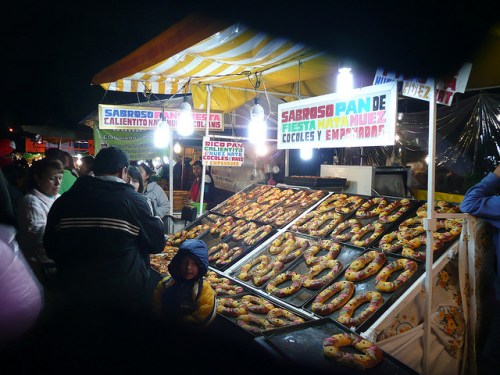
Mexico FlagThe tradition of the “King Cake” spans continents, and is tied to the holiday of Epiphany celebrated on the 6th of January. One variety of sweet celebrating this day is the Bolo Rei of Portugal, and another variety is Rosca de Reyes from Mexico, a ring of sweet bread. Epiphany is known in Mexico as Día de Los Tres Reyes Magos (Three Kings Day), lending the cake its name. Much like the other King Cake varieties, the Rosca de Reyes has a trinket inside, in this case a small porcelain (or plastic) Jesus figurine, the finder of which has to host a party on February 2nd, Candelmas. The Rosca de Reyes is more of a bread than a cake, and instead of frosting, the bread is topped with candied citrus and a bit of sugar. The size of the Rosca is dependent on the size of your party, so here is a recipe if you are expecting a crowd, or another if you would rather have more individual-sized rolls.

Rosca de Reyes

Rosca de Reyes for sale in Mexico City

3 Comments

Filed under Holidays

Happy New Year!

Vintage Happy New Year

[Via Van Paris]

Leave a comment

Filed under Holidays, Note

Recipes for Hogmanay, Scottish New Year!

ScotlandFlagWe have not given much coverage to Scotland on this blog (well… any coverage), so we think its time they got a little love. Apparently Scotland is quite well known for the fun and over-the-top New Year’s Celebrations, known as Hogmanay. One of the traditions of Hogmanay is “first footing” where you try to be the first person over the threshold of an house, where you then give a gift of food. Sounds good to us! Common foods given are shortbread (in its many varieties) or a fruitcake called “black bun.” Black bun is a little different than the average fruitcake since it is much richer and denser, and is then wrapped in a pastry case. People with lighter tastes may like cranachan, a type of Scottish trifle.

HogmanayEdinburgh

Hogmanay in Edinburgh by Robbie Shade

Leave a comment

Filed under Holidays, World Eats

Holiday Eats Around the World: Stollen from Germany

germanyThough everyone is probably already overtired of holiday sweets, here is one more confection for the road (though is it really possible to be completely tired of sweets?) One of the most popular European Christmas treats is the German Stollen, a type of yeast-based fruit cake chock full of nuts, candied fruits and spices, and topped with powdered sugar. The history of Stollen is very complicated, and dates back to the 14th century, when it originated during a baking contest created by the Bishop of Nauruburg. Stollen enjoyed such an exalted place in German cuisine that a church ban on butter was lifted in the 16th century just to make the holiday cake (with some of the proceeds being used to build churches). Though Stollen is found throughout Germany and Europe, the most lauded variety is found in Dresden,  a recipe that can be found here. Dresden even has an annual festival in honor of the cake. Due to our affinity of all things miniature, also check out this recipe for Mini Stollen.

Stollen

Stollen by Joana Petrova

1 Comment

Filed under Holidays, Pastry Post-Poc

A Holiday Feast of the Seven Fishes

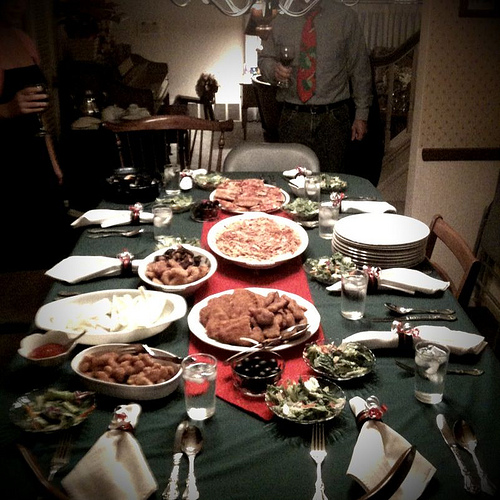
Feast of the Seven Fishes by Austin Kleon

It’s Christmas Eve – which means it’s time for the Feast of the Seven Fishes known as “festa dei sette pesci” in Italian or alternatively as “Vigilia (the Vigil).” We posted briefly on this topic previously, but we figured it would be a good time to expand upon it. The Feast of the Seven Fishes originates from the Catholic tradition of not eating meat on the eve of special holy days, where fish would be consumed instead. The tradition has especially caught on in Italian-American communities, and inventive menus including baccala, calamari, lobster, shrimp and more adorn many “7 Fishes” tables.

Along with the requisite assortment of fishes, sides of veggies and Christmastime desserts like struffoli complete the meal. Traditional or not, any fish dish is welcome at a modern-day feast of two fishes in America. Mario Batali has a traditional Italian menu featuring anchovies, clam and mussels. The Bite Sized blog is cooking their way through an eclectic Feast of the Seven Fishes including Oysters Rockefeller. For those among us who aren’t terribly fond of fish, Buzzfeed has a tongue-in-cheek version of the feast featuring Goldfish Crackers and Swedish Fish. We also like Meatballs and Milkshakes‘ take on the meal, opting for a small menu – doesn’t a bay scallop crudo sound nice?

1 Comment

Filed under Holidays, World Eats

Holiday Eats Around the World: Panettone from Italy

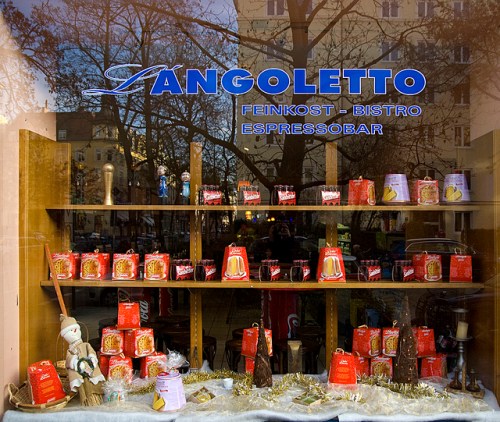
At our favorite grocery store in Lisbon there was an entire wall of Panettone, in distinctive paper boxes, in sizes ranging from tiny to one that would feed an army battalion. This is a testament to both the Portuguese love for Panettone and also the sheer variety of Panettone available. Panettone is a yeast-based Christmas sweet bread from Milan, Italy – traditionally it had pieces of citrus and nuts – however there are other varieties with chocolate or even cream filling. Panettone’s particularly light and fluffy texture is the result of a complicated proofing process (similar to Sourdough bread). Though it originated in Italy, Panettone has flown way past the Italian (and European) borders and is readily available in the US and in South America.

PanettoneBox

A variety of Panettone for sale in Munich

The origin of Panettone is probably the Roman Empire, but I was surprised to learn that it only became commercially available in the 1920s.   Needless to say, it wouldn’t be an Italian Christmas or New Year without some Panettone. The large size Panettone is a lot for one person to handle, so sharing it with family and friends is probably a good idea (M swears by eating it the next day as toast with butter and cinnamon, or you could make a bread pudding). We’ve never tried making Panettone, though these miniature cranberry Panettones seem to be more manageable. Recipe Roll and King Arthur flour have  recipes for a classic Panettone, and Sur Le Table even has Panettone baking molds in traditional parchment.

2 Comments

Filed under Holidays, World Eats