Category Archives: World Eats

Adventures in Brazilian Produce: Pinha or Fruta-do-conde


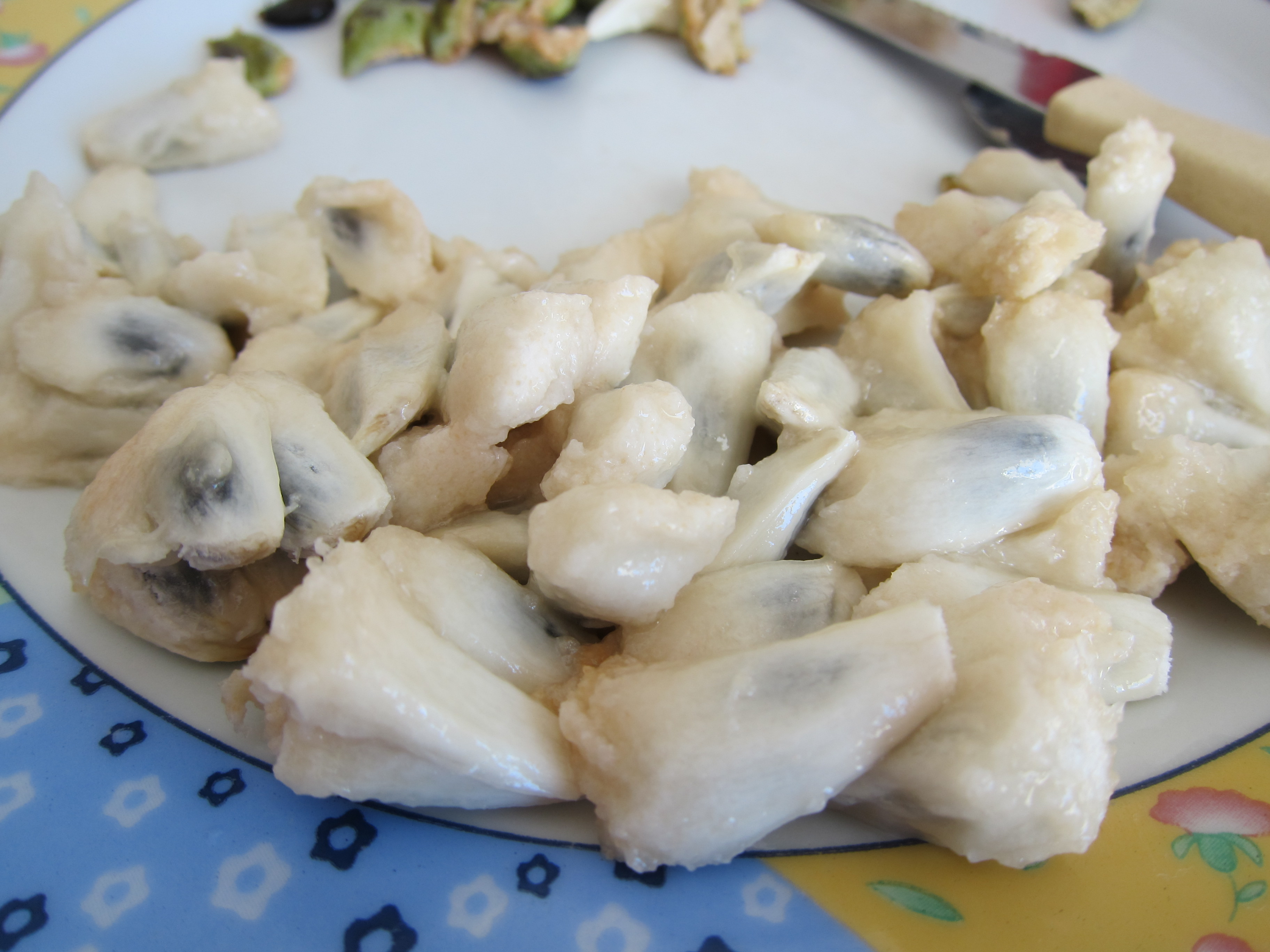
…AKA the Fruta-do-conde or the Sugar Apple. Having been in Brazil for a month, we still don’t know exactly what the proper name for this fruit is, but we know we like it. Here, we are finally getting used to the concept of buying fruits unripened, so the first time we bought a pinha, we didn’t understand what the big deal was. It tasted hard and bland, like an unsweetened pear. But then we figured out we had not let it ripen enough. To properly enjoy a Sugar Apple, you need to let it almost overripen, to the point where the fruit becomes so soft you can squeeze it open with a slight press of your hand. The days passed with anticipation, and we finally got it right. You can gently peel off the green outer layer, and squeeze out the flesh right onto a plate.

Sugar apples are filled with 50 or so black seeds, each of which is coated with a generous helping of flesh. Just pop the seeds into your mouth and squeeze the fruit off. The flesh hits notes like a very sweet, sugary pear; the sugar so dense you can practically feel the crystals in your mouth. It’s a great afternoon snack, and easy to store once you’ve squeezed out all the seeds. They are so readily available in Brazil, we’ll be sad when we have to head home, but we did read recently they are trying to grow the fruit in Florida, so we’ll see!

2 Comments

Filed under World Eats

Adventures in Brazilian Produce: Maxixe


The Maxixe is yet another Brazilian culinary staple brought from western and central Africa. About the size of a roma tomato, their small size and spiky exteriors do a good job of hiding what is actually a sweet and refreshing vegetable. For those of you who have eaten a maxixe, I know what you are going to say: “L&M, it tastes exactly like a cucumber. What’s the big deal?” Well, we agree it may taste remarkably similar to a cucumber, but it also has a smoother texture, the flavor hits better notes of both sour and sweet, and we find it much more refreshing on a hot day in Bahia, to the point where we’d pick maxixe juice over cucumber juice any day.

We have heard that maxixes are actually best when cooked, particularly when incorporated into cozido and other Brazilian stews. We have not tried it this way yet, but will soon!

1 Comment

Filed under World Eats

Xiao Long Bao for Chinese New Year

chinaHappy New Year! Monday, Jan 23rd marks the start of the Lunar year – and the Chinese year of the Dragon. In Salvador, there actually are a few Chinese restaurants, so maybe we will be able to partake (we even saw a Macanese restaurant – cool!). One Chinese food we are craving in honor of the new year is Xiao Long Bao (XLB). XLB are dumplings from Eastern China, which are filled with gelatin (which then melts to liquid through steaming), earning them the English nickname of soup dumplings. While we are admitted XLB novices, XLB have quite a cult following among foodies, and there are countless blog posts reviewing and critiquing dumpling offerings in America and abroad. Eating XLB is also an art unto itself, since the liquid filling of the XLB has the potential for explosion!

Soup Dumplings at Bund Shanghai in San Francisco

3 Comments

Filed under Holidays, World Eats

The cross-cultural Sabich

Cross-cultural food hybrids are some of our favorite eats – so we were very interested to learn about the Sabich in Saveur – an eggplant sandwich that is a product of cultural exchange between Israel and Iraq.

2 Comments

Filed under World Eats

Adventures in Brazilian Produce: Umbus

The local Bompreço here in Salvador’s Barra neighborhood offers the typical slate of big grocery chain items: dairy, produce, meats, kitchen utensils. But remember we are in Brazil, home to a wide range of produce items not typically available in the United States, or elsewhere in the world. So today on ETW we are starting a series called “Adventures in Brazilian Produce,” where each week we sample a new and exciting fruit or veggie from our local grocery store or market.

Umbus, known as Brazilian plums outside of their native homeland (though I’ve never seen them), are sold as snacks by street vendors all over the city. They grow in small bush-like plants in the sertão, and are sold all over Brazil. They are typically sold unripened, slightly hard and green, looking something like an oversized green olive. Let them ripen a few days and they turn a greenish-yellow, with a soft and slightly squishy texture, and then they are ready to eat. I learned the hard way not to eat the skin, which is tough and bitter. Cut around the edge and peel in off, then suck out the juicy/fibrous (think like a peach) insides. Suck on it, chewing around the small seed, and the taste you get is a fascinating juxtaposition of sour and sweet. As I described it to L, it was as if as mad scientist spliced a sour apple with a sweet red grape. But be careful not to let them over-ripen, as they turn back to being bitter and unpleasant. Besides eating them plain, umbus can also be made into a wide assortment of juices and jams.

Next week: Cashew fruit. Yes, a cashew “nut” comes in a pod attached to a big fruit. I was shocked too.

1 Comment

Filed under World Eats

Brazil: Acarajé, Bahia’s signature dish

Acarajé
Bought on Avenida Cesar Zama
Barra, Salvador, Bahia, Brazil

The eaters will be in Brazil for the next two months, based principally in Salvador, capital of Bahia state and one of Brazil’s most distinctive culinary destinations, featuring a host of African-inspired cuisines. Of all Bahia’s treats, none is better-known than the ubiquitous acarajé, sold on nearly every street corner, particularly in the more touristic districts of Barra and Pelourinho, and the vibrant Rio Vermelho neighborhood.ImageI had read many descriptions of acarajé before arriving in Bahia, and was excited to finally try the product, especially one produced by one of the many Baianas, with their white hoop skirts and Candomblé religious beads, who have a near-monopoly of the acarajé industry in the city. I plan on trying multiple acarajés in the city before we come back in March, and this was my first, from a lovely woman on the largo where Avenida Cesar Zama hits the oceanfront road of 7 Setembro in the Barra district.

In the simplest sense, acarajé is skinned white or black beans mashed together into a ball and fried in a distinctive and strong-flavored oil from the dendê palm tree that grows along Bahia’s coastline. Once fried, the ball is sliced in half and filled with your choice of toppings. These can very from locale to locale, but typically they consist of four options: small dried shrimp, fried okra, a salad of tomatoes and cilantro, and vatapá, a thick orange paste made from ground dried shrimp, cashews, coconut milk, and dendê oil.

For those of you who are fans of falafel  (as we are, seen here and here and here), you will find its taste and texture very similar to acarajé. At first I thought this was coincidence, but some recent research has traced the origins of acarajé – a Yoruba dish from southwestern Nigeria – to a trade and raiding relationship with Arabs from the eastern Mediterranean about one throusand years ago. The dish was then brought over by enslaved Yorubas to Bahia during the first half of the 19th century, where it morphed into its present form using local Brazilian ingredients.

Though the falafel similarity is undeniable, I would say acarajé is overall larger, more bready, and more of a container in its own right than a filler. Add the fixings on top – I went with just salad and vatapá (I’m not a big fan of okra, and the shrimp usually cost extra) – and you get a solid snack, or meal if you are not that hungry, for 3.50 reais (about $1.80). Tomatoes and cilantro were as solid as can be expected, but the vatapá was a little surprising. I expected more of a mixture of ingredients, but this was a thorough paste, something like a strong-flavored and slightly spicy hummus.  I bought two on an empty stomach, and was over-full by the time I finished them. In my hammock with a chilled coconut, of course.

Hopefully our next report from Bahia will be a moqueca review – another one of our favorite dishes!

Acarajé stall on Porto do Barra beach, Salvador.

1 Comment

Filed under Reviews, World Eats

Revelation of the year: Yogurt and Honey

How, oh how, did it take us so long to realize the wonders of this culinary marriage? Our first stop in Istanbul had introduced us to the wonders of fresh honey – breakfast each day at the hotel supplied fresh honeycomb, which we liberally spread on, well, everything – but Greece made us realize what it means to spread that honey all over some smooth, rich, yogurt. Our first day in Santorini, we walked into Oia and hopped into a cute cafe. Our honey love having been born only a few days before, M opted for the “yogurt and honey” for 4.5 euros. What came out was nearly a meal – a large bowl of Greek yogurt drowning in honey. This quickly became our newest obsession: we scoured the island, and the rest of Greece frankly, for versions of this culinary delicacy. Both of our hotels in Santorini had great versions, but Crete took things to another level.

Vrysses Yogurt

The famous yogurt of Vrysses, Crete

The small town of Vrysses, in central-west Crete, is famous around the island, and most of Greece, for the honey produced there, as well as the yogurt that goes with it. Driving into the small town square, the central fountain plaza is surrounded by honey shops. With no info to make a decision, we opted for the one that looked the most family-run: Kaprri. We ordered two plates – not bowls here, as they usually come – and we quickly caught on to what makes Vrysses honey so distinctive. The yogurt was approaching the consistency and flavor of sour cream, which was paired with a light clover honey, a wonderful complement that reduced a lot of the overpowering sugary sweetness that we usually associate with yogurt and honey.

In Athens, we were fortunate enough to discover a yogurt and honey BAR, Fresko – yes! – located just outside the spectacular new Acropolis Museum (Fresko, Dionysiou Areopagitou 3, Athens 11742, Greece). Notice: we need this place in the United States. Six kinds of yogurt, two kinds of honey, plus an assortment of smoothies and other drinks. M nearly died and went to heaven, savoring both some honey and a pomegranate smoothie while there.

Fresko in Athens

Fresko in Athens

Back in the USA, we’ve been getting more into the yogurt and honey scene around us. Our favorite brand of Greek yogurt – which we were happy to find also for sale in Lisbon – is Fage. We’ve been buying a four-pack almost weekly, and pairing it with locally-produced honeys at breakfast. Chicago has a great honey collective for those of you around town, the Chicago Honey Co-op.

Leave a comment

Filed under Finer Things Club, World Eats

Finer Things Club: Berthillon

Berthillon
31, rue Saint-Louis-en-l’Île
Paris, 75004

You know ice cream is good if you crave it even in 40 degree, rainy weather (hmmm, just like Chicago right now). Despite the gross grey drizzle we made a pilgrimage to Berthillon on Île Saint-Louis, fine purveyors of delicious house-made ice creams. Along with L’As du Fallafel, Berthillon is another one of our Paris must-dos – beware though – many places on the same road on the Île advertise that they carry Berthilllon ice cream, but only one is the ORIGINAL Berthillon. As a respite from the cold we opted to go into the small but elegant Berthillon tea room to sample some ice cream (in the Summer there is a walkup counter).

The little tea room serves all of Berthillon’s myriad ice cream flavors – which rotate in and out on a daily basis. The flavor selection at Berthillion is massive – and includes all of the classics, like hazelnut or vanilla, as well as particularly fresh and potent fruit sorbets, there are even a few more unusual flavors like Earl Grey Tea, Turron and Ginger (full list of ice creams and sorbets here – both PDFs). We are partial to the chocolate ice cream and raspberry sorbet flavors, however you can’t go too wrong. Also – as a bonus – they serve Mariage Frères tea – another one of our all-time favorites! While the Eaters opted for a decadent dish of chocolate ice cream covered in chantilly and chocolate sauce along with an almond tuile, our friends went for the salted caramel ice cream. For an accompaniment we got a small pot of Thé à l’Opéra, one of our favorite Mariage Frères varieties, a green tea and red berry blend. For the more adventurous there are also more elaborate sundaes (but those will cost you a lot more). It doesn’t matter the weather – you know you want ice cream!

Leave a comment

Filed under Finer Things Club, World Eats

Merry Christmas Bacalhau!

If there is one constant in Portuguese food it is the mighty, iconic Bacalhau. This Portuguese salted cod is found nearly on every traditionl Portuguese menu – often in dozens of preparations. It is in fact rumored that over 500 canonized Balcahu recipes exist in Portuguese cuisine. Some of the most popular Bacalhau dishes are Bacalhau com Natas and Bacalhoada, but there is a Bacalhau recipe to suit nearly every taste.

Christmastime is an especially important time for the Bacalhau – as it is traditionally eaten on Christmas Eve by Portuguese families. Bacalhau can be found in many forms – filleted and dried, in cans, and even frozen is gaining popularity. We were also amused to find specal  “Christmas Bacalhau” for sale. Basically these are the normal splayed, dried and salted bacalhau, but wrapped in cellophane and topped with a red bow. We thought this was a one-off, but we actually saw this festive gift-ready presentation in several Lisbon stores leading up to Christmas.

This calls to mind the Italian tradition of the feast of the seven fishes, which we have written about previously. In Italian, Bacalhau is called Baccala, and sorry to say we do not much care for that either, perhaps betraying our Italian heritage a bit. But, bacalhau is the real heart of Portuguese cuisine, and if you don’t at least try it – you are missing out! You never know when you will need that 7th fish dish for the Feast of Seven Fishes.

Leave a comment

Filed under Holidays, World Eats

Christmas in Paris: Bûche de Noël

Buche de Noel Paris

A Bûche de Noël in Paris

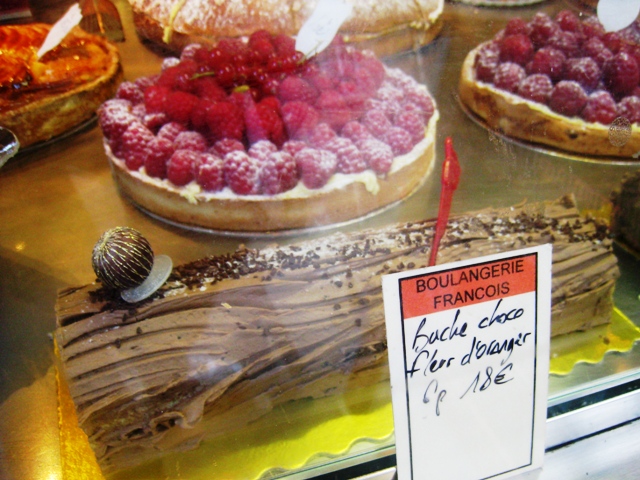
In our continuing coverage of holiday-related cakes and desserts (yum!) we move on to France. As much of a fixture as holiday lights and trees, the arrival of the Bûche de Noël cake in pastry shop windows signals Christmas. Known in the US as a Yule Log, the Bûche de Noël consists of rolled sponge cake, typically with chocolate frosting, that resembles a log (even topped with meringue mushrooms). However, the modern varieties available are almost limitless, including this bitter orange-flower flavored Bûche we saw in a shop window.

As for history, The earliest known recipe of the cake is from 1898, though the tradition of the cake is much older than that. The origins of the Bûche de Noël are with the Yule log traditionally burned by the Celts and other cultures around the Winter Solstice. The form of the Bûche de Noël is then based off of those logs. But when did the cake itself originate? The blog Why’d you Eat That has a pretty awesome explanation – and it includes Napoleon (go figure):

During his reign as Supreme Ruler of the Universe, Napoleon realized there was a lot of disease in Paris. His solution was to mandate that all chimneys must remain closed during the winter months because the cold, drafty air was causing all this inconvenient illness. With chimneys closed, there was no way for the air to get in. Now people were in a pickle. They had no way to burn their traditional Bûche de Noël. So a Parisian baker got creative and invented the cake as a symbolic alternative of the actual piece of wood.

For those intrepid bakers, Saveur has a traditional recipe and Canelle et Vanille has an amazing looking version with lemon creme brulee filling and dark chocolate glaze. According to Serious Eats, Floriole in Chicago has a pretty awesome Bûche de Noël.

1 Comment

Filed under Holidays, World Eats

The Best Macarons in Paris

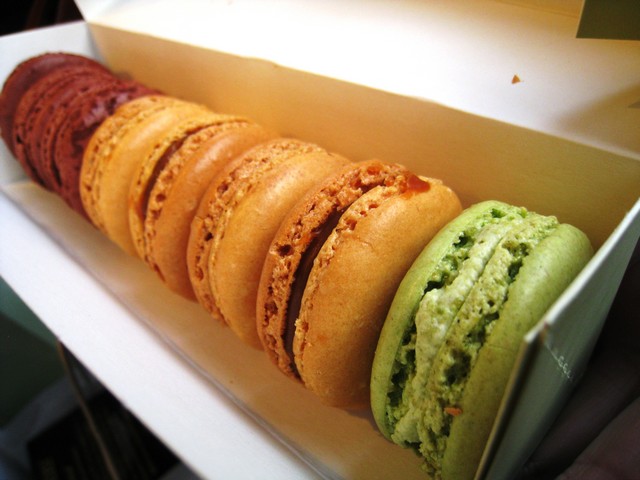
One of our main goals while visiting Paris was to sample the macarons. L and M are huge fans of macarons, and even had them as our wedding favors (chocolate, blueberry and chai). However, we will freely admit that none of the macarons in Chicago (even the most expensive) can rival those in Paris. Prior to our trip, we did some research to narrow down the overwhelming choices for some possible top contenders. After reading many ‘best of ‘ lists we arrived at two top contenders – Ladurée and Pierre Hermé. With this shortlist in mind, we set out to conduct a scientific study of what would be the top macaron in Paris, along with our good friends and gracious Paris hosts, T & I. Below, we compare the two shops on various parameters, and discuss our final decision. And no, we did not get IRB approval for this study (Social Science joke!)
Basic Facts

Ladurée
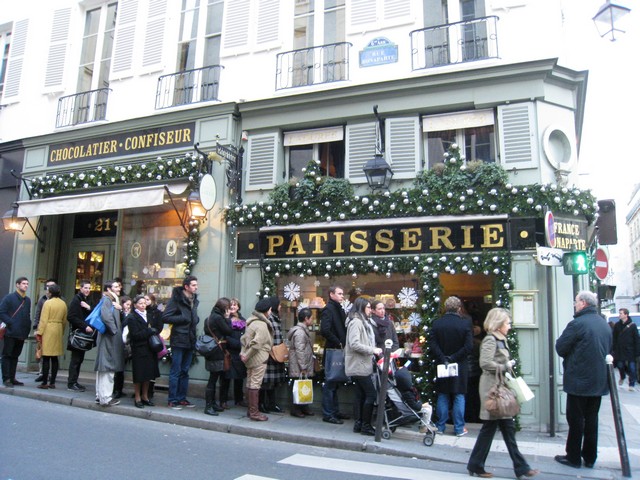
Location in Paris we visited: 21 Rue Bonaparte, Saint Germain des Prés, Paris
Flavors Sampled: Salted Caramel, Colombian Chocolate, Pistachio

Pierre Hermé
Location in Paris we visited: 72 Rue Bonaparte, Saint Germain des Prés, Paris
Flavors Sampled: Creme Brulée, Venezuelan Chocolate, Salted Caramel

Breakdown:

The line outside Ladurée

Price and Line:
Both stores had lines out the door (and were located mere blocks from eachother in the Saint Germain des Prés neighborhood).  However, Ladurée gets the hat-tip for having lower prices for roughly the same sized macarons. At Pierre Hermé eight macarons were €15.70, Ladurée came in at €12.10.
Verdict: Ladurée – we are poor grad students, what do you expect?

Strictness:
We got yelled at in each store for taking pictures – but only after about 20 photos. Oops…?
Verdict: Tie

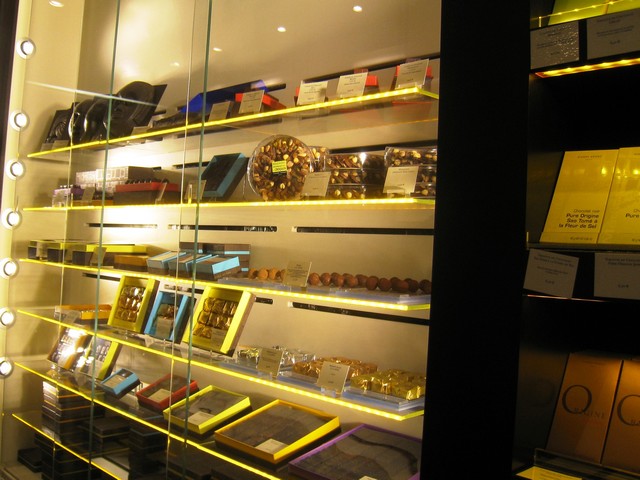
Minimalist display at Pierre Hermé

Decor:
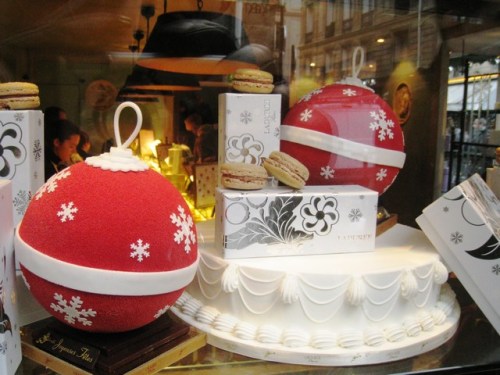
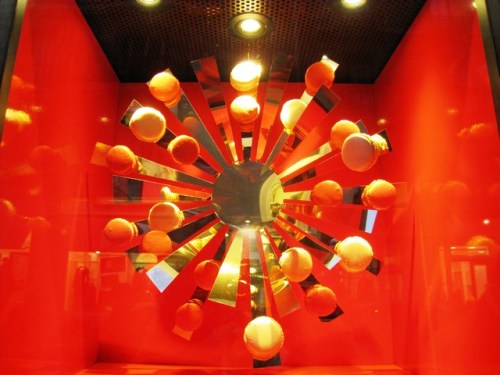
In terms of decor, the two shops could not be more different. Ladurée is a pastel-colored confection, full of filigree and antique fixtures. Pierre Hermé, on the other hand, is extremely stark and sleek, and really goes for the minimalist look. This style was also reflected in each store’s Christmas window decorations, as seen below.
Verdict: We slightly preferred Ladurée, for its old-world charm.

Miscellany:
Pierre Hermé provided little menus with all of the macaron flavors so you could decide while waiting in line. However, Pierre Hermé was also out of a flavor – one that might have been our favorite flavor! Overall, Pierre Hermé was more inventive, and had flavors like Olive Oil/Citrus and Chocolate/Foie Gras, whereas Ladurée only had more classic flavors.
Verdict: Neutral.
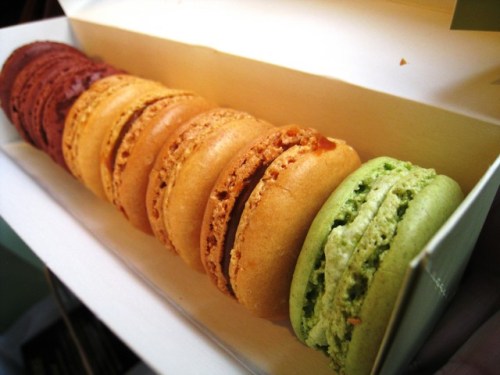
In terms of flavors, it was decided that at both locations, the salted caramel and chocolate were the best, so we will discuss those below.

Chocolates:
Both of the restaurants featured a single-original dark chocolate South American macaron, with chocolate cookies and dark chocolate mousse filling, dusted with cocoa powder.
Verdict: Split Decision – One of our testers preferred the Pierre Hermé, and two preferred Ladurée.

Salted Caramel:
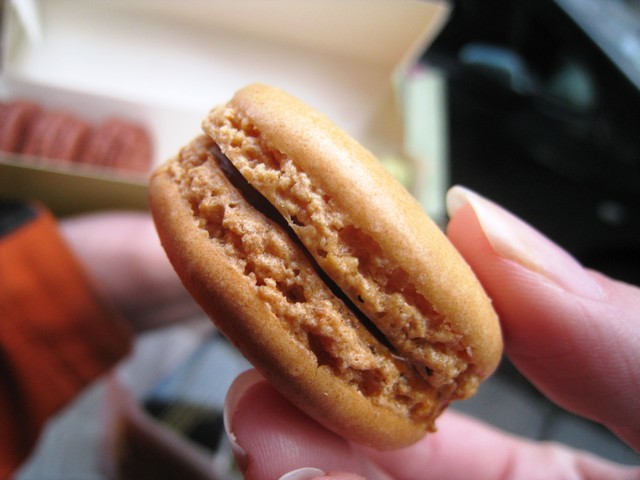
Salted caramel is such a delicious and unexpected flavor – and is one that lends itself very well to macarons! All 4 testers ranked salted caramel as the top flavor at both stores. While each was delicious. the key difference was between the fillings – Ladurée had a filling of actual milk caramel, while Pierre Hermé was filled with a salted caramel-flavored buttercream.
Verdict:
 Ladurée – the actual caramel made all of the difference.

RESULTS:
You can’t really go wrong with either choice. But we do have a winner. Overall, considering price, decor and overall taste, Ladurée was the champion. We can’t wait to go back!

19 Comments

Filed under Finer Things Club, World Eats

Pastéis de Nata

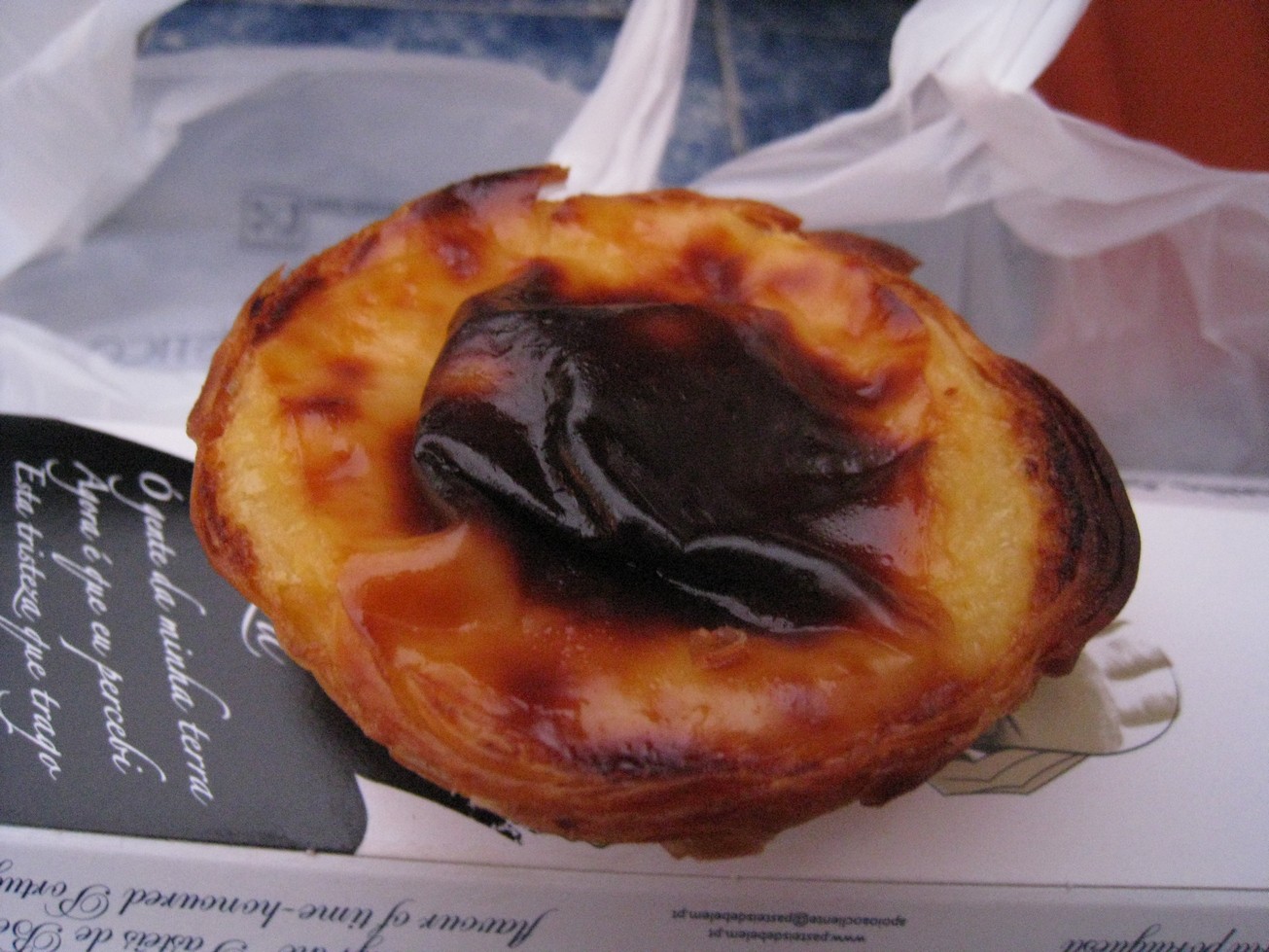
One of the most iconic treats in Portugal is the little Pastel de Nata (Plural Pastéis) – a custard tart similar to a creme brulee in a phyllo shell. But that’s too simple of a description – it really is a completely different thing! However, the same delicious effect of caramelized sugar is the same, as you can see below.

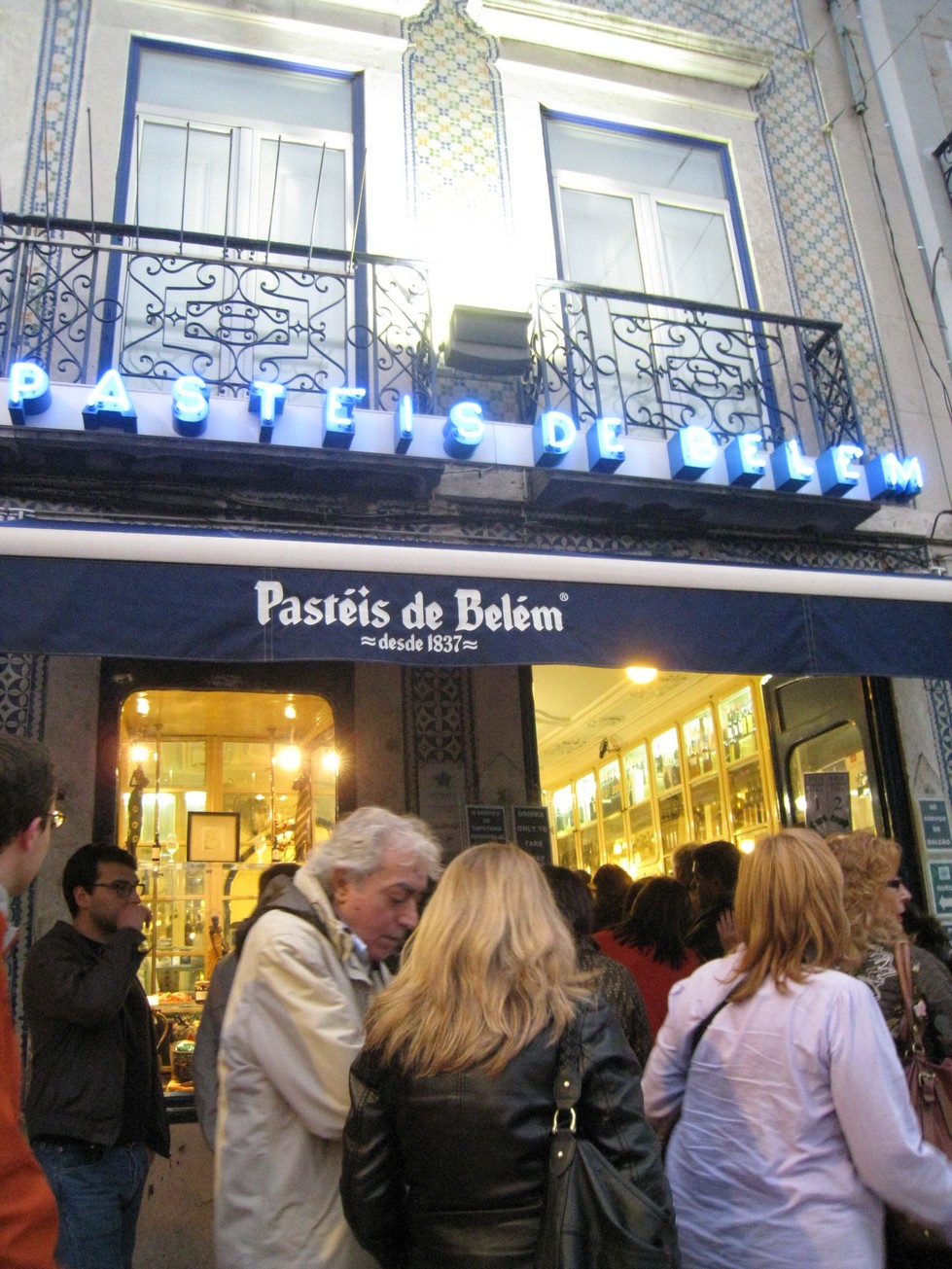
One of the best places to get Pastéis de Natal is at the obviously-named Pastéis de Belém (Rua de Belem, 84, Lisbon). This place is a pure madhouse, with a huge line going down the block at nearly all hours (it is open to 11 or 12 PM every day). Below is a picture of the scene when we arrived – and this is just to To-Go line. There is also inside seating, where you can get a full range of coffees with your Pastéis  but there was even a huge queue to get seated there. Each Pastel is 95 cents, but common orders in the To-Go line (which moved shockingly fast) seemed to be in multiples of 6 – since they make pre-packed boxes of 6 to go. Insider tip – we ordered 4 Pastéis – but they gave us a box of 6. We figured it would only have 4 inside – but it had 6! We don’t know if this was because they didn’t notice, or that turnover was so high and fast that they just didn’t care. Maybe it’ll work for you too! The 6 little 3″ tarts were surprisingly filling, and were fresh out of the oven.

It really is quite an operation, and we can’t even imagine how many Pastéis get made in a day. David Leite has an inside look at the operation, here. Turns out that The Pastéis de Belem are trademarked and are considered the original Pastéis de Nata (which is now used as a  more generic name for the Belem custard tart). Of course there are many other places in Lisbon to get Pastéis de Nata, one of the other most famous being the Confeiteria Nacional in the Baixa (Praça da Figueira 18B, Lisbon). But in truth, nearly every bakery in Lisbon has their own rendition, supermarkets too. There’s no way to get to Lisbon and not enjoy a pastel or two, or a dozen. You can try to make them at home, with some delicious but challenginglooking recipes. But in our experience home renditions of custard tarts are never the same!

5 Comments

Filed under World Eats

Hawaii: The mixed plate lunch

Mix Plate Lunch on Flickr

Hawaiian food is pretty much unknown in the Midwest – not much of a Hawaiian population I guess. The mixed plate lunch is a staple of Hawaiian cuisine. It usually consists of macaroni salad, scoops of white rice and an assorted meat primary dish – anything from BBQ pork to fresh fish. One of L’s favorite places to get an excellent mixed plate lunch is Aloha Mixed plate (1285 Front Street, Lahaina, HI), though there are many fine options. Anyone know of a mixed plate place in Chicago?

1 Comment

Filed under World Eats

50 Breakfasts from Around the world

When we traveled we were completely in love with all of the awesome breakfasts we had every day, so we were delighted to see this list of 50 representative breakfasts from around the world. Anything with coffee and some delicious carbs has my vote….

Leave a comment

Filed under Links, World Eats

Finding Turkish Helva in Chicago

One of the things that we most loved about Turkey were the extraordinary breakfasts we had everyday: yogurt with fresh honeycomb, fresh fruit, cheese and olives, Turkish pastries, the whole works. At one such breakfast we were also introduced to the enigmatic helva, a sweet treat made with sesame seed paste. I have a lot of trouble trying to describe helva since its texture is so unusual – it’s sugary and crumbly, but with the creaminess of peanut butter. The specific variety of helva we had in Istanbul was Tahin Helvası (as in tahini), and we enjoyed varieties with chocolate swirls and pistachio. Helva or helva-like products are widespread throughout the Mediterranean and the Middle East, but it was the first time we had ever tried any other nut butter candies like this. Fortunately, we found Turkish helva in a few middle eastern grocery stores in Chicago.

Where to get your Helva Fix in Chicago:

Pita Inn Market & Bakery (Next to Pita Inn Restaurant)
3924 Dempster
Skokie, IL

Middle East Bakery and Grocery
1512 W. Foster
Chicago, IL

Leave a comment

Filed under Quest, World Eats

Hong Kong: Eggettes

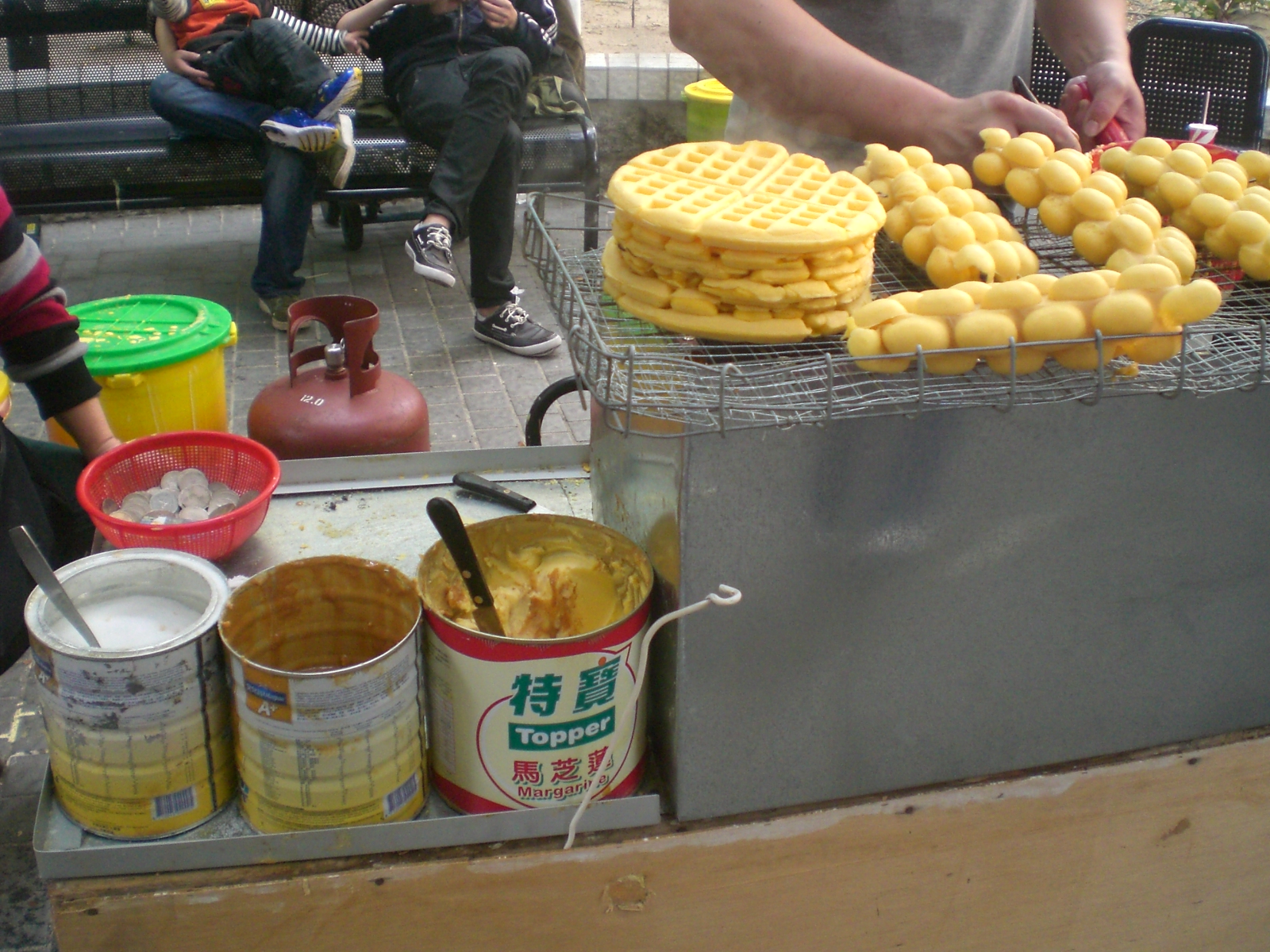
There is nothing we love more than a sweet, sugar carb-y item. Just when we think we have the market cornered we always seem to find a new global combination of flour, butter and sugar. Our latest surprise was the Hong Kong Eggette. Literally named, Eggettes are little bubbly waffles (naturally in the shape of eggs), cooked on a special iron. They are typically a street food in Hong Kong and other Cantonese-speaking areas like Macau. However, if you cannot make it to Hong Kong eggette loving home-cook can try their hand with an egg waffle pan.


Eggettes in Hong Kong

2 Comments

Filed under World Eats

Guyana: Tennis Rolls

Guyana is one of the countries whose cuisines has thus far eluded us. True, there are Guyanese resturants in NYC, but none in Chicago. So we have set out try to educate ourselves on some of the foods from Guyana. One of the most iconic treats form Guyana is the Tennis Roll, a sweet bread roll flavored with vanilla and orange. Notoriously hard to find a recipe for, I located one by Cynthia Nelson that approximates the goodness that is the tennis Roll. For more Guyanese recipes you can check out Guyana Outpost’s recipe section.

Leave a comment

Filed under Links, World Eats

All about Tiffins, the Indian Lunch Box

We love tiffin boxes. In Britain and India a “tiffin” refers to a light lunch or a snack. Today in Southern India, “tiffin” it refers mostly to smaller snacks like dosas or idli. Traditionally, tiffins were carried in tiffin boxes or dabbas, compartmentalized steel carriers that locked together. Today in Mumbai there is even a complicated system involving a delivery service of tiffin boxes from the homes of workers to their office.

Like bento boxes, Tiffins are an awesome way to pack an eco-friendly lunch. If you are in the market for a tiffin box, you can find some great styles online at Amazon, UncommonGoods and Design Within Reach. Happy Tiffin even has colorful models.

Leave a comment

Filed under World Eats

Cambodia: Eating Khmer Cuisine

Cambodian food is not a famous as the cuisine of its Vietnamese or Thai neighbors. Perhpas because Cambodian food is a bit homier and simpler, definitely quieter than its flashier, spicier neighbors. However, when we were in Cambodia we never had a bad meal – we definitely had a few wonderful meals. Between the fresh-baked baguette and the fresh papaya salad, we found that Khmer cuisine could be just as delicious as Thai food.

A Fresh Lunch near Angkor Wat

We ate most nights at the simple restaurant connected to our hotel, and in the day at stalls in and around town. We truthfully never had a bad meal, and appreciated the Khmer attention to how all components combined to make the complete dish. One of our favorite dishes was Lok Lak, a dish of beef cubes cooked in butter (French influenced) and served with a citrus sauce. We also grew to appreciate the green papaya salad, which was extremely refreshing in the heat. Another key to our meals were the amazing assortment of fruits: Lychees, starfruits, mangosteens and the like.

In this interesting blog post by Phonomenon, reasons why many travelers don’t appreciate Khmer food are explored. One common pitfall is not enjoying the different elements of the meal as they come together as a whole. The harmony of the different components of Khmer cuisine was definitely something that stood out to us.

Leave a comment

Filed under World Eats

Cuisine in Pre-Tomato Italy

Though Italian food may now be known for its abundant use of tomatoes, this was not always the case, and pre-Tomato italian food was very different. Tomatoes were introduced to Italy in only the 18th century, having originated in South America.  Gapers Block has an example of food representative of pre-Tomato Italy: Genovese Onion Sauce.

Leave a comment

Filed under Links, World Eats