[Via MetaFilter] I recently learned that the huge Japanese user-contributed recipe site Cookpad, which has over 20 million users and 1.5 million recipes, now has an English version. Cookpad seems similar to Food.com, and you can browse recipes by category or ingredient. Over 1,500 recipes have been translated into English so far, with more planned (the translations are not by a machine, though there are a few errors anyway). There are a ton of cool-looking recipes including Taro Root Croquettes, Somen noodles, Udon with Yuzu and Tofu with dashi sauce. Any fans of Japanese food should definitely explore. Did you find any favorite recipes?
Japanese recipe site Cookpad, now in English
A Visit to Parson’s Chicken and Fish
Parson’s Chicken and Fish
2952 W. Armitage
Chicago, IL
Being out of the country off and on for nearly 2 years, we tend to be pretty far behind most food trends in Chicago. By the time we go to a restaurant, it has already been written up by everyone and their cousin. However, for once we are able to get somewhere before it has totally fallen off the radar. We had the fortune of visiting one of the hot spots of the summer (complete with outdoor patio): Parson’s Chicken and Fish. We arrived at Parson’s with two of our friends on a Thursday night, which we figured would be a slightly off hour. Fortunately we were right, and were able to get a table for 4 outdoors nearly right away.

The atmospheric outdoor setting is a large part of Parson’s appeal. The restaurant itself was a former fast food joint, and only has a few booths. However, the outdoor area in back of the restaurant is pretty huge, and consists of semi-shared picnic tables with striped umbrellas, an open air bar, and whimsical strings of Christmas lights everywhere. The atmosphere is convivial, and there is even a ping pong table to keep you occupied if you wait (which you may have to on most nice nights).

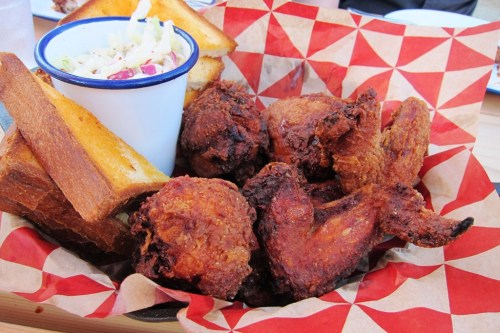
The menu itself is pretty focused, and consists mainly of Southern American classics, especially chicken and fish, as the name would imply. The fried chicken is billed as “Amish” and you can get it grilled or fried (of course we chose fried). The fried chicken, which we figured would be the showpiece of the restaurant, was in fact extremely delicious. The chicken had a savory, crispy cornmeal breading, and was fried to perfection, with a piping hot exterior and juicy interior. We ordered a bucket of chicken for the entire table to share ($24 for the bucket and toast), along with a helping of Texas toast (perhaps our eyes were bigger than our stomachs). The bucket contained about 12 pieces of chicken, and the chicken breasts were cut in half for easier eating – though they were somewhat difficult to identify.
We also ordered a basket of fried fish ($16 for 6), which we agreed was somewhat less successful than the fried chicken, and was pretty greasy. We also enjoyed the sides: hush puppies ($4) and ceviche ($10). The ceviche was Mexican style – with a tomato-y sauce – it was good but a somewhat small portion. The hush puppies were heartily enjoyed by all – they were particularly light and fluffy – also full of bacon pieces. We finished up our hearty country picnic with a slice of lemon curd and blueberry pie from the inimitable Bang Bang Pie Shop (the pie changes regularly), which was particularly excellent. With pie like that, we hope to visit the pie shop itself soon. Parson’s Chicken and Fish is a great place for a tasty meal on a nice day, and a large part of the charming experience is being outside. Better get there before fall!

Filed under Reviews
Blu di Bufala Cheese at Purple Pig
Purple Pig in Chicago (500 N. Michigan Ave, Chicago, IL) is one of our favorite places to get cheese or charcuterie, that is, if you are able to get a table at this tiny no-reservations spot (don’t count on it). Purple Pig has an extensive selection of well-curated cheeses from all over the world. Some on the list we had previously tried (Fontina, Lincoln Log and Robiola), while others were new to us (Quadrello, Iborez, St. Agur). You can make your own cheese plate for $7 per cheese, 3 for $19, or 5 for $32. One now-favorites we first encountered on the Purple Pig cheese list was Blu di Bufala. The name will likely give you a clue to its contents: a blue cheese made with buffalo milk.

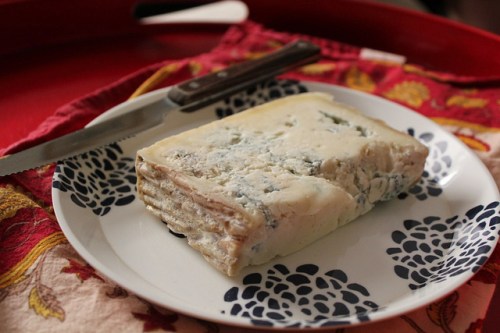
Blu di Bufala by Madame Fromage
Now we are practically obsessed with Mozzarella di Bufala, so we figured we would love this variety, and we were right. There was a strong blue flavor, but the cheese itself was extremely creamy – almost buttery – and it wasn’t overpowering at all. Blu di Bufala hails from Bergamo, Lombardy in northern Italy, and is made by Caseificio Quattro Portoni. This cheese was first made by the Gritti brothers who run Caseificio Quattro Portoni, in 2005, and it has already taken second place in the World Cheese Awards (yes, this is a real thing). Today the brothers manage a herd of 1,000 Water Buffalo to make the cheese. You can buy Blu di Bufala in cheese stores throughout the US, and online. If you can get your hands on some, Blu di Bufala is great for snacking, and for the ambitious, DiBruno Bros. has a creative recipe for a dessert grilled cheese with Blu di Bufala on chocolate cherry bread.
Filed under Cheese
Coffee Culture in Norway
One half of the ETW team is crazy about coffee. However, we were both surprised to learn about the corner of the world where coffee reigns supreme: Scandinavia. Honestly, when we first think of coffee, our mind goes to Italy (Bialetti, Cappuccino, etc), but per capita, Scandinavians consume more coffee than any other countries (think of the Swedish tradition of Fika). It turns out that Finland is the number one consumer of coffee per year at 12 Kg, followed by Norway and Iceland at over 9 KG apiece. Norway in particular is known for its particularly fastidious coffee culture, and Norwegians often win the World Barista Championships.

Fuglen Cafe in Oslo by Nicholas Lundgaard
So how is Norwegian coffee different? Norwegians tend to like their coffee black (called sort kaffe in Norwegian), prepared one cup at a time. The roasting is also different in Norway, and is particularly light, imparting an almost fruity flavor in the coffee. World Barista champion Tim Wendelboe discusses some of his tips for brewing a good Norwegian cup of coffee here, with emphasis on every step of the process. The Dear Coffee I Love You blog took a coffee-tasting tour of Oslo, and found a wealth of cafes serving amazing coffee, including Wendelboe’s cafe. Obviously, the Norwegian coffee scene is thriving, and you can keep up with the latest updates on the Nordic Coffee Culture Blog. The particular Norwegian way of making coffee has even reached Tokyo, with the opening of furniture/coffee shop Fuglen.
Filed under Coffee, World Eats
Globally-Inspired Iced Tea for Summer
Nothing is more refreshing on a hot summer day than iced tea. Tea (in its many forms) is one of the most universal drinks, whether in hot or iced form, so why not give the Snapple and Lipton a rest and try something new? Even though the end of summer is sadly approaching, there are still plenty of hot days to enjoy some cool drinks (preferably on a balcony or beach).
- Morocco: Bellocq’s Iced Majorelle Mint with Muddled Ginger
- Mexico: Cold Brewed Jamaica (Hibiscus Iced Tea)
- India: Chai Iced Tea
- South Africa: Spicy Rooibos Apple Iced Tea
- Taiwan: DiY Bubble Tea
- Thailand: Thai Iced Tea
- Southern US: Southern Sweet Tea
Asitane: Eating your way through Turkish history
Asitane
Kariye Camii Sokak No: 6
34240 Edirnekapi
Istanbul – Turkey
Every once in a while a restaurant comes along that has a concept so intriguing, you have to try it. Asitane has come up with such a concept: using authentic, historical Turkish dishes spanning nearly 1000 years. Each dish has either been re-created from original Ottoman menus, or re-created from descriptions of dishes served at the time. Each dish on the extensive menu is given a date, which may seem gimmicky at first, but really works. The setting of Asitane is quaint and beautiful, and is located on the ground floor of a renovated old building. We were lucky enough to arrive on a pleasant day, so we decided to eat outdoors, though there is also extensive indoor seating.
To start with, we got a sampler plate, which like all of the other items on the menu, was very reasonably priced. We were surprised that it was such a good deal for such a fine dining experience. The sampler plate included four dips (20 Turkish Lira, about $10): Ottoman Hums (1469/1471), Lor Cheese Blend (1898), Fava (no date on this), and a pounded cucumber salad (1844). The Hums was what we might consider hummus, with currants and pine nuts, the Lor was a spreadable mild cheese (much like ricotta) mixed with rosemary, peppers and tomatoes, and the fava bean dip was seasoned with dill. We also received a basket of bread to sop everything up.

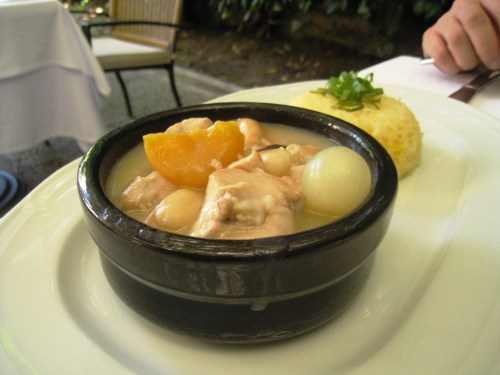
We then tried what was perhaps our favorite dish of the day: ‘Toyga Aşı’ Summer Soup with Yogurt (14th century). The soup was served cool, with mint and olive oil drizzled on top. It was phenomenal! For an entree we chose “Mahmudiyye” with Dane-i Sarı (1539), stewed chicken with cinnamon, cloves and apricots garnished with Rezaki raisins and almonds. The dish was extremely flavorful, with a pleasing sweet taste that went with the saffron pilaf accompaniment.

We highly enjoyed our meal at Asitane, adding even more to our opinion that Turkey has amazing food. To top it off, the setting was lovely, the service was pleasant and the price was extremely reasonable. We also forgot to mention that in addition to your server you will be attended to by the restaurant cat (see below) who likes to visit. To top it off, Asitane is right next to one of the major sights in Istanbul, the Chora Church (Kariye Kilisesi), even though it is a little bit outside of the historical center. If you visit Asitane you are sure to have an extremely unique dining experience you can not get anywhere else (unless you are a time traveler, of course).

Filed under Reviews
Jean-François Mallet’s “Take Away”: Global street food photography
French photographer Jean-François Mallet has a lovely (somewhat) new book called “Take Away” which is an amazing chronicle of street food sellers and customers from all over the world. We were intrigued by his pictures of both familiar and new takes on street food. You can check out some more of Mallet’s food and travel photography on his portfolio site.

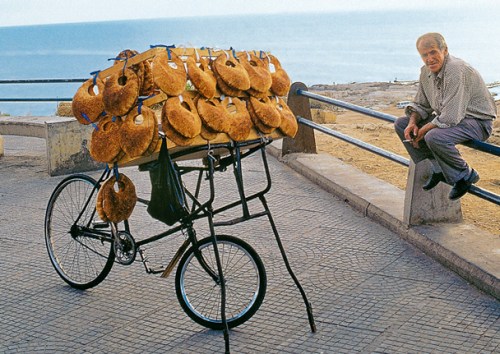
A mobile bread vendor in Beirut, Lebanon by Jean-François Mallet
Filed under Design and Photography, Links
Braai, National BBQ Pastime of South Africa
Though in the United States BBQ may seem as American apple pie, it has a special place in the national consciousness of many countries, none more so than in South Africa. Braai (rhymes with “cry”) literally means “barbecue” or “grill” in Afrikaans, and is a venerable tradition among all South Africans. South Africa even has a national Braai Day, September 24th of every year. While braai refers to the grill, which is almost always wood or charcoal (sorry, no propane here!), it also refers to the event itself, much like barbecue does in the US. A real braai typically includes a heap of meat, a wood grill, icy cold beverage and large group of friends. For the newbie, here’s some braai advice from the king of Braai in South Africa.

Boerewors on the Braai by André van Rooyen
So what do you bring to a braai? The answer is, predictably: it depends, but it seems like nearly anything goes. Though you may grill anything from kebabs to chicken, steaks, fish (in coastal areas); something quintessentially South African is boerewors. Boerewors are a type of spiced beef (sometimes mixed with pork) sausage that is native to South Africa, and is typically found in a coil formation, as seen above. If you find yourself in Wisconsin on Braai Day you can even find South African-style Boerwoers in Milwaukee! Or for the intrepid, make your own boerewors from scratch.

Sosaties on the Braai by MacDara Conroy
Never fear though, even if you don’t have boerewors, you can still have a perfectly respectable braai. Sosaties, or grilled kebabs, usually made with lamb, are a favorite choice for a braai. Another classic non-meat braai dish is pap, a sort of South African polenta made with cornmeal. Yuppiechef has a nice version of Stywe pap with a tomato relish. For more inspiration, Cook Sister has a great description of Braai culture, as well as a great roundup of recipes, both classic and modern. Summer is still going strong, and we are looking forward to adding some Braai flavor to our next barbecue.
Filed under BBQ Tour, World Eats
Carolina Ribs at 12 Bones Smokehouse
12 Bones
5 Riverside Drive
Asheville, NC
Once, M didn’t like BBQ ribs. Too many experiences with gristly, fatty, underwhelming spares and baby backs had led him to a life filled with pulled pork and brisket. Not that he was complaining – these are meals for the gods. But on a drive through Asheville, we decided to give ribs one more chance, at a widely praised smokehouse by the Asheville riverfront. A long story short: M likes ribs now. Loves ribs. Craves them. A slab of six ribs at 12 Bones (and nothing else, mind you) single-handedly changed his barbecue life.
Like any good rib place, 12 Bones does not give you much time: open only 11-4 on weekdays (or until the food runs out, whichever is first), by the time we arrived at 10:30 there was already a line. We were lucky to be early: there were multiple rub glazes to pick, and at the last minute, knowing the ribs were famous, M decided to opt for a standard 6-bones rack of brown sugar glaze. Among other potential choices was pineapple habanero, but we felt that could have been getting a little too playful if we wanted to get something traditional for our first time.
There is something primordial about a rack of ribs that come out on an aluminum plate. No sides, no nothing else. And they did not need anything: the rack of ribs in the background of this photo were easily the best we have ever had – just amazing. Perfectly smoked, all the fat had melted away, leaving behind perfectly tender, well-seasoned, and artfully glazed rack of certified culinary cavemanliness. Extra points for the fun outdoor seating area! Meanwhile, as M was salivating over his rib plate, L was busy on her usual: pulled pork. It was good, but not memorable in comparison to the ribs. A solid, light smoke flavor with a sweet North Carolina vinegar sauce made for a worthy contribution to our meal. Between us, we split cornbread, macaroni and cheese, and cucumber salad as sides. But again, the star here is the ribs: if you have a chance to stop in Asheville, definitely pay a visit to 12 Bones.
A side note: while in Asheville, be sure to check out the city’s riverfront arts and antiques district! There is something about BBQ in North Carolina that attracts it to art. Where else can you find an 1960s Illinois Democratic Party pin for a dollar?
Discovering Chester’s BBQ in Champaign, IL
Chester’s BBQ
302 S. Neil St. (In the parking lot of Tumble Inn)
Champaign, IL
Thursdays and Fridays only 5PM to close
We were jonesing for some BBQ while heading out of Champaign, IL. We didn’t want to have a sit-down meal at Urbana’s well-known Black Dog BBQ (which we have visited previously, and highly enjoyed); but we also weren’t willing to wait until we got back to Chicago (2.5 hours later) to eat at Smoque. In downtown Champaign, we drove past a trailer in the parking lot of the Tumble Inn bar with a hand-painted sign that said “Chester’s BBQ.” We figured we had to try it.

Chester’s sign beckoned us in
We were disappointed at first, the trailer appeared to be open but empty, and me, with my official BBQ shirt on, had to wait around until the owner returned to the truck in 15 minutes. We used the time to settle on a menu selection: an order of the “Award-Winning Pulled Pork” and a side of what was called “Broccoli Slaw.” (total of $8 – a free side was included). The slaw was a mix of broccoli florettes, bacon, feta, cranberries, tossed in honey vinaigrette dressing. It definitely was an unorthodox side, but if you’d prefer there is also some classic slaw and potato salad.

The Menu at Chester’s
When the owner returned – we quickly ordered two pulled-pork sammies. The pulled pork was excellent. The smoke flavor was well-cultivated, and the meat stood very well on its own without any of the sauce (which you add yourself). We devoured it – flavorful, smoky, and addictive, on a bun that was so unnecessary we just used it to dip in the sauce. They change their sauce every week, and there are three levels of heat (mild, medium and hot). We went with the hot sauce, which had a little kick, but not too much; this week a fruity North Carolina style sauce with tomato and vinegar.

Chester’s Pulled Pork sandwich and Broccoli slaw
Chester’s is a competition BBQ truck, and for now is only parked at the Tumble Inn after 5 PM on Fridays and Saturdays, but it’s definitely worth the wait. Chester’s was just as good, if not better, than Black Dog – we hope they can expand their operation in Chambana, because the area could always use another great BBQ option. Chester’s is a great hidden spot we hope won’t stay hidden for long.

Chester’s Pulled Pork sandwich – ready for a closeup
Filed under Reviews
South Carolina Barbecue at Melvin’s in Mount Pleasant
Melvin’s
925 Houston Northcutt Blvd.
Mount Pleasant, SC 29464
Every year or two we take a family trip to Charleston, South Carolina, and one of our chief goals is to eat as much Barbecue as humanly possible. This year our trip was curtailed due to graduation, but we still managed to get a little BBQ in during our short stay. Sadly, we were unable to make it out to Sweatman’s in distant Holly Hill, one of our favorite ‘Que places in the world. However, we found some BBQ joints closer to where we were staying, including Melvin’s. Melvin’s is part of South Carolina barbecue royalty, the Bessigner family, which has been running restaurants in the area for the better part of the century. We felt we had been spoiled by Sweatman’s amazing Mustard sauce, though we hear they have changed owners since our last visit.

Don’t let the location of Melvin’s in the outlot of a stripmall deter you. The restaurant may look a little too new, and perhaps even touristy, but the turnover is high meaning fresh food, and the smoker is legit. The menu at Melvin’s is surprisingly extensive, with chicken, pulled pork, brisket and pork ribs, sandwiches, platters and even burgers. The specialties are ribs and chicken, but we had to order our old standby, a pulled pork platter (which happened to be on special that day). We also tried some of the ribs and chicken ordered by the rest of the family, which are the restaurant’s specialties.

We judge pulled pork on how soon we reach for the sauce after sampling the meat. Good pulled pork should be able to stand on its own, without being doused in sauce. We thought the pulled pork at Melvin’s was excellent – it had tender meat, good moisture, but not too fatty, and a pleasant smoke flavor. The meat itself does not come with sauce – it is provided on the table – you have a choice of iconic South Carolina mustard sauce or a sweeter tomato-based vinegar sauce. We tried a little of each, but we had to go with the signature mustard sauce. However, we pretty much sopped up everything with the delicious golden mustard sauce which was the perfect mix of tangy, spicy and sweet.

There was a wide array of side dishes but we went with our favorites again: macaroni and cheese and corn bread. Sadly, the mac and cheese was very disappointing: a complete mush with very little cheese. The cornbread fared better on our rating scale, but the Que was definitely the star. The ribs we sampled were also very tasty, if a little dry, we preferred the pulled pork. Our drink of choice, was of course, sweet tea, though we also ordered an unconventional-for-a-barbecue-place Oreo milkshake ($3.99 for a large). And as always, we had to splurge for some banana pudding for dessert! We were also pleasantly surprised that all of the sauces were for sale at surprisingly cheap prices, so we bought some mustard-based sauce to take home. Overall, Melvin’s is a great go-to South Carolina BBQ spot with some excellent mustard sauce in a convenient location. We still miss Sweatman’s but it helped ease the pain a little.
Filed under BBQ Tour
Happy Barbecue Week at ETW!
At home and abroad, finding great barbecue is one of our true passions. Cooking meats low and slow over a flame with various seasonings is a worldwide tradition, and we are excited to celebrate it this week as we highlight some of our favorite barbecue food finds from both the US and around the world. We recently picked up a new cookbook/guide, Big Bob Gibson’s BBQ Book, which has really made us hungry to try some more recipes in our own kitchen (no smoker yet, sadly). The book by Chris Lilly (pitmaster at the Big Bob Gibson Bar-B-Q in Decatur, Alabama) is one of the coolest, most informative books we’ve read in a while. If you’re interested in learning the techniques of US BBQ, we highly recommend it. Of course, in the US, BBQ certainly doesn’t mean one single thing, and every region has their own unique take. Check out this infographic for a cheat sheet to the major BBQ regions, and get ready for ETW BBQ week.

International Street Food Menu at Chicago’s iNG
One of our favorite dining experiences in the US was the Thai menu at Next, which was heavily influenced by the country’s superb street food. We recently learned of the new menu at Homaro Cantu’s restaurant iNG (951 W Fulton Market), which is a mash-up of elevated global street foods. The 8-course menu ($105) includes street food favorites like falafel, Korean BBQ, Tacos, Sno-Cones, and more. You can check out the complete menu on iNG’s website [pdf]. None of the interpretations are literal – check out this deconstructed riff on falafel – with pureed eggplant, Ethiopian Awaze, and a yogurt mint sauce. It’s only open for two months – so check it out soon!
Filed under A New Place, Links
Splurge: Jamón Ibérico de Bellota at the Mercado San Miguel, Madrid
M arrived at the Mercado de San Miguel with a single goal: eat jamón ibérico de bellota. “Iberian Acorn Ham” is the name given to the finest quality Spanish jamón, a fiercely protected product produced through a painstaking process. Black Iberian pigs, living in southern and southwest Spain close to the Portuguese border, freely roam oak groves consuming little besides acorns. Their hams are left to dry for weeks, and cured for another twelve months or more. The result is what is universally considered the finest jamón on the peninsula, if not the planet. The price definitely matches the quality – but it is worth it.
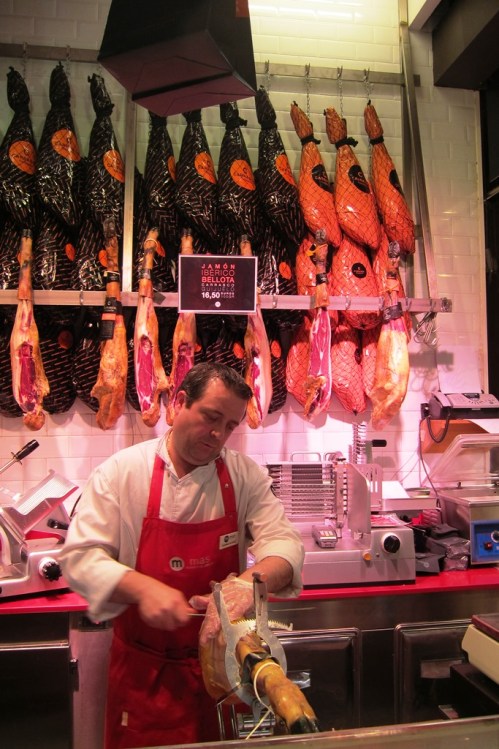
At the Mercado de San Miguel, most patrons get their jamón from a stall featuring Carrasco Guijuelo. The company was founded 120 years ago by the Carrasco family in the tiny town of Guijuelo (Salamanca province, on the border with Portugal). Now a protected designation of origin product, Carrasco Guijuelo now enjoys a major share of the Spanish domestic market, as well as running an enviable export business (but we all know the keep the good stuff). They also produce a lot of other food products.
While the standard jamón is a big seller, I splurged and got the 50 grams of the finest-quality Reserva, priced at 18.5 euros for 100 grams – or $111.13 per pound. The eight slices in this photograph – my total order – were priced at 9.25 euros (although, full disclosure, they accidentally charged me the price for the standard, at 16.5 euros/kilo. I did not correct the error).

We write many words on this blog, but there are simply none that can effectively describe the taste of a perfectly prepared and cured jamón ibérico. The ham is so finely cured that it when sliced, it looks like a wax copy of an actual ham, each slice retaining a light sheen that catches the light of the room. The sheen may is from the fat, which while visually obvious, may as well not exist when eaten. The fat all but liquefies on your tongue, melding with the muscle and acorns in a salty/sweet/nutty flavor profile that is subtle yet precise. Jamón ibérico de bellota is a food that, while you eat it, composes a most beautiful poem about its own taste, and you are more than willing to sit there and have that poem read to you over and over again. By the time I was done, I was ready to pull another ten euros out of my pocket for another 50 grams. If you ever have the chance to get some, don’t pass it up.
Filed under Finer Things Club, Reviews, World Eats
International Chef Summit in NYC
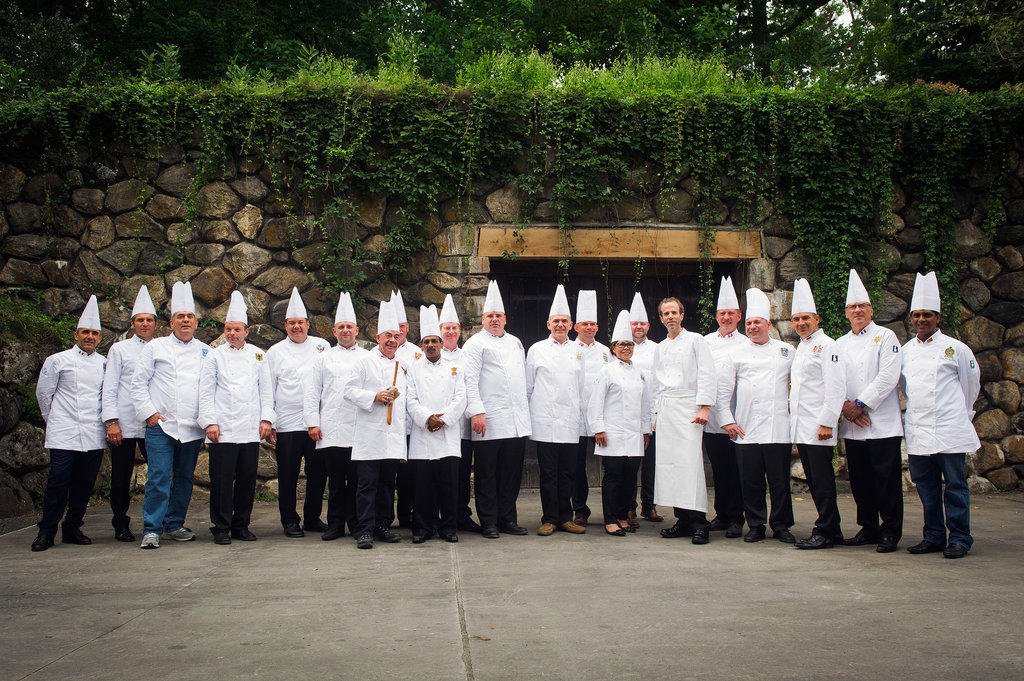
It’s like the UN of food – well, not exactly, but close. This past week there was a meeting of the chefs of the head of state (Called the Club des Chefs des Chefs) of 20 countries, including France, India, Poland, Thailand, Germany, and the US, among others. The New York Times covered the 2013 event, which happens yearly (since 1977). The chefs cooked emblematic dishes from their nations and sought to bring “diplomacy through gastronomy.” We’ll drink to that.
Filed under Links
Delicious, Unique Tacos in Wicker Park: Antique Taco
Antique Taco
1360 N. Milwaukee Ave.
Chicago, IL
The thing we miss most when abroad is Mexican food, so we feel lucky to have so many options practically in our backyard. We tend to enjoy hole-in-the wall spots so we decided to get out of our comfort zone and try one of the newer, more trendy taco places that were getting rave reviews. Fortunately, we found that Antique Taco lived up to the hype. When you first step into Antique Taco, you immediately understand where it gets its name – the entire restaurant is full of antique tchotchkes, baskets as light fixtures and reclaimed woods, which makes it immediately appealing.

The menu at Antique Taco is small and rotating. On the day we visited there were six varieties of taco, including one vegetarian option. We ordered the market mushroom taco, with pepitas, guajillo cream, arugula and radish; the pork carnitas with bacon, spinach and avocado; and the garlic shrimp with corn salsa, avocado and onion. The prices, at $7 and $8 per taco basket, which includes 2 tacos, are certainly higher than many other taco joints. But don’t let that put you off, you definitely get what you pay for.

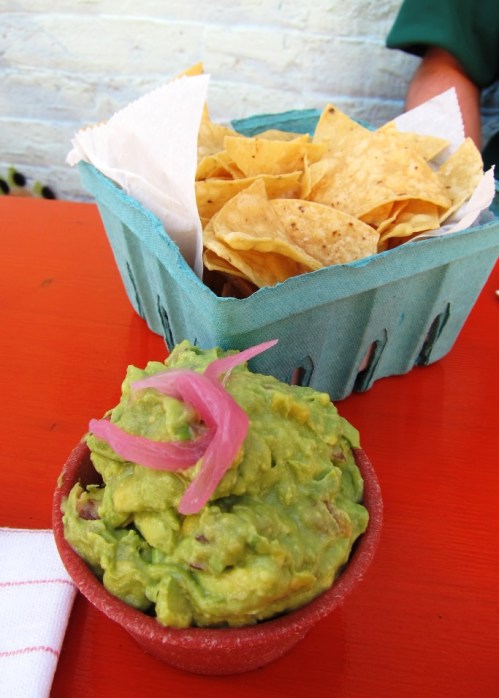
There is indoor and outdoor seating, and since it was nice we decided to grab a picnic table. We also ordered a basket of chips and guacamole ($7) while we were waiting, which came out instantly, and was immediately gobbled up. The tacos came out fairly quickly after the guac. Everything that arrived at the table was fresh and clearly homemade. In all of the tacos, the ingredients really worked together, and none of the toppings were out of place. The pork carnitas had a hint of sweetness from the tamarind glaze and seemed more akin to BBQ than real carnitas, which was still delicious. The garlic shrimp were perfectly complemented by the corn salsa, and the mushroom taco was pleasingly meaty. Only one drawback, some of the filling portions were a little inconsistent, the shrimp was a little skimpy, while there was a ton of pork shoulder.

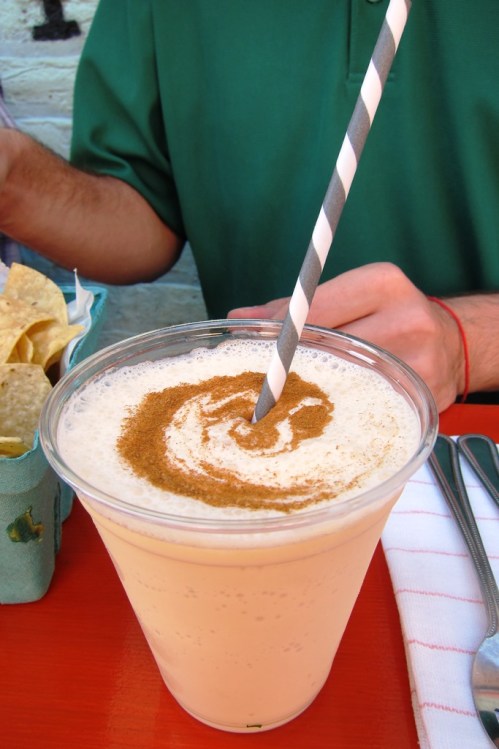
M also ordered the horchata milkshake ($4), a riff on the classic Mexican drink with rice, cinnamon and almond, which was delicious (and gave us a good idea for a paleta). Though it is not a fancy restaurant, Antique Taco stands out for doing little touches right: the combinations are unique, the drinks come with retro striped paper straws and each taco plate has a little wooden pick with the variety printed on it. We definitely appreciated this attention to detail. We will definitely be back, hopefully sitting at the picnic tables.

Filed under Reviews
The story behind Madison favorite, Stella’s Spicy Cheese Bread
We absolutely love the Dane County Farmer’s Market in Madison. It is gigantic, and you can get pretty much any type of produce or baked good there. However, we are creatures of habit, and we make a fairly predictable round of purchases (Hook’s Cheddar, Heirloom Tomatoes, Cilantro, possibly honey, and a few others). One of things we have to get every time we visit is Stella’s hot and spicy cheese bread (which is as awesome as it sounds), and we know many others who feel the same. However, we never really knew the backstory behind the bread. WXOW has the inside scoop, and you may be surprised to learn its origins are actually related to tamale production. You can find the bread in other locations around town, but getting it at the farmer’s market is the best since it is delivered fresh and hot several times throughout the day. If you are far from Madison and craving some cheese bread, Stella’s ships. Or for the more ambitious, Badgerlicious has a DiY recipe.

Stella’s Spicy Cheese Bread Stall & Crowd by Adam Fagen
La Mi Venta, Excellent Tapas in Madrid
La Mi Venta
Plaza de la Marina Española, 7
28013 Madrid, Spain

On our short trip to Madrid we wanted to cram in as much food fun as possible. We had previously experienced the frenetic market scene of San Miguel, and we wanted to take things a little slower for our second foray into Madrid tapas. Spaniards do not eat dinner until 9-10 PM at the earliest, so tapas serves as a kind of happy hour snack, where you can drink, have some munchies and meet with friends. However, Americans tend to buck this tradition and make tapas more of a meal. Alas, so did we, as we found ourselves famished at the odd-for-any-nation hour of 3 PM. In Spain lunch may even run as late as 2:30 or so, so I guess we fell into the late lunch crowd rather than the geriatric early-bird crowd.

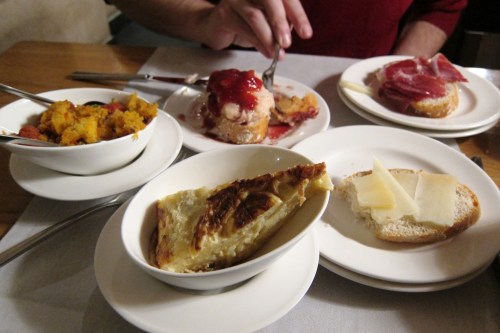
The specialty at Li Mi Venta is tapas (along with a limited selection of main courses). The tiny restaurant consists of a bar and a back room with a few tall tables. You could get most of the offerings in a large portion or as a tapa – so depending on how hungry you are you can either try many different little plates or stock up on a favorite. We decided to go with a variety of meat and vegetables. And of course M could not resist getting his hands on some more rare and delicious Jamon Iberico. As another meat dish we sampled was spicy chorizo “from hell” (how could we skip it), and migas, one of the more unusual offerings, a composed plate of fried breadcrumbs, peppers and chorizo. We were shocked by the reasonable prices – everything was under 3 euros.

La Mi Venta Tapas: (clockwise) Migas, Tuna, Jamon, Manchego and Tortilla.
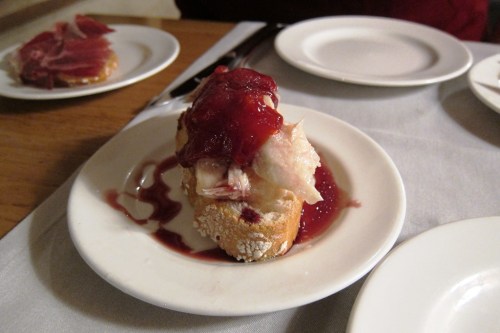
However, not all of our selections were so carnivorous. We also ordered the manchego cheese, which was excellent (but not as good as in the market). M’s favorite selection was the Tuna bocadillo with tomato confit, a delicate combination that really worked well. L also enjoyed the Spanish Tortilla (potato omelette), and could have gone for another slice or two. To finish our tapas “meal” off we decided to end on a paradoxically healthy note: Salted tomatoes in olive oil (8€). Such a simple dish – but it was extremely tasty and refreshing. The portion was also extremely generous, justifying the higher price.

M’s Favorite – Tuna and Tomato Confit.
In addition to tapas, there was a nice selection of teas and coffees that came served in little silver pots. They also had free wifi, though that seemed a little incongruous with the other offerings. We also appreciated the friendly and attentive waitstaff and the pleasant ambiance. It’s almost as if you are eating in a private wine cave – it would definitely be a great place to have a small party (maybe someday). La Mi Venta was a welcoming place with a great selection of fresh, well-prepared tapas. For less than 30 euros we were full for the entire day!

A giant plate of tomatoes – simple but delicious.
Traditional Spanish pastries at La Mallorquina in Madrid
La Mallorquina
Calle Mayor, 2
Madrid, Spain
A seemingly endless window display of beautiful pastries, cakes and candies first entices you in to La Mallorquina. Taking the opportunity to have a weekend brunch and try some new-to-us pastries in the process, we quickly entered. The bakery was packed to the gills, it looked like half of Madrid had the same idea for brunch! La Mallorquina’s bottom floor is a traditional bakery, with stand-up counters where patrons quickly enjoy coffee and a sweet. The full tea room is located upstairs with tile floors and wooden tables. “La Mallorquina” means the little woman from Mallorca, and is also the same name of a famous old cafe in Puerto Rico (no relation). The Madrid cafe was established in 1894, and looks like it hasn’t stopped churning out treats since.

La Mallorquina had a huge selection of baked goods, cakes, sandwiches and coffee drinks, and you can order anything in the tea room that is in the front counter. The selection was nearly overwhelming, but we went in with a few recommendations (the chocolate napolitana is a specialty, as are the rosquilla rolls). We were interested to see some of our favorite treats that are popular in Puerto Rico: mallorca and ensaimada. We went to the bakery around Christmas time, so Christmas favorites like Turron were also on offer.
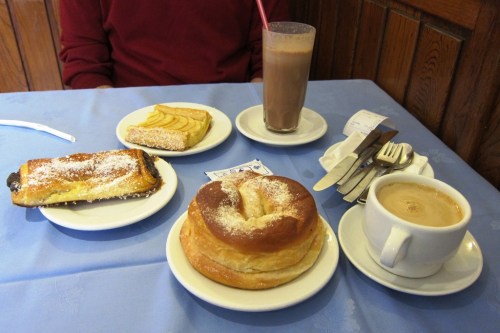
We made our way up to the tea room and were lucky enough to find a spot. We picked an apple tart, a Napolitana and ensaimada. The ensaimada is a rich brioche roll, which was perfect with butter and the apple tart was fresh and had a sweet glaze. However, the chocolate Napolitana was definitely the star of the show, think a rich croissant filled with chocolate custard. Of course, to complement our brunch we had a cappuccino and some chocolate milk (we also hear the orange juice is excellent). Given the sheer variety, there were so many selections we wish we could have tried. The torrija, a Spanish take on french toast looks amazing. If you are looking for a classic Spanish pastry experience, this is definitely the place. Just be prepared for a crowd!

Filed under Pastry Post-Poc, Reviews
A Photo Tour of the Mercado de San Miguel
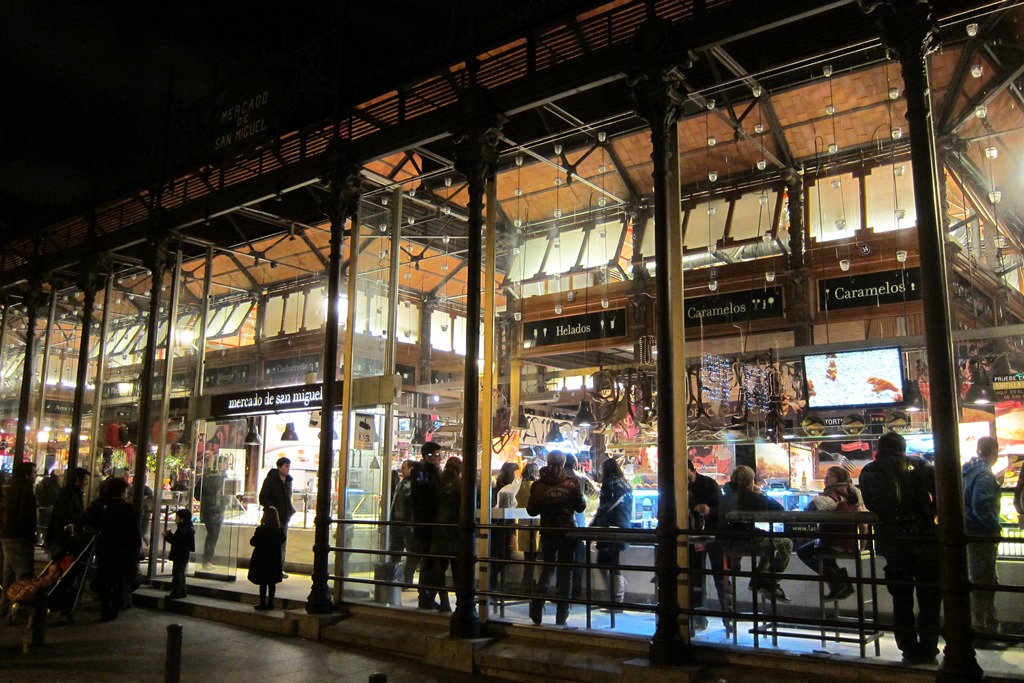
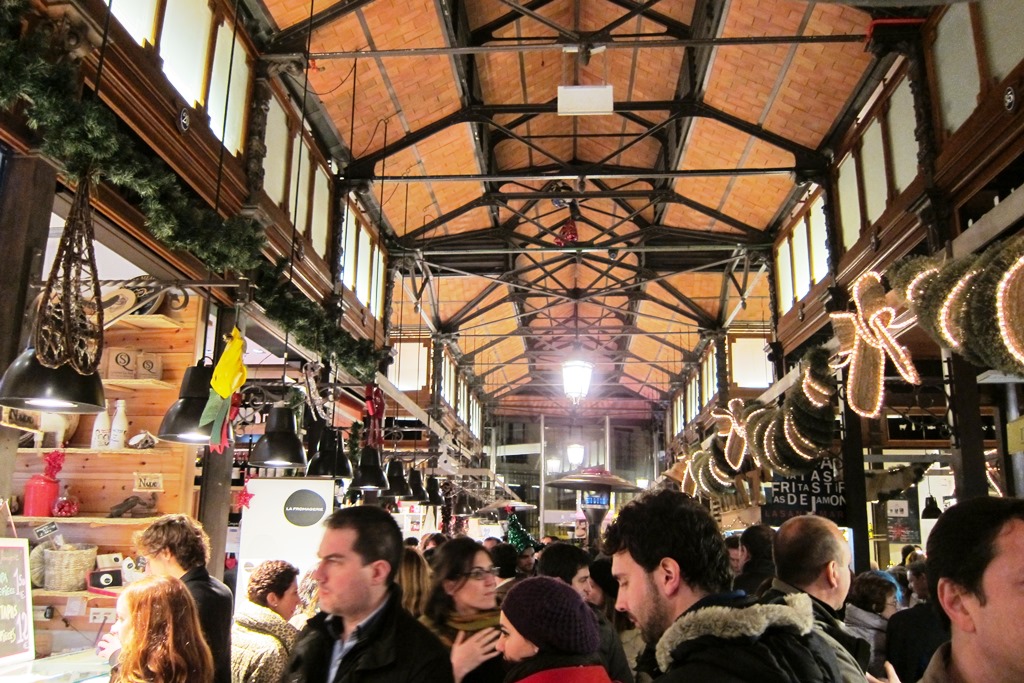
We love visiting markets while traveling, and making a little picnic out of the local meats, cheese and fruits. One of our recent favorites is the Mercado de San Miguel in the heart of Madrid. The Mercado de San Miguel is a metal and glass Beaux-Arts masterpiece that was recently opened after a long renovation. You can find nearly any kind of Spanish food in the mercado, including produce, cheese, meats, paella, pastries, ice cream, seafood and more. The market is open until midnight on most days (and 2 AM on weekends) and is nearly always full of people. It is especially crowded around Tapas time, from 7 to 9 or so, before the extremely late Spanish dinner. We visited one evening and filled up on a variety of excellent meats and cheeses, just wandering around and sampling to our heart’s content.
Filed under Finer Things Club, World Eats