Brazil: Café e Creperia Laranjeiras

Café e Creperia Laranjeiras
Rua da Ordem Terceira, 13
Pelourinho, Salvador – BA

Located on the ground floor of the Laranjeiras Hostel, it is no surprise that this little creperie mainly attracts a steady stream of backpackers. The speciality is (unsurprisingly) crepes, but the  menu also features a selection of sandwiches and fruit drinks. Though there are many traditional crepe combinations: sweet crepes with nutella, savory crepes with cheese and mushrooms, etc. However, there are also some patently Brazilian varieties, like those filled with passionfruit, Catupiry cheese or corn. M had a Hawaiian crepe – turkey, cheese and pineapple (R$ 13), which L went for the basil, tomato, and cheese (R$ 11). We were frankly surprised at just how filling and overstuffed the crepes were for such a low price – but that was fine with us since we were extremely hungry.

Like many restaurants in the area the creperie is open to the square, where you can get some people watching and a pleasant (if faint) breeze. There is very little air conditioning in this town. Another interesting point of difference are the cool comic-book themed azulejos on the walls (POW! BAM! etc), which also completely cover the inside of the restaurant’s bathroom. It may not be Paris, but the Laranjeiras Creperie is worth a stop for any in the area looking for a reasonable and quick lunch in Pelourinho.

Leave a comment

Filed under Reviews

Adventures in Brazilian Produce: Maxixe


The Maxixe is yet another Brazilian culinary staple brought from western and central Africa. About the size of a roma tomato, their small size and spiky exteriors do a good job of hiding what is actually a sweet and refreshing vegetable. For those of you who have eaten a maxixe, I know what you are going to say: “L&M, it tastes exactly like a cucumber. What’s the big deal?” Well, we agree it may taste remarkably similar to a cucumber, but it also has a smoother texture, the flavor hits better notes of both sour and sweet, and we find it much more refreshing on a hot day in Bahia, to the point where we’d pick maxixe juice over cucumber juice any day.

We have heard that maxixes are actually best when cooked, particularly when incorporated into cozido and other Brazilian stews. We have not tried it this way yet, but will soon!

1 Comment

Filed under World Eats

South American Cheesy Bread

We love cheesy bread products, and in Brazil, the Pão de Queijo is practically a national treasure. However, other countries in South America have their own delicious cousins of Pão de Queijo, including Paraguay’s Chipa and Colombia’s Pan de Bono, as featured on Our Eyes Eat First.

Leave a comment

Filed under Links

Xiao Long Bao for Chinese New Year

chinaHappy New Year! Monday, Jan 23rd marks the start of the Lunar year – and the Chinese year of the Dragon. In Salvador, there actually are a few Chinese restaurants, so maybe we will be able to partake (we even saw a Macanese restaurant – cool!). One Chinese food we are craving in honor of the new year is Xiao Long Bao (XLB). XLB are dumplings from Eastern China, which are filled with gelatin (which then melts to liquid through steaming), earning them the English nickname of soup dumplings. While we are admitted XLB novices, XLB have quite a cult following among foodies, and there are countless blog posts reviewing and critiquing dumpling offerings in America and abroad. Eating XLB is also an art unto itself, since the liquid filling of the XLB has the potential for explosion!

Soup Dumplings at Bund Shanghai in San Francisco

3 Comments

Filed under Holidays, World Eats

Brazil Trip 2k12: In Bahia

Both of the Eaters have arrived in Salvador da Bahia, Brazil – look for more Brazil-updated posts in the coming months. In the meantime, enjoy this song about Bahia, sung by Jorge Ben, that mentions some of the many delicious food items like Vatapá, Carurú and Acarajé.

Leave a comment

Filed under Note

The cross-cultural Sabich

Cross-cultural food hybrids are some of our favorite eats – so we were very interested to learn about the Sabich in Saveur – an eggplant sandwich that is a product of cultural exchange between Israel and Iraq.

2 Comments

Filed under World Eats

Adventures in Brazilian Produce: Umbus

The local Bompreço here in Salvador’s Barra neighborhood offers the typical slate of big grocery chain items: dairy, produce, meats, kitchen utensils. But remember we are in Brazil, home to a wide range of produce items not typically available in the United States, or elsewhere in the world. So today on ETW we are starting a series called “Adventures in Brazilian Produce,” where each week we sample a new and exciting fruit or veggie from our local grocery store or market.

Umbus, known as Brazilian plums outside of their native homeland (though I’ve never seen them), are sold as snacks by street vendors all over the city. They grow in small bush-like plants in the sertão, and are sold all over Brazil. They are typically sold unripened, slightly hard and green, looking something like an oversized green olive. Let them ripen a few days and they turn a greenish-yellow, with a soft and slightly squishy texture, and then they are ready to eat. I learned the hard way not to eat the skin, which is tough and bitter. Cut around the edge and peel in off, then suck out the juicy/fibrous (think like a peach) insides. Suck on it, chewing around the small seed, and the taste you get is a fascinating juxtaposition of sour and sweet. As I described it to L, it was as if as mad scientist spliced a sour apple with a sweet red grape. But be careful not to let them over-ripen, as they turn back to being bitter and unpleasant. Besides eating them plain, umbus can also be made into a wide assortment of juices and jams.

Next week: Cashew fruit. Yes, a cashew “nut” comes in a pod attached to a big fruit. I was shocked too.

1 Comment

Filed under World Eats

Let it Snow (Cone)

So we are getting our first real snow storm in Chicago today, which is making me grateful I will be escaping to Brasil to join M in the next few days. In order to get my mind in a warmer state, I am happy to share this gorgeous photo post of à la mode’s journal’s summer trip to Hawaii, filled with lots of beautiful food pictures, including this tempting shave ice (or snow cone to us mainlanders).

Snow Cone / Shave Ice

Shave Ice from Waiola’s Shave Ice

1 Comment

Filed under Design and Photography, Links

Beignets and Chicory Coffee at Cafe du Monde

Cafe du Monde
800 Decatur Street
New Orleans, LA

There are some places that are tourist draws for a reason – and still manage to turn out good food even with the constant onslaught of crowds. Cafe du Monde is one of those places. Since 1862, Cafe du Monde has been turning out world-famous beignets with cups of trademark chicory coffee. You can wither choose to sit in the historic open-air tent or take your coffee and beignets to go. Either way, expect a line, even though CdM is open 24h!

A beignet is really nothing more than a fried piece of dough, doused with a heaping helping of powdered sugar; however, like the descriptions of many of our favorite baked goods, the whole is greater than the sum of its parts. Chicory coffee, again deceptively simple, is basically a strong coffee blend mixed with chicory root. It is a pretty divisive topic – people either love it or don’t get its appeal, I think I am a fan so far (though M doesn’t drink coffee so his verdict is still out).

We arrived at Cafe du Monde on a pleasant fall day, and decided to enjoy our treats in nearby Jackson Park – so we headed straight for the takeout line. The line went pretty rapidly (an order or two of beignets seemed to pretty much be the standard order) and the cashier was hyper-efficient (as the cashiers at this type of high-volume operation tend to be). Within a minute or two we were out – a small pack of three beignets and a cup of chicory coffee in our possession. The beignets especially were amazing, totally fresh and way more delicious than they needed to be. Moreover – we were covered in clouds of powdered sugar for the next few hours. The pigeons of Jackson Park enjoyed the powdered sugar even more than we did, however. We’d love to try to make beignets someday, but I think we’d prefer a return trip to New Orleans.

3 Comments

Filed under Reviews

Tunisia: Chez Jafaar

Chez Jafaar
22 Rue du Sommerard
75005 Paris, France

It is almost criminal we think, that Tunisian food has so far eluded us. We absolutely love North African food and we can’t get enough of it. However, Tunisian places in Chicago are few and far between, while in Paris they are particularly common (we hear there is a place for Brik in Chicago, though). We were super excited to find a variety of places in Paris to try and made a shortlist – depending on which neighborhood we ended up in. At about lunch time we found ourselves on the left bank neart he Sorbonne– right near Chez Jafaar. Our intrepid Paris hosts I & T were up for almost any kind of food adventure (which is why they are our friends!) so off to Chez Jafaar we went.

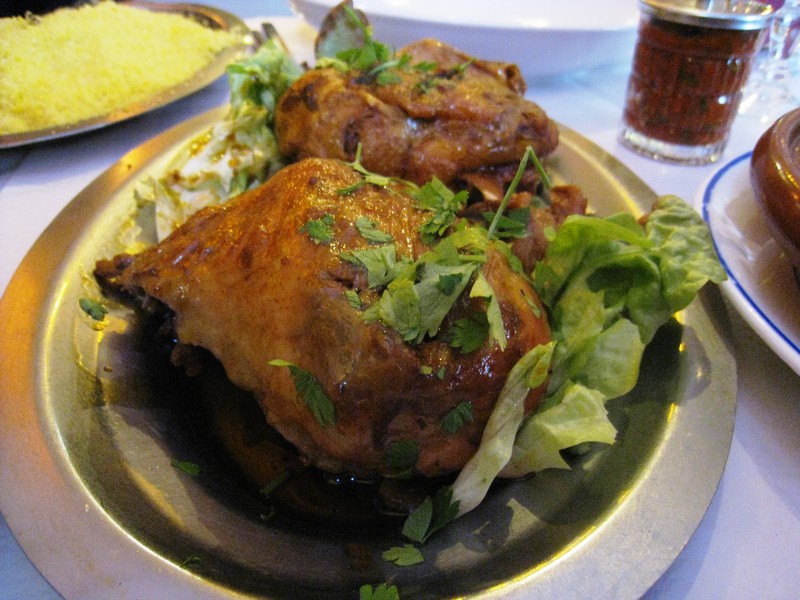
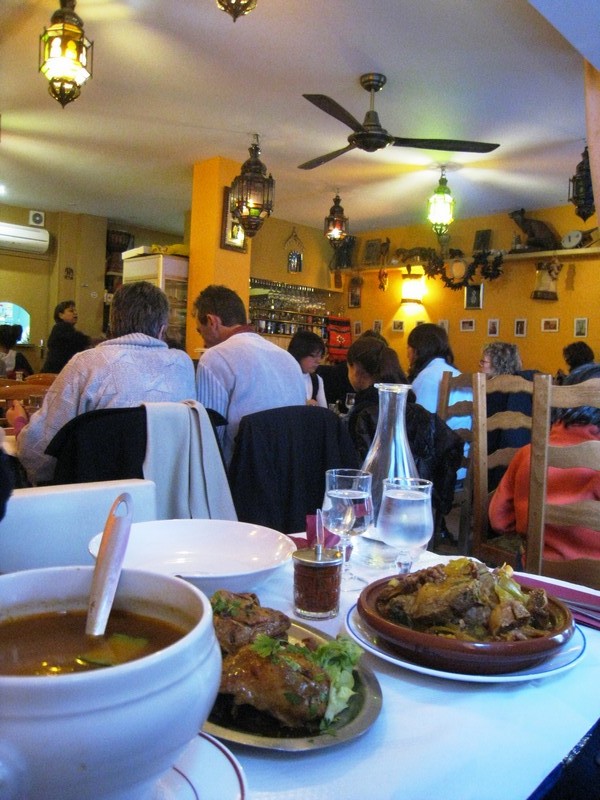
We were also drawn in by the advertised lunch special – an appetizer or dessert and entree for 12 Euros. Other offerings on the menu included tagines and Tunisian specialties like brik and merguez sausage. Both T & L had the lunch special – appetizer of chorba soup, and a serving of chicken couscous (12 euros). The chorba was almost like a thick minestrone filled with celery and pasta shells. Since the weather outside was somewhat frightful, the soup just hit the spot. Since two at the table ordered the couscous it came out family style – with a giant plate of couscous, a giant plate of marinated chicken and a giant bowl of fragrant sauce – with tomato broth, whole carrots and potatoes.  M had a lamb and fig tajine, flavored with cinnamon, tumeric, walnuts, and with potatoes. The tajine came out steaming / bubbling hot, and there was a great mix of flavors. The lamb was very well done, tender and fall off the bone, and though the inclusion of the figs was a great taste complement, though he was surprised at how dry they were given how tender everything else in the tajine was.

In terms of general impressions, service was a little slow to get going, but our wonderful French-speaking friends, T & I, cleared that up! We were seated, and then over 20 minutes went by before we were thought of again. However, once they remembered us, the service was pretty speedy. Overall, the menu seemed a little on the pricy side when first entering, but we got a staggeringly large amount of food, so our trip to Chez Jafaar was well worth it. Too bad we were unable to take leftovers home….

Leave a comment

Filed under Reviews

Brazil: Acarajé, Bahia’s signature dish

Acarajé
Bought on Avenida Cesar Zama
Barra, Salvador, Bahia, Brazil

The eaters will be in Brazil for the next two months, based principally in Salvador, capital of Bahia state and one of Brazil’s most distinctive culinary destinations, featuring a host of African-inspired cuisines. Of all Bahia’s treats, none is better-known than the ubiquitous acarajé, sold on nearly every street corner, particularly in the more touristic districts of Barra and Pelourinho, and the vibrant Rio Vermelho neighborhood.ImageI had read many descriptions of acarajé before arriving in Bahia, and was excited to finally try the product, especially one produced by one of the many Baianas, with their white hoop skirts and Candomblé religious beads, who have a near-monopoly of the acarajé industry in the city. I plan on trying multiple acarajés in the city before we come back in March, and this was my first, from a lovely woman on the largo where Avenida Cesar Zama hits the oceanfront road of 7 Setembro in the Barra district.

In the simplest sense, acarajé is skinned white or black beans mashed together into a ball and fried in a distinctive and strong-flavored oil from the dendê palm tree that grows along Bahia’s coastline. Once fried, the ball is sliced in half and filled with your choice of toppings. These can very from locale to locale, but typically they consist of four options: small dried shrimp, fried okra, a salad of tomatoes and cilantro, and vatapá, a thick orange paste made from ground dried shrimp, cashews, coconut milk, and dendê oil.

For those of you who are fans of falafel  (as we are, seen here and here and here), you will find its taste and texture very similar to acarajé. At first I thought this was coincidence, but some recent research has traced the origins of acarajé – a Yoruba dish from southwestern Nigeria – to a trade and raiding relationship with Arabs from the eastern Mediterranean about one throusand years ago. The dish was then brought over by enslaved Yorubas to Bahia during the first half of the 19th century, where it morphed into its present form using local Brazilian ingredients.

Though the falafel similarity is undeniable, I would say acarajé is overall larger, more bready, and more of a container in its own right than a filler. Add the fixings on top – I went with just salad and vatapá (I’m not a big fan of okra, and the shrimp usually cost extra) – and you get a solid snack, or meal if you are not that hungry, for 3.50 reais (about $1.80). Tomatoes and cilantro were as solid as can be expected, but the vatapá was a little surprising. I expected more of a mixture of ingredients, but this was a thorough paste, something like a strong-flavored and slightly spicy hummus.  I bought two on an empty stomach, and was over-full by the time I finished them. In my hammock with a chilled coconut, of course.

Hopefully our next report from Bahia will be a moqueca review – another one of our favorite dishes!

Acarajé stall on Porto do Barra beach, Salvador.

1 Comment

Filed under Reviews, World Eats

Filipino food ABC

We are totally into Jun-blog, a blog focusing on Filipino food, coupled with some pretty amazing photographs. We especially like the Filipino Food ABCs feature, where a Filipino recipe starting with A-Z is featured. The blog is currently up to N. We are especially excited to try the E-Recipe: Ensaimada brioche rolls.

Leave a comment

Filed under Links

Happy New Year!

[Soviet New Years card via Mazaika]

Leave a comment

Filed under Holidays, Note

Revelation of the year: Yogurt and Honey

How, oh how, did it take us so long to realize the wonders of this culinary marriage? Our first stop in Istanbul had introduced us to the wonders of fresh honey – breakfast each day at the hotel supplied fresh honeycomb, which we liberally spread on, well, everything – but Greece made us realize what it means to spread that honey all over some smooth, rich, yogurt. Our first day in Santorini, we walked into Oia and hopped into a cute cafe. Our honey love having been born only a few days before, M opted for the “yogurt and honey” for 4.5 euros. What came out was nearly a meal – a large bowl of Greek yogurt drowning in honey. This quickly became our newest obsession: we scoured the island, and the rest of Greece frankly, for versions of this culinary delicacy. Both of our hotels in Santorini had great versions, but Crete took things to another level.

Vrysses Yogurt

The famous yogurt of Vrysses, Crete

The small town of Vrysses, in central-west Crete, is famous around the island, and most of Greece, for the honey produced there, as well as the yogurt that goes with it. Driving into the small town square, the central fountain plaza is surrounded by honey shops. With no info to make a decision, we opted for the one that looked the most family-run: Kaprri. We ordered two plates – not bowls here, as they usually come – and we quickly caught on to what makes Vrysses honey so distinctive. The yogurt was approaching the consistency and flavor of sour cream, which was paired with a light clover honey, a wonderful complement that reduced a lot of the overpowering sugary sweetness that we usually associate with yogurt and honey.

In Athens, we were fortunate enough to discover a yogurt and honey BAR, Fresko – yes! – located just outside the spectacular new Acropolis Museum (Fresko, Dionysiou Areopagitou 3, Athens 11742, Greece). Notice: we need this place in the United States. Six kinds of yogurt, two kinds of honey, plus an assortment of smoothies and other drinks. M nearly died and went to heaven, savoring both some honey and a pomegranate smoothie while there.

Fresko in Athens

Fresko in Athens

Back in the USA, we’ve been getting more into the yogurt and honey scene around us. Our favorite brand of Greek yogurt – which we were happy to find also for sale in Lisbon – is Fage. We’ve been buying a four-pack almost weekly, and pairing it with locally-produced honeys at breakfast. Chicago has a great honey collective for those of you around town, the Chicago Honey Co-op.

Leave a comment

Filed under Finer Things Club, World Eats

Finer Things Club: Berthillon

Berthillon
31, rue Saint-Louis-en-l’Île
Paris, 75004

You know ice cream is good if you crave it even in 40 degree, rainy weather (hmmm, just like Chicago right now). Despite the gross grey drizzle we made a pilgrimage to Berthillon on Île Saint-Louis, fine purveyors of delicious house-made ice creams. Along with L’As du Fallafel, Berthillon is another one of our Paris must-dos – beware though – many places on the same road on the Île advertise that they carry Berthilllon ice cream, but only one is the ORIGINAL Berthillon. As a respite from the cold we opted to go into the small but elegant Berthillon tea room to sample some ice cream (in the Summer there is a walkup counter).

The little tea room serves all of Berthillon’s myriad ice cream flavors – which rotate in and out on a daily basis. The flavor selection at Berthillion is massive – and includes all of the classics, like hazelnut or vanilla, as well as particularly fresh and potent fruit sorbets, there are even a few more unusual flavors like Earl Grey Tea, Turron and Ginger (full list of ice creams and sorbets here – both PDFs). We are partial to the chocolate ice cream and raspberry sorbet flavors, however you can’t go too wrong. Also – as a bonus – they serve Mariage Frères tea – another one of our all-time favorites! While the Eaters opted for a decadent dish of chocolate ice cream covered in chantilly and chocolate sauce along with an almond tuile, our friends went for the salted caramel ice cream. For an accompaniment we got a small pot of Thé à l’Opéra, one of our favorite Mariage Frères varieties, a green tea and red berry blend. For the more adventurous there are also more elaborate sundaes (but those will cost you a lot more). It doesn’t matter the weather – you know you want ice cream!

Leave a comment

Filed under Finer Things Club, World Eats

Côte d’Ivoire and Senegal: Maïmouna et Mandela

Maïmouna et Mandela
48 rue Clignancourt
75018 Paris

The bright orange sign on this small take-away restaurant makes itself known for blocks. And again, at nearly all hours, it is full of hungry patrons, with Senegalese guitar music blaring through the restaurant (Youssou N’Dour, we think). We were excited to try it for its stellar reviews, but even moreso when we discovered that take-out entrees were only 5E. We both tried the chicken yassa (Yassa Poulet), a traditional west African dish with a mustard and onion sauce. When we arrived right after they opened at 12:30 they were already doing a brisk business (both carry-out and dine-in) though we had to wait about 30 minutes, a tiny amount when compared to the previous night’s adventures at G.J. Restaurant. For 5 euros the yassa chicken is an amazing steal – the portions were ample and the sauce was delicious. As far as it goes, we actually probably prefer the yassa chicken at Yassa in Chicago, but for some cheap and (relatively speedy) Senegalese food in Paris this will fit the bill just fine.

Leave a comment

Filed under Reviews

Back from Lisbon, Next Stop Brazil

We arrived back from Lisbon just a few days before Christmas, and as our blissful holiday food coma slowly wears off,  we are gearing up for another trip. In fact, one of the 2 eaters is already in Brazil (where we will be staying for the next 2.5 months). For Christmas we got a cool book, Eat Smart in Brazil, which we are looking forward to putting to use.

Leave a comment

Filed under Note

Merry Christmas Bacalhau!

If there is one constant in Portuguese food it is the mighty, iconic Bacalhau. This Portuguese salted cod is found nearly on every traditionl Portuguese menu – often in dozens of preparations. It is in fact rumored that over 500 canonized Balcahu recipes exist in Portuguese cuisine. Some of the most popular Bacalhau dishes are Bacalhau com Natas and Bacalhoada, but there is a Bacalhau recipe to suit nearly every taste.

Christmastime is an especially important time for the Bacalhau – as it is traditionally eaten on Christmas Eve by Portuguese families. Bacalhau can be found in many forms – filleted and dried, in cans, and even frozen is gaining popularity. We were also amused to find specal  “Christmas Bacalhau” for sale. Basically these are the normal splayed, dried and salted bacalhau, but wrapped in cellophane and topped with a red bow. We thought this was a one-off, but we actually saw this festive gift-ready presentation in several Lisbon stores leading up to Christmas.

This calls to mind the Italian tradition of the feast of the seven fishes, which we have written about previously. In Italian, Bacalhau is called Baccala, and sorry to say we do not much care for that either, perhaps betraying our Italian heritage a bit. But, bacalhau is the real heart of Portuguese cuisine, and if you don’t at least try it – you are missing out! You never know when you will need that 7th fish dish for the Feast of Seven Fishes.

Leave a comment

Filed under Holidays, World Eats

Holiday Snacks Cheat Sheet

Saturday Evening Post Cover Holidays

Saturday Evening Post Cover Feast, 1960

The holiday party season is in full swing, and has been for a while. This means you might be called upon to bring some appetizers of your own. But it is now easier than ever: Check out New York Times Holiday Finger-Food Combination Generator and Serious Eats’ Holiday Snacks in 20 Minutes Or Less. if you are feeling more retro, check out these scans of mid-century holiday recipes (use at your own risk!) [Image:”Snow Buffet Party,” Saturday Evening Post Cover, February 20, 1960]

1 Comment

Filed under Holidays, Recipes

Christmas in Paris: Bûche de Noël

Buche de Noel Paris

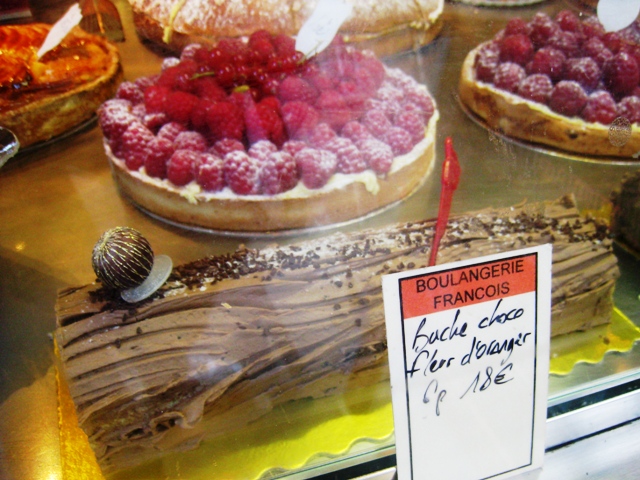
A Bûche de Noël in Paris

In our continuing coverage of holiday-related cakes and desserts (yum!) we move on to France. As much of a fixture as holiday lights and trees, the arrival of the Bûche de Noël cake in pastry shop windows signals Christmas. Known in the US as a Yule Log, the Bûche de Noël consists of rolled sponge cake, typically with chocolate frosting, that resembles a log (even topped with meringue mushrooms). However, the modern varieties available are almost limitless, including this bitter orange-flower flavored Bûche we saw in a shop window.

As for history, The earliest known recipe of the cake is from 1898, though the tradition of the cake is much older than that. The origins of the Bûche de Noël are with the Yule log traditionally burned by the Celts and other cultures around the Winter Solstice. The form of the Bûche de Noël is then based off of those logs. But when did the cake itself originate? The blog Why’d you Eat That has a pretty awesome explanation – and it includes Napoleon (go figure):

During his reign as Supreme Ruler of the Universe, Napoleon realized there was a lot of disease in Paris. His solution was to mandate that all chimneys must remain closed during the winter months because the cold, drafty air was causing all this inconvenient illness. With chimneys closed, there was no way for the air to get in. Now people were in a pickle. They had no way to burn their traditional Bûche de Noël. So a Parisian baker got creative and invented the cake as a symbolic alternative of the actual piece of wood.

For those intrepid bakers, Saveur has a traditional recipe and Canelle et Vanille has an amazing looking version with lemon creme brulee filling and dark chocolate glaze. According to Serious Eats, Floriole in Chicago has a pretty awesome Bûche de Noël.

1 Comment

Filed under Holidays, World Eats