Category Archives: World Eats

Regional Diwali Recipes

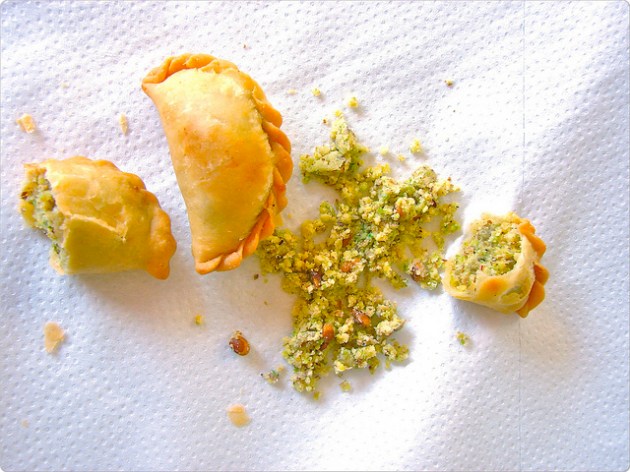
India FlagDiwali, the Hindu “festival of lights” is upon us, and that means a vast supply of excellent food. We talked a little bit about the Diwali snacks, known as Mithai, before. Mithai vary widely from region to region and it is near impossible to cover them all. This year we decided to dig a little deeper into regional specialties, like fov/poha from Goa, a rice-based dish (5 more recipes here), Ghughra, filled turnovers from Gujarat, and Susiyam, fried sweet chickpea fritters from Tamil Nadu. The recipe site Barwachi has an extensive list of regional Indian Diwali recipes, including many dishes we never have heard of before.

Ghughra, a Diwali snack from Gujurat

Ghughra, a Diwali snack from Gujurat by chiragndesai

Leave a comment

Filed under Holidays, World Eats

Pańska skórka for All Saints’ Day in Poland

Pańska skórka - from Wikipedia

Pańska skórka – from Wikipedia

PolandWe are most familiar with Latin American traditions for Dia de Los Muertos / All Saints’ Day, but the holiday is also celebrated in Europe (with some similarities and differences). All Saints’ Day is a national holiday in Poland, where it is known as Wszystkich Świętych. One of the most popular treats for All Saints’ Day in Warsaw is pańska skórka which translates to “The Lord’s Crust.” Pańska skórka is a pink-and-white nougat, similar in texture to Turkish Delight, and is sold in and around cemeteries during the week of All Saints’ Day where families go to light candles (znicze) in cemeteries in honor of the deceased. In Krakow a similar candy is called Miodek Turecki, or “Turkish honey.”

Leave a comment

Filed under Holidays, World Eats

The weirdest fruit tree in Brazil: Jaboticaba

brazilTrying to describe a Jaboticaba/Jabuticaba tree to someone who has never seen one is a particularly humorous and futile task. While the fruit of the Jaboticaba itself is not that visually unusual, resembling and tasting like a large black grape or a small plum – the fashion in which it grows is quite unusual – with the fruit attaching directly to the trunk and the branches of the tree. Jaboticaba is very popular in Brazil, and you will often see it as a flavoring for sweets or as a jam. We first saw a Jaboticaba tree in the courtyard of the restaurant Paraíso Tropical, in Salvador, Brazil where it was practically dropping fruit onto our table. “It looks diseased” was the succinct response of one of our American friends after we showed them a picture of a Jaboticaba tree. We have never seen Jaboticaba fruit sold outside of Brazil, and they apparently have a very short shelf-life, so you just may have to travel there to enjoy it!

Jaboticaba

Jaboticaba tree at Paraiso Tropical restaurant in Bahia

1 Comment

Filed under World Eats

Russian Ice Cream, Morozhenoe, for all seasons

RussiaSo as any fair-weather reader of this blog knows, we love ice cream, whether in hot or cold weather. This attitude is shared, perhaps unsurprisingly, by Russians, who enjoy ice cream year round. A recent Culture article on Russian ice cream, or morozhenoe, clued us in to this international ice cream we knew next to nothing about! Apparently Morozhenoe is served slightly soft, and has a creamier texture than US ice cream. If this piques your interest, you can try your hand at making your own Russian-style ice cream.

Leave a comment

Filed under World Eats

Mujin Hanbai: Stores without staff

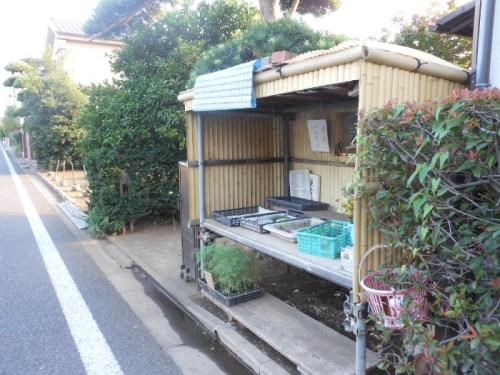
JapanPingmag has a fascinating article about mujin hanbai, or “honor stores,” a type of farmstand in Japan that relies on the honor system. The simplest of these just has a locked cashbox, while others more resemble vending machines. They are popular nationwide, even in Tokyo. I’ve seen a few honor roadside farmstands before (one even boasting “self-serve rocks”), but nothing so elaborate as those found in Japan. Have you ever encountered something like an a honor store?

Mujin Hanbai from Pingmag

Mujin Hanbai from Pingmag

Leave a comment

Filed under Links, World Eats

Crawfish festival in Breaux Bridge, Louisiana

When we were in Louisiana in the fall, crawfish (aka crayfish, crawdad or mudbug) season was well over. However, if you have the good fortune to be in Cajun country in Spring, crawfish are everywhere. The epicenter for crawfish culture and consumption is the town of Breaux Bridge, “Crawfish Capital of the World,” which is just over the Atchafalaya Basin Bridge (a pretty gigantic bridge) from Baton Rouge. The names of the some of the restaurant in town seem to bear out that distinction: Crawfish Town USA, Crazy Bout Crawfish, etc. The annual Crawfish Festival in Breaux Bridge occurs in May and includes nearly every crawfish-related event you could dream of. The New Yorker has an interesting old piece about a trip to Breaux Bridge for the Festival. Hopefully we’ll be able to visit Cajun country in Spring one year to get our fill of super-fresh crawfish.

Breaux Bridge

Leave a comment

Filed under Links, World Eats

Cajun Street Food in Baton Rouge: Boudin

The pronunciation of some words is enough to separate locals from tourists, and connoisseurs from newbies. One of those such words is “Boudin.” Boudin, a rice-stuffed pork sausage from Louisiana, is pronounced “boo-dan” not “boo-deen,” as one might expect. Boudin is found all over Cajun country (you can even take “Boudin Trail” tour), and is descended from sausages found in French Acadian cuisine. Boudin is available in any good Louisiana Cajun restaurant or grocery store, but we think we have found our favorite way to enjoy Boudin – as a late-night Po’Boy topped with pulled pork.

Southern Dawgz Stand -ready for night owls

Southern Dawgz Stand -ready for night owls

We found this particular incarnation of Boudin sold in a stand called Southern Dawgz on the corner of Florida and 3rd in downtown Baton Rouge. The truck is there most Thursday-Saturday nights (until 2 AM!), and there is a small selection of items, though most everyone is there for the Boudin. You can get a basic Boudin dog, or a “Bleu” topped with blue cheese or a “Heart Attack” topped with bacon. The cookmaster of this particular Boudin stand is Jerry, who is actually from Southern Ohio, and sous chef is from Indiana. Boudin is often sold in fried “Boudin Balls” much like meatballs, but at Southern Dawgz you get them in a form similar to brats. We ordered a smoked Boudin Po’Boy, which was great. The filling was perfectly seasoned, and the Boudin link had a charred snap. However, Jerry upped the ante by suggesting we try the stand’s “Red Dawg,” a Boudin dog topped with pulled pork and a tomato-based BBQ sauce. The pulled pork was a great addition, and contributed even more to the ultimate late night pig out!

Southern Dawg

Southern Dawg photo by digbatonrouge.com

Leave a comment

Filed under Reviews, World Eats

Songpyeon (rice cakes) for Chuseok, the Korean Harvest festival

koreaToday is the last day of the 3-day Korean harvest holiday, Chuseok, which is centered around the full moon during the autumn equinox. Many Chuseok activities relate to paying respects to ancestors, with families visiting their ancestral homelands, cleaning graves and making offerings of foods to the deceased. Of course, as with any holiday, traditional foods have pride of place, and one of the most traditional Chuseok foods is Songpyeon (송편). Songpyeon is a sweet chewy cake made with rice flour, and filled with honey, red bean paste, sesame seeds (or another sweet filling). Though the traditional shape is half-moon, Songpyeon can come in a myriad of colors and flavors. They are also traditionally layered on top of pine needles, which does make everything taste a little like pine! Tradition also holds that it is important to make the prettiest Songpyeon possible, since the prettier the cake, the prettier you future child will be. The Korean Bapsang blog has a guide to making your own Songpyeon, in a variety of colors and flavors.

Songpyeon

Songpyeon by Korea.net

Leave a comment

Filed under Holidays, World Eats

The Quark Cheese Revival

Topfentorte quark cheese cake with seasonal fruit at Cafe Sabarsky

Topfentorte quark cheese cake with seasonal fruit at Cafe Sabarsky by Loretta Hui

germanyThe first time we heard the word “Quark” our minds immediately went to the elementary particle and the publishing software (I guess we are a bit nerdy). However, much more appropriately to this blog, Quark can also refer to a type of fresh, un-aged cow’s milk cheese from Germany. While the name may not sound too appetizing, Quark is tasty and versatile, and can be used in any sweet or savory dish that calls for cream cheese or ricotta. Quark is popularly eaten in Germany for breakfast or as a snack (often with Nutella or fruit mix-ins). Popular recipes are quark kuchen/Käsekuchen, German cheesecake made with Quark, and Austrian TopfenstrudelThough it has always been popular in Europe, Quark is experiencing something of a revival in the US. Vermont Creamery has a version of Quark, and Quark is now made in the Midwest, too. Quark has even been popping up on Chicago menus. Apparently one of the easiest cheeses to master, you can even make your own Quark.

Leave a comment

Filed under Cheese, World Eats

Refreshing Agua Fresca Recipes for Hot Weather

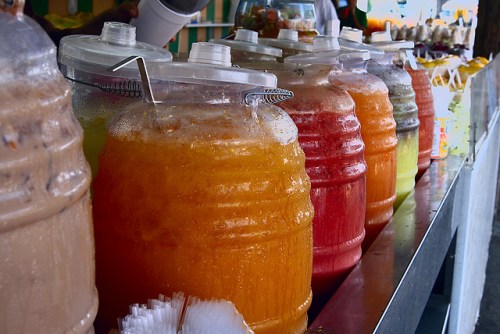
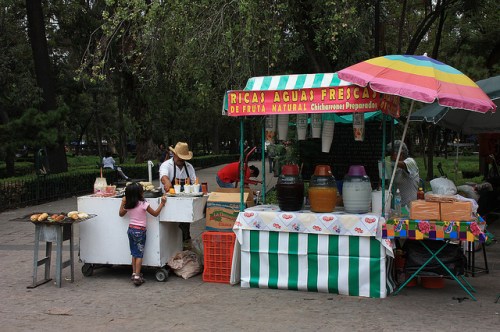
Mexico FlagIt may be September, but the thermometer in Chicago is still peaking in the 90s. One of our favorite remedies for a blisteringly hot day in any month is a nice batch of Aguas Frescas. Aguas Frecas (“Fresh Waters” in Spanish) are cold water-based drinks flavored with combinations of fruit, grains, herbs, sugar and spices popular in Mexico and the US. You can find Aguas Frescas sold by street vendors and in many restaurants and bodegas, often in large, iconic glass dispensers. The range of Agua Fresca flavors is almost infinite, but our two favorites are Sandia (Watermelon) and Jamaica (Hibiscus). It won’t be long before everyone is dipping into their hot Pumpkin Spice Lattes, so enjoy the Aguas Frescas while you can. We also think these combinations would make excellent paletas.

Aguas Frescas in San Jose, California

Aguas Frescas in San Jose, California by Lifeofpie

Agua Fresca Recipes:

New spins on the Agua Fresca classics:

Aguas Frescas for sale in Mexico City

Aguas Frescas for sale in Mexico City by Frankenschulz

2 Comments

Filed under Links, Recipes, World Eats

To do this weekend: Nosh, a weekly food festival in Wicker Park

Chicago is a city known for its festivals, and nearly every weekend throughout the summer you can expect to see multiple events dedicated to food, booze, music or any combination of the three. Enter Nosh, one of the city’s newest food festivals. Any weekend fair with a food theme is sure to attract us, and unlike most other festivals in Chicago, there is no entrance fee to visit Nosh.

???????????????????????????????

The goal of Nosh is to showcase a rotating selection of Chicago food producers, restaurants and food trucks (check out all vendors here). Much like Taste of Chicago, each booth sells several signature items, at varying price points, and many of the dishes are available for less than $5. The Nosh fair is located in the parking lot of Pritzker elementary school, and is going on every Saturday 11-6 until October.

???????????????????????????????

On the day we visited, there was a wide selection of different cuisines represented, from Mexican (Cherubs) to Vegan Ice Cream (Robin’s) to Indonesian (The Rice Table). Two food trucks were also present on our visit: The Eastman Egg Company and Da Lobsta. Since it is located on school property, there is no alcohol, but you could buy a selection of Filbert’s soda, Horchata and Lemonade. There was even live music when we visited. Nosh is definitely a fun way to spend a nice Saturday, and is also very family friendly. Go visit before Summer is through!

???????????????????????????????

Leave a comment

Filed under A New Place, World Eats

New Mexico’s Hatch Chile Festival

Hatch, NM, Chile Capitol of the World

A Rainbow of Hatch Chiles in Hatch, New Mexico – by Steev Hise

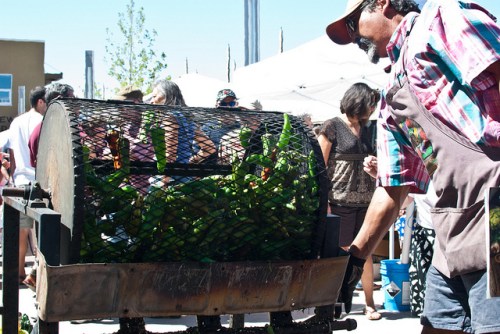
If you are lucky enough to be in New Mexico this weekend, one of the US’s great food events, the Hatch Chile Festival, is occurring. The Hatch Chile Festival is dedicated to all things related to the iconic green pepper of New Mexico. Hatch, New Mexico has even earned the honorific of being the “Chile Pepper Capitol of the World.” The name “Hatch” chile can actually refer to a variety of closely-related species, many first bred by new Mexico State University (a close analog is the less-spicy Anaheim pepper). Hatch chiles are famously green, and are harvested in late summer (just about now) before fully ripening. The chiles are then fire roasted, often on a large scale (as seen below). If they are left on the vine to fully ripen later into the fall, they indeed turn red! 

Hatch Chile Roasting in Santa Fe

Hatch Chile Roasting in Santa Fe – by Krissa Corbett Cavouras

Hatch chile verde is emblematic in new Mexico and is a classic choice that has as many recipes as there are cooks (which you can even make without Hatch chiles). But, like any good pepper, Hatch Chile can be used in a huge number of dishes, and as Hatch chile harvest season rolls around, creative recipes tend to pop up:

Though, mostly confined to the Southwest – there are still a few ways to get a Hatch chile fix – you can order them online at various stores. If anyone has any hints on where to get Hatch Chiles in Chicago, clue us in!

Hatch Chiles in Seattle

Hatch Chiles shipped to Seattle – by Paul Gibson

1 Comment

Filed under World Eats

Coffee Culture in Norway

norwayOne half of the ETW team is crazy about coffee. However, we were both surprised to learn about the corner of the world where coffee reigns supreme: Scandinavia. Honestly, when we first think of coffee, our mind goes to Italy (Bialetti, Cappuccino, etc), but per capita, Scandinavians consume more coffee than any other countries (think of the Swedish tradition of Fika). It turns out that Finland is the number one consumer of coffee per year at 12 Kg, followed by Norway and Iceland at over 9 KG apiece. Norway in particular is known for its particularly fastidious coffee culture, and Norwegians often win the World Barista Championships.  

Fuglen Cafe in Oslo

Fuglen Cafe in Oslo by Nicholas Lundgaard

So how is Norwegian coffee different? Norwegians tend to like their coffee black (called sort kaffe in Norwegian), prepared one cup at a time. The roasting is also different in Norway, and is particularly light, imparting an almost fruity flavor in the coffee. World Barista champion Tim Wendelboe discusses some of his tips for brewing a good Norwegian cup of coffee here, with emphasis on every step of the process. The Dear Coffee I Love You blog took a coffee-tasting tour of Oslo, and found a wealth of cafes serving amazing coffee, including Wendelboe’s cafe. Obviously, the Norwegian coffee scene is thriving, and you can keep up with the latest updates on the Nordic Coffee Culture Blog. The particular Norwegian way of making coffee has even reached Tokyo, with the opening of furniture/coffee shop Fuglen.

1 Comment

Filed under Coffee, World Eats

Braai, National BBQ Pastime of South Africa

South Africa FlagThough in the United States BBQ may seem as American apple pie, it has a special place in the national consciousness of many countries, none more so than in South Africa. Braai (rhymes with “cry”) literally means “barbecue” or “grill” in Afrikaans, and is a venerable tradition among all South Africans. South Africa even has a national Braai Day, September 24th of every year. While braai refers to the grill, which is almost always wood or charcoal (sorry, no propane here!), it also refers to the event itself, much like barbecue does in the US. A real braai typically includes a heap of meat, a wood grill, icy cold beverage and large group of friends. For the newbie, here’s some braai advice from the king of Braai in South Africa.

Boerwoers on the Braai

Boerewors on the Braai by André van Rooyen

So what do you bring to a braai? The answer is, predictably: it depends, but it seems like nearly anything goes. Though you may grill anything from kebabs to chicken, steaks, fish (in coastal areas); something quintessentially South African is boerewors. Boerewors are a type of spiced beef (sometimes mixed with pork) sausage that is native to South Africa, and is typically found in a coil formation, as seen above. If you find yourself in Wisconsin on Braai Day you can even find South African-style Boerwoers in MilwaukeeOr for the intrepid, make your own boerewors from scratch.

Sosaties on the Braai

Sosaties on the Braai by MacDara Conroy

Never fear though, even if you don’t have boerewors, you can still have a perfectly respectable braai. Sosaties, or grilled kebabs, usually made with lamb, are a favorite choice for a braai. Another classic non-meat braai dish is pap, a sort of South African polenta made with cornmeal. Yuppiechef has a nice version of Stywe pap with a tomato relish. For more inspiration, Cook Sister has a great description of Braai culture, as well as a great roundup of recipes, both classic and modern. Summer is still going strong, and we are looking forward to adding some Braai flavor to our next barbecue.

2 Comments

Filed under BBQ Tour, World Eats

Splurge: Jamón Ibérico de Bellota at the Mercado San Miguel, Madrid

spainM arrived at the Mercado de San Miguel with a single goal: eat jamón ibérico de bellota. “Iberian Acorn Ham” is the name given to the finest quality Spanish jamón, a fiercely protected product produced through a painstaking process. Black Iberian pigs, living in southern and southwest Spain close to the Portuguese border, freely roam oak groves consuming little besides acorns. Their hams are left to dry for weeks, and cured for another twelve months or more. The result is what is universally considered the finest jamón on the peninsula, if not the planet. The price definitely matches the quality – but it is worth it.

???????????????????????????????

At the Mercado de San Miguel, most patrons get their jamón from a stall featuring Carrasco Guijuelo. The company was founded 120 years ago by the Carrasco family in the tiny town of Guijuelo (Salamanca province, on the border with Portugal). Now a protected designation of origin product, Carrasco Guijuelo now enjoys a major share of the Spanish domestic market, as well as running an enviable export business (but we all know the keep the good stuff). They also produce a lot of other food products.

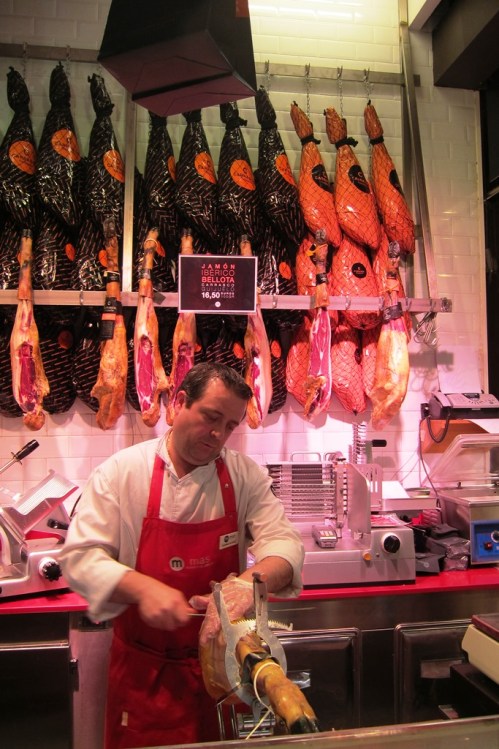
While the standard jamón is a big seller, I splurged and got the 50 grams of the finest-quality Reserva, priced at 18.5 euros for 100 grams – or $111.13 per pound. The eight slices in this photograph – my total order – were priced at 9.25 euros (although, full disclosure, they accidentally charged me the price for the standard, at 16.5 euros/kilo. I did not correct the error).

???????????????????????????????

We write many words on this blog, but there are simply none that can effectively describe the taste of a perfectly prepared and cured jamón ibérico. The ham is so finely cured that it when sliced, it looks like a wax copy of an actual ham, each slice retaining a light sheen that catches the light of the room. The sheen may is from the fat, which while visually obvious, may as well not exist when eaten. The fat all but liquefies on your tongue, melding with the muscle and acorns in a salty/sweet/nutty flavor profile that is subtle yet precise. Jamón ibérico de bellota is a food that, while you eat it, composes a most beautiful poem about its own taste, and you are more than willing to sit there and have that poem read to you over and over again. By the time I was done, I was ready to pull another ten euros out of my pocket for another 50 grams. If you ever have the chance to get some, don’t pass it up.

2 Comments

Filed under Finer Things Club, Reviews, World Eats

A Photo Tour of the Mercado de San Miguel

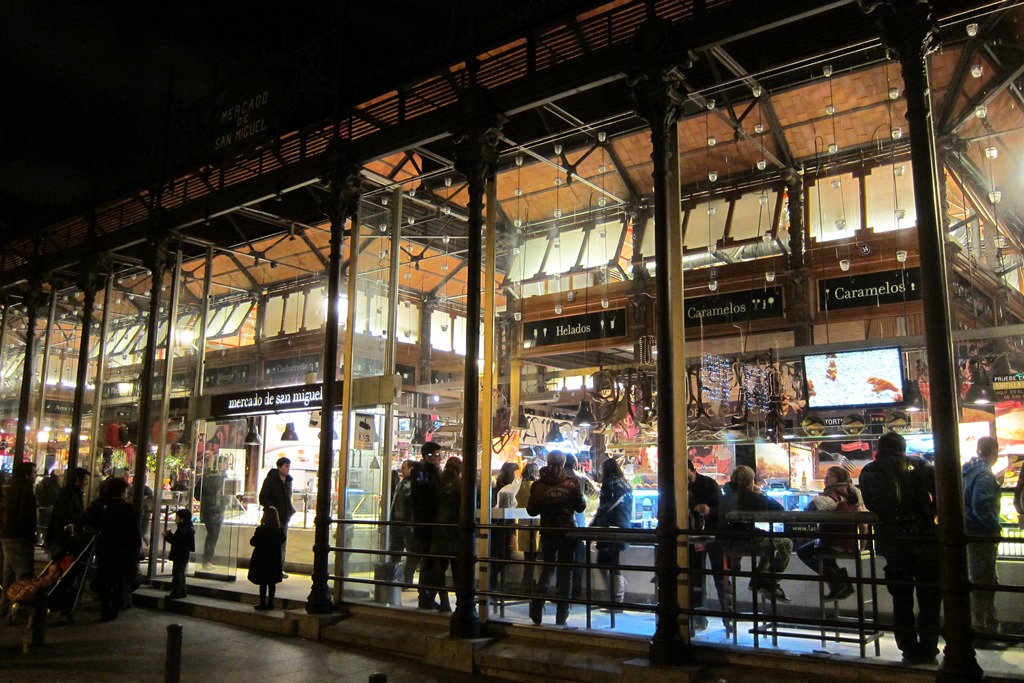
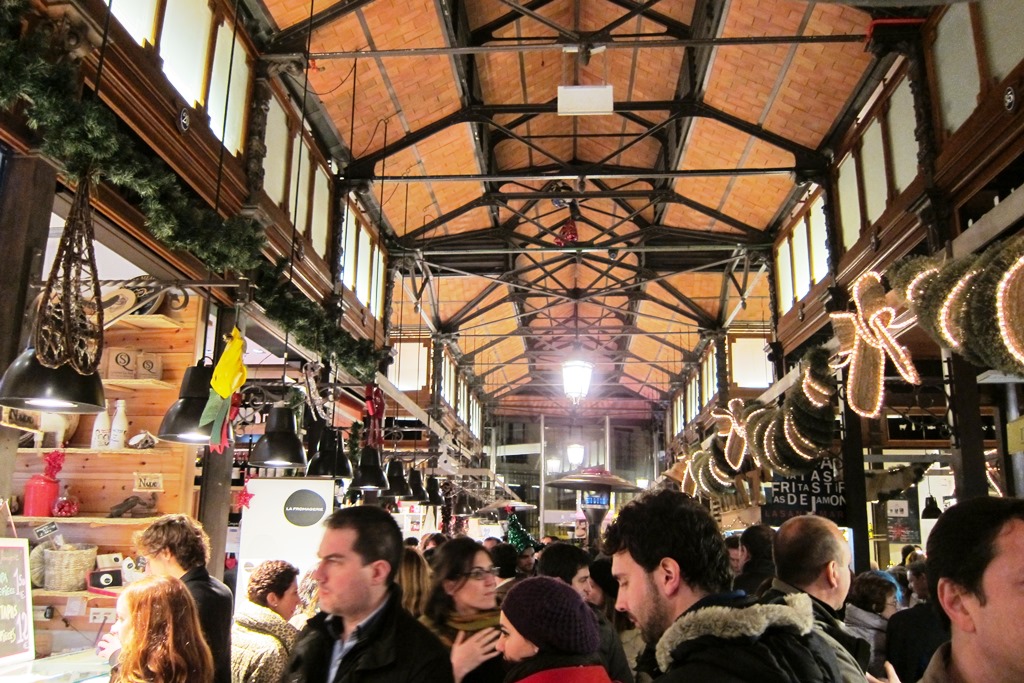
spainWe love visiting markets while traveling, and making a little picnic out of the local meats, cheese and fruits. One of our recent favorites is the Mercado de San Miguel in the heart of Madrid. The Mercado de San Miguel is a metal and glass Beaux-Arts masterpiece that was recently opened after a long renovation. You can find nearly any kind of Spanish food in the mercado, including produce, cheese, meats, paella, pastries, ice cream, seafood and more. The market is open until midnight on most days (and 2 AM on weekends) and is nearly always full of people. It is especially crowded around Tapas time, from 7 to 9 or so, before the extremely late Spanish dinner. We visited one evening and filled up on a variety of excellent meats and cheeses, just wandering around and sampling to our heart’s content.

Mercado de San Miguel

Mercado de San Miguel

Interior of the market

Interior of the market

A variety of Spanish Cheeses

A variety of Spanish Cheeses for sale

Cheese shop in the market

Cheese shop in the market

A cheese tapa

Garrotxa cheese tapa

Jamon Iberico

Selecting Jamon Iberico

Jamon Iberico

Carving Jamon Iberico

Jamon Iberico

Jamon Iberico

Macarons for Sale

Macarons and pastries for sale

Leave a comment

Filed under Finer Things Club, World Eats

Chocolate and churros in Madrid

spainOne of our favorite things to do in a country is to sample their typical iconic breakfast foods. We have found some of our most favorite foods this way – yogurt and honey from Greece, helva from Turkey, Torta Caprese from Italy, etc. –  and we find it quite a lot more enjoyable than taking a bland continental breakfast. In Spain, the breakfast treat of choice is hot chocolate and churros. In the US, churros have something of a dubious reputation. While, of course, you can find some excellent renditions of churros in the US, the sugar-coated, soggy churro is often the purview of school lunches and amusement parks. I had personally sworn off churros after they were the only dessert offered in our junior high cafeteria. However, I am open to an opinion change.

Churros and Porras

Churros (left) and Porras (right) at Chocolatería San Ginés in Madrid

Churros are a different affair in Spain though: no extra sugar is added, and the fried pastry is the whole deal. However the best part of having churros is dipping them in the thick, rich hot chocolate that traditionally accompanies them. No Swiss Miss hot chocolate here: this is thick, rich sipping chocolate. They sometimes even give you a little spoon to eat it with. We tried chocolate and churros and two locations in Madrid, each of which was completely different.

Waiting in line at San Gines

Waiting in line at Chocolatería San Ginés

The first stop for churros was Chocolatería San Ginés (Pasadizo de San Ginés, 5, Madrid). All they serve is chocolate and churros, and boy do they serve a lot! We went on a Saturday night, which admittedly is probably the most crowded time you can get chocolate and churros, and there was a line snaking out of the door. The routine is similar to Giolitti: you order and pay and then get a receipt for what you ordered. If you are able to get one of the tables (either inside, outside or in the basement) the waiter will take your ticket and give you your order. The only things available to order are chocolate, churros and porras (a thicker churro). The churros were excellent: a nice portion and not at all greasy. The cost of a cup of chocolate and 6 churros is less than 4 euros.

Chocolate and Churros at San Gines

Chocolate and Churros at Chocolatería San Ginés

On our last day we sampled churros from Chocolatería Valor (Calle Postigo de San Martin, 7, Madrid), which is more of a regular full service café. We visited Valor at an admittedly off hour, 8:45 on a Monday morning. So we were very pleased to find that a fresh batch of churros was fried up just for us. Perhaps as a product of their freshness, we found these churros a little greasier than the offerings from San Gines. However, the price was a lot cheaper, and you could get additional items off of the menu if you so desired. There are even paper cones for those who want to take the churros to go.

Chocolate and Churros at Valor

Chocolate and Churros at Valor

Going to Madrid completely changed my idea of the churro (especially when combined with hot chocolate). We especially enjoyed Chocolatería San Ginés, and we are looking forward to going back someday and trying more varieties. Do you have a favorite place for churros in Madrid?

Leave a comment

Filed under Finer Things Club, Pastry Post-Poc, World Eats

Brazilian Samba Food: Bolo de Fubá

brazilIn our other lives, we are Brazilian music aficionados. As much time as we spent eating everything in sight while in Brazil, we were as dedicated to listening to as much live music as we could, including seeing the world-famous carnival parade twice: once at the technical rehearsal, and finally during the main event. We had the good fortune both times to see the eventual parade winners, the GRES Unidos de Vila Isabel (headlined, as always, by one of L’s favorite sambistas, Martinho da Vila). Vila’s 2013 samba-enredo (theme song) was the unrelentingly catchy “Água no feijão que chegou mais um;” sing along with the video below:

The song is a celebration of the simple life in the Brazilian countryside, and makes use of some creative wordplay to talk about the samba school’s job of making music using words that evoke farming, planting, and harvesting country crops (“Vila Isabel is going to plant some happiness tomorrow morning”). Once we had listened to the song on repeat 30 times, one particular verse caught our attention:

Bota água no feijão (“[He] throws water in the beans”)
Já tem lenha no fogão (“There’s already wood in the stove”)
Faz um bolo de fubá (“[He] makes a cornmeal cake”)

Question to us, then: what is a bolo de fubá, and given our self-professed love of Brazilian pastries and cakes, why have we not made one yet? A bolo de fubá is literally a cornmeal cake, but it is more than cornbread: using finely ground cornmeal (the finer than the better), you make a slightly sweet cake that is a ubiquitous accompaniment to breakfast or midday coffee. Bolo de fubá is also a popular food eaten in the Brazilian June Festivals, or Festas Juninas

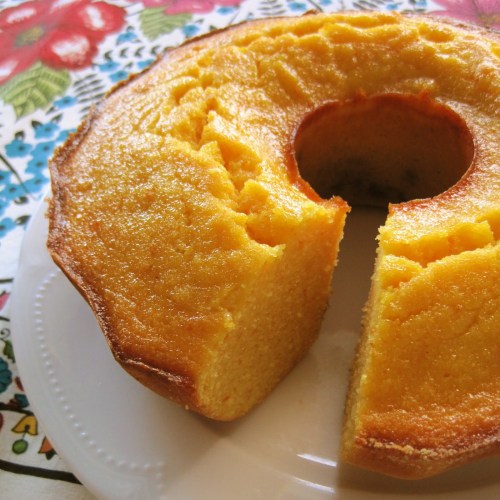
bolodefuba

Gluten-free bolo de fubá cremosa with orange, from Sabor Saudade.

Everyone has their own take on a bolo de fubá. The most common variations are to make it a bolo de fubá cremosa (“creamy”) or bem cremosa (“super creamy”), usually by adding coconut or a creamy substitute like extra cheese or eggs. For beginners, try this recipe for a simple bolo from about.com. Denise Browning over at From Brazil to You has a good recipe for a bolo de fubá cremosa with coconut, complete with some reminiscing about some of her bolos of years past. But really, the good recipes will all be in Portuguese: try the one from Sabor Saudade (above), or this one from Tudo Gostoso (Everything Tasty).

And thanks to Vila Isabel for introducing us to a new treat: now we have a food to get addicted to as we get more and more addicted to your song. E está chegando o povo do samba!

Leave a comment

Filed under Holidays, World Eats

Fêtes de Bayonne: Omelette aux Piments in Basque Country

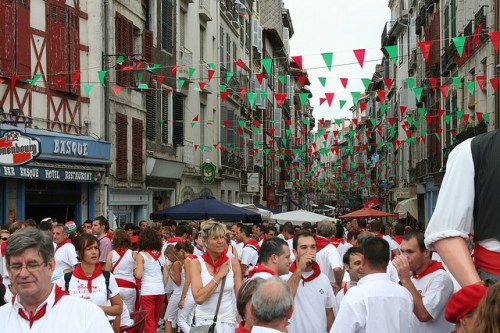
The most famous Bull-fighting festival in the world may be in Pamplona, but the gigantic Fêtes de Bayonne in the Basque region of France features not only bull-fighting, but a festival dedicated to omelettes (Championnat du monde d’omelette aux piments) at the end of every July. Indeed, there is an championship for nearly everything, and this one has been running since 2004One of the most emblematic foods of the French Basque county, Omelettes aux Piments (Omelette with Peppers) is an egg dish with potatoes and the famous sweet Espelette peppers (piments doux in French or Ezpeletako bipera in Basque).

Fetes de Bayonne

Fetes de Bayonne by Greg.road.trip

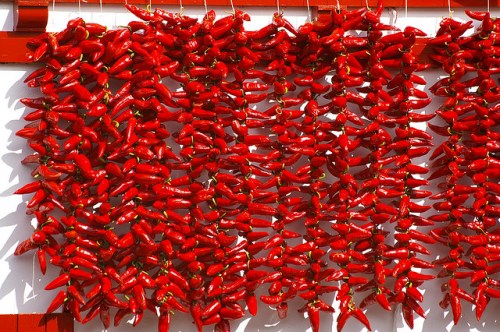
Espelette peppers are a mild red pepper originally from Mexico, and were brought to France in the 16th century, but they are so much a part of Basque cuisine that they have governmental status as a protected destination of origin product. In the town of Espelette, it is not uncommon to see large strings of Espelette peppers drying in the sun. French Basque Country, which is in Southwestern France, and shares a border with Spain, is known for their unique cuisine, and the Omelette aux Piments marries both the Spanish and French influences (classic French egg omelette and Spanish tortilla)Eat Live Travel Write has a wonderful write-up of the entire Bayonne Fest, along with coverage of the Omelette Championship. The Chopping Block has an omelette recipe calling for Espelette peppers. Another use for Espelette peppers is in Piperade, a typical French Basque condiment used on almost anything.

EspelettePeppers

Espelette Peppers in Espelette, France, by Franck Barre

Leave a comment

Filed under World Eats

The International Origins of Nando’s Peri-Peri

Over at Africa is a Country, our favorite African news and opinion site, historian Sarah Emily Duff has a fascinating write-up on the multinational origins of Nando’s Peri-Peri, a self-described South African peri-peri chicken joint with locations throughout Africa (including Gaborone, capital of Botswana, from where she writes this piece), Europe, and a few in the USA. M visited a location in Washington, DC last year, and raved about the food. Now, we have a much greater understanding of the surprisingly complex history of the chain, with ties to Portugal, Mozambique, South Africa, and the UK during the second half of the 20th century. We’ll take all this cultural learning with us when we return to the DC Nando’s again in October!

Nando's peri-peri chicken with extra spicy sauce, rice, and cole slaw in Washington, DC.

M’s favorite: Nando’s peri-peri chicken with extra spicy sauce, rice, and cole slaw in Washington, DC.

Leave a comment

Filed under Links, World Eats