Category Archives: World Eats

A Holiday Feast of the Seven Fishes

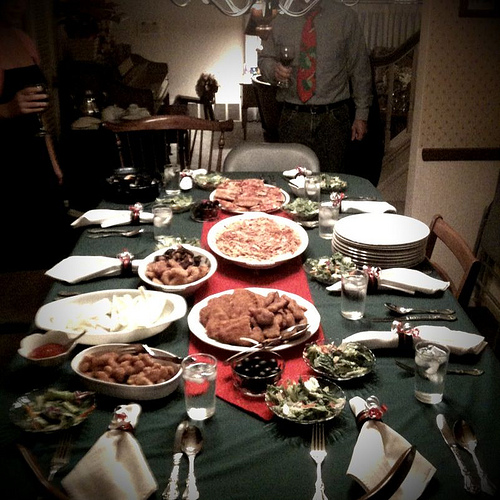
Feast of the Seven Fishes by Austin Kleon

It’s Christmas Eve – which means it’s time for the Feast of the Seven Fishes known as “festa dei sette pesci” in Italian or alternatively as “Vigilia (the Vigil).” We posted briefly on this topic previously, but we figured it would be a good time to expand upon it. The Feast of the Seven Fishes originates from the Catholic tradition of not eating meat on the eve of special holy days, where fish would be consumed instead. The tradition has especially caught on in Italian-American communities, and inventive menus including baccala, calamari, lobster, shrimp and more adorn many “7 Fishes” tables.

Along with the requisite assortment of fishes, sides of veggies and Christmastime desserts like struffoli complete the meal. Traditional or not, any fish dish is welcome at a modern-day feast of two fishes in America. Mario Batali has a traditional Italian menu featuring anchovies, clam and mussels. The Bite Sized blog is cooking their way through an eclectic Feast of the Seven Fishes including Oysters Rockefeller. For those among us who aren’t terribly fond of fish, Buzzfeed has a tongue-in-cheek version of the feast featuring Goldfish Crackers and Swedish Fish. We also like Meatballs and Milkshakes‘ take on the meal, opting for a small menu – doesn’t a bay scallop crudo sound nice?

1 Comment

Filed under Holidays, World Eats

Holiday Eats Around the World: Panettone from Italy

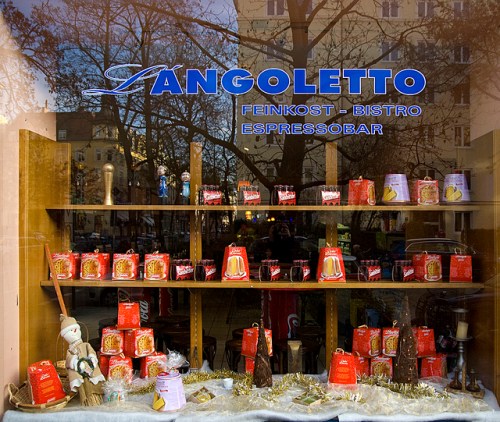
At our favorite grocery store in Lisbon there was an entire wall of Panettone, in distinctive paper boxes, in sizes ranging from tiny to one that would feed an army battalion. This is a testament to both the Portuguese love for Panettone and also the sheer variety of Panettone available. Panettone is a yeast-based Christmas sweet bread from Milan, Italy – traditionally it had pieces of citrus and nuts – however there are other varieties with chocolate or even cream filling. Panettone’s particularly light and fluffy texture is the result of a complicated proofing process (similar to Sourdough bread). Though it originated in Italy, Panettone has flown way past the Italian (and European) borders and is readily available in the US and in South America.

PanettoneBox

A variety of Panettone for sale in Munich

The origin of Panettone is probably the Roman Empire, but I was surprised to learn that it only became commercially available in the 1920s.   Needless to say, it wouldn’t be an Italian Christmas or New Year without some Panettone. The large size Panettone is a lot for one person to handle, so sharing it with family and friends is probably a good idea (M swears by eating it the next day as toast with butter and cinnamon, or you could make a bread pudding). We’ve never tried making Panettone, though these miniature cranberry Panettones seem to be more manageable. Recipe Roll and King Arthur flour have  recipes for a classic Panettone, and Sur Le Table even has Panettone baking molds in traditional parchment.

2 Comments

Filed under Holidays, World Eats

Holiday Glögg for St. Lucia Day

sweden_flagSt. Lucia’s Day is a Swedish holiday that occurs on December 13th, marked by feasts and candles. Despite it being pretty dark in Sweden in the weeks leading up the Christmas, St. Lucia’s day and Advent as a whole are a great time of celebration filled with lots of light. We have written about some sweet treats like Lussekatter and pepparkakor that are used to celebrate the holidays in Sweden, but if you need some warming up the best prescription is Glögg, a mulled red wine. Glögg is so integral to the holiday season, there are dedicated “Glögg parties.” While you can buy Glögg at many stores, it is definitely more fun to make your own.

Glogg

Glogg by Aya Patron

2 Comments

Filed under Holidays, World Eats

Holiday Eats Around the World: Sufganiyot for Hanukkah

Happy Hanukkah! Hanukkah in America is often associated with latkes, however, an equally delicious treat is popular for Hanukkah in Israel – Sufganiyot – a type of a jelly doughnut. There has long been a tradition of associating fried foods with Hanukkah due to the importance of oil to the holiday, and Sufganiyot is a mash-up of North African and European traditions. Here is a recipe for Sufganiyot, with a classic jelly filling – though you might find them with any manner of exotic fruit or cream fillings. For another twist, try these Sufganiyot-inspired cupcakes.

Sufganiyot

Sufganiyot for Hanukkah- by Avital Pinnick

2 Comments

Filed under Holidays, World Eats

Traditional Dutch celebration foods for Sinterklaas

Netherlands flagThough in the USA, Santa Claus is the symbol of the holiday season, in Europe it is St. Nicholas that children wait up for on December 5th. Sint Nikolaas, in Dutch, is then typically known as Sinterklaas, and is considered the precursor to the American concept of Santa. The figure of Sinterklaas is indeed similar to Santa, a benevolent figure wearing a red robe and delivering presents to children, though he rides a horse on his journey from house to house. Kids, instead of leaving milk and cookies, leave carrots for the horse beside their shoes (which is where the presents get delivered – if you are naughty you will be left with an empty shoe).

Sweets abound at Sinterklaas celebrations both on the 5th and 6th, including one of our favorites, the crisp, cinnamon speculaas cookies. Other sweet treats include pepernoten (same as German pfeffernüsse) and kruidnoten, similar to speculaas, but in more of a nugget shape.  Many Dutch recipes instruct you to make kruidnoten with pre-blended “speculaas spice” which is definitely not available in the USA. However, to make your own, the Dutch Baker’s Daughter has a good DiY speculaas spice breakdown. Another food tradition is getting a large chocolate letter representing your first name called a chocoladeletter. Sinterklaas is definitely a day with tradition – many of the festive occurrences in this 17th century painting by Jan Steen (note the empty shoe) remain unchanged today.

Jan Steen - Het Sint Nicolaasfeest

Jan Steen – Het Sint Nicolaasfeest / Festival of St. Nicholas

1 Comment

Filed under Holidays, World Eats

Roast Chestnuts herald the arrival of Winter in Lisbon

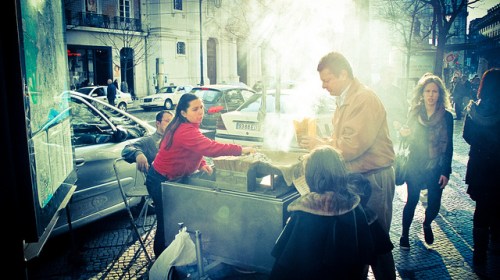
One sure sign that fall has arrived in Lisbon is the appearance of the roast chestnut vendors. As the holiday season approaches, they only become more popular. If the air is crisp enough, it is not uncommon for the Baixa area of Lisbon to be filled with smoke and steam from the roast chestnuts. The typical setup is a metal cart, as seen below, but there are some other nifty arrangements where the chestnut roaster is attached to the front of a motorcycle. For about 2€ you can get about a dozen chestnuts. The chestnuts are completely charred and perfect for staving off the winter chill, definitely a must-do for anyone visiting Lisbon in the colder months.

Chestnut vendors in Lisbon by Sr. Nefasto

Leave a comment

Filed under Holidays, World Eats

Japan and Taiwan: Honey Toast

Honey Toast from Sheng Kee Bakery in San Francisco by Jeffrey Chiang

I love learning about unique foods from around the world, especially if they are a little quirky. One of the quirkiest foods I have encountered recently is honey toast, a Japanese creation that has caught on in Taiwan, where the topping choices have become even more extravagant.  Honey toast is composed of a small loaf of hollowed out white bread,  the interior of the bread is cubed, toasted and stuffed back inside, and all is covered with a heaping helping of honey. Honey toast toppings may be a simple as ice cream, or may include fruit, syrups, or even something as decadent as macarons. Curious yet? A review of What8ver Cafe in British Columbia has a great description of honey toast. Or if you need a better visual, here is a video of Honey toast at Dazzling Café in Taipei being dissected. Making the honey toast does not seem terribly difficult, but definitely for carb lovers only.

Leave a comment

Filed under World Eats

France: A Tour of Rue Montorgueil-Les Halles

L’Escargot on Rue Montorgueil by straightfromthecask

There is nothing we love more than touring cities in search  of food and food shops, so we were very excited to see David Lebovitz’ description of a tour down Rue Montorgueil-Les Halles in Paris. It seems like an amazing, concentrated taste of the food culture Paris has to offer (not that there is any shortage of that). Food for thought for anyone planning a Paris trip.

Leave a comment

Filed under Design and Photography, World Eats

Diwali Mithai: Celebrating the Festival of Lights with sweet treats

India FlagHappy Diwali! It is the first day of the Hindu Festival of Lights today, which mean a time for family, togetherness, celebration, and naturally lots and lots of delicious foods. Foods eaten on Diwali vary widely by location and family, however it is generally agreed that there should be a large assortment of sweet treats. Of course, we are absolutely for any excuse to put out a huge dessert spread. As part of the Diwali celebration, street fairs, or melas, are often set up, providing entertainment and selling any manner of delicious foods. The little sweets are known as mithai, and are:

 a cross between snack, dessert and confectionery. If there’s one thing that captures the Indian culinary psyche, it’s mithai. Little morsels are nibbled throughout the day, on their own, with masala chai or as part of a meal alongside savoury items.”

If you are not near a Diwali market, or would simply like to prepare some mithai of your own, the Guardian has a slideshow of some of the most quintessential Diwali sweets to inspire you. For those looking to make their own mithai, I Love India, SpicyTastyRak’s Kitchen and Divya’s Cookbook have recipes for favorites like gulab jamun, laddu, barfi and jalebi. For a non-traditional take, why not make some truffles inspired by the traditional barfi sweets.

Diwali Market Sweets in Toronto by Chow Yun-Slim

4 Comments

Filed under Holidays, Pastry Post-Poc, World Eats

Finer Things Club: (Re)Discovering Yoku Moku Cookies

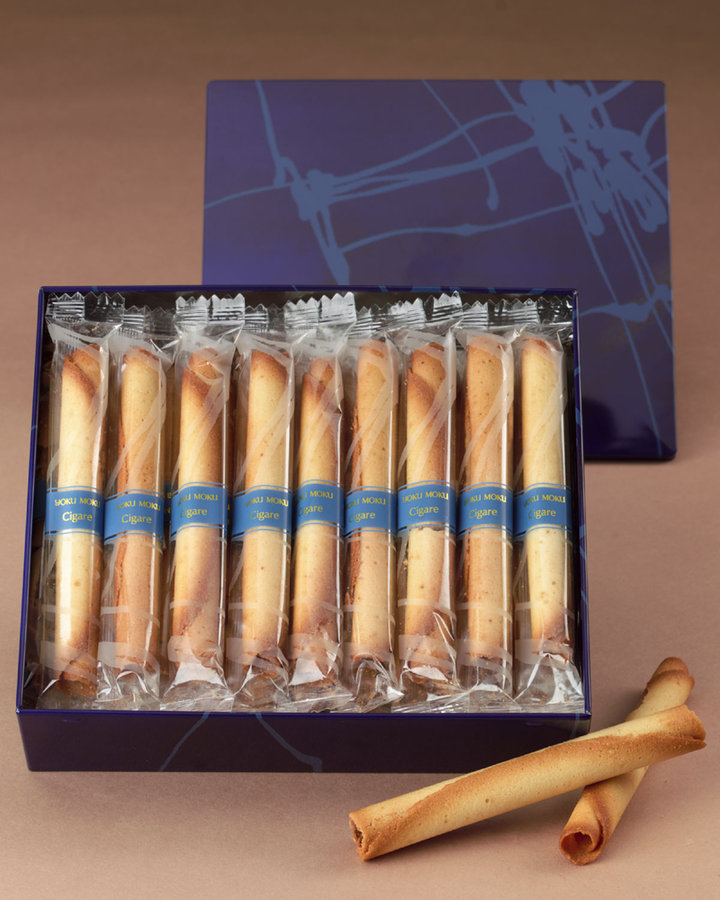
I finally put a name to a food memory of buttery cookies I had many years ago – Yoku Moku cookies. I remember eating these cookies a long time ago and being very impressed by both the taste and the presentation, I think my dad brought them home from work, and I still have the distinctive blue tin. However, I didn’t know what they were called until I ran across a picture of the very same tin online (the style seems unchanged over the years). The Japanese company Yoku Moku got its unique name from the northern Swedish city of Jokkmokk, where the founder, Noriichi Fujinawa first tried European butter cookies. That first encounter was the impetus for the creation of Yoku Moku (and the towns’ name was adopted for the company). The most famous Yoku Moku cookies, and the ones I remember were the  Cigares, rolled thin butter cookies with a hint of vanilla flavor. Yoku Moku also makes larger tins with other cookie assortments. Though primarily available in Japan, the cookie tins are available at Neiman Marcus, Bergdorf Goodman and Dean & Deluca in the US.

Yoku Moku Cookies

Leave a comment

Filed under Finer Things Club, World Eats

An Afternoon “Fika”: A Sweet Swedish Coffee-break

We love daily snack rituals, and we just learned of Sweden’s tradition of Fika. Fika is analogous to British teatime, though a Swedish Fika usually comprises of coffee and a sweet snack. Apparently Fika is so ingrained in Swedish psyche that it has become both a noun and a verb (“do you want to Fika?”), and is a daily ritual honored by both young and old.  Fikabröd (“fika bread”) is the name for the sweet snacks (cookies, tarts, breads, cakes, etc.) that are part of a Fika, and there are sometimes even Fika buffets with a variety of sweet treats. If you are looking for an authentic Fika, and you happen to be in the NYC area, you can visit the aptly-named Fika Coffee Shop.

Afternoon Fika by Elisabet.S

3 Comments

Filed under Coffee, World Eats

Pastry Post Doc: Torrone dei Morti in Naples

The arrival of torrone, the delicious honey and nougat confection, means the holiday season is coming in Spain and Italy. We have had torrone many times before, but we have never seen the kind of torrone we recently encountered in Naples, which was sold by the slice, covered in chocolate, and at first glance, even looked like ice cream cake. Turns out this is “Torrone dei Morti” or “Torrone morbido”- “dead torrone” which is a traditional All Saints’ Day dessert with a base of cocoa. Neapolitan pastry shops were filled with this version of torrone at the end of October, in any number of nut, chocolate and fruit varieties. Our favorite was the gianduja, or hazelnut and chocolate blend, as seen below. Getting a slice of torrone will run you less than 1€ a slice, so you have every incentive to try many varieties. When we were in Naples we didn’t realize that this version of torrone was season-specific, so we don’t know if it will be on display at other times of the year. We hope it is! We looked for a recipe in English – and we finally found one – but Google Translate can help you out with some of the Italian versions.

Cross-Section of Gianduja Torrone in Napoli

2 Comments

Filed under Holidays, Pastry Post-Poc, World Eats

Italy: Eating the food Markets and Shops of Bologna

Bologna’s nickname is “The Fat” and we certainly know why. Bologna is not only full of wonderful restaurants, but exceptional food markets and specialty shops, crowding on nearly every corner. We have truly never before seen such varied and high-quality food within such a small area. We only had a day in Bologna, but we definitely made the most of Bologna’s food in that single day – come join us on our tour.

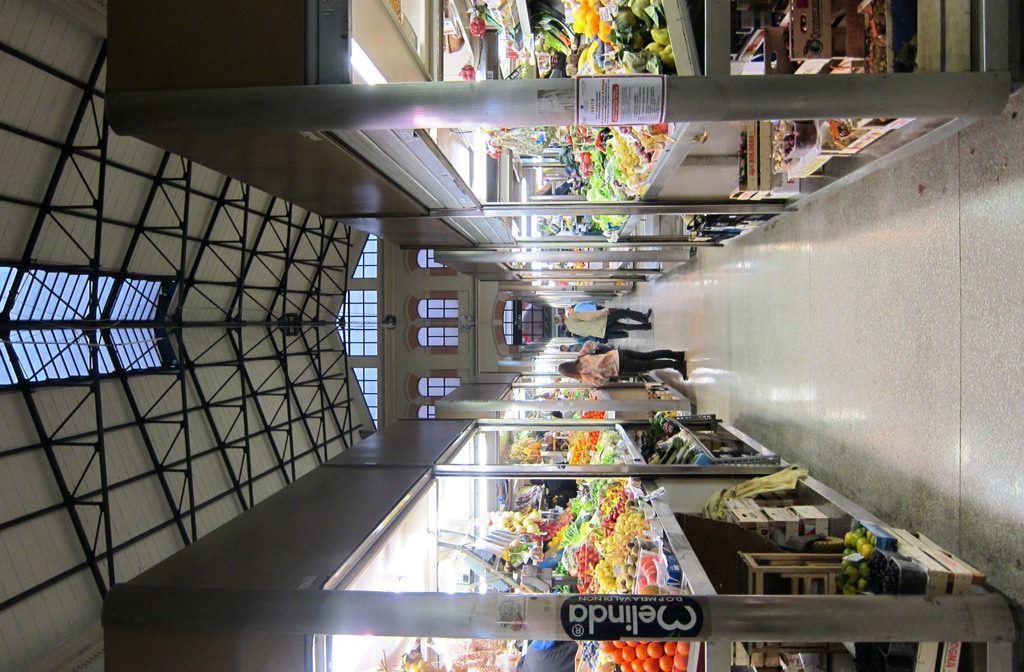
After a highly successful meal at All’Osteria Bottega, we headed north into the center of town. We started our tour at the traditional green market, Mercato delle’erbe (Via Ugo Bassi, 23). This old-school market is housed in a historical covered market building, and is considered the local place to get fresh food. It is a little bit off the tourist track (and is closed around lunchtime), but it is worth seeking out. The array of foods and veggies available at this market are astounding: the freshest herbs, every variety of tomato, romanesco broccoli, and a wide array of Sicilian citrus. Along the perimeter of the market are meat and cheese shops ready to sell accouterments for your meal.

Mercato dell’Erbe

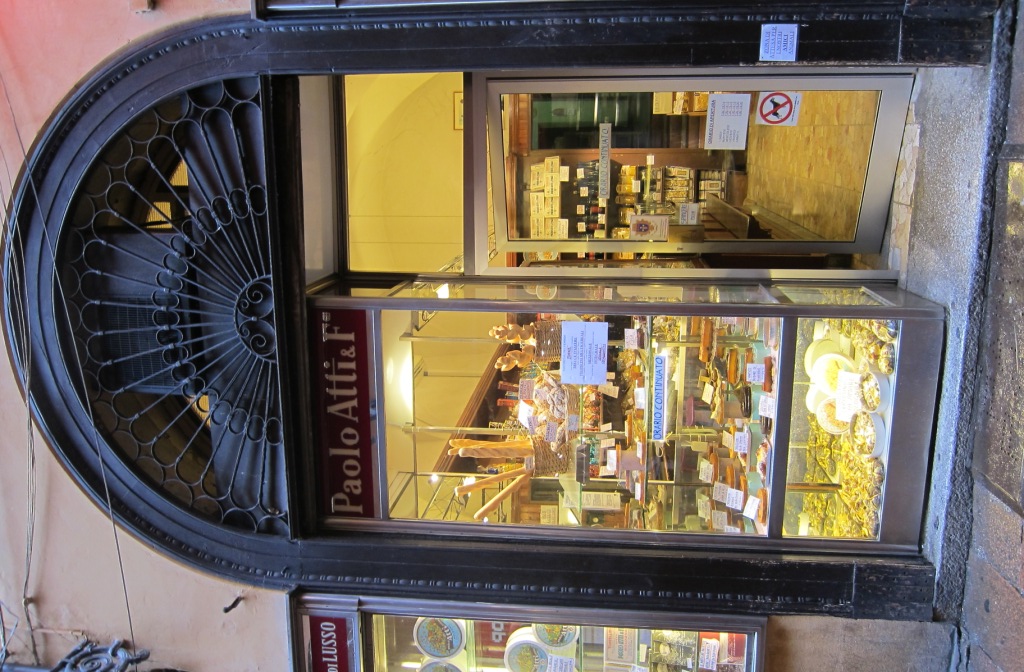
Next we headed to the area just off of the central historical square in Bologna, right outside of the Duomo. In places like Rome, you will want to give the food places near the touristic center a wide (and we mean WIDE) berth. However this is not so in Bologna, where amazing food is found literally in the shadow of the Duomo. Our first stop was Paolo Atti & Figli (Via Caprarie, 7) and our first food mission was Tortellini.
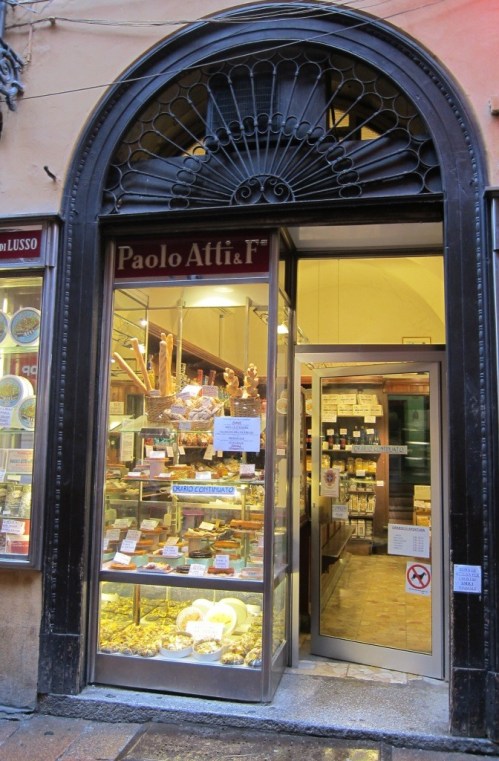
Paolo Atti & Figli

Tortellini, or their larger cousins, tortelli,  are little folded rings of pasta stuffed with meat or cheese. They are native to Bologna, where they are traditionally served in broth. After having divine tortelli at all’Osteria Bottega, we were of the mind to find some to bring home.  Fresh tortellini graced the storefronts in many food stores across Bologna- including Paolo Atti which immediately drew us in. Unfortunately, these fresh, handmade pasta morsels only had a couple days longevity. No preservatives here. Sadly this meant no tortellini could return with us to Lisbon.

Fresh tortelli for sale at Paolo Atti & Figli

However, we found a way to  take a taste of Bologna’s tortellini with us – chocolate tortellini! Chocolate tortellini held pride of place at the amazing food shop Drogheria Gilberto (Via Drapperie, 5). They came in three varieties – white, milk and dark chocolate – all of which are filled with a rich chocolate ganache. Though the prices may seem a little high, you definitely get what you pay for. We’re thinking we should have gotten a kilo more and have carefully been portioning out our remaining choco-tortellini.

Heavenly chocolate tortellini on display at Drogheria Gilberto

If you are looking for some ready-made food to make a quick meal, look no further than A. F. Tamburini (Via Caprarie 1), which had a full counter of lovely Bolognese specialties by the kilo. As you can see, along with prepared foods, there is also no shortage of meats and cheeses on offer. One great thing about Italian cheese stores is that they will vacuum seal any cheese for you. Our favorite kind of souvenir.

A. F. Tamburini

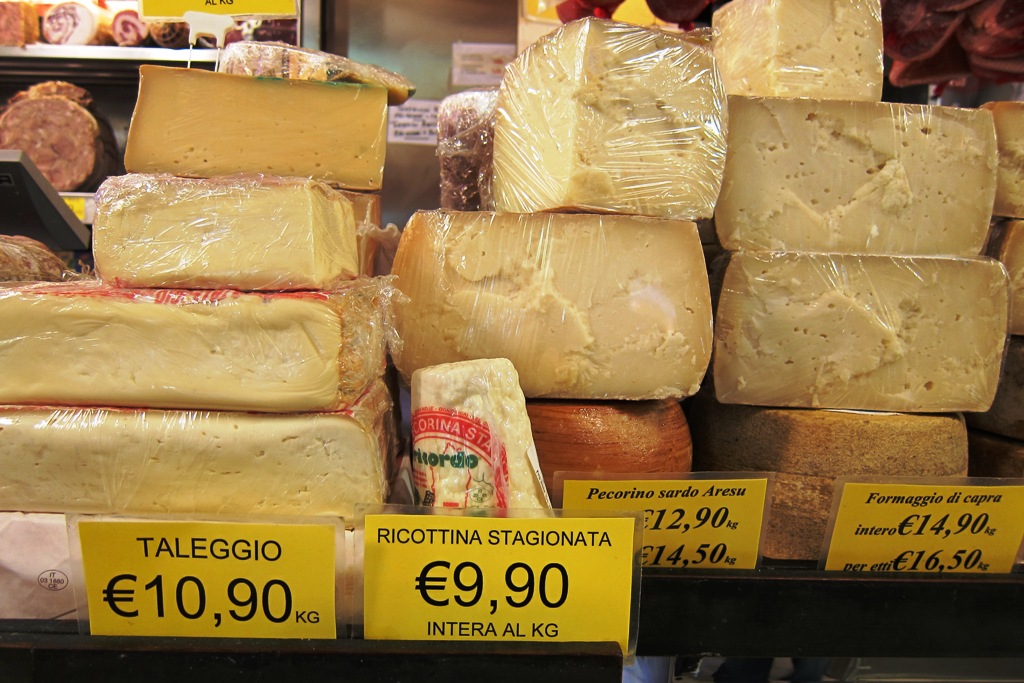
Throughout the day we had been comparing prices for cheese. We decided it was essential to get a block of DOP, 100% authentic Parmigiano-Reggiano, and we know Bologna would be our best chance (outside of Parma). When we happened upon Ceccarelli (Via Pescherie Vecchie, 8) we knew we had found our winner. They had a very friendly, helpful, and welcoming staff, along with an astounding array of cheeses (and prosciutto) at extremely reasonable prices. Also,  there was nary a tourist in sight.
This is a small sampling of the beautiful cheeses on offer at Ceccarelli. Soon enough we were on our way with a healthy wedge (1/2 kilo) of vacuum-sealed parmigiano-reggiano.
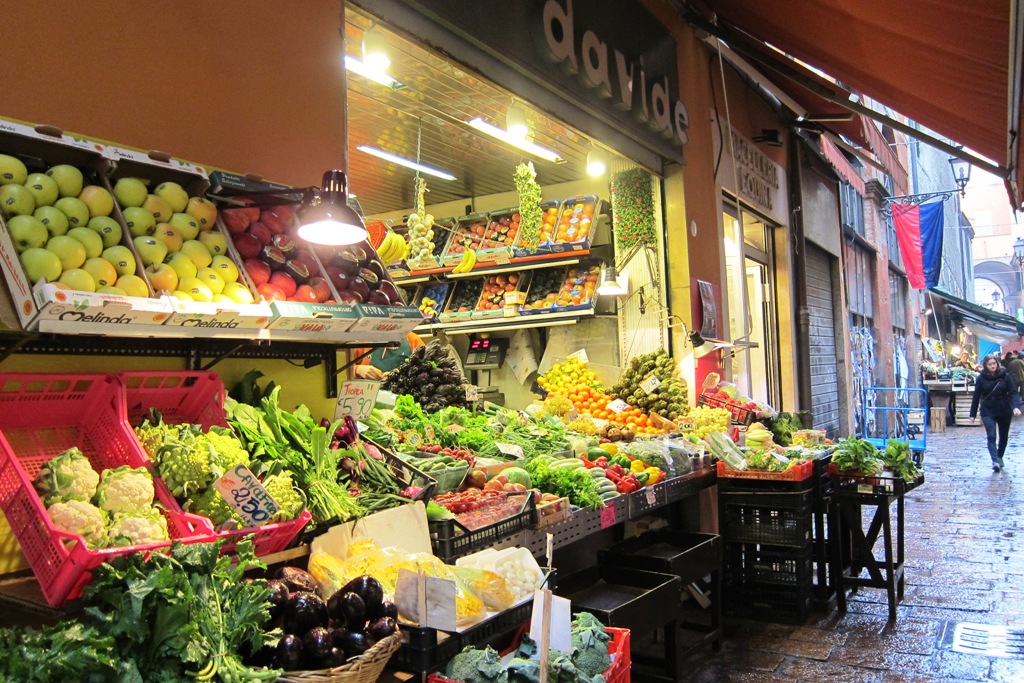
We continued our Bologna food walk right outside the doors of Ceccarelli. In the tiny old streets and back alleys along Via Drapperie, Via Pescherie Vecchie and environs, were tons of open-air greengrocers, fishmongers and countless others under canvas awnings. Despite the rain it was fun to walk along these old market streets where it seems nothing has changed for hundred of years.
We definitely fell in love with the sumptuous food of Bologna, “The Fat” and we only wish we had more time to explore the labyrinthine food wonders of this medieval city. We know we will be back someday. As final proof that Bologna takes its food seriously, check out this food stall in the Bologna airport, sending travelers off with some delicious memories.

Leave a comment

Filed under World Eats

Panellets for La Castanyada – All Saints’ Day in Catalonia

Panellets for All Saint’s Day – by Xaf

In the Catalonia region of Spain, All Saints’ Day (called Dia de Tots Sants in Catalan), is celebrated as La Castanyada. La Castanyada, true to the inclusion of chestnut in the name (castanyas means chestnuts), is celebrated in Catalonia by roasting and eating chestnuts and having a festive meal to celebrate the autumn season and honor ancestors that passed. One of the typical foods for La Castanyada are Panellets: round almond and potato cookies covered in pine nuts (who would have thought of that combination?). For more information on how to make panellets for yourself – check out this recipe.

1 Comment

Filed under Holidays, World Eats

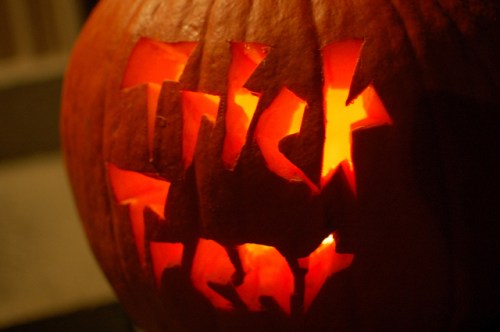
Pão por Deus: “Trick or Treating” on All Saints Day in Lisbon

Trick or Treat? – By Chris Devers

They don’t have trick-or-treating on Halloween in Lisbon, but there is a similar tradition that occurs on All Saints Day, November 1st, called  Pão-por-Deus. Instead of asking “Trick or Treat” Portuguese children go door to door asking, “Ó tia dá bolinho!?”(Originally – “Ó tia dá Pão por Deus?”) Literally – does auntie have any cookies? Traditionally the children would get bread from the neighbors and shop owners they visited, though it is now sometimes substituted for cookies, change or candies. This also leads to the other name for the holiday, “Dia de Bolinho.” Kids collect goodies in special drawstring bags, saquinhos, that are often decorated with embroidery or patches. Unlike Halloween, children go asking for Pão por Deus before noon (no costumes are involved, either).

November 1st, in addition to being All Saints Day, is also particularly known in Lisbon as the day of the destructive  1755 earthquake. This particular event is seen as triggering the Pão por Deus tradition, as the city was  devastated and people had to go asking for food.  The first Pão por Deus was held the following year, and continues today, though there is increasing influence form “Halloween”-type traditions. The holiday is most popular around Lisbon, but has also expanded to Brazil.

1 Comment

Filed under Holidays, World Eats

Foods to Celebrate Dia De Los Muertos

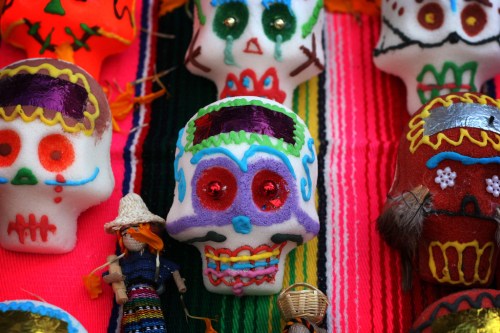
Sugar Skulls for Dia de los Muertos in California – by Gwen

Feliz Dia De Los Muertos! Happy Dia de Los Muertos! Looking for inspiration? Here are some posts ETW has done to commemorate the traditional foods enjoyed on this holiday:

Leave a comment

Filed under Holidays, World Eats

Dia de los Muertos in Guatemala: Fiambre

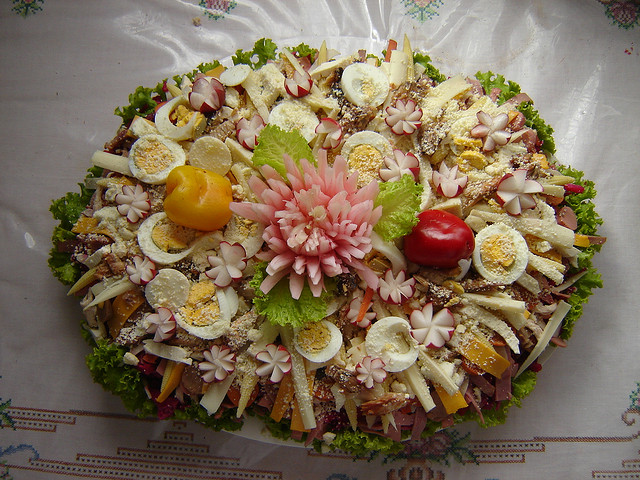
While Dia Los Muertos is perhaps best known in the USA through its Mexican-style celebrations, it is a holiday celebrated throughout Latin America. I was doing a little research on other countries’ traditional foods, and came across Fiambre, a veritable Guatemalan smorgasbord served in honor of Dia de los Muertos/Dia de Todos Santos (All Saints Day). Fiambre is a chopped salad akin to a giant antipasti dish, which may include up to 50 ingredients , and weight up to 20 pounds. Of course there are as many variations as families, but a common denominator is a base of sliced meat, cold cuts, cheeses and sausages followed by veggies (carrots, broccoli, cauliflower, and more), topped with eggs, grated cheese, radishes and dressing. A signature touch is pacaya palm blossoms, a traditional Guatemalan ingredient.

El Fiambre -by Keneth Cruz

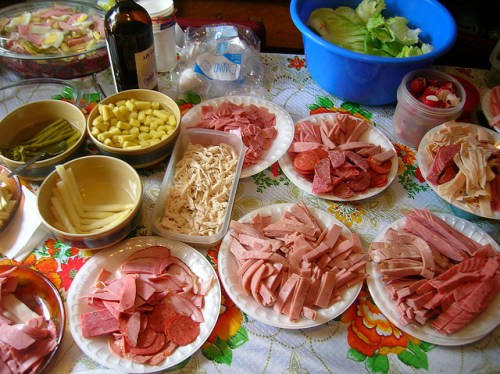
Allegedly, the origins of fiambre are rooted in the tradition of bringing ancestors their favorite foods in honor of Dia de Todos Santos. Gradually, according to legend, all of the dishes of food brought to the the graves of the dead were combined to create one large dish of fiambre. Fiambre, unlike many other celebratory dishes, is truly only served on this day, and requires a lot of preparation. The fiambre components have to be sliced and chopped and the assembled fiambre is marinated over night, and is served chilled. Given the amount of ingredients (see below for a sampling), it looks incredibly time-consuming. These two recipes from Growing Up Bilingual and The Latin Kitchen give you a good idea on the preparation of fiambre.

Fiambre ingredients – by guillermogg

1 Comment

Filed under Holidays, World Eats

Dia de los Muertos and Pan de Muerto

It seems like the iconic sugar skulls for Día de los Muertos/the Day of the Dead, have become increasingly popular in mainstream US culture – I have even seen recommendations for calavera Halloween costumes! But we cannot forget about the other sweet staple that is a necessity for any ofrenda (an altar set up to commemorate the dead) – Pan de Muerto – literally, “bread of the dead.”

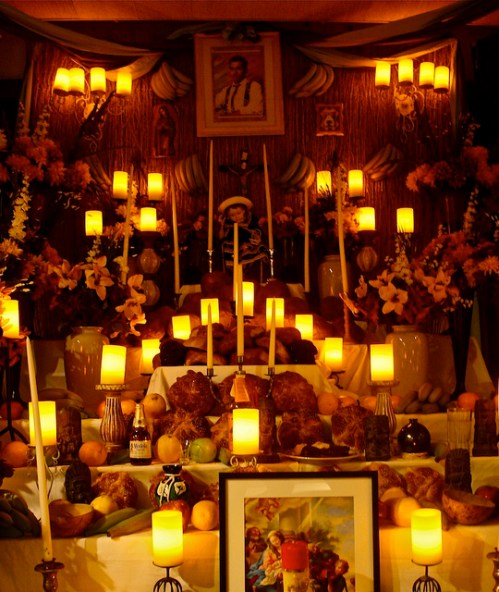
An Altar in Seattle with Pan de Muerto – by jeck_crow

Dia de los Muertos as celebrated today is a combination of Pre-Columbian and Catholic traditions and encompasses All Saints’ Day (Nov 1) and All Souls’ Day (Nov 2). The purpose of the holiday is to commemorate and celebrate deceased ancestors and relatives, and the purpose of the pan de muerto on the ofrenda is to provide sustenance for the souls of the returning relatives. For this same reason, other favorite foods and drinks of the deceased are included on the ofrenda. However, not just used as an offering, Pan de muerto is also eaten in the period leading up to Día de los Muertos, and is a mainstay in bakeries and cafes during the season.

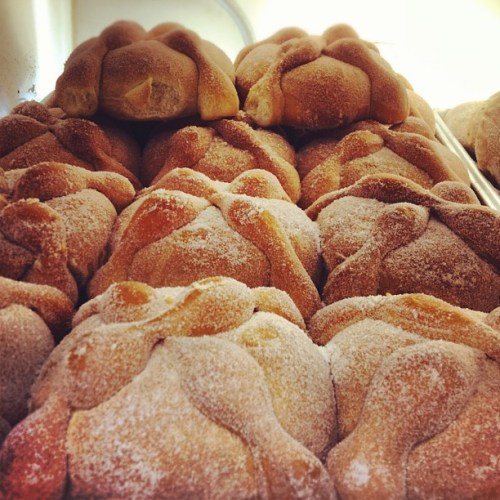
Pan de Muerto in the Zocalo, Mexico City – by Ericrkl

Pan de muerto is a simple sweet bread, think brioche, that is flavored with orange blossom water, orange zest or anise (or all of the above). Pan de muerto takes on different shapes, depending on the region, and the iconic Mexico City version of pan de muerto is usually round with strips of dough representing bones crisscrossed on the top. Pan de muerto may be topped with sesame seeds or a generous helping of sugar (as seen below). Though the round versions are the most common in the US, other other versions have the bread made in the form of little people, bones, angels or even for elaborate shapes. Check out this recipe from Cooking in Mexico to make some Pan de Muerto of your own. Kitchen Parade even has a tutorial to show you how to make the distinctive “bones” for your bread.

4 Comments

Filed under Holidays, World Eats

Marranitos/Puerquitos for Dia de los Muertos

Marranitos made by the Muy Bueno Cookbook Blog

Dia de los Muertos is less than two weeks away – so it’s time to start gathering some recipes to celebrate. We’ve previously featured sugar skulls, but for those looking for a different sort of treat for the Day of the Dead might want to try these delicious gingerbread pigs called, alternatively, marranitos, cochinitos, or puerquitos (all variations on “little pig”). These little pig cookies are made with a generous helping of molasses and unrefined cane sugar, piloncillo, giving them a rich gingerbread-y flavor. The marranitos above were made by the Muy Bueno cookbook blog, which provides a recipe as well as a lovely photoshoot and accompanying story. Marranitos are cut using a special pig-shaped cookie cutter, and as you might be able to tell, they are quite a bit larger than the typical cookie. Not strictly a “Dia de Los Muertos” food, marranitos are enjoyed year round and are especially good with coffee for a light breakfast. We found a large pig cookie cutter for sale on CopperGifts, and we definitely think we need to add some of these pig cookies to our repertoire.

2 Comments

Filed under Holidays, World Eats

Portuguese Pastry Post-Doc: Pão de Deus

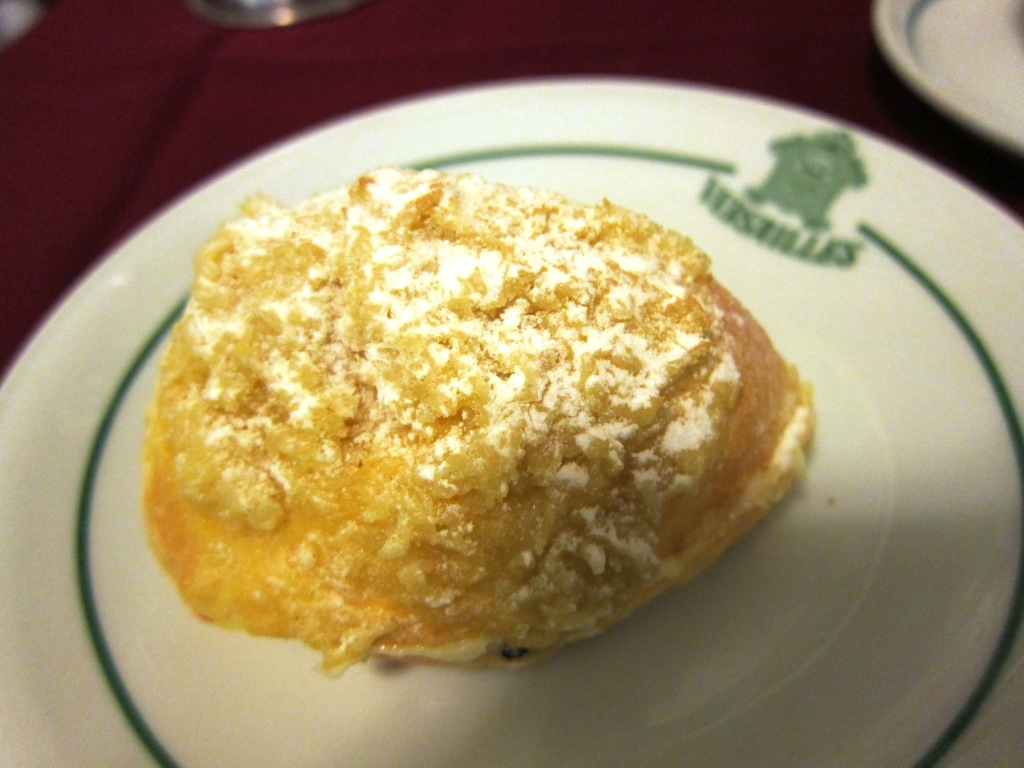
The pastries in Portugal are often  quite uniquely – almost poetically – named. Case in point – Pão de Deus – God’s bread.  Many of Portugal’s most iconic pastries originated in convents many centuries ago, perhaps accounting for the recurring religious allusions in pastry names. In appearance, Pão de Deus is somewhat more humble of a creation than its name implies. It is a sweet brioche roll with a topping of coconut and a shower of powdered sugar.  The coconut develops a gooey almost macaroon-like texture beneath the surface, and is pleasantly crispy on top. As seen below, the Pão de Deus we sampled from Pastelaria Versailles (review coming soon) came with a healthy slather of butter, and if you are feeling especially hungry you might even include some ham and cheese! Pão de Deus is a typical breakfast all across Portugal, though it is not very well known outside of the country. Home Gourmets has a recipe for Pão de Deus if you are feeling nostalgic for some Portuguese patisserie, or are looking to try it for the first time.

2 Comments

Filed under Pastry Post-Poc, World Eats