Category Archives: World Eats

Chocolates + Macarons = Les Macarolats

We spent a wonderful weekend in Paris last December with our friends T & I, where we determined the best macarons in Paris. Though our international paths are nearly missing each other again, we were lucky enough to see them before we left for Portugal. We were so grateful and surprised when they gave us Macarolats from Michel Cluizel as a going-away present, and it was a wonderful reminder of our time in Paris. So you’re probably thinking, “What on earth is a Macrolat?” It is basically a filled chocolate in the shape of the iconic macaron.

The flavors included in our box of 5 Macrolats were: Dark chocolate ganache, Caramel ganache, Coffee ganache, and Crunchy hazelnut praline. All of the flavors were absolutely delicious! Our favorites were the caramel and hazelnut varieties, which were impossibly rich. What’s more, Macrolats are more transportable than the delicate Macarons (they made the journey across the Atlantic unscathed) – practical and delicious!

Leave a comment

Filed under World Eats

Sukiyabashi Jiro: The $20-a-Minute Meal

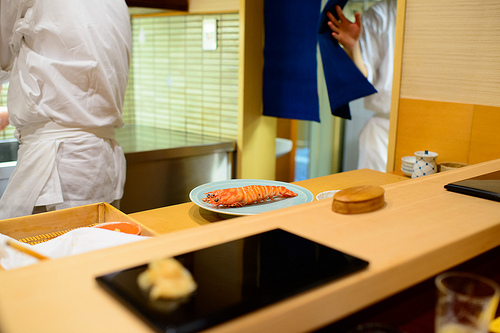
Recently, I posted about the wonderful documentary film about sushi expert Jiro Ono, Jiro Dreams of Sushi. Via Kottke.org I found an account of A Life Worth Eating’s recent visit to Jiro’s restaurant, Sukiyabashi Jiro, where the entire meal lasted a mere 19 minutes, with a tab of $380. You can check out the entire stunning meal on Flickr.

A scene from Sukiyabashi Jiro

Leave a comment

Filed under Links, World Eats

Japan: Jiro Dreams of Sushi

We recently watched the documentary, Jiro Dreams of Sushiabout Jiro Ono, a dedicated Japanese Sushi chef that has earned three Michelin stars for his tiny restaurant  Sukiyabashi Jiro in a Tokyo subway station. Jiro was the first sushi chef to ever receive 3 Michelin stars and it is clear that his life is completely dedicated to perfecting his craft. The movie is beautiful and engrossing, and I guarantee you will have a newfound respect for sushi. Anthony Bourdain has stated that it is his favorite sushi experience, and we agree that the tasting menu looks amazing.

1 Comment

Filed under Reviews, World Eats

The Mystery of Sweden’s Green Princess Cake: Prinsesstårta

A Princess cake in Stockholm, by Peter Sunna

One of the most striking cakes we have ever seen is the Swedish Prinsesstårta, or “Princess cake.”  It is called a princess cake because it was said to be a favorite of the daughters of Prince Carl, Duke of Västergötland – princesses Margaretha, Märtha and Astrid. Since its creation in the 1930s, it has been popular for special occasions in Sweden. This festive cake is covered in green marzipan, one of the rare sweets to have green as its principal color. CakeSpy did a wonderful post researching why the princess cake is green (unfortunately the answer is still unknown). The cake, while beautiful, seems fairly labor intensive. Just take a look at the cross section on the Baking Obsession site for a better idea – the components are layers of genoise cake, jam, and buttercream, all covered by a dome of whipped cream and the distinctive marzipan. If you are feeling up to the task War and Yeast and have great step-by-step recipes. We think we will stick to getting the cake from the experts, Swedish Bakery (5348 N. Clark, Chicago).

1 Comment

Filed under World Eats

Brazil: Suco de Clorofila (Chlorophyll Juice)

The rundown of juices available at the trifecta of Açai bars in Farrol de Barra in Salvador da Bahia, Brazil is mind boggling. However, most of the fruits in question were something we had heard of – Jackfruit, Apple, Mango, Passionfruit, etc. However, one of the juice choices stood out as something utterly bizarre and untranslatable – Clorofila. Yes, that’s Portuguese for Chlorophyll. We were completely intrigued by the idea of ordering chlorophyll juice so one day we decided we had to try it. True to name, the juice was shockingly bright green – but the taste was something completely bizarre. It tasted like a mix of bubblegum, mint, green apple and pineapple. L likened it to the fluoride foam they used to put on your teeth when you went to the dentist as a kid (remember that?). While not disgusting, I don’t think we’ll ever order it again. Unfortunately we neither turned green nor started processing sunlight into energy. We also remain skeptical – was that really chlorophyll (even if it was just used as a colorant), or just a mix of juices that are green? Our hunch is towards the latter option. So, will we ever unravel the mystery of the clorofila drink? Can you help us?

Leave a comment

Filed under World Eats

Turkey: Dining Under the Galata Bridge in Istanbul

Some destinations have “must-do” experiences, visiting the Eiffel Tower, the Golden Gate Bridge, etc., but our favorite requisites tend to be food-related. One quintessential Turkish dining experience is enjoying a meal under the Galata Bridge that spans the Golden Horn in Istanbul. In terms of natural and architectural beauty, Istanbul is a grand city, and the Bosphorus plays a huge part in its history and the landscape. Though we found plenty of awesome cheap food in Istanbul, you can hardly beat the panoramic setting of the Galata bridge. It’s also the perfect place to take in some of the city and its people. The bridge is always bustling, full of pedestrians and fishermen. If you’re craving a Galata dining experience, there are two ways you can go, dining under the bridge itself, or dining on the neon-bedecked fishing boats docked on the Eminonu side of the river.

We chose to eat underneath the bridge, (partially because we ended up on the side of the river opposite of the neon boats). There we found a range of eateries serving seafood, from dirt cheap to more expensive, packing in both crowds of tourists and locals. The cuisine is not the draw though, the views are. We found a restaurant serving simple fish sandwiches for 5 Lire and a particularly potent Turkish coffee. Next time around we would love to try the neon fish boats, which were literally jumping and rollicking and blasting music as the sun set.

Leave a comment

Filed under World Eats

Diverse, International Restaurants in London

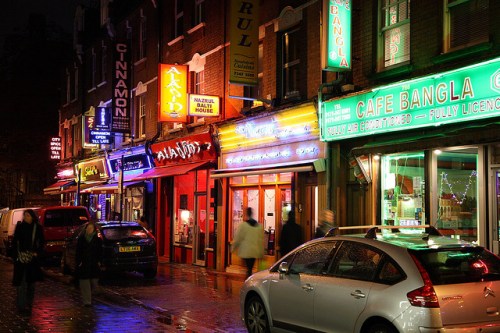
So the Olympics are officially over – and we are sad (though we are looking forward to Rio)! However, while the international athletes may have gone home, the international food scene in London is only growing. With over 8 million people, London has an amazingly diverse population and food scene. Indian food, arguably the most popular cuisine in the UK, is found nearly everywhere in the city, and there are amazing Indian restaurants for every budget. While London has long been home to South Asian food on Brick Lane and has a Vibrant Chinatown, it is home to many other far-flung cuisines.  London Ethnic Eating is a blog dedicated to exploring ethnic food in the city, turning up eateries ranging from Vietnamese to AlgerianTime Out London’s List of top 50 restaurants includes many international options.

Brick Lane at Night

1 Comment

Filed under Links, World Eats

Nasi Lemak: National Dish of Malaysia

Until a few days ago, every medal won by the country of Malaysia had been won by a male in badminton,. That all changed with 19 year-old Pandelela Rinong, who won a bronze medal in women’s 10 meter platform diving. Rinong was also the flag-bearer for her country at the opening ceremony, and it is easy to see why: the interview she conduced with NBC reporters after winning her medal could have been a commercial for the Malaysian tourism board, with Rinong endlessly beaming with pride over being Malaysian.

The national dish of Malaysia is Nasi Lemak, a rice-based dish cooked in coconut milk and served on a pandan leaf. The name translates to “rich” or “fatty” rice, a name derived from the cooking process: the rice is steamed and simmered in coconut milk, giving it a rich and creamy texture and flavor. That done, the nasi lemak is served with any number of accompaniments, depending on the time of day (it can be breakfast, lunch, or dinner): this usually includes sambal, along with sliced cucumber, hard-boiled egg, anchovies (usually fried), roasted peanuts, and meat. Then, just mix and match the flavors any way you wish! We can only assume the dish is plentiful at all times of day on Jalan Alor, the main eating street in Kuala Lumpur, but unfortunately we did not sample it on our 12-hour layover tour of KL in 2010. We’ll have to go back – Pandelela, want to take us on a tour of your capital? You seem just like the person to do it!


2 Comments

Filed under Reviews, World Eats

Seswaa: National Dish of Botswana

File:Flag of Botswana.svgCongratulation to Nijel Amos of Botswana, who earned the first-ever medal for his home nation by finishing second in the men’s 800 meters! In celebration of his achievement, we learned a little about Seswaa, arguably Botswana’s national dish. Seswaa (also called Chotlho) is a mashed-meat stew, often reserved for special occasions. It’s preparation is simple: typically cooked by men, chunks of meat are slowly simmered in salt and water in a three-legged iron pot (like the ones pictured below courtesy of our friend Brendan). Margarita’s international recipes has a rather humorous recollection of trying to pound the meat with a wooden spoon to produce the desired result, but with little luck – for her, the gristle seemed to prevent a proper pounding, so she had to resort to shredding instead.

Image

And if you don’t want to try Seswaa or one of the any other great Botswana dishes, you should give a Mopane worm a try!

Leave a comment

Filed under World Eats

Top Food Trucks in London

It is no secret that we are mad about food carts, and we consider them to be one of America’s most important exports. Food cart culture has spread to Paris in recent years and has taken root in London. It is worth noting that food “cart” and food “truck” have very different connotations in British English, with food carts having a somewhat dubious reputation. Not to fear though, high quality and innovative food trucks are on the rise in London, right on the heels of booming food truck culture in the US. The variety of London food truck is admirably vast and street foodies can choose from gourmet burgers, curry, chocolate, Vietnamese, and Mexican, among others.

The Luardos Food Truck in London

The Guardian has a list of food trucks picks in London , along with some mouth-watering recipes from each (we are especially digging the Carnitas recipe from Luardos). Migrationology has another round of 6 picks, including meatballs and hotdogs (sounds a little familiar to Chicago, no?). Another truck that found its way onto nearly all of the lists was Crêperie Nicholas, a fan-favorite for crêpes, served out of a restored 1965 Citroën truck. Southern food has also made its way to London, and the Pitt Cue Co. truck even offers pulled pork. This extremely important development means we could move to London easily, should the need arise. Most intriguingly we are excited to note the appearance of the HMS Flake 99, an ice cream truck that doubles as a BOAT (see below). For the latest in London street food developments, you can keep up with the Eat.st site.

HMS Flake 99 photo by Eater

2 Comments

Filed under World Eats

Oil Down / Oildown: The National Dish of Grenada

Kirani James of Grenada delivered his country’s first gold in medal in style with what looked like an effortless win in the 400 meter dash. Though we are fans of Caribbean cuisine, tiny Grenada tends to fly under the radar of other larger nation’s cuisines like Trinidad and Jamaica. The national dish of the country is the colorfully-named Oildown or (Oil Down), a fact even corroborated by the government of Grenada. Oildown is a stew made with coconut milk with a variety of salted meat or fish, dumplings,  saffron, dasheen (taro leaves), breadfruit and whatever veggies may suit your fancy. At its core, oildown seems to be a cousin of the Brazilian moqueca, another stew with a coconut milk base.

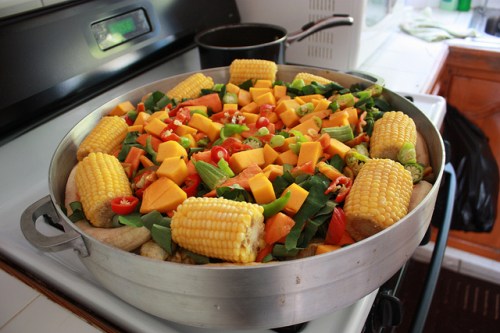
Oildown in Production by SnarkleMotion

So where does it get its name? According to popular legend, the name of oildown comes from the cooking of the veggies in the coconut milk, where most of the milk gets absorbed, leaving the oil behind. Like any good dish, the best oildown is made by everyone’s grandma or mom, and in a tradition we quite enjoy, it is best enjoyed when made on the beach.  Not to be confined to the borders of Grenada, there are even Trinidadian versions of Oildown.

1 Comment

Filed under World Eats

Chicken Tikka Masala: National Dish of Britain

Mughal_Empireunited_kingdomIndia Flag

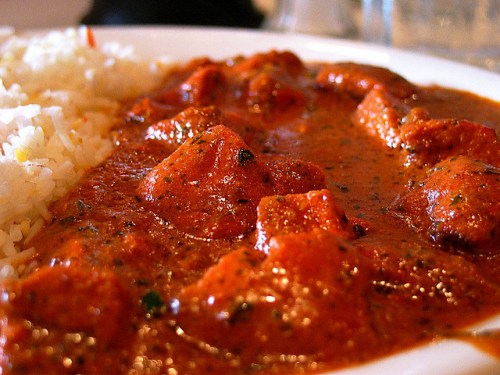
Until about a week ago, Team GB had all but struck-out in the medal department at their home Olympics. Fast forward half a fortnight, and their 16 golds places them third on the overall list, as well as garnering them today’s national dish highlight at ETW – chicken tikka masala. Wikipedia offers this succinct definition: “Chicken tikka masala is chicken tikka, chunks of chicken marinated in spices and yogurt, that is then baked in a tandoor oven, [and] served in a masala (‘mixture of spices’) sauce.” The recipes variations are as wide-ranging as its origin histories, but nothing obscures its popularity. Recently Robin Cook, the British Foreign Secretary, declared chicken tikka masala as the new national dish of the United Kingdom. Today, 1 in 7 of all curries sold in Britain are tikka masala, and it is the most popular restaurant dish in the country. But while tikka masala is unquestionably popular in Britain, and has been declared the national dish, its transnational origins reveal a fascinatingly complex and controversial history.

Chicken Tikka Masala at Akbar’s Indian Restaurant in Santa Monica, CA.

Continue reading

10 Comments

Filed under Uncategorized, World Eats

Pabellón criollo: National Dish of Venezuela

Pabellón Criollo from Wikipedia

Many congratulations to fencer Rubén Limardo, winner of Venezuela’s first Olympic gold medal since the 1968 Mexico City games. In honor of this achievement, it’s time for some Venezuelan food! When we think of Venezuelan cuisine what immediately comes to mind are arepas – filled pockets of corn dough that strike the perfect carb-to-filling ratio. Though arepas are popular – the quintessential Venezuelan dish is Pabellón criollo (which translates roughly to “Creole Flag”) – a comforting dish of rice and beans with shredded beef. Similar variants of the mother dish of rice and beans are popular throughout South and Central America, as well as the Caribbean. Fried plantains are also an essential component of Pabellón criollo and for a variation, you can get your dish served with a fried egg, which is called a caballo (“on horseback”). The secret to the dish, however, is in the sofrito, the fragrant triumvirate of bell pepper, onion and garlic.  What’s for Eats has a delicious-sounding recipe as does Venezuela cooking (with each component broken into a separate recipe)– seems like good party food!

2 Comments

Filed under World Eats

Beshbarmak: National Dish of Kazakhstan

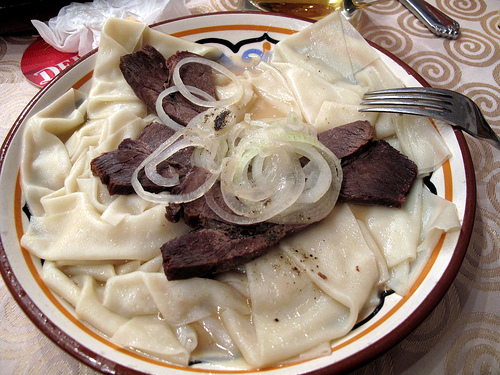
Beshbarmak photo from PeretzP

In the early morning hours on the first full day of the 2012 Olympics we saw Kazakh athlete Alexandr Vinokurov win the men’s cycling road race. In honor of this feat we decided to do a little feature on Kazakh food, especially the national dish, Beshbarmak. The name means “five fingers,” and as this implies, the dish is usually eaten by hand, and is a favorite for special events like weddings. It is usually made with horse meat (owing to the traditionally nomadic nature of the country), potatoes, onions and very wide noodle sheets. The dish is also popular in Kyrgyzstan, where it is also claimed as a national dish.  Foodista has a recipe for Beshbarmak using the more conventional for western tastes choice of lamb.

1 Comment

Filed under World Eats

Switzerland’s Röstigraben: Culinary Divide Between West and East

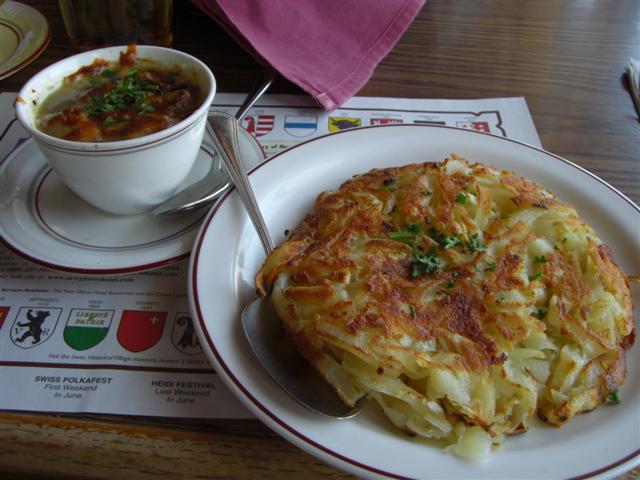
We here at ETW love the Olympics, so we are excited to cover some international cuisine as it relates to this very international sporting event. An important spot for the Olympics is Lausanne, Switzerland, home of the International Olympic Committee. An awesome Swiss Geopolitical and food related concept (how fun!) is that of the Röstigraben. It garners its name from the grated potato dish Rösti, which originated in Bern and is popular in the Swiss German areas. We were first introduced to the Röstigraben through the Strange Maps blog, and it is a strange map, represented above by Switzerland in the shape of a Rösti. The Röstigraben is the divide between the cultural areas of eastern German and western French Switzerland, which is further described in this National Geographic article. Lausanne, as it so happens is on the Western side of the Röstigraben.  Well west of the Röstigraben, we enjoyed some very nice Rösti in the heavily-Swiss New Glarus, Wisconsin. Yumblog has a recipe for Rösti, which looks easy as pie.

Rösti in New Glarus, Wisconsin

Leave a comment

Filed under World Eats

Spaghettieis: Ice Cream that looks like pasta?

Spaghettieis from Wikipedia

It’s going to be another hot day in Chicago (seems like we’ve been saying that nearly every day this month) so we figured it was time for another ice cream post. This one is a little more surreal than usual. We saw a link on Boing Boing about Ice-cream that looks like spaghetti – spaghettieis. and we were thoroughly intrigued. Apparently this confusing German treat is composed of vanilla ice cream extruded through a Spaetzle Press/Pasta Extruder/Play-dough mold to look like spaghetti. To complete the spaghetti-dinner look, the ice cream is topped with some sort of red berry sauce, and finally covered in coconut shavings. Since its invention in the 1960s, spaghettieis has become something of a national dish in Germany. For more proof of its popularity, check out the huge amount of spaghettieis documentation of Flickr. We’re pretty impressed at the verisimilitude!

Leave a comment

Filed under World Eats

The Renaissance of the French Baguette

Image
Image: Afar Magazine

When one thinks of French bread, artistry, tradition and quality probably come to mind. However, we were very surprised to learn that in Post War France, quality bread was hard to come by. Quelle horreur! Afar Magazine has a fascinating article about the fall and rise of bread in France, and how the writer apprentices with one of the current arbiters of the artisanal bread tradition.

In 1987 a cultural critic writing in the French newsmagazine Le Nouvel Observateur proclaimed that the baguette had become “horribly disgusting.” It was “bloated, hollow, dead white,” he said. “Soggy or else stiff. Its crusts come off in sheets like diseased skin.” Renowned French baking professor Raymond Calvel mused that the best baguette might soon be made in Tokyo. What had brought this on? And how was quality bread revived in the 1990s? The answers to these questions lay in Paris, which is what brought me to the door of Boulangerie Arnaud Delmontel at three that morning last February.

Leave a comment

Filed under Links, World Eats

American Independence Day…in the UK

We cover a lot of international holidays and festivals on ETW, but that got us thinking, in every other country American holidays are international. So what kind of recommendations would those in other countries give to celebrate the American holidays (if we could find such sites)? We did some scouting, and came up with some international, specifically UK, sites that had recipes to celebrate July 4th at home. We noticed a trend toward BBQ, which makes sense given the cookout tradition of the 4th. The Good Food Channel in the UK suggested Cherry Pie and Pork Ribs. The BBC went even more BBQ heavy with pulled pork and a few varieties of ribs. It’s interesting to see some of the other recipes the BBC has in the “American” section, like fluffy American pancakes.

Leave a comment

Filed under Holidays, Links, World Eats

Dondurma (Turkish Ice Cream) on a Hot Day

On a hot summer’s day there is nothing better than some ice cream, and given this current heat wave (seems like Brazil in Chicago here today with the humidity) we could use a LOT of ice cream. One of our favorite ice cream permutations is Dondurma, a stretchy and pliable ice cream from Turkey. Dondurma has a texture unlike any commerical American ice cream (almost like taffy), and is flavored with mastic and thickened with salep, a type of flour made from orchids. If you have an ice cream maker, here is a recipe for DIY dondurma. However, part of the fun of dondurma is watching the dondurma sellers prepare the ice cream – we saw them all over Istanbul – check out the video of a seller below.

Leave a comment

Filed under World Eats

Origin of the Taco

Chorizo Taco from Carniceria Guadalajara in Chicago

They may be wildly popular in Mexico, the US and…pretty much everywhere else, but what is the exact origin of the taco? We can assume they are from Mexico, but what beyond that? Though somewhat shrouded in mystery, this Smithsonian Magazine interview with Mexican food expert Jeffrey M. Pilcher, professor of history at the University of Minnesota, talks about the history of the taco.

The origins of the taco are really unknown. My theory is that it dates from the 18th century and the silver mines in Mexico, because in those mines the word “taco” referred to the little charges they would use to excavate the ore. These were pieces of paper that they would wrap around gunpowder and insert into the holes they carved in the rock face. When you think about it, a chicken taquito with a good hot sauce is really a lot like a stick of dynamite. The first references [to the taco] in any sort of archive or dictionary come from the end of the 19th century. And one of the first types of tacos described is called tacos de minero—miner’s tacos. So the taco is not necessarily this age-old cultural expression; it’s not a food that goes back to time immemorial. [Read more here].

Leave a comment

Filed under World Eats