
We are back in America (for the time being). In the words of James Brown, “Superhighways and coca cola…” but perhaps most importantly for us: cheap peanut butter, BBQ, sharp cheddar cheese, Greek Diners, Taquerias and Thai food. Only one month and a few important holidays to indulge in before we leave for Brazil!
Category Archives: Holidays
Sephardic recipes for Hanukkah
 While Ashkenazi (Eastern European) Hanukkah foods may be more well-known in the USA, Sephardic (Mediterranean) traditional foods are worth a second look if you are hoping to switch up your Hanukkah menu. The mix of Jewish traditions and Mediterranean flavors is definitely a good one. I am very interested to try Jessamyn’s Sephardic Challah Recipe, which seems different than its eggier Eastern European counterpart. Other traditional Sephardic Hanukkah foods include buñuelos, a Spanish cousin to sufganiyot, and even fried turnips. Buñuelos, (aka Bimuelos, Burmuelos, among others) were initially created by Spanish moriscos, but have since spread in popularity across Latin America.

Bunuelos / Bimuelos by Joe Goldberg
Holiday Glögg for St. Lucia Day
 St. Lucia’s Day is a Swedish holiday that occurs on December 13th, marked by feasts and candles. Despite it being pretty dark in Sweden in the weeks leading up the Christmas, St. Lucia’s day and Advent as a whole are a great time of celebration filled with lots of light. We have written about some sweet treats like Lussekatter and pepparkakor that are used to celebrate the holidays in Sweden, but if you need some warming up the best prescription is Glögg, a mulled red wine. Glögg is so integral to the holiday season, there are dedicated “Glögg parties.” While you can buy Glögg at many stores, it is definitely more fun to make your own.

Glogg by Aya Patron
Filed under Holidays, World Eats
Holiday Eats Around the World: Sufganiyot for Hanukkah
Happy Hanukkah! Hanukkah in America is often associated with latkes, however, an equally delicious treat is popular for Hanukkah in Israel – Sufganiyot – a type of a jelly doughnut. There has long been a tradition of associating fried foods with Hanukkah due to the importance of oil to the holiday, and Sufganiyot is a mash-up of North African and European traditions. Here is a recipe for Sufganiyot, with a classic jelly filling – though you might find them with any manner of exotic fruit or cream fillings. For another twist, try these Sufganiyot-inspired cupcakes.

Sufganiyot for Hanukkah- by Avital Pinnick
Filed under Holidays, World Eats
Traditional Dutch celebration foods for Sinterklaas
 Though in the USA, Santa Claus is the symbol of the holiday season, in Europe it is St. Nicholas that children wait up for on December 5th. Sint Nikolaas, in Dutch, is then typically known as Sinterklaas, and is considered the precursor to the American concept of Santa. The figure of Sinterklaas is indeed similar to Santa, a benevolent figure wearing a red robe and delivering presents to children, though he rides a horse on his journey from house to house. Kids, instead of leaving milk and cookies, leave carrots for the horse beside their shoes (which is where the presents get delivered – if you are naughty you will be left with an empty shoe).
Sweets abound at Sinterklaas celebrations both on the 5th and 6th, including one of our favorites, the crisp, cinnamon speculaas cookies. Other sweet treats include pepernoten (same as German pfeffernüsse) and kruidnoten, similar to speculaas, but in more of a nugget shape. Many Dutch recipes instruct you to make kruidnoten with pre-blended “speculaas spice” which is definitely not available in the USA. However, to make your own, the Dutch Baker’s Daughter has a good DiY speculaas spice breakdown. Another food tradition is getting a large chocolate letter representing your first name called a chocoladeletter. Sinterklaas is definitely a day with tradition – many of the festive occurrences in this 17th century painting by Jan Steen (note the empty shoe) remain unchanged today.

Jan Steen – Het Sint Nicolaasfeest / Festival of St. Nicholas
Filed under Holidays, World Eats
Roast Chestnuts herald the arrival of Winter in Lisbon
 One sure sign that fall has arrived in Lisbon is the appearance of the roast chestnut vendors. As the holiday season approaches, they only become more popular. If the air is crisp enough, it is not uncommon for the Baixa area of Lisbon to be filled with smoke and steam from the roast chestnuts. The typical setup is a metal cart, as seen below, but there are some other nifty arrangements where the chestnut roaster is attached to the front of a motorcycle. For about 2€ you can get about a dozen chestnuts. The chestnuts are completely charred and perfect for staving off the winter chill, definitely a must-do for anyone visiting Lisbon in the colder months.
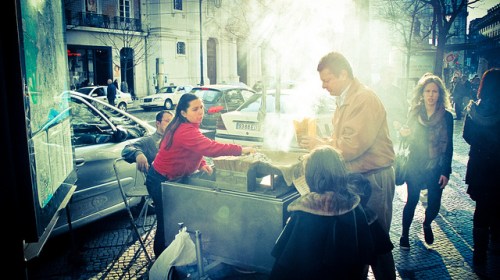
Chestnut vendors in Lisbon by Sr. Nefasto
Filed under Holidays, World Eats
Celebrating American Thanksgiving while Abroad
 Happy Thanksgiving! Feliz Thanksgiving! This year we are spending Thanksgiving abroad in Lisbon, so we will have to miss out on the traditional feast. However, we are going to do the best we can in a country that isn’t too fond of turkey and with an oven that doesn’t exactly work. The Kitchn has tips to get back to basics and cook a simple Thanksgiving meal, which is what we will attempt. We know we will be buying a celebratory pie or tart, though (Do Pasteis de Nata count as miniature pies?)! As suggested by Farsickness, it is a good idea to check out celebrations in the area, but we are not really up for a Saturday night Thanksgiving at the Hard Rock Cafe, thus far the only option is Lisbon. We are definitely not alone in our Thanksgiving saudade (nostalgia), Bon Appetit is also featuring stories of Americans celebrating Thanksgiving in Rome and Lebanon.
Diwali Mithai: Celebrating the Festival of Lights with sweet treats
 Happy Diwali! It is the first day of the Hindu Festival of Lights today, which mean a time for family, togetherness, celebration, and naturally lots and lots of delicious foods. Foods eaten on Diwali vary widely by location and family, however it is generally agreed that there should be a large assortment of sweet treats. Of course, we are absolutely for any excuse to put out a huge dessert spread. As part of the Diwali celebration, street fairs, or melas, are often set up, providing entertainment and selling any manner of delicious foods. The little sweets are known as mithai, and are:
“ a cross between snack, dessert and confectionery. If there’s one thing that captures the Indian culinary psyche, it’s mithai. Little morsels are nibbled throughout the day, on their own, with masala chai or as part of a meal alongside savoury items.”
If you are not near a Diwali market, or would simply like to prepare some mithai of your own, the Guardian has a slideshow of some of the most quintessential Diwali sweets to inspire you. For those looking to make their own mithai, I Love India, SpicyTasty, Rak’s Kitchen and Divya’s Cookbook have recipes for favorites like gulab jamun, laddu, barfi and jalebi. For a non-traditional take, why not make some truffles inspired by the traditional barfi sweets.

Diwali Market Sweets in Toronto by Chow Yun-Slim
Filed under Holidays, Pastry Post-Poc, World Eats
Pastry Post Doc: Torrone dei Morti in Naples
 The arrival of torrone, the delicious honey and nougat confection, means the holiday season is coming in Spain and Italy. We have had torrone many times before, but we have never seen the kind of torrone we recently encountered in Naples, which was sold by the slice, covered in chocolate, and at first glance, even looked like ice cream cake. Turns out this is “Torrone dei Morti” or “Torrone morbido”- “dead torrone” which is a traditional All Saints’ Day dessert with a base of cocoa. Neapolitan pastry shops were filled with this version of torrone at the end of October, in any number of nut, chocolate and fruit varieties. Our favorite was the gianduja, or hazelnut and chocolate blend, as seen below. Getting a slice of torrone will run you less than 1€ a slice, so you have every incentive to try many varieties. When we were in Naples we didn’t realize that this version of torrone was season-specific, so we don’t know if it will be on display at other times of the year. We hope it is! We looked for a recipe in English – and we finally found one – but Google Translate can help you out with some of the Italian versions.
Cross-Section of Gianduja Torrone in Napoli
Filed under Holidays, Pastry Post-Poc, World Eats
Panellets for La Castanyada – All Saints’ Day in Catalonia

Panellets for All Saint’s Day – by Xaf
 In the Catalonia region of Spain, All Saints’ Day (called Dia de Tots Sants in Catalan), is celebrated as La Castanyada. La Castanyada, true to the inclusion of chestnut in the name (castanyas means chestnuts), is celebrated in Catalonia by roasting and eating chestnuts and having a festive meal to celebrate the autumn season and honor ancestors that passed. One of the typical foods for La Castanyada are Panellets: round almond and potato cookies covered in pine nuts (who would have thought of that combination?). For more information on how to make panellets for yourself – check out this recipe.
Filed under Holidays, World Eats
Pão por Deus: “Trick or Treating” on All Saints Day in Lisbon
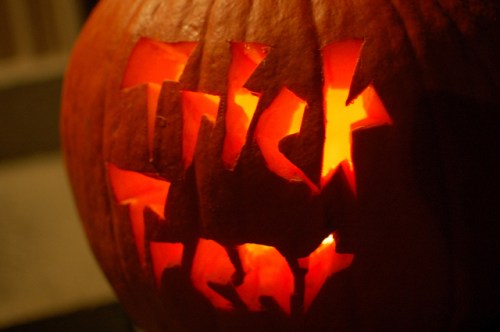
Trick or Treat? – By Chris Devers
They don’t have trick-or-treating on Halloween in Lisbon, but there is a similar tradition that occurs on All Saints Day, November 1st, called Pão-por-Deus. Instead of asking “Trick or Treat” Portuguese children go door to door asking, “Ó tia dá bolinho!?”(Originally – “Ó tia dá Pão por Deus?”) Literally – does auntie have any cookies? Traditionally the children would get bread from the neighbors and shop owners they visited, though it is now sometimes substituted for cookies, change or candies. This also leads to the other name for the holiday, “Dia de Bolinho.” Kids collect goodies in special drawstring bags, saquinhos, that are often decorated with embroidery or patches. Unlike Halloween, children go asking for Pão por Deus before noon (no costumes are involved, either).
November 1st, in addition to being All Saints Day, is also particularly known in Lisbon as the day of the destructive 1755 earthquake. This particular event is seen as triggering the Pão por Deus tradition, as the city was devastated and people had to go asking for food. The first Pão por Deus was held the following year, and continues today, though there is increasing influence form “Halloween”-type traditions. The holiday is most popular around Lisbon, but has also expanded to Brazil.
Filed under Holidays, World Eats
Foods to Celebrate Dia De Los Muertos
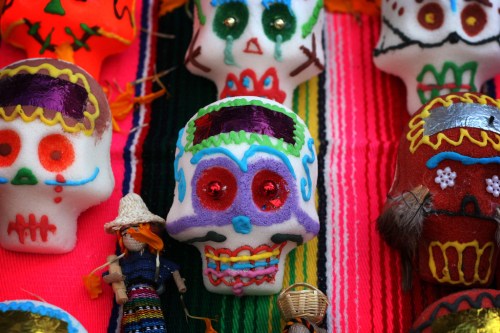
Sugar Skulls for Dia de los Muertos in California – by Gwen
Feliz Dia De Los Muertos! Happy Dia de Los Muertos! Looking for inspiration? Here are some posts ETW has done to commemorate the traditional foods enjoyed on this holiday:
- Pepitas – Pumpkin Seeds
- Pan de Muerto – Sweet anise and orange flavored bread
- Marranitos/Puerquitos – Pig-shaped gingerbread
- Sugar Skulls
- Fiambre – A Guatemalan Dia De Los Muertos treat
Filed under Holidays, World Eats
Dia de los Muertos in Guatemala: Fiambre
 While Dia Los Muertos is perhaps best known in the USA through its Mexican-style celebrations, it is a holiday celebrated throughout Latin America. I was doing a little research on other countries’ traditional foods, and came across Fiambre, a veritable Guatemalan smorgasbord served in honor of Dia de los Muertos/Dia de Todos Santos (All Saints Day). Fiambre is a chopped salad akin to a giant antipasti dish, which may include up to 50 ingredients , and weight up to 20 pounds. Of course there are as many variations as families, but a common denominator is a base of sliced meat, cold cuts, cheeses and sausages followed by veggies (carrots, broccoli, cauliflower, and more), topped with eggs, grated cheese, radishes and dressing. A signature touch is pacaya palm blossoms, a traditional Guatemalan ingredient.
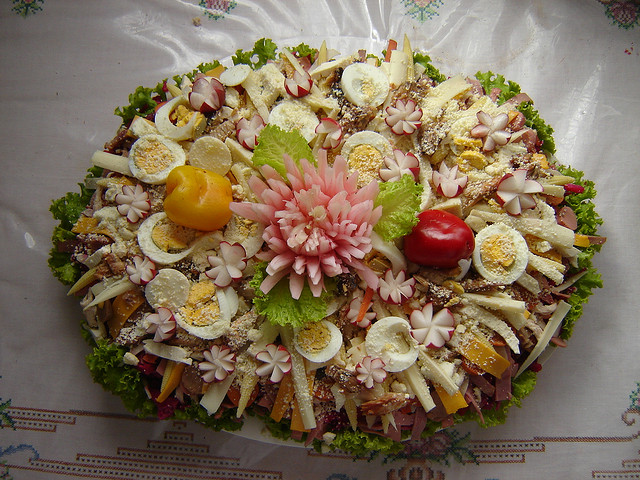
El Fiambre -by Keneth Cruz
Allegedly, the origins of fiambre are rooted in the tradition of bringing ancestors their favorite foods in honor of Dia de Todos Santos. Gradually, according to legend, all of the dishes of food brought to the the graves of the dead were combined to create one large dish of fiambre. Fiambre, unlike many other celebratory dishes, is truly only served on this day, and requires a lot of preparation. The fiambre components have to be sliced and chopped and the assembled fiambre is marinated over night, and is served chilled. Given the amount of ingredients (see below for a sampling), it looks incredibly time-consuming. These two recipes from Growing Up Bilingual and The Latin Kitchen give you a good idea on the preparation of fiambre.
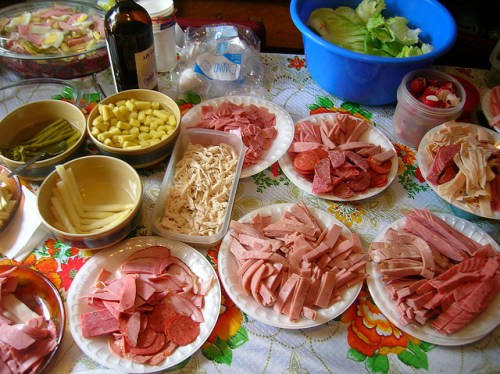
Fiambre ingredients – by guillermogg
Filed under Holidays, World Eats
Dia de los Muertos and Pan de Muerto
 It seems like the iconic sugar skulls for Día de los Muertos/the Day of the Dead, have become increasingly popular in mainstream US culture – I have even seen recommendations for calavera Halloween costumes! But we cannot forget about the other sweet staple that is a necessity for any ofrenda (an altar set up to commemorate the dead) – Pan de Muerto – literally, “bread of the dead.”
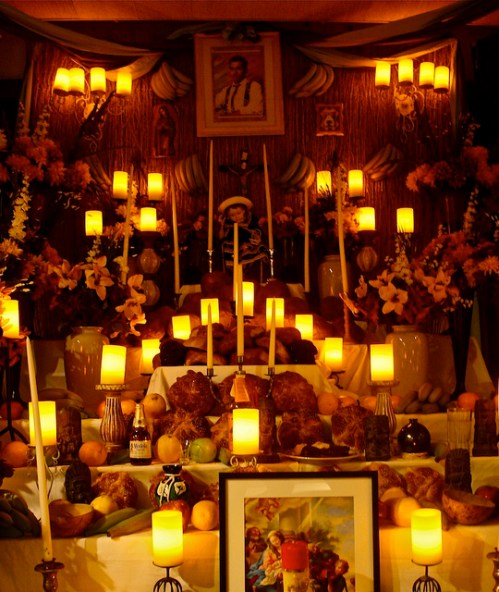
An Altar in Seattle with Pan de Muerto – by jeck_crow
Dia de los Muertos as celebrated today is a combination of Pre-Columbian and Catholic traditions and encompasses All Saints’ Day (Nov 1) and All Souls’ Day (Nov 2). The purpose of the holiday is to commemorate and celebrate deceased ancestors and relatives, and the purpose of the pan de muerto on the ofrenda is to provide sustenance for the souls of the returning relatives. For this same reason, other favorite foods and drinks of the deceased are included on the ofrenda. However, not just used as an offering, Pan de muerto is also eaten in the period leading up to Día de los Muertos, and is a mainstay in bakeries and cafes during the season.

Pan de Muerto in the Zocalo, Mexico City – by Ericrkl
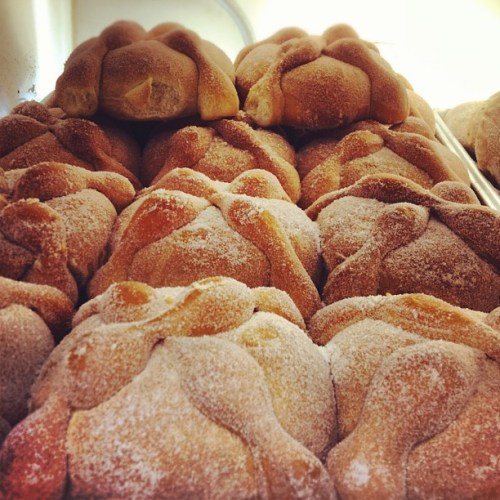
Pan de muerto is a simple sweet bread, think brioche, that is flavored with orange blossom water, orange zest or anise (or all of the above). Pan de muerto takes on different shapes, depending on the region, and the iconic Mexico City version of pan de muerto is usually round with strips of dough representing bones crisscrossed on the top. Pan de muerto may be topped with sesame seeds or a generous helping of sugar (as seen below). Though the round versions are the most common in the US, other other versions have the bread made in the form of little people, bones, angels or even for elaborate shapes. Check out this recipe from Cooking in Mexico to make some Pan de Muerto of your own. Kitchen Parade even has a tutorial to show you how to make the distinctive “bones” for your bread.
Filed under Holidays, World Eats
Marranitos/Puerquitos for Dia de los Muertos

Marranitos made by the Muy Bueno Cookbook Blog
Dia de los Muertos is less than two weeks away – so it’s time to start gathering some recipes to celebrate. We’ve previously featured sugar skulls, but for those looking for a different sort of treat for the Day of the Dead might want to try these delicious gingerbread pigs called, alternatively, marranitos, cochinitos, or puerquitos (all variations on “little pig”). These little pig cookies are made with a generous helping of molasses and unrefined cane sugar, piloncillo, giving them a rich gingerbread-y flavor. The marranitos above were made by the Muy Bueno cookbook blog, which provides a recipe as well as a lovely photoshoot and accompanying story. Marranitos are cut using a special pig-shaped cookie cutter, and as you might be able to tell, they are quite a bit larger than the typical cookie. Not strictly a “Dia de Los Muertos” food, marranitos are enjoyed year round and are especially good with coffee for a light breakfast. We found a large pig cookie cutter for sale on CopperGifts, and we definitely think we need to add some of these pig cookies to our repertoire.
Filed under Holidays, World Eats
American Independence Day…in the UK

 We cover a lot of international holidays and festivals on ETW, but that got us thinking, in every other country American holidays are international. So what kind of recommendations would those in other countries give to celebrate the American holidays (if we could find such sites)? We did some scouting, and came up with some international, specifically UK, sites that had recipes to celebrate July 4th at home. We noticed a trend toward BBQ, which makes sense given the cookout tradition of the 4th. The Good Food Channel in the UK suggested Cherry Pie and Pork Ribs. The BBC went even more BBQ heavy with pulled pork and a few varieties of ribs. It’s interesting to see some of the other recipes the BBC has in the “American” section, like fluffy American pancakes.
Filed under Holidays, Links, World Eats
Food for the Festas Juninas / Festa de São João

Festa Junina Dancers by Christoph Diewald
 June is a very important month in Brazil, especially due to the many mid-summer festivals called “Festas Juninas” – celebrating the three saints days of Anthony (June 13th – Santo Antônio), John (June 24th – São João) and Peter (June 29th – São Pedro). Festas Juninas are naturally filled with lots of merriment and delicious food. The events take place in large spaces with festive flags called an arraial, and there are elaborate dances called quadrilhas. The festivals are particularly popular in the Northeast of the country, and one rather humorous tradition is to dress up like a “caipira,” in a costume similar to what those in the US would think of as a “country bumpkin.” Though those outside of Brazil likely won’t be able to get the full Junina experience (though there are some celebrations in the US), there is certainly a lot of food to try. Corn based dishes are particularly popular including pamonha, bolo de fuba and Canjica (or Muzunga). Another popular Junina drink that I imagine would be a stateside hit is Quentão, mulled Cachaça. Peanuts also make an appearance in Festa Junina food, and a recipe for Doce de amendoim (Peanut Bars) can be found on the House of Pinheiro Blog.
Filed under Holidays, World Eats
Australian and New Zealand Sweets for Anzac Day

 We have to admit that there is a bit of a blind spot in our repertoire for Australia and New Zealand, perhaps due to their geographic distance and the fact that we don’t have any Aussie / Kiwi restaurants around here. So unfortunately, we don’t often give this area of the world its fair due. We would like to thank our commentor Whitney for writing to us about Australian treats, and we figured we would do a link roundup of some Australian and New Zealander desserts, especially since ANZAC day is coming up on April 25th.

Pavlova by AnneCN
- ANZAC Biscuits – Perhaps the most appropriate way to start – these are classic rolled oat cookies associated with ANZAC Day
- Lamingtons – chocolate and spongecake – what could be better!
- Vanilla Slice – the Australian take on the mille-feuille
- Pavlova – the famous meringue dessert named for Anna Pavlova
- Louise Cake – a coconut and raspberry cake that is a favorite in New Zealand
Filed under Holidays, World Eats
Global Easter Recipe Roundup
 Easter may be over, but that doesn’t mean that you can’t make holiday-themed food (and we aren’t going to be retiring our Peeps-shaped muffin pan). In that spirit, we have a roundup of some international carb-heavy Easter recipes for your enjoyment.
Pasta di San Giuseppe – St. Joseph’s Day Pasta

St. Joseph’s Day Pasta – by Erin Zieske
 March 19th is St. Joseph’s Day, a holiday celebrated in Southern Italy, or in communities of southern Italian Immigrants. Naturally, having the proper food is a huge part of St. Joseph’s Day, with many churches even constructing elaborate St. Joseph’s Day altars full of food. We’ve written previously on the most famous St. Joseph’s Day food – the fried sweet Zeppole – so this year we wanted to introduce another holiday dish – Pasta di San Guiseppe. There are many variations on the recipes – but at its core it is a dish of pasta and breadcrumbs. The pasta dishes made on this day are typically meatless to represent the famines experienced in Sicily. The breadcrumbs represent sawdust, which is symbolic of the profession of St. Joseph, carpentry. Another popular dish for St. Joseph’s Day is Pasta con Sarde (Pasta con Sardi in Sicilian) – pasta with Sardines [another version here].
Filed under Holidays, World Eats


 Eating The World