Category Archives: World Eats

A guide to street food in Sicily

After our visit to Next Sicily we have Sicily on the brain. We visited the real Sicily last fall on our honeymoon, and we loved the food there (no surprise). What we especially loved was the abundance of cheap, tasty street food. Palermo in particular is a street food mecca – with fast and delicious morsels being sold from stands or tiny storefronts on almost all corners. When we were headed to Palermo we shortlisted a few types of street food we had to try while there, and fortunately we were not disappointed. We set out right away to start sampling street food, and made a beeline to the markets, where street food is king. Below are the favorite street foods we sampled (and one even we were not brave enough to try). So let’s go to Palermo….

Panelle – Panelle is a riff on a falafel – and is composed of chickpea flour fried up on a hot griddle. It is then served in a pita or eaten alone. One wouldn’t think that this carby concoction would work, but it is actually quite delicious (fans of falafel will approve). We had some handmade Panelle griddled up for us at the bustling Ballarò market, a cool food market with a lot of awesome African stalls.
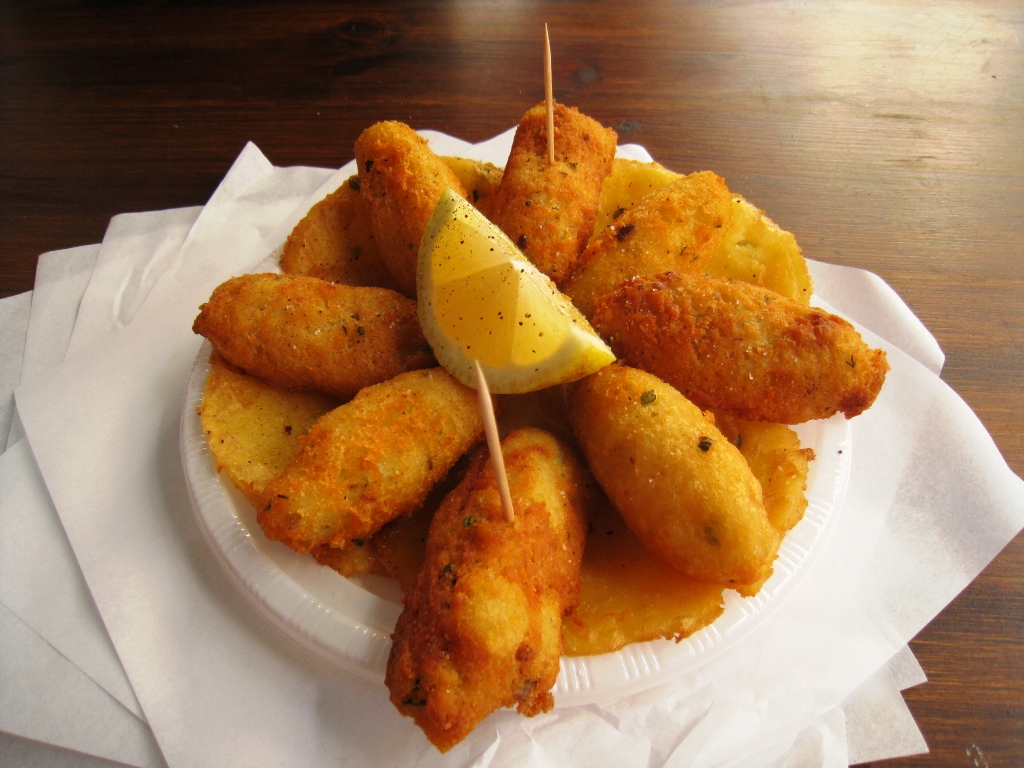
Crocchè – We dodn’t even realize our Panelle would be coming with a special topping – crocchè- a little fritter made of mashed potatoes and parsley. Think of them as the most delicious tater tots you will ever have. The crocchè are the top layer of the snack below, and panelle is the bottom layer. Don’t forget to add a squeeze of lemon to help cut through all of the starch.

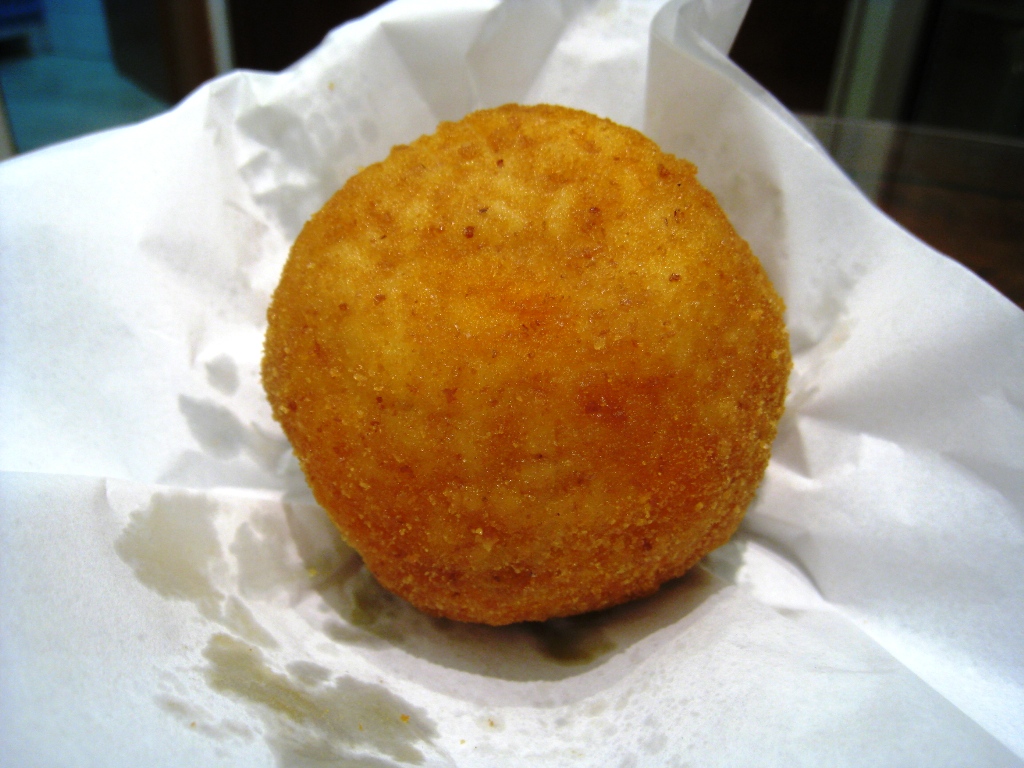
Arancini – The humble arancine is basically a fried dough ball filled with cheese and meat. However, the beauty of the arancine lies in its proper execution. If done wrong, an arancine is a gelatinous mealy blob that settles into a leaden ball in the pit of your stomach. Yes, we’ve had a few of those. However – when done right – the arancine is a warm gooey mess that does not leave you feeling like you ate a cannonball. Let’s just say – we had both varieties for Arancini on our Sicilian adventure. Arancine were found in pretty much every snack shop in Palermo, and one, Bar Touring, even specializes in giant arancini.

Pane cà meusa – Pane cà meusa is for braver stomachs than ours, and this street food dish consists of boiled calf spleen served in a roll. When happening across a pane cà meusa stall, you will usually find a hot bubbling cauldron of spleen. While its sheer popularity leads us to believe it is probably decently good, we would much rather take gelato in a brioche, thanks.
Gelato con Brioche – Saving the best for last, Gelato con Brioche is perhaps the most epic street food we have ever encountered in all of our travels. It is exactly what it sounds like, amazing gelato stuffed in a split brioche roll. Think of it as an ice cream cone carried to its next logical extreme. The first gelato in brioche we had even helped us get over the gruesome sites at the Convento dos Capuccinos in Palermo.

1 Comment

Filed under World Eats

Food for the Festas Juninas / Festa de São João

Festa Junina Dancers by Christoph Diewald

June is a very important month in Brazil, especially due to the many mid-summer festivals called “Festas Juninas” – celebrating the three saints days of Anthony (June 13th – Santo Antônio), John (June 24th – São João) and Peter (June 29th – São Pedro). Festas Juninas are naturally filled with lots of merriment and delicious food. The events take place in large spaces with festive flags called an arraial, and there are elaborate dances called quadrilhas. The festivals are particularly popular in the Northeast of the country, and one rather humorous tradition is to dress up like a “caipira,” in a costume similar to what those in the US would think of as a “country bumpkin.” Though those outside of Brazil likely won’t be able to get the full Junina experience (though there are some celebrations in the US), there is certainly a lot of food to try. Corn based dishes are particularly popular including pamonha, bolo de fuba and Canjica (or Muzunga). Another popular Junina drink that I imagine would be a stateside hit is Quentão, mulled Cachaça. Peanuts also make an appearance in Festa Junina food, and a recipe for Doce de amendoim (Peanut Bars) can be found on the House of Pinheiro Blog.

2 Comments

Filed under Holidays, World Eats

Our first – and last – visit to Testaccio Market

We absolutely love Italian markets. From Philadelphia to Siracusa to Rome, there is nothing better than the hustle and bustle of purchasing fresh produce, fish, bread, olive oil, prosciutto, and cheese from knowledgeable folks who have been doing it for years and years. As such, we were a little disappointed when we went to Campo di Fiori market in Rome and found it overrun with stands catering mainly to tourists seeking weird dried spice mixes (“Taco Spice”, “Aphrodisiac Romance Spice,””Pasta Spice” etc.). Not exactly what we wanted.

Yet relief awaits. Just cross the Tiber river, to the Testaccio neighborhood. It’s full of old buildings and quaint cafes, along with beautiful churches tucked into hidden courtyards.  Testaccio is also home to one of M’s favorite Roman sites – the Pyramid of Cestius – as well as the nearly 100 year-old Testaccio Market.

Right away we could tell that this place wasn’t designed for tourists. The Testaccio market was the real deal. It makes its home in a partially enclosed structure with huge glass skylights, containing vendors selling any kind of delicious item, from meat to bread to veggies. The market was crowded, even at the afternoon hour, and was full of locals chatting and haggling. We spotted tourists, too, but the market certainly wasn’t geared to tourist tastes. One of our favorite stalls was dedicated completely to tomatoes – manned by a kind Sicilian woman who let us sample a few of tomatoes (you can find a few of the varieties below). We also ended up buying arugula, bread, cheese, and some prosciutto all to make a little picnic in the Borghese Gardens.

Sadly, we recently learned that Testaccio Market will only live in its current state until the end of the month. Parla Food give a particularly bleak outlook for the market’s future: moved to a new building, the new market is ugly, built on a parking garage, and worst of all, will charge nearly double for vendor space. Seasoned vendors will probably close up shop instead of pass the expense onto their regular customers, meaning the market could soon morph into another tourist trap like Campo de Fiori. Sounds like a lose-lose situation. Really, since when are Romans known to visit the marketplace by car? Much like the Maxwell St. Market in Chicago, we are sure something will be lost in the move. RIP Testaccio Market.

Leave a comment

Filed under Reviews, World Eats

British Pasties in Bridgeport at Pleasant House Bakery

Cornish Pasty by Uglix

What with the Diamond Jubilee reaching fever pitch, you might find yourself hankering for some British food while stateside. Though Chicago may be flooded with Irish (and even Scottish) pubs, it is also home to some pretty good British food. We were very pleased to learn that the historically Irish neighborhood of Bridgeport on the south side is home to a couple of noteworthy British options. The first is Bridgeport Pasty, a food truck which was recently awarded 3rd place in the World Pasty Championships. The pasty (rhymes with “vast”) is a filled savory pastry that originated in Cornwall, and is now found in countries with large amounts of Cornish immigrants (such as the Upper Peninsula of Michigan where there is even a PastyFest). For other British cravings, a bricks and mortar shop also in Bridgeport, Pleasant House Bakery (964 West 31st Street) is known for its savory pies. So there are definitely some places for homesick British and American Anglophiles alike.

2 Comments

Filed under A New Place, World Eats

Macarons for the Diamond Jubilee

This coming weekend marks Queen Elizabeth’s Diamond Jubilee – 60 years on the throne –  and British companies have been pulling out all all of the stops to put out special editions of clothes, tea and even Heinz baked beans. However, what has most caught our eye are the special Laduree jubilee-edition macarons. The Union Jack themed box of six red and white macarons runs $25 and is available at Laduree NYC, Paris and London locations (and also Harrods in the UK). Apparently this is only the second time that special edition macarons were made – the first being a special nod to Hello Kitty. This year also marks the 150-year anniversary of Laduree, which first opened at 16 Rue Royale in Paris in 1862. We are a little sad that we cannot sample the special edition macarons, since Laduree was voted the winner of our Parisian macaron taste-test, but maybe one of our lovely readers can let us know how they are!

Leave a comment

Filed under Finer Things Club, World Eats

Military Chocolate on Memorial Day

In honor of Memorial Day, I found this patriotic chocolate-themed ad from World War II-era Nestle. Hershey chocolate bars were part of the soldiers’ rations, however, they were made in special formulas specifically for nutritional needs and to withstand heat (meaning they didn’t taste as good). For example, the first military chocolate bar was called the “D. Ration” and was required to:

  • Weigh 4 ounces (112 g)
  • Be high in food energy value
  • Be able to withstand high temperature
  • Taste “a little better than a boiled potato”

World War II Magazine has an extensive feature about the wartime chocolate bars, including the fact that by the end of WWII, Hershey produced 40.2 million D Ration bars, and 380 million Tropical Chocolate Bars.

Leave a comment

Filed under World Eats

Brazil: Broa de Milho – Brazilian Cornbread

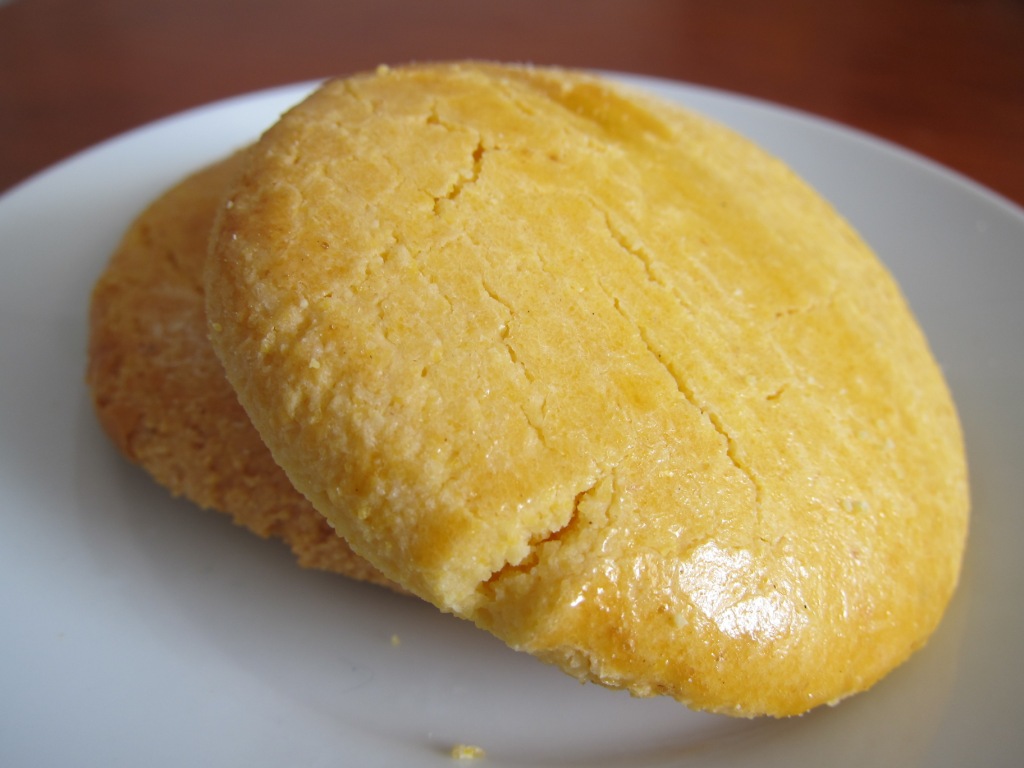
In Brazil, cornbread, known as Broa de Milho, often comes in cookie form (can’t complain about that), and is found pre-prepared in most grocery stores and bakeries. So if you’ve ever dreamed of snacking on some cornbread cookies with your tea, you’re in luck. The taste is not quite the same as US cornbread, and Broa de Milho have a more crumbly texture, less sweetness, and a shiny egg-wash finish. However, the one thing that really makes them stand out as true broa de milho vs. cornbread cookies is fennel seed (erva doce in Portuguese). There is a recipe in Portuguese to make broinhas “little breads” on Tudo Gostoso. The following English language recipe on From Brazil to You makes a monster-sized cookie/round, which is the traditional way to make broa, as opposed to in small cookie format. The name “Broa de Milho” may also refer to Portuguese Cornbread, which is more likely made in loaf form.

Broa de Milho from Bahia

1 Comment

Filed under World Eats

The Origin of the Mongolian Grill

A Mongolian Grill in Texas, by Luna 715

Last week we went to a Mongolian grill with our family, the first one M and I had ever visited. In case you are not familiar, the centerpiece of the modern Mongolian grill type restaurant is a giant round flat top grill manned by cooks with huge metal scraper swords. Before it hits the grill, you pick out your own selection of meats, veggies and sauces from a salad-bar type setup. However, we couldn’t help but wonder – was this really Mongolian-style cooking? While the promotional info for many American Mongolian grills states that this type of cooking originated with Mongolian soldiers cooking large amounts of foods on their shields, we didn’t find any research that really backed up this claim. The Mongolian Grill concept may be Mongolian in some small way, but the major component of the Mongolian grill originated in Taiwan as a restaurant concept to attract customers in the 1950s. Several guidebooks to Taiwan from the 1960s talk about the wonders of Mongolian grill restaurants, like this 1967 example from Olson’s Orient Guide.

 The groaning hors d’oeuvres tables are generously decorated with platters of spicy, marinated raw beef, venison, wild boar, mutton, and heaping mounds of green uncooked vegetables. The diner makes his choice of the uncooked victuals, selects his all-important sauces and seasoning, and passes to the end of the table where he hands his choices to a clever chef presiding over the charcoal-filled broilers. The seething flames, the sizzling meats, and the spitting oils present an unusual sensory experience. When cooked, the Mongolian feast is something extraspecial for your chopsticks. As when coping with Swedish smorgasbord, you are expected to go back to the Mongolian grill again and again.Try rice wine with the Mongolian barbecue. It is taste stimulating and, while it seems weak, has a high degree of potency.

This descriptions sounds pretty similar to the types of Mongolian grills seen today. Another influence is speculated to be Teppanyaki grills from Japan, and also Korean barbecuing. Wherever it came from, the concept has been adopted successful across the US by several chains, and one, BD’s, even spread to Mongolia itself, making it the first American franchised restaurant in the country. If you’re in the mood for some Mongolian-style food from Mongolia, you can try to make some of the simple, hearty fare, including Kuushuur (filled dumplings) and Boortsog (deep-fried cookies).

2 Comments

Filed under World Eats

Finer Things Club: Biscoff Cookie Spread

One of our favorite treats to have at tea-time are Biscoff cookies, which are kind of a riff on Dutch/Belgian Speculoos. However, we have recently been made aware of an amazing new Biscoff product – Biscoff spread! Basically, this is a peanut-butter like spread made OUT of Biscoff cookies. Though it seems to have been available in Europe for a while, the product has only recently become popular in the states. Trader Joe’s even has a knock-off version called Cookie Butter. Enchanted by the Biscoff spread, naturally our first order of business was to make a Biscoff sandwich, combining 2 Biscoff cookies and Biscoff spread, which even though it seems hopeless redundant, was very delicious. For the more ambitious, you can make your own spice cookies with Biscoff filling or Biscoff truffles. M will also be happy to note that they make a crunchy Biscoff spread, which I have never seen in the wild, but is available on Amazon.

Leave a comment

Filed under Finer Things Club, World Eats

A new place for… Açai bowls in Chicago

One of our favorite things to eat for breakfast is an Açai Bowl, one of the few recipes from Brazil that we have NOT been able to perfect back in the states, sadly. So we were very excited to learn from Chicagoano about the opening of Brazilian Bowl in Lakeview (3204 N Broadway). The store, specializing in Brazilian food (including some of our favorite salgadinhos), opened its doors over the weekend, and our friends who went said they are fans. We are looking forward to going to Brazilian Bowl to test out some Açais very soon!

Leave a comment

Filed under A New Place, World Eats

Tracking down Granitos from Humacao, Puerto Rico

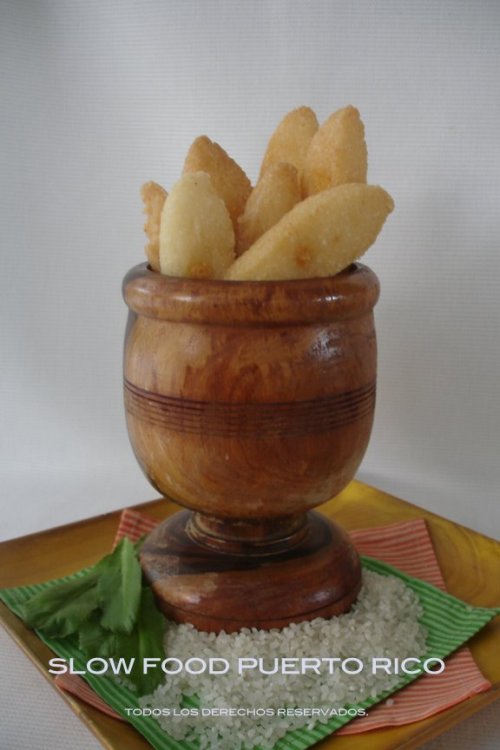
If there is one thing we love, it is solving (or attempting to solve, as the case may be) enigmatic food mysteries from around the world. Among the most elusive foods we have learned about recently is the granito, a canoe-shaped Puerto Rican rice flour fritura, stuffed with cheese. As far as we can tell, granitos are found only in the town of Humacao, on the Eastern coast of the island. The preparation is fairly simple and requires few ingredients, which are then eventually fried up into a finished product. Check out Granitos in production in Humacao, or this Granito sideshow from Slow Food Puerto Rico. RecipeLink has a simple-sounding recipe, which we may soon try. However, a RecipeLink poster has stated that the previous recipe is actually for almojabanas, a sibling of granitos. Other posters have commented that almojabanas are not a fair substitute (text in Spanish) and true granitos are stuffed with cheese, and don’t have cheese incorporated throughout.

Slow Food PR has some information about how granitos came to be, as told by one Mrs. Bartolo Rodriguez. Apparently, the original recipe for granitos was inherited by her father, Mr. Rodriguez, from Don Vicente Vazquez  in the sixties. It was Mr. Rodriguez who came up with the signature canoe shape, and it was his daughter, Mrs. Bartolo Rodriguez, who added the cube of cheese to the center of the granito.  On the site they are also referred to as “granos,” Spanish for “grains,” no doubt where the rice-shaped granitos or “little grains” earned their name. You can read the complete story in Spanish on the Slow Food page. Origin nonwithstanding, I still haven’t been able to find an approved recipe for granitos. So can anyone find describe a true recipe for these enigmatic snacks?

5 Comments

Filed under World Eats

What is a puffy taco? Where can I find one?

Puffy Tacos by angrywayne

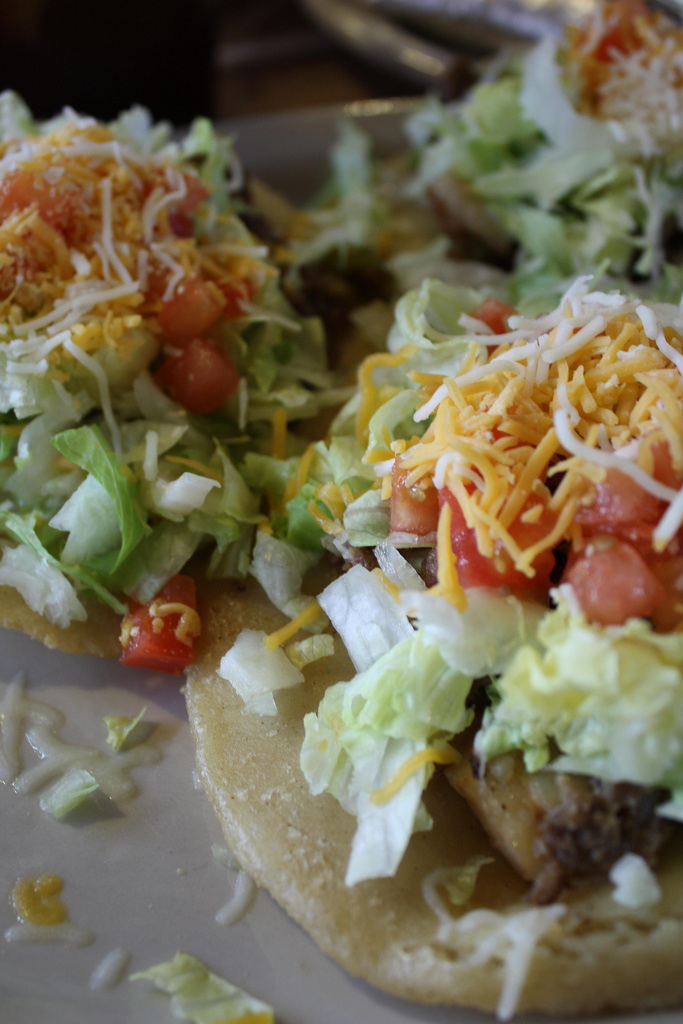
Here in Chicago, we have an amazing array of Mexican foods, but just as soon as we think we figured it out, we find a wonderful new hybrid we never even knew existed. The latest among these discoveries is the “puffy taco”, which is noteworthy for its puffy shell. To make the signature shell, uncooked masa is deep-fried, and as a result, takes on a puffy shape. With origins in San Antonio, Texas, the puffy taco is a hybrid Tex-Mex creation, which originated at a place aptly called Henry’s Puffy Tacos in the 1970s. The association between San Antonio and puffy tacos runs so deep that the minor league baseball team, The San Antonio Missions, even has a mascot called Henry the Puffy Taco. Though you are most likely to get puffy tacos in San Antonio, there are a few outposts, like  Goat Town in NYC. If you are feeling ambitious (or if you don’t live anywhere near Texas) you can make puffy tacos yourself.

1 Comment

Filed under World Eats

Xue Hua Bing at 527 Cafe

 Now that Cloud 9 in Chicago is closed, and Spring is theoretically around the corner, where can you go for you Xue Hua Bing (Taiwanese shaved ice) fix? 527 Cafe! Right in downtown Evanston (527 Davis St.), Cafe 527 makes some pretty good XHB, with gargantuan portions. The flavors available are mango, strawberry and passion fruit and the serving size is more than enough for you and your 2 closest friends.

Xue hua bing by Kimberlykv

Leave a comment

Filed under Reviews, World Eats

Australian and New Zealand Sweets for Anzac Day

We have to admit that there is a bit of a blind spot in our repertoire for Australia and New Zealand, perhaps due to their geographic distance and the fact that we don’t have any Aussie / Kiwi restaurants around here. So unfortunately, we don’t often give this area of the world its fair due. We would like to thank our commentor Whitney for writing to us about Australian treats, and we figured we would do a link roundup of some Australian and New Zealander desserts, especially since ANZAC day is coming up on April 25th.

Pavlova by AnneCN

2 Comments

Filed under Holidays, World Eats

A World of Popovers: Poffertjes, Aebelskivers and Paniyaram

India FlagWhen we discovered Eggettes, a Hong Kong sweet we profiled previously, little did we know that there were similar popover confections present around the world (though we should have guessed). Ranging from India to Denmark, all of these treats are made in special pans with round indentations (as can be seen above). First up are poffertjes, mini-pancakes made with buckwheat flour that originated in the Netherlands in the 15th century. Kitchen butterfly has a recipe for poffertjes from Dutch Cooking Today (Kook ook Holland).

Aebelskivers

Aebelskivers in a pan.

Similar to poffertjes are ebelskivers / abelskivers / aebelskivers from Denmark, not surprising, given the proximity of the two countries. The recipes are quite similar, but an aebelskiver (or their pan, rather) is larger. For those ready to commit to the recipes: Fante’s Kitchen Shop in Philadelphia has both poffertje and aebelskiver pans, as does William-Sonoma. Also falling into this small-popover milieu are Paniyaram (seen above), an Indian snack that can be made sweet or savory. We think this serves as evidence that some things – like bite-sized carb-y snacks – are universal.

1 Comment

Filed under Pastry Post-Poc, World Eats

Queijo coalho, essential Brazilian beach food

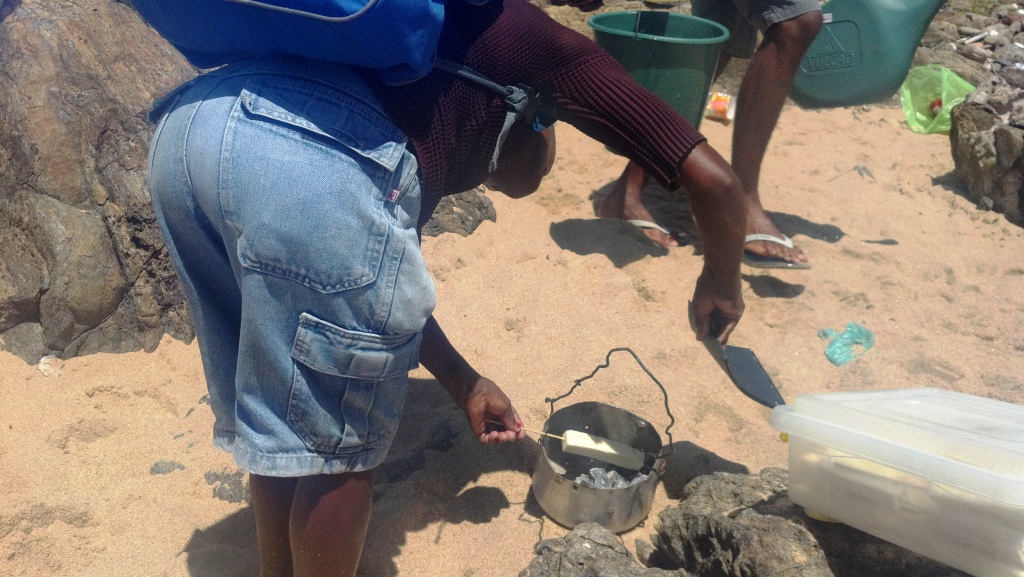
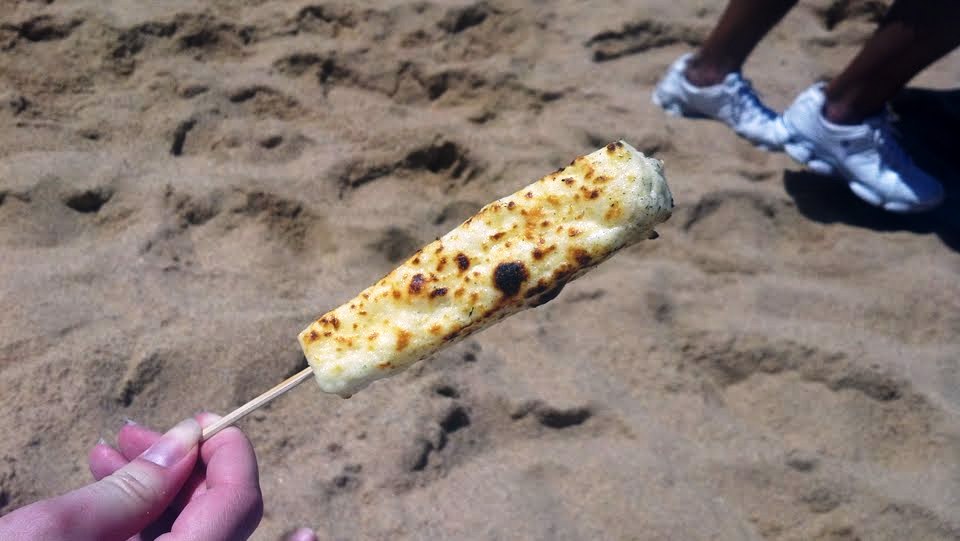
There is something about food on a stick that makes it all the more awesome. This trend carries over to Brazilian street food, which has many stick-laden options. One of our favorites among these was the queijo coalho – roast cheese. You have to love a country where roasting sticks of cheese over an open flame and coating it in rosemary is a viable beach snack. The cheese used to produce queijo coalho goes by the same name, and has a squeaky texture similar to cheese curds. The cheese is near-impossible to find in the US, but Carlos Figueira has a great roundup and review of some possible substitutes. Once on a stick, the cheese is roasted over a little handheld coal stove and coated in rosemary or possibly molasses, for the sweet-lovers. The roasting gives the cheese a bubbly, burnt outer layer. Surprisingly, it is the perfect complement to a hot day.

Queijo Coalho in production in Rio Vermelho

The finished product

1 Comment

Filed under World Eats

Québec: Poutine in Chicago (updated)

canadaquebec Québec has a unique food history (including some superlative bagels), but until recently we haven’t been able to find the inimitable Québecois staple, poutine, anywhere in Chicago. Poutine is an unusual concoction of french fries served with fresh cheese curds and brown gravy, which originated some time in the mid-20th century in Canada. Until fairly recently, poutine was the domain of Québec only, but now restaurants serving the specialty are popping up all over the United States. The Chicago Tribune has a list of restaurants that serve poutine in Chicago.

Classic Poutine

Classic Poutine from L’Authentic Burgers & Poutine in Victoria, BC by Jen Arrr

3 Comments

Filed under World Eats

Pasta di San Giuseppe – St. Joseph’s Day Pasta

Giuseppe

St. Joseph’s Day Pasta – by Erin Zieske

March 19th is St. Joseph’s Day, a holiday celebrated in Southern Italy, or in communities of southern Italian Immigrants. Naturally, having the proper food is a huge part of St. Joseph’s Day, with many churches even constructing elaborate St. Joseph’s Day altars full of food. We’ve written previously on the most famous St. Joseph’s Day food – the fried sweet Zeppole – so this year we wanted to introduce another holiday dish – Pasta di San Guiseppe. There are many variations on the recipes – but at its core it is a dish of pasta and breadcrumbs. The pasta dishes made on this day are typically meatless to represent the famines experienced in Sicily. The breadcrumbs represent sawdust, which is symbolic of the profession of St. Joseph, carpentry. Another popular dish for St. Joseph’s Day is Pasta con Sarde (Pasta con Sardi in Sicilian)  – pasta with Sardines [another version here].

2 Comments

Filed under Holidays, World Eats

São Paulo: Esfihas at Jaber

Jaber
Rua Domingos Morais, 86 – Vila Mariana
Sao Paulo, 04010-000, Brazil

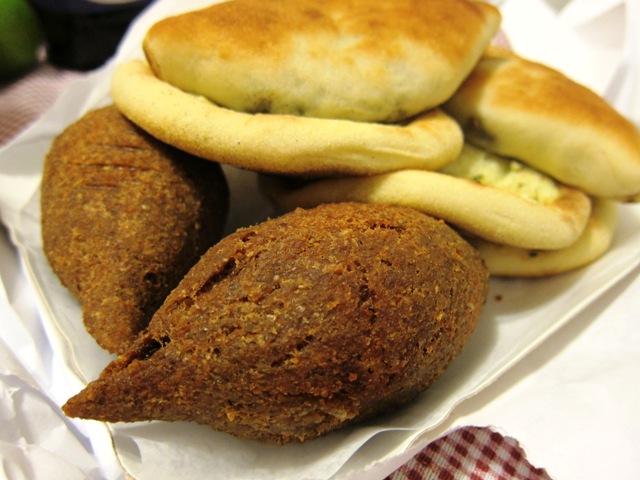
São Paulo, with its cosmopolitan populace, is home to a large middle-Eastern population – especially Lebanese residents. This of course means delicious Lebanese food, one of our favorite varieties. Some Lebanese-inherited dishes have become popular all across Brazil – including kibbe – ground beef and cracked wheat fritters and the esfiha – an open faced pastry with either sweet or savory toppings. There are Middle Eastern restaurants on almost every corner of Sampa, so were definitely spoiled for choice (much as we were for Pizzas, as we will write about shortly). Right around the corner from our friends’ place was a Lebanese takeout restaurant that racked up accolades from Veja magazine and the like for awesome Lebanese treats. The menu at Jaber had both individual dishes, hot small snacks (salgados), and huge-family-style platters, they seemed to be doing very rapid turn over on large take-out plates for hungry families.

kibbe and esfiha

Of course we were pleased to see both kibbe and esfiha on offer at Jaber, both of which are pictured above. We sampled 3 types of esfihas, Za’atar, Cheese and Endive. The Za’atar esfiha really impressed us – the topping on the pastry crust was nothing but a solid layer of spice – Za’tar is a spice mix of thyme, oregano, sumac, sesame and salt – and the flavor of the esfiha was nothing short of explosive. Also on the menu were varieties of Esfiha that are “closed”, kind of a Brazilian/Lebanese take on Stromboli, with the pastry folded over the filling. Sao Paulo made us esfiha addicts! One thing about Brazil – they definitely have a lock on the pocket-sized savory pastry – who knew such myriad wonders even existed?

1 Comment

Filed under Reviews, World Eats

Street / beach food in Brazil: Beijus

We are huge fans of street food, but Brazil has added a whole new dimension to that love – beach food! On the beaches of Brazil there are always a plethora of food trucks and roaming food vendors who are ready to fill you up with snacks (including cheese on a stick – more on that later) while you are chilling on the beach. The key to beaches in Brazil is to basically bring nothing to the beach, because the rest will be provided for you – water, sunglasses, sarongs, cheese on a stick, whatever. One of the more unique beach finds we encountered was the Beiju – a sort of tapioca crepe with a myriad of sweet and savory fillings. Popular choices include Nutella, fresh coconut and a delicious combination known as “Romeo and Juliet” (Goiabada and Minas cheese). In order to make a Beiju- a layer of tapioca starch is cooked in the bottom of a pan or mold on a flattop- solidifying the tapioca into a type of pancake. The texture is a little bit unusual – and the Beiju has a certain amount of chewiness and crumbliness – but in a good way. Though Beijus are more popular in the Northeast, you can find them around Brazil. We have tried Beijus both at Ipanema beach in Rio, and at a storefront in Salvador. Much like crepes – there are a million different variations – but what you are basically getting is always comfortingly familiar.

Beiju on Ipanema Beach

Beiju with a view – Ipanema Beach

1 Comment

Filed under World Eats