Nom Wah Tea Parlor: old school dim sum in NYC

Nom Wah Tea Parlour
13 Doyers St.
New York, NY

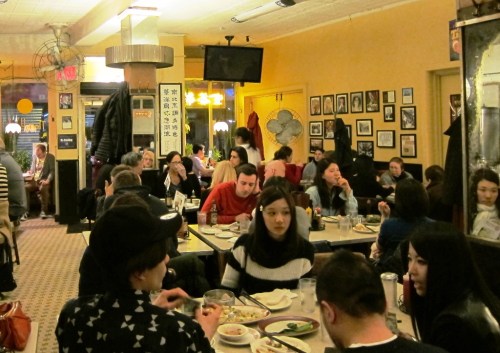
China flagNom Wah doesn’t look like any other restaurant we have been to. Think the crazy ambiance of a 1950s diner meets corner pizza restaurant meets mah jongg parlor. The little street Nom Wah is on seems to be out of another era, and was given an especially surreal touch by a fashion-student photo shoot taking place with a model dressed in shiny spandex and vinyl while propped up against the shuttered entrance of a neighboring store. Only in NYC. We met our friends there for a Friday night dinner, and the joint was hopping. Nom Wah claims to be one of the first dim sum places in NYC, and it certainly has remained popular over the years.
Nom Wah

You begin by marking your selections on a paper menu with a full range of dim sum options. Then the waiter fills you order, with plates coming out as they come out of the kitchen (which is pretty fast). There is no cart here, which means all of the food is made to order, and hasn’t been wallowing on wheels for the better part of the day. One other major plus is that there is something for vegetarians and meat lovers alike, but the menu itself is actually not as overwhelming as it is at some Dim Sum places, or at places with NO menu.Nom Wah Here’s what we ordered for  people:
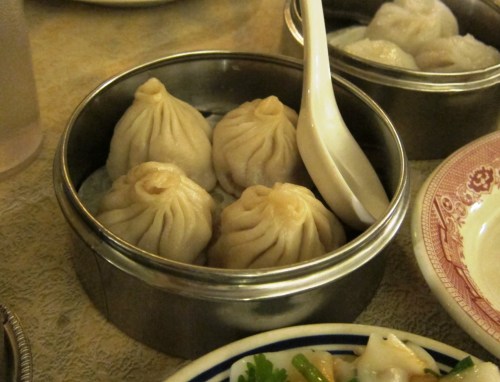
  • XLB (Shanghainese soup dumplings – above) – Try to eat these in just one bite!
  • Scallion pancakes – These were deliciously crispy with a tasty hoisin sauce.
  • Steamed BBQ pork bun (char siu bao) – Whoa, check out the size of these (below)! An order gets you two gigantic softball-sized bao filled with a great sticky sweet/sour pork filling and acramelized onions. Definitely give these a try.
  • Pan Fried Noodles – Thin egg noodles stir fried with scallions, onions, bean sprouts and soy sauce.
  • Veggie dumplings – Gluten free in a tapioca wrapper!
  • Pork dumplings – Pork and chives in a wheat wrapper – who doesn’t like pan-fried things?
  • Vegetarian Rice Roll – Mushrooms wrapped in a thin rice noodle wrapper with soy sauce. These are a favorite at NW, and though we thought they were slightly rubbery, they provided a good, more unique options for veggie eaters.

We were also excited to see a nice and reasonably priced tea selection. We got a Shou Mei White tea and a Jasmine green tea. We were not sure how much to order, but we need not have worried. The food was more than enough to feed 5 with ease, and more to spare. The scallion pancakes, bao and dumplings were standouts. There was so much good food… it is hard to believe that it only set is back about $10 apiece! Can you believe it? Who said there was nowhere cheap to eat in NYC?

Nom Wah

Leave a comment

Filed under Reviews

Bella Paulista, something for everyone in São Paulo

Bella Paulista Casa de Pães
R. Haddock Lobo 354
São Paulo – SP 01414-000

brazilNo matter what kind of food you a craving, from cake to Italian, to health food to hearty traditional Brazilian fare, chances are 24-hour Bella Paulista in the Jardins neighborhood of São Paulo has it. The full name of the restaurant is Bella Paulista Casa de Pães, (House of Bread), but that really doesn’t tell the whole story. Bella Paulista is kind of a riff on a kilo restaurant – where you pay by how much your food weighs – but a little more high tech. You are given a plastic card, and everything you order – whether through a waiter or at a counter – is added to the card. At the end of the meal, you bring your card to the cashier near the exit when you are done and they then add up the final total. Pretty spiffy.

???????????????????????????????

There is also R$ 29.95 for the all-you-can eat (as opposed to kilo) lunch buffet – which seemed to mainly consist of cold cuts, yogurt, breads and fruit, so we skipped, though it would be excellent for the healthy eaters around (not us, I guess). There was also more of sit down lunch counter for typical Brazilian fare of hot sandwiches and comidinhas. On the menu there were pages and pages of options, including diverse juice drinks, omelettes, pasta, waffles, Gourmet sandwiches such as mozzarella and arugula (all about $R 25+), Traditional sandwiches like turkey, cheese or tuna (around R$ 15). Of course, there is also a huge assortment of bread, like the massive pao de queijo we enjoyed above. We enjoyed sandwiches and fresh squeezed juices for a pretty good deal in this posh area of Sampa.

???????????????????????????????

However, our favorite part of Bella Paulista was the dessert counter. Actually just calling it a counter is a misnomer – it actually formed a big circle, with an attendant inside the middle of the counter, waiting to weight your purchase. You could buy whole round cakes in a myriad of flavors, simpler strawberry or chocolate loaf cakes, as well as cookies, cakes and pies by the slice (you paid for these by weight). We went for the passion fruit cheesecake (below), which we found through experience is one of the most popular and consistently delicious Brazilian desserts. M was also happy to encounter a wide variety of filled doughnuts, not too common of a sight in Brazil. Bella Paulista was certainly one of the more impressive kilo restaurants we encountered in Brazil, and there certainly was something for everyone!

???????????????????????????????

Leave a comment

Filed under Reviews

Coming Soon: The North Clark Street Taco Crawl in Chicago

Mexico FlagWe recently returned from a trip to Mexico, where our love for tacos (particularly, Tacos al Pastor) grew ever stronger. Our favorite taqueria is in Pilsen, but sometimes you just get a taco craving, and driving all the way down to 18th street isn’t feasible. So we decided to give the North Clark Street corridor in the Rogers Park neighborhood of Chicago a thorough exploration for tacos. You know, we feel pretty badly that we have ignored this teeming avenue as a spot for Mexican food for so long. However, slowly but surely, we are stating to explore the area, and with good reason – practically every 4th storefront is a taqueria! Do you have any favorites in the North Clark area you can recommend (especially for al pastor)?
1 Comment

Filed under Note, Quest

538’s International Food Association World Cup: Results are In

We wrote a little bit earlier about 538 Blog’s International Food Association World Cup, where users could vote for their favorite national cuisines. While the World Cup of Futebol has been over for a while, the Food Cup just ended. The four teams making it into the semi-finals were Italy, USA, Thailand and Mexico, which seems like a pretty solid match-up. The final round was between the USA and Italy, and Italy eventually prevailed. Not too surprised with the result – who doesn’t love Italian food?

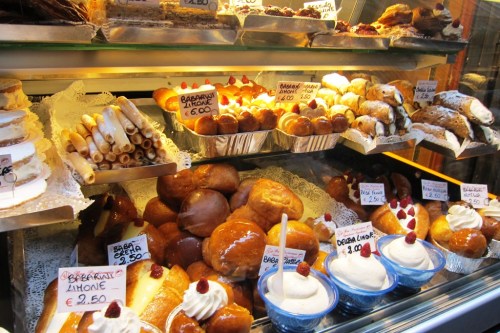
Varieties of Rum Baba (and friends) in naples

Italian Pastries – just one of the country’s many culinary delights

Leave a comment

Filed under Links

Kahk al-Eid: Egyptian cookies for Eid

flags_of_Egypt Today is Eid Al-Fitr – the breaking of the fast after the month of Ramadan. Of course, this means lavish, delicious feasts. Every country has its own food traditions to celebrate Eid, but all have an iconic dessert or two! Sweet rice/vermicelli puddings are found in India, Pakistan and Burma as a way to celebrate Eid. In Egypt there is a classic cookie: Kahk al-Eid (literally, “Eid Cookie”). These sugary shortbread-like cookies get their kick from a combination of spices including fennel and anise – which may be listed as “Kahk Flavor” in some recipes. Cookies may be made into small circles or can be shaped with a wooden mold, as in this recipe. A simpler recipe is provided by Food Republic, if you do not have access to Kahk spice.

Kahk

Egyptian Eid Cookies (Kahk) – by Lorenz Khazaleh

Leave a comment

Filed under Holidays

Von y Carmen: Cooking her way through Puerto Rican Classics

Flag of Puerto RicoWe love our mofongo, and we are grateful that Chicago has a bunch of great Puerto Rican restaurants. Despite its deliciousness, Puerto Rican cooking flies a bit under the radar in the US. However, we have grown to love it and are looking for a good basic cookbook. Apparently much like Joy of Cooking for the US, Puerto Rico has an iconic tome, Cocina Criolla, by Carmen Valldejuli that has pretty much every recipe you need to know. This Puerto Rican classic has inspired journalist Von Diaz to get in touch with the soul of Puerto Rican cuisine by cooking her way through it, a la Julie and Julia.

Leave a comment

Filed under Books, Links

Masouleh, Northern Persian Cuisine in Chicago [Closed]

Masouleh [closed]
6653 N. Clark St.
Chicago, IL 60626

flag_of_IranWe’ve driven past Masouleh on Clark a thousand times, but it was only when we were seeking a spot for a low-key date night that we actually popped in – and we are glad we did. Named after a picturesque town in Northern Iran, Masouleh specializes in northern Persian food, a new regional specialty to us. Masouleh is a family place, and attracts a wide swath of neighbors, locals and Persian families making the special trip. Masouleh is not too fancy, but just a little bit romantic if you have a low key significant other (nice touch: flowers and candles on the table!).??????????????????????????????? The menu at Masouleh  is small and straightforward. You will recognize many of the main dishes from other restaurants, however we were also pleased that they had Northern Persian specialties. We started off with a cucumber and yogurt salad, which M devoured too quickly to be photographed. For mains we got fesenjan ($13) – chicken with ground walnut and Pomegranate sauce, served with rice (pictured below). The dish was simple, but hearty, and the sauce took on a deliciously creamy flavor.

For the second entree we decided to do a little something different. Every day there is a northern Persian specialty, and on that day it was an intriguing salty/sweet dish: Gheimeh Nessar, which is made of beef stew marinated with onions, saffron, split peas, sourberries, pistachios, almonds and orange peels served with white rice. The flavor combination had the potential to be overpowering but it was actually perfectly spiced and delicate. Both of our entrees came with a huge variety of side dishes, certainly more than we expected: pita bread, feta cheese with tomatoes, and a cup of the soup of the day, a hearty lentil. We were positively and pleasantly stuffed, but we decided to make a little room for dessert.

??????????????????????????????? To finish our meal, we ordered Persian Ice cream($3), which was flavored with rose water, saffron and pistachio. Maybe a little too much rosewater, but still very tasty. The table next to us got some tempting-looking baklava, and we are looking forward to trying that next time. We highly enjoyed our dinner at Masouleh, and we can’t wait to try some more Northern Persian food. If you’re looking to impress your foodie date, this is the place!

1 Comment

Filed under Reviews

How (fresh) Ramen Noodles are made

Japan[Video via Kottke] We spoke recently how authentic ramen restaurants were becoming increasingly popular across the US, and that trend has no sign of slowing down. Some of these restaurants make noodles in-house, but many buy them. Check out how fresh ramen is made for some of the most popular ramen eateries across the US, at Sun Noodle.

Leave a comment

Filed under Links, World Eats

Mexican Ice Cream shops – Neverias (and Paleterias) – in Chicago

Mexico FlagOne of our go-to places for a cool summer treat is Palateria La Monarca in Rogers Park (6955 N. Clark) – we usually get the lime and mango paletas. However, there are a whole variety of Mexican Paleterias (popsicle shops) and Neverias (Ice cream stores) throughout Chicago that we have not yet tried. Even just on the stretch of North Clark near Monarca we noticed a few new ice cream places popping up, including Las Delicias de Michoacan (6649 N. Clark).  However, shops aren’t just popping up on North Clark – it is a city-wide phenomenon! WBEZ’ Monica Eng has an article about the proliferation of Mexican ice cream shops, and more than a few recommendations of places/treats to try. In particular, Eng recommends the mangonada, a neveria staple of mango sorbet topped with mango slices and a sweet and salty pickled fruit sauce called chamoy. The mangonada is now on our summer bucket list. What’s your favorite thing to order at a Neveria or Paleteria?

Paletas from, Zihuatanejo, Guerrero, Mexico

Paletas from, Zihuatanejo, Guerrero, Mexico – by Dolanh

2 Comments

Filed under World Eats

Post World Cup Wrap-Up

brazilSo the World Cup is over, and it has been quite a ride! While we are sad the Brazil went out the way they did, we were excited to share lots of food links and recipes from the countries featured in the Cup. And of course, we enjoyed the opportunity to feature Brazilian food in all of its glory. And there was some measure of victory, because Salvador’s famous Baianas won the right to sell the emblematic street food acarajé outside Fonte Nova stadium (a rare victory against FIFA)!

Baianas FIFA


Leave a comment

Filed under Links, Note

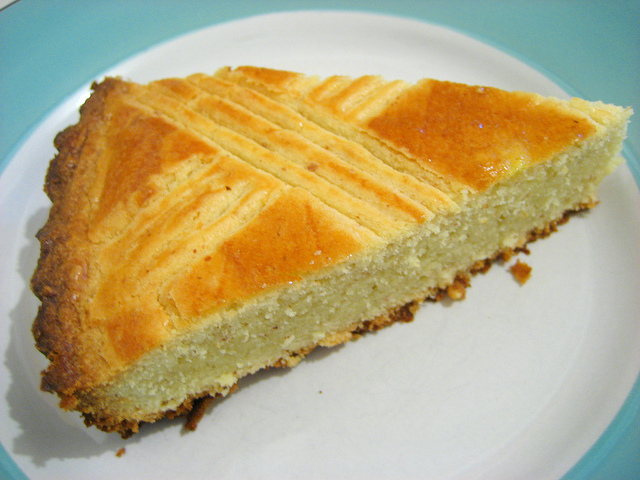
Celebrate Bastille Day with Breton Butter Cake (Gâteau Breton)

BrittanyfranceToday is Bastille Day, so it seems only appropriate that we cover our favorite French food group: Desserts. The dessert at hand today is the Breton Butter cake aka Gâteau Breton, a shortbread-like cake with a signature crosshatch design. This is a simple cake from the Northwest of France (where it gets its name from the region of Bretagne/Brittany), an area with a distinct food culture and language. The cake itself really is nothing more than eggs, sugar, flour and (lots of) butter – but sometimes simple things are the best! Check out recipes from Gâteau Breton from Lottie and DoofNot Quite Nigella and Serious Eats.

GateauBreton

A slice of Gateau Breton by Jen Steele


1 Comment

Filed under Finer Things Club, Holidays, Pastry Post-Poc

A real Brazilian steakhouse experience: Porcão

Porcão
Avenida Infante Dom Henrique
Rio de Janeiro, Brazil

brazilGermany plays Brazil today, and while we still hope the Canarinho can pull it out, Neymar’s injury and Thiago Silva’s suspension means this may be our last chance to highlight Brazilian cuisine before the end of the World Cup. In the United States, as well as Germany, it seems, the idea of Brazilian food usually conjures up the picture of a giant buffet with roving gauchos serving up meat on skewers. Fine cuts of meat are less Brazil-specific than they are at home in the broad swath of land between Argentina, Uruguay, and southern Brazil – the land of the gauchos. Nevertheless, large transnational chains like Fogo de Chão and Texas de Brazil are responsible for popularizing this concept of Brazilian cuisine, which has now gained global popularity. But while we were living in Rio de Janeiro, we were curious if Brazilian steakhouses are the same or similar in Brazil. On many a carioca’s recommendation, we decided to head to Porcão, a high-end churrascaria north of Botafogo bay so large it has its own exit off of Infante Dom Henrique. Turns out, while beef is only a very small slice of Brazilian cuisine (think of fancy steakhouses representing all of US cuisine abroad), the experience at Porcão was very, very similar to those you would find in the United States. There were a wider variety of cuts of meat – Matt’s favorite anticuchos (hearts) come to mind – but overall, we have to say we were a tiny bit disappointed the experience was not more different. Don’t get us wrong, the food was excellent. But trust us when we say when you go to the Texas de Brazil or the Fogo de Chão in Chicago you are are getting basically the same experience (minus the Portuguese, of course).

???????????????????????????????

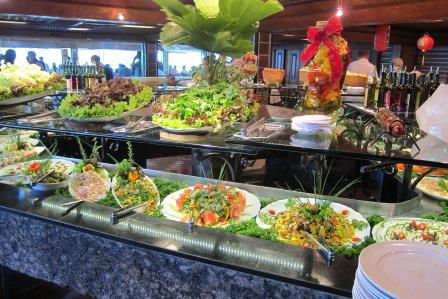
You know the routine. You pay a set rate for the meal (at the time we went for lunch it was R$110; about 55 US dollars, and then you stuff yourself on the lavish salad bar and buffet. Then, you return to your seat and wait for the roving guacho to come around with particular cuts of meat that suit your fancy. And come they did, as always: every cut imaginable, overall of a wider variety and a bit saltier than you find at US versions. This Porcão was quite large, and seemed to cater to the business executive crowd, who hosted clients and co-workers for marathon meat-eats.???????????????????????????????

The salad bar, was of curse quite extensive, and consisted of various salad fixings, fruit and veg, a small selection of cheeses and bread. Again – no pão de queijo – basically a food crime against humanity. There were some winners at the salad bar though. We really enjoyed the mango and goat cheese salad. One major difference from the US, though is that at Porcão, there was no fish or chicken – only beef. Now, there was basically every type of beef under the sun, but if you don’t like beef you are pretty much out of luck. Sides were only so so, perhaps a little better in the American rendition of the Brazilian steakhouse.

???????????????????????????????

However, where Porcão excelled was in the atmosphere. Most of Rio does, of course, and you simply cannot replicate it at a strip mall in suburban Chicago. In this particular location, the natural setting also plays a big role. Diners here are treated to a very cool view looking out on Sugar Loaf over Botafogo Bay (above). In fact, we don’t think we’ve ever been to a restaurant with quite so nice a view. So fans of the Brazilian steakhouse experience in the US – rest assured that your beloved meat skewers are very much a Brazilian thing – but you may not get quite the authentic view.

2 Comments

Filed under Reviews

Eating on Route 66

USA-flagHappy 4th of July! We were thinking of what American food to highlight for this occasion, and we figured – what’s more American than Route 66? Even though the road is past its heyday (blame the Interstates for that), it is still home to a vast and diverse array of tasty eateries. 2,451 miles seem a little daunting? This article from Saveur lets you take a virtual roadtrip! However, with Route 66 being as expansive as it is, there are countless eateries to try – the Route 66 forum has a other suggestions, as does Roadtrippers.

Palm Cafe on Route 66

Palm Cafe in Barstow, CA on Route 66 by Pete Zarria

Leave a comment

Filed under Holidays, Links

The Bel-Gem Waffle: Introducing Belgian Waffles to the US

BelgiumThough there may be some lingering animosity towards Belgian waffles after the fateful US/Belgium World Cup game (and with the Waffle House restaurant chain declaring war on Belgian Waffles), waffles seem like an everyday part of life in the US. However, it turns out that Belgian waffles were first introduced into the US in 1962! That seems awfully recent, don’t you think? They first turned up at the 1962 Seattle World’s Fair at a stand run by the Belgian Vermersch family, where the waffles  were marketed to Americans as “Bel-Gem.” The main difference between Belgian waffles and “regular” waffles is that Belgian waffles have a yeast batter, while the other has a pancake batter. The Bel-Gem waffles, a hit in Seattle, were sold again at the much larger 1964 World’s Fair in Queens.  Many people believe that they were first introduced at the NYC World’s Fair, but that credit actually goes to Seattle. However, it was at the 1964 Fair that the waffles really caught on…and the rest is history. Good Food Story has even unearthed an original Bel-Gem recipe.
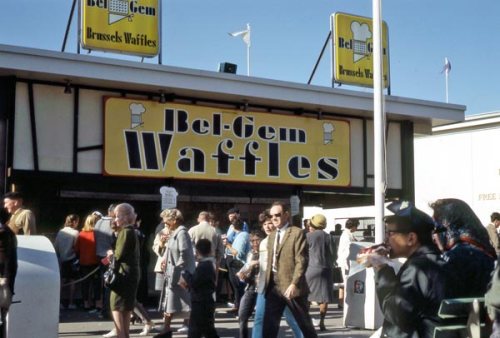
64-waffle-shop

Bel-Gem Waffle Stand at the 1964 World’s Fair in Queens

Leave a comment

Filed under Pastry Post-Poc, World Eats

Celebrate Canada Day with a Butter tart

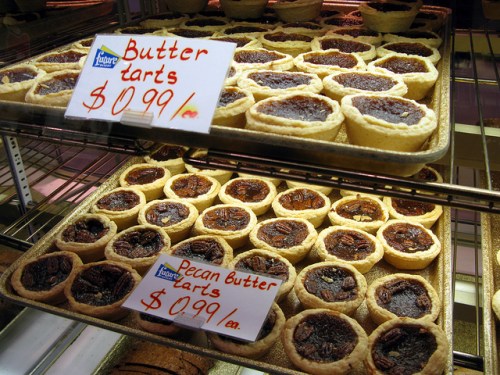
Butter Tarts

Butter Tarts in Toronto by Ursamajor

canadaThe Butter tart, along with the Nanaimo bar, is one of Canada’s most emblematic treats, and a perfect way to celebrate Canada Day on July 1st. The exact origins of the butter tarts are not known, though the treat is said to go back to pioneer days. Now you can find them across Canada, though their foothold is strongest in Ontario (where there is even a butter tart trail). The filling, as you might guess is primarily sugar and butter, with a little vinegar, though there may be some variations with nuts or raisins. The crust is a flaky pie crust, similar to an American pie, though butter tarts seem to usually come in miniature form. However, this is not an eggy custard like a Portuguese pastel de nata – it’s decidedly more sugary. Butter tarts actually sound kind of similar to a chess pie in the US, a Southern American classic. It is thought that both of these pies descended from a similar Scottish pie. I guess both come from the same principle – making a pie when there is not fruit available (or affordable enough) for filling.  Recipes for butter tarts abound on the internet – and you probably already have the ingredients on hand. Happy Canada Day!

Leave a comment

Filed under Pastry Post-Poc

The Ghana/Nigeria – Brazil Connection: Acarajé and Akara/Acara

nigeriaGhana.svg

brazilThis post is particularly appropriate for the world cup since it connects host country Brazil with one of the countries playing a game today, Ghana. One of the most emblematic foods in Brazil, especially in the Northeast of the country, is acarajé, which we have written about extensively for this blog. However its roots are in Africa, and brought and adapted by enlaved Africans brought from West Africa to Brazil. Both Nigeria and Ghana have a dish called acara/akara, which is very similar to acarajé, and all variants are fritters made from black eyed peas. Betumi blog  and Kitchen Butterfly have recipes for akara, which definitely seem similar to acarajé. However, akara is typically eating for a snack or breakfast, while acarajé is more of a later-in-the-day snack. Another difference is that, in Nigeria, the akara fritters may be fried in vegetable oil, while in Brazil it is always the bright-red palm oil – our favorite!We love acarajé, so we assume we would be fond of its predecessors as well.
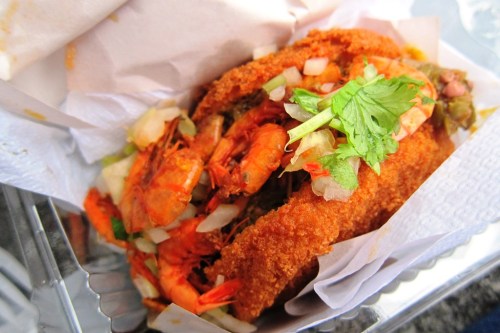
Cida Acaraje

Acarajé with dried shrimp from Cida in Salvador da Bahia, Brazil

2 Comments

Filed under World Eats

The FiveThirtyEight International Food Association World Cup

We are fans of Nate Silver’s 538 for its mix of culture, sports, politics and statistics. However, now they have taken it even one further and incorporated food into the mix. Perfect! In honor of the World Cup, the 538 team has created a ranking based on the national cuisines of the countries participating in the World Cup, as well as other culinary powerhouses. Here’s their methodology:

We polled 1,373 Americans through SurveyMonkey Audience and asked them to rate the national cuisines of the 32 teams that qualified for the World Cup, as well as eight additional nations with bad soccer but great food: China, Cuba, Ethiopia, India, Ireland, Thailand, Turkey and Vietnam.

So who’s going on to the Round of 16? Personally we think the list is pretty decent, though we’d have picked Turkey over Germany.

  • Mexico vs. Ethiopia
  • Japan vs. Vietnam
  • France vs. Argentina
  • U.S. vs. Belgium
  • Spain vs. Brazil
  • Italy vs. Greece
  • Cuba vs. China
  • Thailand vs. Germany
Acai at Tacaca do Norte

Acai at Tacaca do Norte – a taste of Brazil!

Leave a comment

Filed under Links, World Eats

Blue Seal, the original Okinawan Ice Cream

JapanOur World Cup coverage continues with an unexpected cross-cultural treat from Japan. Okinawa, Japan may not be first place you think of when you think of ice cream, but it turns out the island is crazy about it! Ice cream came to Okinawa with American troops in WWII, but became a trend that lasted much longer. The main purveyor is Blue Seal, originally founded to provide troops with a taste of ice cream from home, but eventually the ice cream became available island-wide, where it has gained quite a following. There are flavors that Americans would be familiar with, as well as Okinawan flavors like sugarcane, bitter melon and purple sweet potato. Blue Seal-branded cafes are found all over Okinawa, and now even in Tokyo, too. Softserve is more popular in Japan, but Blue Seal definitely holds the top spot for American-style ice cream.

Blue Seal Ice Cream

Blue Seal Ice Cream by Jason Poon

Leave a comment

Filed under Reviews, World Eats

Costa Rican Chocolate Makes a Comeback

500px-Flag_of_Costa_Rica_(state).svg Mario Balotelli, the Azzurri‘s star striker, was born in Sicily, in our minds the undisputed capital of chocolate production in Italy, and one of the few places you can find chocolate produced in Europe based on ancient Mesoamerican recipes. Yet Italy’s opponents today, the Ticos of Costa Rica, now hold claim to an ancient chocolate renaissance of their own. Chocolate has been grown in Costa Rica for thousands of years, and was considered so valuable it was utilized as a medium of exchange prior to the arrival of the Spanish in the early 1500s. Cacao plantations were common fixtures across the country until the 1970s, when a fungus called monilia began to decimate the crop. Nearly 90% of Costa Rica’s cacao crops succumbed to the disease – but now they are making a comeback. The Tico Times provides the exciting (and well-researched) narrative behind the work of Costa Rica’s Tropical Agricultural Research and Higher Education Center (CATIE), and their work to cultivate strains of cacao resistant to the fungus. The resultant work has led to a boom in Costa Rican chocolate, made all the more popular by the country’s commitment to fair working conditions and environmental sustainability (which cannot be said for production practices in other major cacao production centers, especially in western Africa). Now, visitors to Costa Rica have many different ways to experience the country’s resurgent chocolate culture, from chocolate tours and agricultural volunteering, to a wide range of chocolate-influenced foods, to just tasting the offerings at a respected retailer like Sibú. We are lucky enough to be heading to Costa Rica in December, so we will definitely experience as much of the new chocolate culture as we can!

wide-1000-12

Rainforest Chocolate Tour sign just outside Arenal Volcano in Costa Rica.

Leave a comment

Filed under Reviews

Eating at the Maquis, Côte d’Ivoire’s Favorite Spot

cote_divoire1In a few minutes, Les Éléphants will square off against Colombia in Group C, with a win by either team sending them to the knockout stage. In Abidjan, and likely across all of Côte d’Ivoire, Ivorians will watch the game at one of the city’s countless maquis: a small, open-air restaurant that serves as a go-to meeting place for locals. Developed in Ghana around the 1950s, the maquis is now an indelible part of the Ivorian cultural landscape. Anyone visiting Abidjan will find maquis packed not only with locals, but with some of the best home-made offerings of Ivorian cuisine. Maquis can also be found throughout West Africa, from Mali to Burkina Faso, as well as further afield wherever Ivorians have gone – you can find them in Geneva and Paris. Indie Travel Podcast provides a great breakdown of the history of the maquis, the range of Ivorian classics on offer, maquis eating etiquette, and some suggestions for the best maquis to try while in Abidjan. Based on their recommendations, we would definitely hit up Poulet aves les doigts (“Chicken with the Fingers”, a maquis in Abidjan’s Treichville district serving up mouth-watering chicken and alloco, a classic Ivorian snack of fried plantains served with chili peppers and onions. Maybe Côte d’Ivoire and Colombia can swap plantain preparations recipes after the game?

Women grilling fish at a maquis in Abidjan.

Women grilling fish at a maquis in Abidjan (via Courrier International)

Leave a comment

Filed under Reviews