
 The first in our Winter Olympics newcomer series is Tonga. The sole athlete from Tonga is certainly making waves at their first Winter Olympics, the luger, born Fuahea Semi , now Bruno Banani, did not place, but by changing his name he won an endorsement deal from a German underwear manufacturer with the same name. Antics aside, we have always wanted to try Tongan cuisine, since the South Pacific has so far eluded us in culinary terms. Being an island nation, fish plays a large part in the island’s cuisine, along with other staples like coconut, sweet potato and cassava. One of the most iconic dishes in Tonga is ‘Ota ‘ika, known sometimes as “Tongan ceviche,” fish marinated in citrus and coconut milk, similar in some ways to Latin American ceviches. Since M loves ceviche, I can only assume we will be making this recipe soon. Check out recipes from Daily Dish and Radio NZ to get a good start. Are there any other Tongan recipes you would recommend?
‘Ota ‘Ika – Tongan Ceviche

Filed under World Eats
Cuisines of the seven countries making their Olympic debuts
 Though we started off the Sochi Olympics by covering Russian food, the Olympics are perfect time to highlight food from all around the world. The US, Canada, Russia and Northern European are usually heavy hitters in the medal count because they are COLD, however, many other countries are making winter Olympics appearances, including seven for the first time ever. Check out the Olympic Teams from each of these countries – Paraguay, Malta, Togo, Tonga, Zimbabwe, Dominica, East Timor – and get ready for ETW posts featuring national dishes and other foodie delights from each of these countries in the coming weeks.
Russian menu ideas for the Sochi Olympics
 What did you think of the Opening Ceremony? With the 2014 Sochi Winter Olympics officially under way, we are in full Russian food mode. We are not experts in Russian food, but we have trying to learn more about the country’s different regional and local specialties. We’ve done a little research in preparation for a Russian dinner party in honor of the Sochi Olympics, to get a little beyond Borscht (Beet soup) and vodka (though of course, those are great, too). Here are some recipes to get your Russian dinner party started. Do you have any favorites you would recommend?
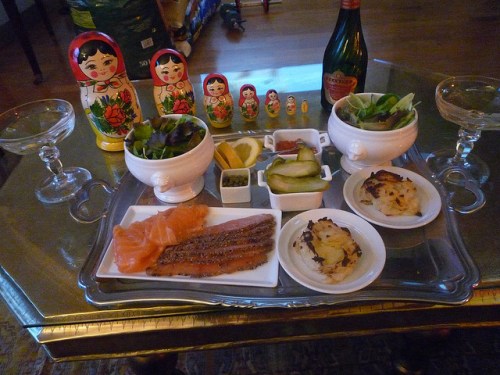
Russian dinner by Vincen-t
Appetizers and Sides:
- Blini – Thin crepe-like pancakes
- Baklazhannaia Ikra – Sweet/smoky eggplant spread
- Golubtsy – Stuffed cabbage rolls
- Pirozhki – Stuffed yeast bread rolls
- Vinagret – Vinegary beet and potato salad
- An assortment of pickled veggies, caviar and farmers cheese, Tvorog
Mains:
- Zhulien – Mushroom casserole
- Pelmeni – Dumplings stuffed with meat
- Solianka – Beef/Sausage stew
- Beef Stroganoff – Beef and mushroom stew
- Lamb Shasklik – Lamb Kebabs
Dessert:
- Apple Sharlotka – Sweet apple cake
- Ptichye moloko – Sponge cake layered with cream filling
- Ponchiki – Russian doughnut holes
- Rogalik (aka Rugalach) – Cinnamon and walnut cookies
- Medovik – Layered honey cake
Filed under Links, World Eats
The state of the coffee scene in France
 While we consumed macarons and mimolette gleefully in France, we never really sought out French coffee… and I guess we weren’t the only ones. Turns out France has never been big on coffee, cafe culture yes, but the actual coffee, not so much. We greatly enjoyed Roads and Kingdoms’ essay, “Why is Coffee in France La Merde?” which discusses the history of coffee in France, and how there has been recent push for more craft roasters and coffee-centric cafes.

Holybelly, part of the new coffee scene in Paris, by Roads and Kingdoms.
San Juan Icon La Bombonera Closes
 When we went to San Juan, Puerto Rico, one of our favorite places to eat was the stalwart La Bombonera, an excellent place to grab a pastry and while away the time. Unfortunately, it has come to our attention that it has recently closed! There was talk of re-opening but it seems unlikely. Sad day for pastry-lovers in San Juan.

La Bombonera in San Juan by John Picken
Filed under Links, Note, Pastry Post-Poc
A Taste of Chile in Brazil: El Guatón
 El Guatón
Rua Artur de Azevedo, 906
Pinheiros, São Paulo, Brazil
El Guatón was our first foray into Chilean food, and we had to go all the way to Brazil to do it! One of the world’s great foodie cities, São Paulo is known for its range of restaurants. We were excited (but not really surprised) to find a Chilean restaurant among its ranks of eateries. We heard good things about El Guatón, and looking at their menu online we noticed some similarities with both Peruvian and Argentine restaurants that we had visited before. We were on board!

Dinner at El Guatón in São Paulo
El Guatón is cute and cozy with red-tablecloths, and a little patio out front. Unfortunately, we arrived on a chilly day, so everyone chose to stay warm inside. We got a small table in the back, which – at the risk of stereotyping Brazilian restaurants – means you will never be served. But the service was prompt and courteous, and even more surprising for Brazil, there was a basket of food placed on our table for zero charge. In the land of couverts, this was a nice change! El Guatón also features an extensive wine list,featuring many Chilean varieties. There is even a bottle of the house red put on the table, and most people do seem to take advantage of it.

Chilean Empanada
One of the most popular items on the menu, according to reviews, are the empanadas (in Spanish) or empadas (in Portuguese), terms basically referring to the same sort of delicious carb filled with meat or cheese. The cost was a reasonable at R$6 for baked and R$8.50 for fried. We ordered a baked cheese, and fried shrimp. The baked empanada was slightly smaller and a had a lighter taste, perhaps it would be good for the “health-conscious” empanada lover (if such a person exists). The fried variety was seemingly twice as big and came out piping hot, with a tender crust and nice oozy cheese. They definitely made both of these varieties to order – and it showed. YUM!
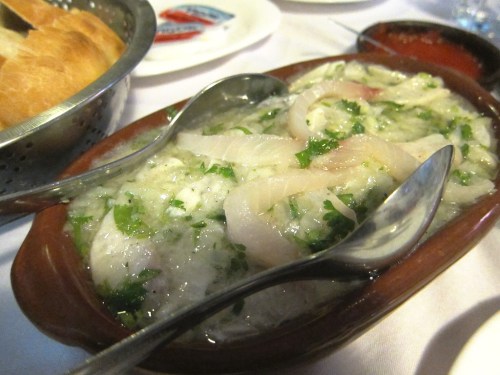
El Guatón Ceviche
Beyond empanadas there were a variety of meat and seafood dishes including picanha, fried fish, ceviche and humitas (Chilean tamales). Matt is a major fan of ceviche, and after our successful ceviche meal in Rio at Cevicheria Carioca (review forthcoming!), he wanted another hit. The ceviche at El Guatón was only R$53 for fish ceviche for two. It is plenty large enough for two people, and in many ways simpler and subtler than many of the Peruvian ceviches with which he, and many readers, may be more familiar. This ceviche was simple: just white fish, lime juice, diced white onions, and cilantro – a combination that resulted in a rather tame tiger milk, but still mixed and effectively presented all the great flavors.
We were also surprised to find lúcuma on the menu. A fruit native to mountain valleys in the Andes, Matt grew to love its sweet potato / maple / nutty flavor while living in Peru. El Guatón featured a lúcuma cake (R$13), which was very tasty, but essentially just a puff-ball of whipped cream on a very thin crust. It needed a little more substance (and definitely a little more lúcuma).
We had a great meal at El Guatón and we wish there were more Chilean places around. We love it almost as much as Peruvian food! Maybe someday we will be back, until then we’ll have to scour for another Chilean eatery. Is there a Chilean restaurant in your neck of the woods?

Lúcuma Cake
Filed under Reviews
Discovering Yen Ta Foe at Win Coffee in Bangkok
Lindsay and I (now that we have revealed our real names!) were in southeast Asia in 2010, traversing around the region after a short stop-off for an academic conference in Singapore. As loyal readers know, we are big advocates for street food and small, specialty restaurants that specialize in a few items. Without painting with too broad a brush, this style is classic southeast Asian food culture, and Bangkok is no exception.
Luckily, we made a friend. While doing some shopping and wandering around Wat Ratchabophit, we met Bee, a Bangkok native who had gone to school in North Carolina (we speak hardly any Thai, but she speaks perfect English). And she was eager to show us her favorite restaurant: Win Coffee, not far from her shop on Thanon Tanao. We’re actually not sure how to render the address, but they have a Google Plus page.

Win Coffee, though billed as a coffee place, had what Bee said was her favorite Yen Ta Foe in the city, a classic Thai dish made with lots of ingredients that, at least according to her, would make Americans cringe. Ingredients l fish balls, squid slices, and coagulated blood are put in a soup flavored with chilis, fish sauce, and fermented soybean paste, and topped with crispy chips like the casing for Crab Rangoon. Eatingthaifood.com has a great description of Yen Ta Foe if you would like more detail. Though Bee suggested the dish, in Thai, to the owner, I heard the owner say back to her something about a farang – the Thai word for a foreigner.

If there’s any point we try to make on this blog, it’s that you shouldn’t be afraid to try new things. And for me in particular, the more a local person tells me I won’t like something, the more I want to try it. And I loved the Yen Ta Foe (ordered extra Thai spicy, of course). Bangkok street food provides a thrilling mix of textures and flavors, unlocking palettes that other regional cuisines don’t. Yen Ta Foe is great at this – it’s an exciting mix of textures and flavors, and I loved it. While Win Coffee is well off the standard Bangkok tourist trail, we would encourage visitors to explore these lesser-known areas of town. Any small place that is open is going to make you happy, and Win Coffee definitely did.
On a sidenote, Bee was supposed to facebook us after we parted ways (and after she so graciously paid for our food), but we never connected. Bee, if you stumble upon this, send us an email! We’d love to head back to Thailand and try more food with you.
Filed under Reviews
Red Tortoise Cakes (Ang Ku Kueh) for Chinese New Year
 Happy Lunar New Year! In China, today is the start of the year of the horse, and it’s time for delicious, celebratory treats as well. We’ve always loved the pretty Chinese cakes made in traditional wooden molds, like mooncakes. But the Red Tortoise Cake (In Hokkien dialect, “Ang Ku Kueh”: 紅龜粿) kicks it up another notch by being shaped like a turtle! Red Tortoise Cake is filled with mung bean paste and covered with a skin of glutinous rice flour and sweet potato (colored red), then steamed on a banana leaf.

Red Tortoise Cakes by chooyutshing
The turtle represents longevity, and auspicious cakes are popular for Lunar New Year, birthdays of elders, and to celebrate a baby’s first month. Due to this, you can find them year-round. Along with China, the cakes are also popular in areas with Hokkien-Chinese communities, like Singapore. You can get a turtle cake mold online, and try a recipe from Nasi Lemak Lover. Or perhaps you have your heart set on a tiny, clay rendition of a Tortoise Cake!
Filed under Holidays, World Eats
How to Eat at a Kilo Restaurant in Brazil
 One of the things you have to do before you leave Brazil is eat at a kilo restaurant. One of the quintessential Brazilian dining experiences, we long for places in the United States where you can get great food by the pound. While you can find kilo restaurants on nearly every street corner in Brazil, our absolute favorite kilo restaurant is the vegetarian-friendly Ramma in Salvador.
But here’s the big question. If you find yourself in a kilo restaurant, what do you do? Where do you start? What do you order? Here are the basics. What happens is this: you are given a plate and a little order form/ticket. With this, you are welcome to serve yourself at the buffet, much as you do in a typical American-style buffet. However, be careful that your eyes are not bigger than your stomach, because it will end up costing you! At the end of the buffet your plate is weighed and you are charged by the kilo. The price is then written on your ticket, or sometimes at fancier places the scale has a machine that prints an automatic sticker. “Extras” like drinks, coffee or single-serve desserts are marked on your ticket as well, and sometimes you can order these from your table once you have sat down.

The offerings at Aipo e Aipim, a fancy kilo restaurant in Copacabana, Rio de Janeiro.
After getting your ticket, you sit down to eat your food. This can sometimes be tricky at more popular kilo places, which can get absolutely packed around lunchtime, especially in the business districts. As such, don’t worry about filling up the first time: if you want more, you can add to your ticket, or get a second one. When you’re done, you pay the cashier on the way out by handing them your marked ticket. It is absolutely imperative that you do not lose your ticket, and it is the only way that you can exit the restaurant. If you happen to lose your ticket you usually have to pay an exorbitant fee (fortunately this has not happened to us…yet) though we noticed that at certain other kilo places the fee is not too high (maybe 50 reais or about US $25 at the time we were there). Maybe this would encourage people to eat a ton, and “lose” a ticket?
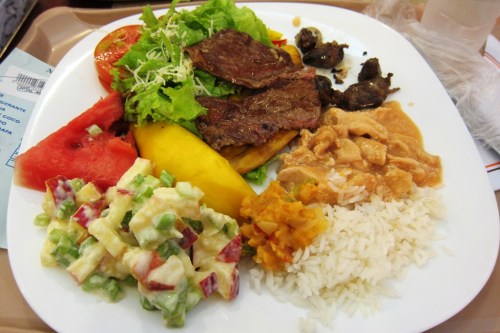
All this for only about $8
There are different types of kilo restaurants for all different tastes – including salad places, vegetarian places, pasta places (Spoleto) and places with homestyle Brazilian food (Aipo e Aipim), and many have several branches in Rio. Sometimes there is a whole separate dessert buffet or even a churrasco (grilled meats) station, which may be offered at a different kilo rate (the churrasco at Aipo e Aipim is great). The selection varies by price, but most restaurants will have at least a dozen options.

Cake buffet at Aipo e Aipim
The menu at a kilo restaurant varies daily, so if you find a favorite kilo place you can go there a few times a week and not be too bored. Prices vary, but the lowest price at a decent kilo restaurant was about R$20 ($10) ranging up to about R$50 ($25). Prices are cheaper outside the tourist areas, obviously. The prices may also vary inside “peak” hours (12-2 or so), and off hours may cost less. At first we were bewildered, but we grew to love the kilo restaurant. It may seem like a lot to consider, but you’ll be eating at kilo restaurants like a native Brazilian in no time!
Filed under World Eats
A Quick Guide to Street Food in Istanbul
 The street food in Istanbul is amazing, and there is a whole lot more than Döner on offer. Though of course the ubiquitous cone of meat is available, we found some options for street food that were completely unique. When we were in Istanbul, we ate as much street food as possible, and we really enjoyed the ubiquitous culture of street stalls and carts. Here are our favorite street eats, but if you’re looking for more, Witt Hotels and Atdaa have great rundowns of the myriad different types of street food in Istanbul. We wish we were enjoying these munchies by the Bosporus right now.
Mısır – One thing we never expected to see for sale in Istanbul was something distinctly “new world” – grilled corn on the cob! Much like Mexican elote, misir is served with salt and spices (though there is no butter). This was absolutely one of the most popular street foods, and is surprisingly tasty and filling.

Misir / Kestane Cart in Istanbul
Kestane – Delicious roast chestnuts often sold alongside corn, or alone after corn has gone out of season. Chestnuts are a popular fall food throughout Europe, as we saw in Lisbon, and are a great warm-up in chilly weather.
Simit – One of the many ring-shaped carb-y options available as street food in Istanbul, simit is a savory bagel-esque bread ring covered in sesame seeds. For breakfast simit, is often accompanied with yogurt and jam.
Açma – This similar to Simit, but is sweet and fried. Think of a Turkish doughnut.
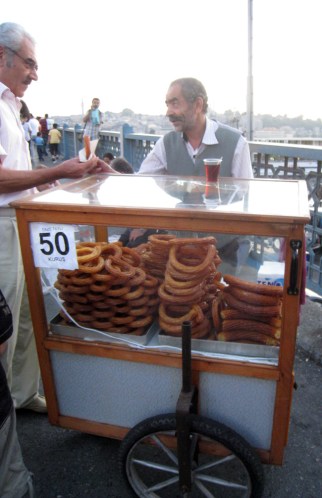
Halka Tatlisi cart in Istabul
Halka Tatlisi – If Açma is not sweet enough for you, you graduate to the Turkish churro: Halka Tatlisi. This street food staple consists of fried dough with a glossy sugar glaze. For the sweet tooth only.
Dondurma – Turkish ice cream – which has a much denser, pliable consistency. Half the fun is watching the ice cream cone being prepared.
Pide and Lahmacun – Thin flatbreads topped with cheese and/or meat, perfect if you are feeling like more of a meal. There are also full restaurants dedicated to these foods, though you can get them on the street.
Mussels – Down by the docks we also saw buckets of Mussels for sale (and ready consumption). This particular street food we did not partake in, but we were just about the only ones. We imagine the high turnover keeps everything pretty fresh.
Filed under World Eats
Northern Thai Cuisine in Chicago at Sticky Rice
Sticky Rice
4018 N Western Ave.
Chicago, IL
 One of our favorite cuisines is Thai, and though we love our go-tos, sometimes we get a little suck in a rut and keep ordering the same thing. However, Sticky Rice is the perfect antidote. Most Thai restaurants in Chicago specialize in Southern Thai food, and the cuisine of Bangkok. However, Chicago is lucky enough to have Sticky Rice, a Northern Thai restaurant that has dishes that are uniquely local. Sticky Rice is cute, clean and open, and was pretty crowded (though the photo from this angle doesn’t show it) when we arrived on a Saturday night. The menu is prodigious, covering, curries, soups and noodle dishes; but on this night we made a beeline for the Thai Northern specialties.

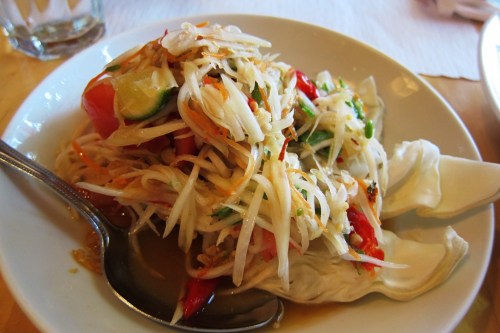
For appetizers, we ordered Som Tum, papaya salad with lime ($5.95), chicken satay ($5.95- not adventurous, but delicious) and the sugarcane shrimp ($6.25). Our food arrived surprisingly quickly, and we dove right in. The papaya salad was light and refreshing, and the sugarcane shrimp was not exactly what we expected – shrimp patties on huge hunks of sugarcane, but it was still tasty.
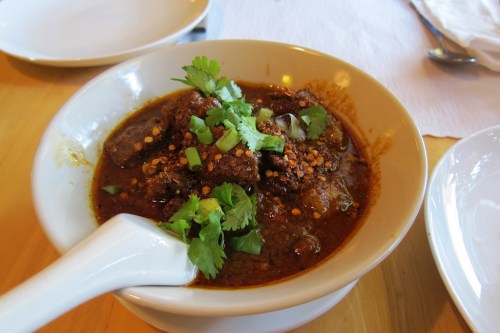
M ordered the Gang Hung Lay ($7.50), pork garlic and ginger in a Northern Thai chili paste and L ordered Chicken Kow Soy ($7.50), a Northern coconut curry soup. We also were intrigued by the Gang Kae frogs legs, cooked in a spicy soup ($8.95). The Kow Soi was delicious and creamy, was richly spiced with turmeric and cardamom, and was reminiscent of Indian cuisine. turns out this dish is the result of Yunnanese traders who settled along the trade routes from India and China crossing in Thailand – delicious. M’s curry was spicy and hearty, and he slurped up the broth.
Sticky Rice is a great place to try to different flavors of Northern Thai cuisine, and we can’t wait to go back and work our way through some of the Northern Thai specialties. However, if you or your dining companions are feeling more in the mood for a classic curry or Pad Thai, you can find it here too.
The secret behind Italian olive oil
The New York Times has an interesting visual story, “Extra Virgin Suicide” about the true production practices of Italian Olive oil. It’s a little shady.
Filed under Links
French Galette des Rois
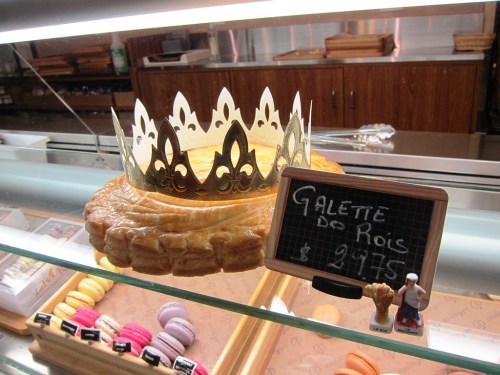
Galette des Rois at La Fournette in Chicago
King cake is commonly eaten on Epiphany, January 6th, and whoever finds the trinket (la fève) in the cake (sometimes ceramic, or sometimes edible, like a fava bean) is king/queen for a day. However, it is fashionable in Paris to serve it long after that, and perhaps this tradition holds in Chicago as well, since we still saw it on offer in Mid-January. The French Galette des Rois is made with puff pastry and filled with almond cream. David Lebovitz has a recipe to DiY, though we think it’s nicer to pick one up at the bakery (and the crown that goes with it).
Filed under Holidays, World Eats
Getting ready for the Sochi Olympics

The 2014 Winter Olympics in Sochi, Russia start February 6th, which means even more inspiration for exploring international cuisines. The setting in Sochi, a resort town on the Black Sea, also provides a great springboard for learning more about Russian cuisine. Sochi, in particular, is known for its idiosyncratic cuisine that is a result of the cultural interchange along trade routes. The Russia and India report has a list of unique Sochi-specific dishes to try.
Filed under World Eats
A Taste of Alsace in Chicago: La Fournette
La Fournette
1547 N. Wells
Chicago, IL
It is particularly appropriate that I am writing this review of a little French bakery while listening to Julia Child’s “My Life in Paris” (so she’s not a pastry chef, but still…) We happened upon La Fournette after a trip to the Chicago History Museum, and we were pleased by the quaint ambiance and the large variety of baked goods. We were a little taken aback that we were greeted with a chipper “Bonjour” upon entering, but in the best possible way.

La Fournette seating space
The bakery itself is long and narrow, with wooden tables at one end, and a very long glass counter at the other (you can even do a tour on Google Maps). “Fournette” means little oven, so it is no surprise that the specialty of the house is the delicious bread. We sampled some of the house specialty bread, a dense sourdough called “Miche La Fournette” ($6.95 for a 2 lb loaf). There was a large selection of attractive carb-y delights piled on the baking racks. The Provençal Olive Fougasse bread ($5.75) looked particularly appealing, and who could go wrong with a classic baguette. The chef is from the German-influenced French region of Alsace, so that unique culinary heritage is also present in the bakery – they even have Bretzels ($2.15)!
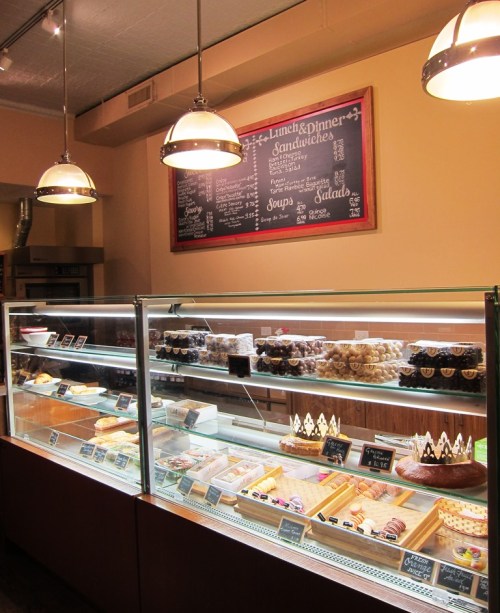
The Pastry Case at La Fournette
Of course we also made a beeline for the sweets. There was a pretty decent selection of macarons ($1.80), from which we ordered a chocolate and passion fruit/mango. The chocolate was a little flat but the fruit macaron was light and delicious. We were a little disappointed to find the financiers and madeleines pre-wrapped, but we were reassured that everything is made in-house. For something more substantial, there are a rotating selection of soup and sweet or savory crepes. M selected a bacon lentil soup, which was very warming (and very bacon-y). There is also a small drink menu from which we ordered some chocolate chaud, or hot chocolate. It was not too sweet (which we like) and perfect for the freezing weather. Perhaps a cafe au lait some other morning?
Galette des Rois – “King Cake”
One of the key features of the cafe that we enjoyed is that you will find people actually talking to each other, not just working on laptops, as you see in most other cafes. We highly enjoyed our relaxing afternoon snack and the convivial atmosphere, and we hope to get there earlier another morning so we can sample the croissants and brioche that had long sold out by the time we arrived. Moreover, we are looking forward to visiting the outdoor cafe portion in more friendly weather.
Coffee Culture in Miami
 We were in Miami for a friend’s wedding and we had a fabulous time taking in the local cuisine. One thing L especially loved was the coffee culture in Miami, where delicious espresso was found on every corner. Our Miami-native friend Fredo assured us that Miami’s coffee culture was the greatest in the US, so we were pretty excited to get drinking. Fredo was definitely right, people in Miami are truly passionate about coffee, and we got a ton of suggestions for where to get the best coffee from our Miami-local friends. However, no matter where you go, there are a few major types of Cuban coffee that you will commonly find offered:

Cortadito at Panther Coffee in the Wynwood Art District
Cafecito / Cafe Cubano – very similar to the Brazilian cafezinho, a strong shot of espresso, with a healthy amount of sugar. The drink is not sweetened after, but rather the sugar is added during the brewing process. This drink is ubiquitous, and will run you less than a dollar. We warn, though, you’d better like your coffee strong.
Cortadito – My favorite, a cafecito with some milk added. This drink is often offered to “beginners” who may think a Cafecito is too strong, but I like it anyway!
Cafe con Leche – Typically for breakfast, a shot of Cafecito with a generous amount of steamed milk
Colada – A quadruple shot of espresso with four (usually Styrofoam) shot glasses. Under no circumstances are you supposed to drink all four shots alone, but rather you are supposed to share with friends. Usually this ends up being a pretty good deal.
Another unique aspect of coffee culture in Miami is the fact that coffee counters abound, and are still the most popular way to enjoy a cup. This reminded us of Brazil, where people would enjoy their cafezinhos standing up at small counters. While you can get your cafe to go, many places also have small areas to sit down. You can find Cuban coffee all over Miami, but many of the most famous places are in Little Havana all along Calle Ocho.

Interior of Versailles, at the western end of Little Havana / Calle Ocho
Versailles (3555 SW 8th St.) is one of the more famous Cuban restaurants in Miami, and a solid bet for both Cuban food and coffee. There is a full restaurant, which is a favorite among visitors and locals alike (we were actually there about 1 hour before Beyoncé and Jay Z), but there is also a smaller cafe with a coffee counter attached. Along with coffee, you can also get a wide variety of tarts and pastels and while away the time. We enjoyed a Guava pastry and an apple and citrus Torta de Santiago. The coffee and pastries together reminded us a little of our favorite pastelaria in Lisbon, also called Versailles, though the Miami setting was not as opulent. Another good choice in the area is El Pub, with a more minimalist counter (1548 SW 8th St.).

Cortadito, a Pastel de Guayaba, and a Torta de Santiago at Versailles
Offering a more modern take on the cafecito is Panther Coffee (2390 NW 2nd Ave.). Panther is reminiscent of a NYC or Chicago coffee shop, with a wide menu of small-batch coffee varieties, and even a menu of alcoholic drinks. Located in the artsy Wynwood district, Panther draws a young crowd that looks like they would be more at home in Wicker Park. Even if you are hipster-averse, the coffee is great.

Panther Coffee in Wynwood
This list only is the tip of the iceberg, and you can find Cafe Cubano on every corner of Miami. We are excited to try out more spots when we return there in February. In the meantime, maybe we should pick up some Bustelo Coffee at the supermarket.
Filed under World Eats
The science of taste at the Nordic Food Lab
 I recently learned about the Nordic Food Lab, and I have never heard of anything like it before! The mission of the Nordic Food Lab is as follows:
Nordic Food Lab is a self-governing organization run on a not-for-profit basis. Established in 2008, we work to investigate the idea of deliciousness and its interconnected systems. We explore the raw materials of our region, the flavours that say something about us and imbue the foods we eat with a connection to this place and this time.

The Nordic Food Lab via Facebook
The lab is the brainchild of René Redzepi, the owner and founder of Noma, considered one of the best restaurants in the world. It is not a lab in the strict sense of the word, but rather a place to experiment with the latest intersections of taste, chemistry, flavor and even the idea of dining itself. Chefs, scientists and anthropologists alike all collaborate on lab projects. It also appears to be right on the water, which really appeals to us!

Waxing Plums at the Nordic Food Lab
The ideas coming out of the food lab are extremely avant-garde, and by just poking around on the blog you’ll get an idea of what the mad scientists are up to. For example, learn about the flavor science of vinegar, or using wax to ferment plums. The lab even received 3.6 million Danish Kroner ( Over $600K US) to conduct research on edible insects. There is definitely something to be said for the Nordic countries being on the cutting edge of cuisine. We are curious to see what the Food Lab will come up with next.
Filed under World Eats
Miami’s Best Pan con Lechón: Papa Llega y Pon
Papa Llega y Pon
2928 NW 17th Avenue
Miami, FL 33125
Well, we finally managed to make it home from our whirlwind culinary tour of Miami (thanks to the Polar Vortex for the delays)! In the coming days we’ll have reviews of eats around Little Havana / Calle Ocho, Miami’s amazing coffee culture, and why South Beach scares us. But today, we head straight for the reason M loves Miami so much: pan con lechón, a classic cuban pork sandwich. Lechón is a Spanish term for roasted suckling pig (BBQ lovers: note that lechón is NOT smoked, so do not expect a pulled pork sandwich). In Cuba, and especially among Cuban expats in Miami, pan con lechón (literally bread with roasted pig) is a classic lunch. We asked around, and there was near-universal agreement as to where to go to find the best of the best: Papa Llega y Pon, in Miami’s Allapattah neighborhood.

It seems by now that we have an affinity for places serving lechón by someone named Papa. At Papa Llega y Pon, pan con lechón is the specialty of the house and a simple affair. Papa Llega y Pon seems to take pride in being nondescript. There is no sign either on the street or at the restaurant, so it is easy to miss if you do not know what you are looking for. Even so, the small parking lot, we were told, is almost impossible to get in and out of on weekdays around lunchtime. We played it safe and went at late afternoon on a Saturday, when it was nearly empty. Walking up the counter, you are greeted by women brandishing meat cleavers, ready to take your order. You have few options: you can order a pan con bistec (beef sandwich) or pan con lechón. While there are rumors of people ordering the former, the sign on the building’s north side is there to remind you of what you should be asking for:

When ordering, you are given a choice of sizes for your sandwich (we opted for medium, $6 each) as well as toppings. We went all out and chose both possible toppings, cebolla y picante (onions and hot sauce).
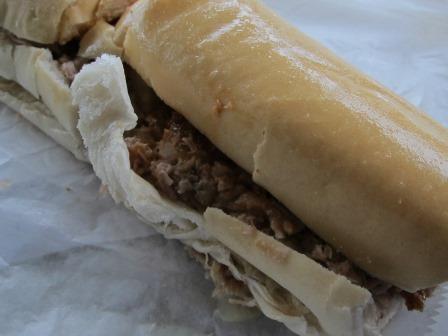 At Papa Llega y Pon, the pork is lightly but effectively seasoned, the hot sauce adds a tinge of spice (barely discernible to M), and the onions blend in with the rest of the pork, adding a little extra texture and variety to the flavors. Adding more texture is the obligatory chicharrón (fried pork rinds) mixed in with the pork meat. You can order yours without chicharrón, but you’ll get some strange looks from your servers. Overall, this is simple comfort food, so those expecting bold flavors or exquisite preparation will be disappointed. This is well-made, well-seasoned, and classically prepared food for those who have come to expect the best of the same. It definitely satisfied our lechón cravings, and there is no wonder it is so popular in Miami.
Filed under Reviews
The end of the Srirachapocalypse is near
Hot sauce addicts, never fear, Huy Fong Sriracha sauce will start shipping to stores again in late January. The Sirachapocalypse will soon be over.
Filed under Reviews
Michelangelo’s Grocery List

The more things change, the more they stay the same. Take for example, Michelangelo’s handwritten 16th-Century grocery list. The list includes staples like fish and bread, and even comes with illustrations. So, ok maybe that is a bit different since the person buying groceries for Michelangelo was likely illiterate.
Filed under Links


 Eating The World
