Cacahuates Estilo Japonés (Japanese-Style Peanuts)

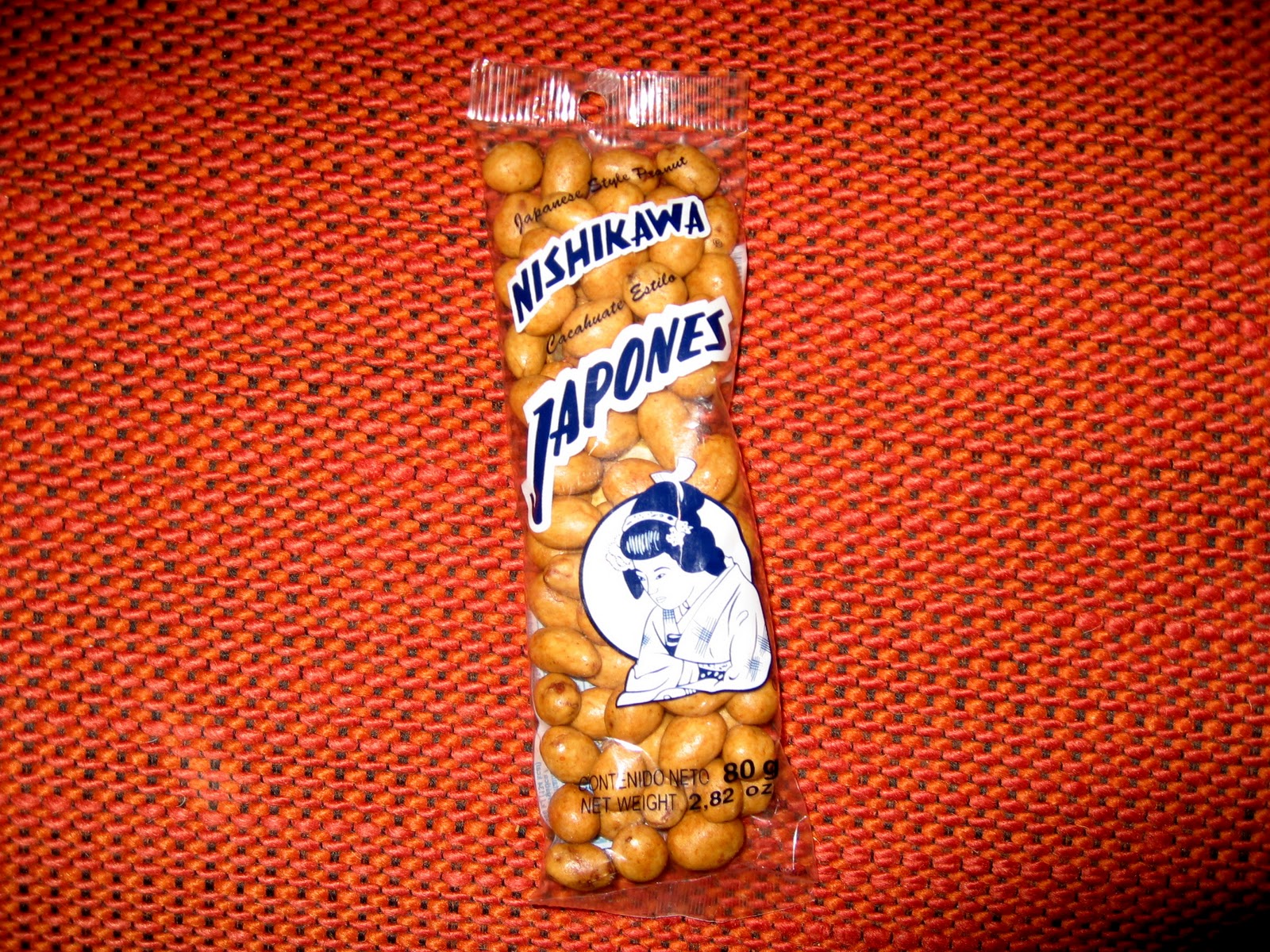
In July, we attended the wedding of one of our good friends – a Mexicophile – and a wonderful man from Puebla state. They had excellent wedding favors: a packet of candy, filled with their favorite candies from Mexico and the U.S. We were particularly struck by what a blue plastic packet of “Cacahuates Estilo Japonés” (literally “Japanese Style Peanuts.”) They appear to be unique to Mexico: large peanuts, de-shelled, covered with a thick, dried sweet coating with a hint of soy sauce. It took us a couple minutes to figure out that the coating we even edible (too used to shelling peanuts at baseball games, I suppose!), and when we finally did, we were perplexed by the texture and the flavor. After that, they became one of our go-to snacks: salty, sweet, crunchy, and soft all at the same time. A bit of research has yielded no definitive answer as to their origins: unique to Mexico, they appear to have no relation to Japan other than a hint of soy flavor. Beyond that, it is unclear how they were developed in Mexico, and who developed them. The best part, according to Slashfood contributor Joe DiStefano, is the packaging, which depending on the brand “which ranges from a geisha to a Mr. Peanut-type character dressed in a baseball uniform.

Nishikawa brand Japanese-style peanuts (via The Grande Enchilada)

4 Comments

Filed under Reviews

Julia Child’s 100th Birthday

Julia Child would have turned 100 today, so it’s the perfect time to reflect on her amazing contribution to the world of gastronomy.  When Julia Child published Mastering the Art of French Cooking in 1961, it completely rekindled American interest in French cuisine. The book has since gone into 18 printings (and is even available as an eBook). Child continued to spread her love for French cooking through a series of successful television shows, beginning with The French Chef, one of the first TV cooking series, and subsequent cookbooks. However, one of her most important contributions is introducing Americans to the fun of cooking, rather than treating cooking as a chore.

Leave a comment

Filed under Note

Diverse, International Restaurants in London

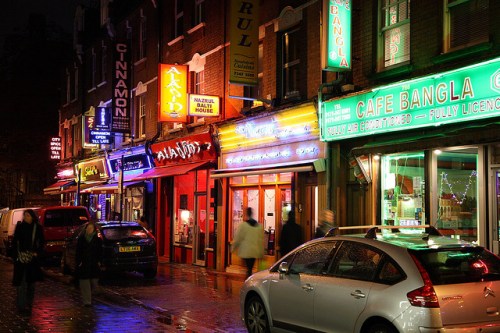
So the Olympics are officially over – and we are sad (though we are looking forward to Rio)! However, while the international athletes may have gone home, the international food scene in London is only growing. With over 8 million people, London has an amazingly diverse population and food scene. Indian food, arguably the most popular cuisine in the UK, is found nearly everywhere in the city, and there are amazing Indian restaurants for every budget. While London has long been home to South Asian food on Brick Lane and has a Vibrant Chinatown, it is home to many other far-flung cuisines.  London Ethnic Eating is a blog dedicated to exploring ethnic food in the city, turning up eateries ranging from Vietnamese to AlgerianTime Out London’s List of top 50 restaurants includes many international options.

Brick Lane at Night

1 Comment

Filed under Links, World Eats

Nasi Lemak: National Dish of Malaysia

Until a few days ago, every medal won by the country of Malaysia had been won by a male in badminton,. That all changed with 19 year-old Pandelela Rinong, who won a bronze medal in women’s 10 meter platform diving. Rinong was also the flag-bearer for her country at the opening ceremony, and it is easy to see why: the interview she conduced with NBC reporters after winning her medal could have been a commercial for the Malaysian tourism board, with Rinong endlessly beaming with pride over being Malaysian.

The national dish of Malaysia is Nasi Lemak, a rice-based dish cooked in coconut milk and served on a pandan leaf. The name translates to “rich” or “fatty” rice, a name derived from the cooking process: the rice is steamed and simmered in coconut milk, giving it a rich and creamy texture and flavor. That done, the nasi lemak is served with any number of accompaniments, depending on the time of day (it can be breakfast, lunch, or dinner): this usually includes sambal, along with sliced cucumber, hard-boiled egg, anchovies (usually fried), roasted peanuts, and meat. Then, just mix and match the flavors any way you wish! We can only assume the dish is plentiful at all times of day on Jalan Alor, the main eating street in Kuala Lumpur, but unfortunately we did not sample it on our 12-hour layover tour of KL in 2010. We’ll have to go back – Pandelela, want to take us on a tour of your capital? You seem just like the person to do it!


2 Comments

Filed under Reviews, World Eats

Seswaa: National Dish of Botswana

File:Flag of Botswana.svgCongratulation to Nijel Amos of Botswana, who earned the first-ever medal for his home nation by finishing second in the men’s 800 meters! In celebration of his achievement, we learned a little about Seswaa, arguably Botswana’s national dish. Seswaa (also called Chotlho) is a mashed-meat stew, often reserved for special occasions. It’s preparation is simple: typically cooked by men, chunks of meat are slowly simmered in salt and water in a three-legged iron pot (like the ones pictured below courtesy of our friend Brendan). Margarita’s international recipes has a rather humorous recollection of trying to pound the meat with a wooden spoon to produce the desired result, but with little luck – for her, the gristle seemed to prevent a proper pounding, so she had to resort to shredding instead.

Image

And if you don’t want to try Seswaa or one of the any other great Botswana dishes, you should give a Mopane worm a try!

Leave a comment

Filed under World Eats

Top Food Trucks in London

It is no secret that we are mad about food carts, and we consider them to be one of America’s most important exports. Food cart culture has spread to Paris in recent years and has taken root in London. It is worth noting that food “cart” and food “truck” have very different connotations in British English, with food carts having a somewhat dubious reputation. Not to fear though, high quality and innovative food trucks are on the rise in London, right on the heels of booming food truck culture in the US. The variety of London food truck is admirably vast and street foodies can choose from gourmet burgers, curry, chocolate, Vietnamese, and Mexican, among others.

The Luardos Food Truck in London

The Guardian has a list of food trucks picks in London , along with some mouth-watering recipes from each (we are especially digging the Carnitas recipe from Luardos). Migrationology has another round of 6 picks, including meatballs and hotdogs (sounds a little familiar to Chicago, no?). Another truck that found its way onto nearly all of the lists was Crêperie Nicholas, a fan-favorite for crêpes, served out of a restored 1965 Citroën truck. Southern food has also made its way to London, and the Pitt Cue Co. truck even offers pulled pork. This extremely important development means we could move to London easily, should the need arise. Most intriguingly we are excited to note the appearance of the HMS Flake 99, an ice cream truck that doubles as a BOAT (see below). For the latest in London street food developments, you can keep up with the Eat.st site.

HMS Flake 99 photo by Eater

2 Comments

Filed under World Eats

Oil Down / Oildown: The National Dish of Grenada

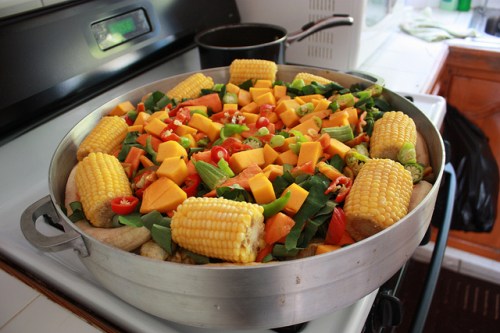
Kirani James of Grenada delivered his country’s first gold in medal in style with what looked like an effortless win in the 400 meter dash. Though we are fans of Caribbean cuisine, tiny Grenada tends to fly under the radar of other larger nation’s cuisines like Trinidad and Jamaica. The national dish of the country is the colorfully-named Oildown or (Oil Down), a fact even corroborated by the government of Grenada. Oildown is a stew made with coconut milk with a variety of salted meat or fish, dumplings,  saffron, dasheen (taro leaves), breadfruit and whatever veggies may suit your fancy. At its core, oildown seems to be a cousin of the Brazilian moqueca, another stew with a coconut milk base.

Oildown in Production by SnarkleMotion

So where does it get its name? According to popular legend, the name of oildown comes from the cooking of the veggies in the coconut milk, where most of the milk gets absorbed, leaving the oil behind. Like any good dish, the best oildown is made by everyone’s grandma or mom, and in a tradition we quite enjoy, it is best enjoyed when made on the beach.  Not to be confined to the borders of Grenada, there are even Trinidadian versions of Oildown.

1 Comment

Filed under World Eats

Chicken Tikka Masala: National Dish of Britain

Mughal_Empireunited_kingdomIndia Flag

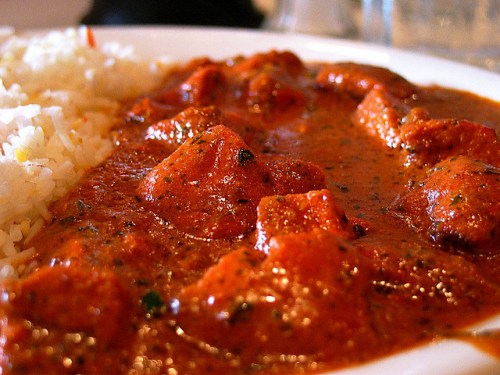
Until about a week ago, Team GB had all but struck-out in the medal department at their home Olympics. Fast forward half a fortnight, and their 16 golds places them third on the overall list, as well as garnering them today’s national dish highlight at ETW – chicken tikka masala. Wikipedia offers this succinct definition: “Chicken tikka masala is chicken tikka, chunks of chicken marinated in spices and yogurt, that is then baked in a tandoor oven, [and] served in a masala (‘mixture of spices’) sauce.” The recipes variations are as wide-ranging as its origin histories, but nothing obscures its popularity. Recently Robin Cook, the British Foreign Secretary, declared chicken tikka masala as the new national dish of the United Kingdom. Today, 1 in 7 of all curries sold in Britain are tikka masala, and it is the most popular restaurant dish in the country. But while tikka masala is unquestionably popular in Britain, and has been declared the national dish, its transnational origins reveal a fascinatingly complex and controversial history.

Chicken Tikka Masala at Akbar’s Indian Restaurant in Santa Monica, CA.

Continue reading

10 Comments

Filed under Uncategorized, World Eats

Pabellón criollo: National Dish of Venezuela

Pabellón Criollo from Wikipedia

Many congratulations to fencer Rubén Limardo, winner of Venezuela’s first Olympic gold medal since the 1968 Mexico City games. In honor of this achievement, it’s time for some Venezuelan food! When we think of Venezuelan cuisine what immediately comes to mind are arepas – filled pockets of corn dough that strike the perfect carb-to-filling ratio. Though arepas are popular – the quintessential Venezuelan dish is Pabellón criollo (which translates roughly to “Creole Flag”) – a comforting dish of rice and beans with shredded beef. Similar variants of the mother dish of rice and beans are popular throughout South and Central America, as well as the Caribbean. Fried plantains are also an essential component of Pabellón criollo and for a variation, you can get your dish served with a fried egg, which is called a caballo (“on horseback”). The secret to the dish, however, is in the sofrito, the fragrant triumvirate of bell pepper, onion and garlic.  What’s for Eats has a delicious-sounding recipe as does Venezuela cooking (with each component broken into a separate recipe)– seems like good party food!

2 Comments

Filed under World Eats

Beshbarmak: National Dish of Kazakhstan

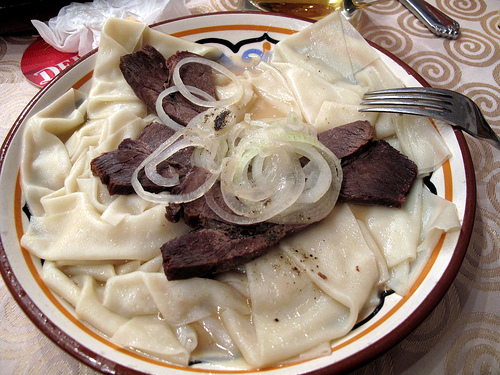
Beshbarmak photo from PeretzP

In the early morning hours on the first full day of the 2012 Olympics we saw Kazakh athlete Alexandr Vinokurov win the men’s cycling road race. In honor of this feat we decided to do a little feature on Kazakh food, especially the national dish, Beshbarmak. The name means “five fingers,” and as this implies, the dish is usually eaten by hand, and is a favorite for special events like weddings. It is usually made with horse meat (owing to the traditionally nomadic nature of the country), potatoes, onions and very wide noodle sheets. The dish is also popular in Kyrgyzstan, where it is also claimed as a national dish.  Foodista has a recipe for Beshbarmak using the more conventional for western tastes choice of lamb.

1 Comment

Filed under World Eats

Switzerland’s Röstigraben: Culinary Divide Between West and East

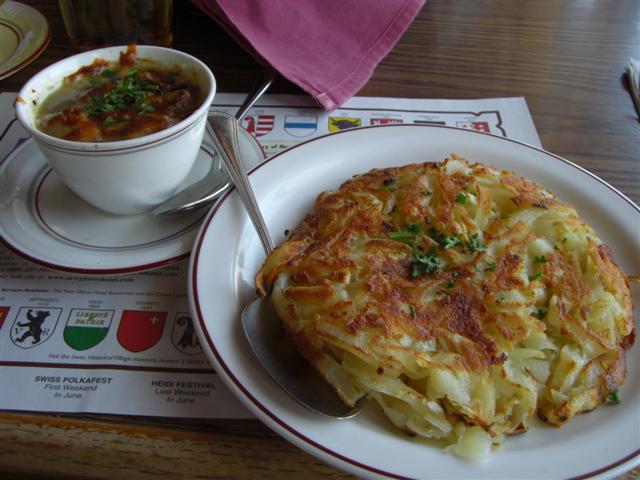
We here at ETW love the Olympics, so we are excited to cover some international cuisine as it relates to this very international sporting event. An important spot for the Olympics is Lausanne, Switzerland, home of the International Olympic Committee. An awesome Swiss Geopolitical and food related concept (how fun!) is that of the Röstigraben. It garners its name from the grated potato dish Rösti, which originated in Bern and is popular in the Swiss German areas. We were first introduced to the Röstigraben through the Strange Maps blog, and it is a strange map, represented above by Switzerland in the shape of a Rösti. The Röstigraben is the divide between the cultural areas of eastern German and western French Switzerland, which is further described in this National Geographic article. Lausanne, as it so happens is on the Western side of the Röstigraben.  Well west of the Röstigraben, we enjoyed some very nice Rösti in the heavily-Swiss New Glarus, Wisconsin. Yumblog has a recipe for Rösti, which looks easy as pie.

Rösti in New Glarus, Wisconsin

Leave a comment

Filed under World Eats

The Olympics (of Food)

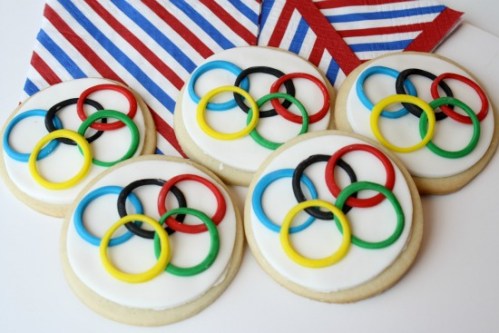
Olympic Cookies from Papery and Cakery

The Olympics are on – one of our favorite times! In honor of the event we are going to be covering the national dishes of Gold Medal winning countries, along with other Olympic-related foodie tidbits. Let the games begin. If you’re feeling extra festive, why not whip up a batch of Olympic cookies.

Leave a comment

Filed under Note

The Olympics and British Cuisine

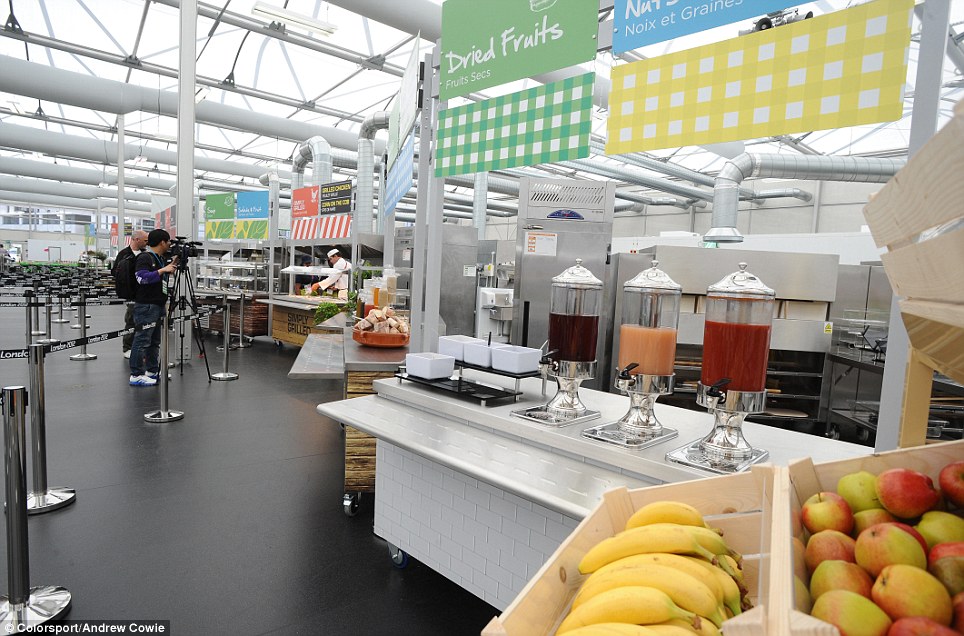
A view inside the Olympic Village Dining Hall – courtesy of The Daily Mail

The 2012 Olympic Games begin today in London, and Britain is using the international exposure to rebrand its still paltry international culinary reputation. Of course, anyone who still believes Britain has terrible food has either not visited London in the past ten years or, if they did, managed to have their heads stuck in the Underground for too long. As Henry Chu of the LA Times noted, London is a very different place from when it last hosted the Olympics (1948), and Londoners today are used to having the world at their doorstep. But just in case you missed the memo, here’s some light reading to catch you up: The New York Daily News is asking whether or not the Olympics can put British cuisine back on the menu, noting that the Olympic Village’s main dining hall contains a number of different culinary zones highlighting the international influences that make up the British culinary menu, including “Best of Britain; Europe, the Americas and Mediterranean; Asian, and Afro-Caribbean” cuisines. Meanwhile, Gavin Cleaver at An Englishmen in BBQ Sauce (he’s a Briton writing in Dallas – get it?) has a celebration and occasional loathing of British cuisine, dishing out gold, silver, and bronze medals (try the curry!) in an Olympics of British food. Lastly, Katrina Heron at The Daily Beast outlines how, as spectacular as the Beijing Olympics were overall, they were an unmitigated culinary disaster, with terrible food that kept running out. Instead, in London, they are trying to launch a “culinary revolution,” insisting that this Olympics presented “an unprecedented opportunity to look at our diets and our health, at our catering industry, at the state of our farms, and to commit to a long-term plan for good food and environmental stewardship.” Internationally diverse, readily available, locally sourced, delicious food? London, we wish we were there too.

Leave a comment

Filed under Reviews

Spaghettieis: Ice Cream that looks like pasta?

Spaghettieis from Wikipedia

It’s going to be another hot day in Chicago (seems like we’ve been saying that nearly every day this month) so we figured it was time for another ice cream post. This one is a little more surreal than usual. We saw a link on Boing Boing about Ice-cream that looks like spaghetti – spaghettieis. and we were thoroughly intrigued. Apparently this confusing German treat is composed of vanilla ice cream extruded through a Spaetzle Press/Pasta Extruder/Play-dough mold to look like spaghetti. To complete the spaghetti-dinner look, the ice cream is topped with some sort of red berry sauce, and finally covered in coconut shavings. Since its invention in the 1960s, spaghettieis has become something of a national dish in Germany. For more proof of its popularity, check out the huge amount of spaghettieis documentation of Flickr. We’re pretty impressed at the verisimilitude!

Leave a comment

Filed under World Eats

Stunning International Restaurant Interior Design

The British website We Heart is arbiter of all things design-related, and we have always been impressed by their coverage of international restaurant design. Though most of the restaurants we frequent are of the hole-in-the-wall variety, we always appreciate some elegant design, and judging by the coverage on We Heart, there are some pretty innovative ideas out there. The photo above is from an ultra-modern, stark-white Cioccolato a chocolate shop/bakery in Mexico City. Another futuristic design is presented by the monochromatic Arthouse Cafe in Hangzhou, China. For a more industrial look, check out this Philly-style diner, Pat’s, in Melboourne, Australia. The photo below is of Nando’s Ashford in Kent, UK, a sister restaurant in the Nando’s chain M visited in Washington D.C. More photos of the Ashford Nando’s are available at Design Milk. For even more cool restaurant designs, check out the Lifestyle section of We Heart. For those who want to delve deeper, Dwell Magazine has an interesting post about the history of restaurant design.

Leave a comment

Filed under Design and Photography, Links

An Illustrated Trip (To Brazil, Thailand and Beyond)

I recently came across the blog, An Illustrated Trip, which has amazing illustrations of a French couple’s globe-trotting tour of Argentina, New Zealand, Nepal, India, Thailand and Brazil (plus a few more countries). The illustrations are great, and lucky for us, many of them are food-related. I especially love thir Brazil illustrations because they remind me of some of the food finds that surprised me – such as learning that the Cashew nut is only part of a much larger fruit. They recently returned from their trip, but browsing through the archives gives a wealth of images.

Leave a comment

Filed under Design and Photography, Links

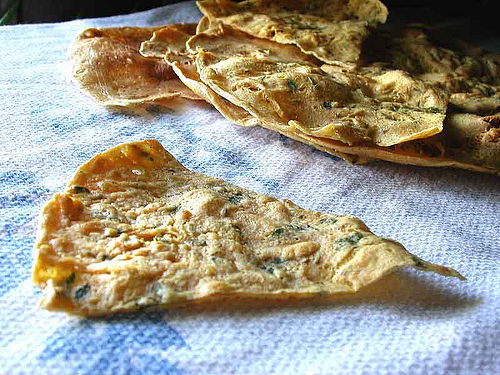
Chickpea flatbread from France: Socca

Socca by Chotda

We searched high and low yesterday for food related to Bastille Day, but the consensus seemed to be that pretty much anything goes. That gives us licence to highlight one of our favorite lesser known French street foods, Socca. Socca, originating in Nice, France is a flatbread made out of chickpeas. Since Nice is so close to the Italian border it is no surprise that there is an Italian version of Socca, called Farinata that is nearly identical. Given the Sicilian proclivity to chickpeas and our love of street food, it is no surprise that we are big fans of Socca. Socca is simply made out of chickpea flour and olive oil, and can be made very thin and crispy, as seen above, or can be much thicker, with toppings like a pizza. However, according to purists, in order to properly make a Socca, you need a special copper pan and a wood-burning oven.  Fortunately The Minimalist assures us that making Socca at home isn’t really too daunting of a task, and the homemade result can be as good as what you find on the streets of Nice. The ingredients really are just that simple, and Lottie and Doff ups the ante a little with the addition of rosemary. As the Kitchn points out, it is also naturally gluten-free!

1 Comment

Filed under Reviews

Mexico: Huaraches Dona Chio

Huaraches Dona Chio
1547 W. Elmdale Ave.
Chicago, IL

When we got back from Brazil we went straight for the food we craved most – in our case, BBQ and Mexican food. Fortunately, Chicago is more than overflowing with Mexican eateries, so we decided to try someplace new. Huaraches Dona Chio had a reputation for being difficult to find, but the big awning meant we did not have any trouble.  On a chilly and blustery day, there could be nothing more comforting than some fresh Mexican food. Inside, the welcoming yet spartan space provides a few tables and an open view of the small kitchen where Dona Chio herself was busily at work preparing the food for the night. Her specialty? Huaraches, a type of thick, open-face masa tortilla from from Mexico City. Huarache toppings provide an almost endless variety, and HDC did not disappoint.

You can get the regulars at HDC: the usual tacos and burritos, and quesadillas. But you come for the huaraches. Naturally, we selected two huaraches as our entree (at only $6.50 each, how could we not)? L got the tinga (it came highly recommended) and M picked the huitlacoche (still his favorite from his time in Mexico). Tinga was by far our favorite. The huitlacoche was topped with both mild green and spicy red salsa, black beans, corn, white onions, cotija cheese and cilantro. The tinga, shredded chicken marinated in chipotle sauce,  was topped with white onion, cilantro and a hearty helping of cotija cheese. We’ve tried a few places around town and also in other cities and these were definitely the best huaraches we’ve had. The masa was not soggy (a problem we encountered elsewhere), and the toppings were extremely generous.

Our dining companion went a more conservative route and got a plate of tacos ($2.50), noting they were excellent as well. To finish up the meal M ordered a banana chocolate smoothie. With our time in Brazil, we will never take for granted the great Mexican food selection in Chicago again (side note: We met up with a friend from Guatemala in São Paulo, who is planning on starting a Mexican food distribution business in Brazil. We hope he succeeds!). Huaraches Dona Chio is one of the fine examples: small, family-run, and serving up great regional Mexican dishes to a small but discerning clientele.

Tinga huarache, we miss you already!

Leave a comment

Filed under Reviews

A New Place for Falafel: Falafill

Falafill
Various Locations in Chicago, IL

The Eaters – especially L – are pretty particular about falafel. It’s no exaggeration to say we make a point to try falafel in pretty much every city we go to. In all our travels, a few places stand out above the rest. Pita Inn in Skokie has some of our favorite falafel in Chicagoland; while the expanding fast-food joint Maoz remains our all-time favorite, owing to their great falafel and toppings. Maoz’ Philadelphia location remains the standard by which L judges all other falafel, a shining beacon of perfection on the Delaware River, never to be equaled….Until today.
We like the logo!

Falafill, a brand-new falafel lunch spot in the Loop, may have perhaps the best topping bar we have ever encountered, and while its falafels may not be as good as Maoz, the topping bar and the excellence of the falafel otherwise may actually put this place over the top in L’s rankings. Falafill starts out appealingly, with a sleek and appealing dining area decorated with falafel witticisms perfectly suited to the Facebook generation. On the food side, the simple menu is complemented by an impressively wide range of sodas and juices: M got a mango yogurt drink , while our old salty yogurt favorite Ayran was also available. The menu is simple. Pick your falafel (classic, curried, or seasonal – all with fries)  in a pocket or a bowl ($5.95/$7.95). The seasonal falafel when we visited was white bean, and we heard from our dining companions that it was out of this world. L opted for some classic falafel and M for the curried, and a side of some sweet potato fries ($2.95).
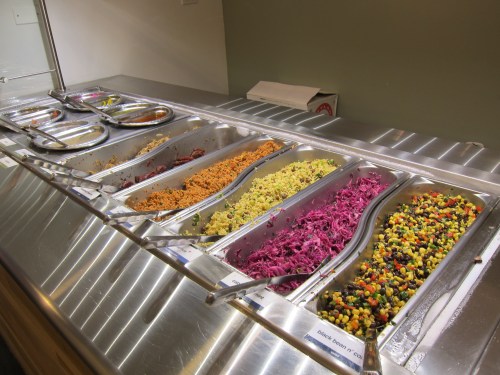
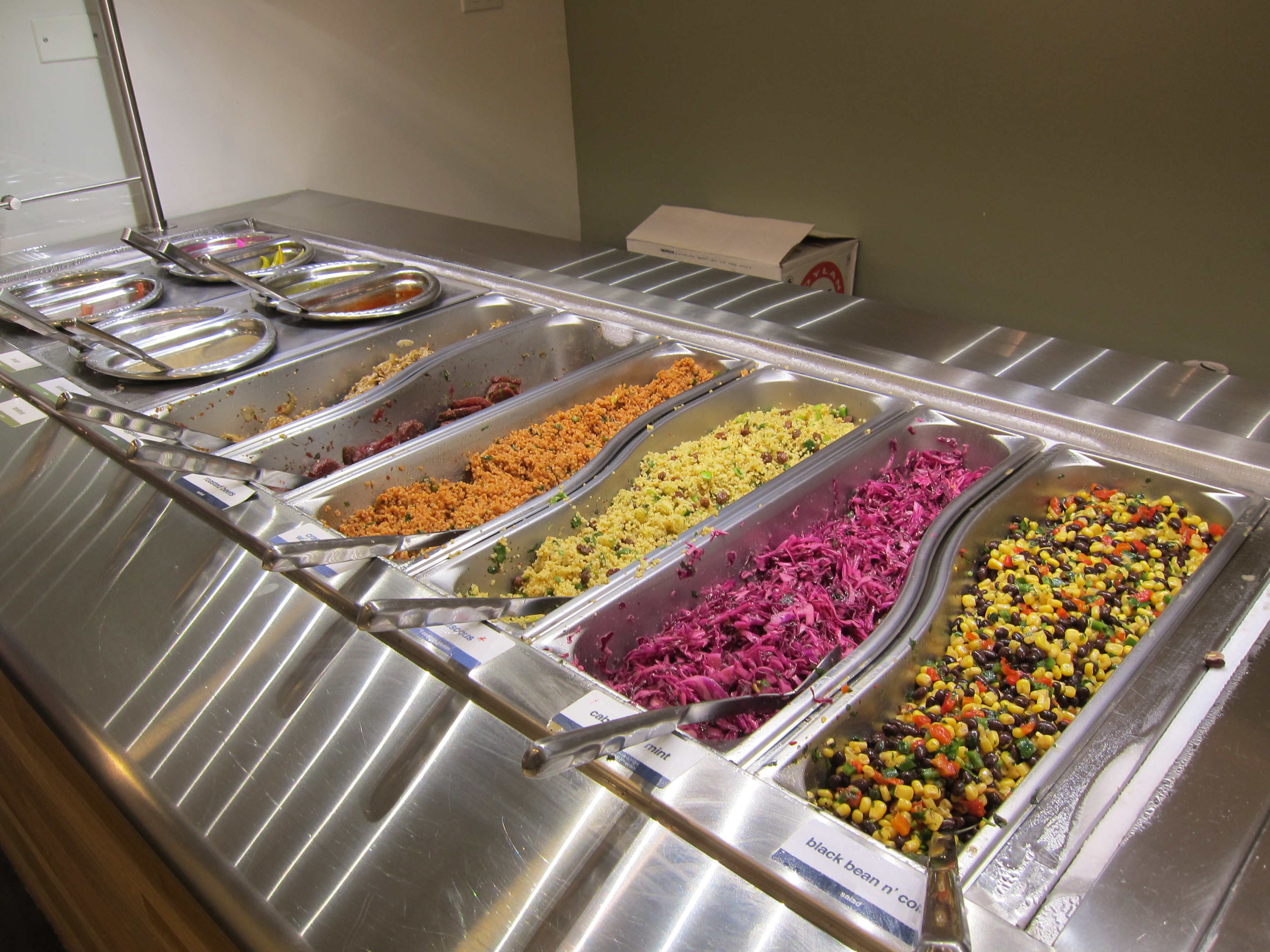
The toppings bar at Falafill. Amazing.

Both falafels, curried and classic, were cooked to order, and perfectly spiced.  L’s classic had the hallmark appealing green color that means there ‘s fresh parsely and cilantro inside. Yum! The fries were also tasty and crisp, not soggy like many other sweet potato fries. Yet what REALLY sets Falafill apart is the Mezza bar, where you can select all the toppings you want for your falafel. As expected, the salad bar contained hummus, baba ghanouj, lentils, tatziki, harissa tabbouleh, all middle eastern standards we love. In addition, we were really excited to see some awesome new flavors at the bar, including cracked wheat with pomegranate, beets, toum (garlic sauce), zough (jalapeno sauce) black bean and corn salad, and cabbage and mint. Each order of falafel includes a trip to the salad bar, and there is no limit to how many toppings you can add. For those who are obsessed, you can order simply a bowl ready to fill with mezza toppings ($6.95). All in all, for under 8 dollars you can create an out-of-this-world falafel experience with a wide variety of contrasting flavors that will have you full for days. Falafill is now one of our go-to Loop lunch spots, and like L has sacrilegiously stated: if not her favorite falafel place in the United States, it is definitely giving Maoz a run for its money.

Comments Off on A New Place for Falafel: Falafill

Filed under A New Place, Reviews

The Renaissance of the French Baguette

Image
Image: Afar Magazine

When one thinks of French bread, artistry, tradition and quality probably come to mind. However, we were very surprised to learn that in Post War France, quality bread was hard to come by. Quelle horreur! Afar Magazine has a fascinating article about the fall and rise of bread in France, and how the writer apprentices with one of the current arbiters of the artisanal bread tradition.

In 1987 a cultural critic writing in the French newsmagazine Le Nouvel Observateur proclaimed that the baguette had become “horribly disgusting.” It was “bloated, hollow, dead white,” he said. “Soggy or else stiff. Its crusts come off in sheets like diseased skin.” Renowned French baking professor Raymond Calvel mused that the best baguette might soon be made in Tokyo. What had brought this on? And how was quality bread revived in the 1990s? The answers to these questions lay in Paris, which is what brought me to the door of Boulangerie Arnaud Delmontel at three that morning last February.

Leave a comment

Filed under Links, World Eats