
 Having long been a fan of bagels – I never realized they are called “beigels” at some places in the UK – where they have long been sold at stores on Brick Lane. The wonderful blog Spitalfields Life recently had a detailed post about the Grandaddy of all of these London bagel shops “Brick Lane Beigels” which includes a history and some great photos of the employees and beigel production. I highly recommend it.
Category Archives: World Eats
Beigels/Bagels in London
Filed under World Eats
Science and Cooking
Cooking is both an art and a science, a connection that has been highlighted by by the meteoric rise of molecular gastronomy. Taking this into account, Harvard introduced a series of public lectures last fall on the intersection of Science and Cooking. The series was overwhelmingly popular and included talks by culinary heavyweights like David Chang, Wylie Dufresne and Grant Achatz. Lucky for us that don’t live in Boston, all of the lecturess are now available on iTunes.
Filed under Links, World Eats
Sweden: Lussekatter for St. Lucia’s Day
 Little known fact: One of the Eaters is partially Swedish – and though we are not particularly keen on Swedish food – there is no denying the appeal of the delicious cookies and pastries served on St. Lucia’s Day. One of the most traditional are the Lussekatter – saffron sweet rolls. The name means “Lucy’s Cats” – but these leavened yeast rolls are figure-8 shaped. And here are even some Gluten-free versions of traditional St. Lucia items – something for everyone.

Filed under Holidays, World Eats
Dia de los Muertos and Sugar Skulls

Sugar Skulls for Sale in San Francisco by Digiyesica
Today is the 2nd day of the colorful, delicious holiday of Dia De Los Muertos! One of our favorite parts of Dia de los Muertos are the colorful sugar skulls. While in previous years we have bought our pre-made there are also many ways you can make your own – with the help of a special sugar skull mold. If pure sugar’s not your thing, you can go the ultra-edible route with chocolate skulls. Another typical treat made for this holiday is Pan de Muerto an anise-flavored bread traditionally placed on ofrendas.
Filed under Holidays, World Eats
Singapore: Chilli Crab
 Chilli Crab is the national dish of Singapore – a whole fresh crab cooked in a spicy tomato and chili broth. We’d been craving Chilli Crab for about a year before we went to Singapore, when the dish was introduced to us by way of a recipe attached to a miniature chilli crab stuffed animal, who took part in our chilli crab adventure below. There’s nowhere to get it in Chicago, and we are definitely not ambitious enough to do it on our own in seafood-starved hometown (Here’s a Recipe if you feel like DiY-ing it). We saved our chilli crab experience for our last hawker center experience in Singapore, saving the best for last, you could say.

We went along with one of my (L’s) colleagues, who had recently moved to Singapore, along with two other friends to the Newton Food Center, just outside of the Singapore city center. The Newton Food Center specialized in seafood, and it shows the second you enter. There were many chilli crab stalls with many eager chefs ready to call us to attention. The stall we settled on was my colleague’s favorite, and when we saw a cage of real live crabs for picking we knew we were in the right place. Once we picked out our crab (Sorry little guy!) we paid by weight and went to sit down for our chilli crab to arrive.
After about 15 minutes a gargantuan plate landed before us. The chilli crab, still wholly intact arrived steaming in a plateful of spicy hot bright-red tomato and chili broth. The only way into the dish was with our hands. Good thing we had a lot of napkins…. It took some elbow grease to crack the claws, but the reward was great. The crab couldn’t have been fresher and the chili sauce was the perfect blend of sweet and savory. Despite the intimidating name, the dish itself wasn’t terribly spicy (perhaps to the disappointment by the heat-seeking M).

For side dishes we got mantou and the misleadingly named carrot cake. Mantou are tiny steamed wheat rolls taken from Chinese cuisine which are perfect for sopping up the chili broth. Carrot cake, as we described in our Malaysian post is a stir fry with eggs and root vegetables. Our final Hawker market experience in Singapore was definitely our best and our group ate like kings. We will be thinking about our swan song meal in Singapore for years to come.
Filed under World Eats
Malaysia: The Food of Jalan Alor
 Jalan Alor is known as Kuala Lumpur’s “eating street.” Much like Singapore’s hawker markets, Jalan Alor is lined with small stalls and some larger restaurants, each boasting a specialty or regional cuisine. By day it looks a little quiet, most of the food stalls are shuttered, and the street is full of parked cars. But by night, Jalan Alor explodes and overflow seating takes over nearly the entire street.

We arrived at Jalan Alor at about 2 PM, and it was just about a ghost town, however we did manage to scrounge up some eats. We ducked into one of the few open stand for some curry. Malaysia and Singapore boast many of the same types of cuisines, so the food was familiar to us. M ordered a bowl of BBQ Pork with noodles and I got the dry curry mee, a gritty curry that is almost more like a marinade than a sauce. BBQ of various types, including BBQ chicken wings is one of the specialties on Jalan Alor, and M enjoyed the sweet and spicy tamarind sauce.

After a foot-busting day of wandering around KL, we arrived back at Jalan Alor at about 11Pm, and it was absolutely packed. This time we didn’t have to search out food – it was everywhere. For our late night dinner we split a large carrot cake. Carrot cake in Malaysia, also called chai tow kway, is not what it seems. Instead of a cakelike texture “carrot cake” is almost like a Spanish frittata, and is an egg dish full of daikon, radishes and green onions, stir fried in soy sauce. Noshing on our carrot cake under an umbrella on a crowded street was the perfect way to finish our 12-hour tour of KL.
Filed under World Eats
Singapore: Nonya Cuisine
Another cuisine unique to the culinary playground that is Singapore is Nonya (or Peranakan or Nyonya cuisine) a mix of Chinese techniques and Malaysian spaces a product of marriages between Chinese workers and local Malays in the early days of Singapore’s history.

Possibly the most famous Peranakan dish is Laksa Lemak, which we sampled in a hawker market in Chinatown. Hawker Markets are basically giant food courts (either open-air or inside) with tons of stalls specializing in different cuisines and sometimes different foods. We enjoyed our Laksa in a hawker market in Singapore’s Chinatown, which was also the site of our first Durian encounter.

Laksa is quintessentially Singaporean and Malaysian and is a spicy seafood curry, and one of the most popular Nonya dishes. The primary ingredients are coconut milk, chili paste and shrimp, though depending on where you get your laksa you might get a dish with the addition of blood or cuttlefish. Rasa Malaysia has a recipe for Laska, as does Top Hat, a famous KL eatery.
Filed under World Eats
Korean Tacos sweep the nation

 Speaking of world cuisines, a type of fusion that we had never seen before – Asian-influenced tacos – is making its way across the nation. Originating in California, the New York Times describes the arrival of Korean-Style Tacos across the nation. One restaurant, Taco Chino, is even located in Chicago. LTH Forum describes the Taco Chino experience here.
Filed under World Eats
Thailand: Enjoying Chaa Yen in Bangkok
 We love Thai iced teas stateside and were pleased to learn that they actually are popular in Thailand as well (unlike some other of our favorite Thai dishes). Thai Iced teas are called “Chaa Yen” in Thai which literally means “Tea Iced.” Haphazardly we found out that by ordering a cha yen flavored smoothie at an Au Bon Pain outside the Grand Palace (not our finest culinary moment).
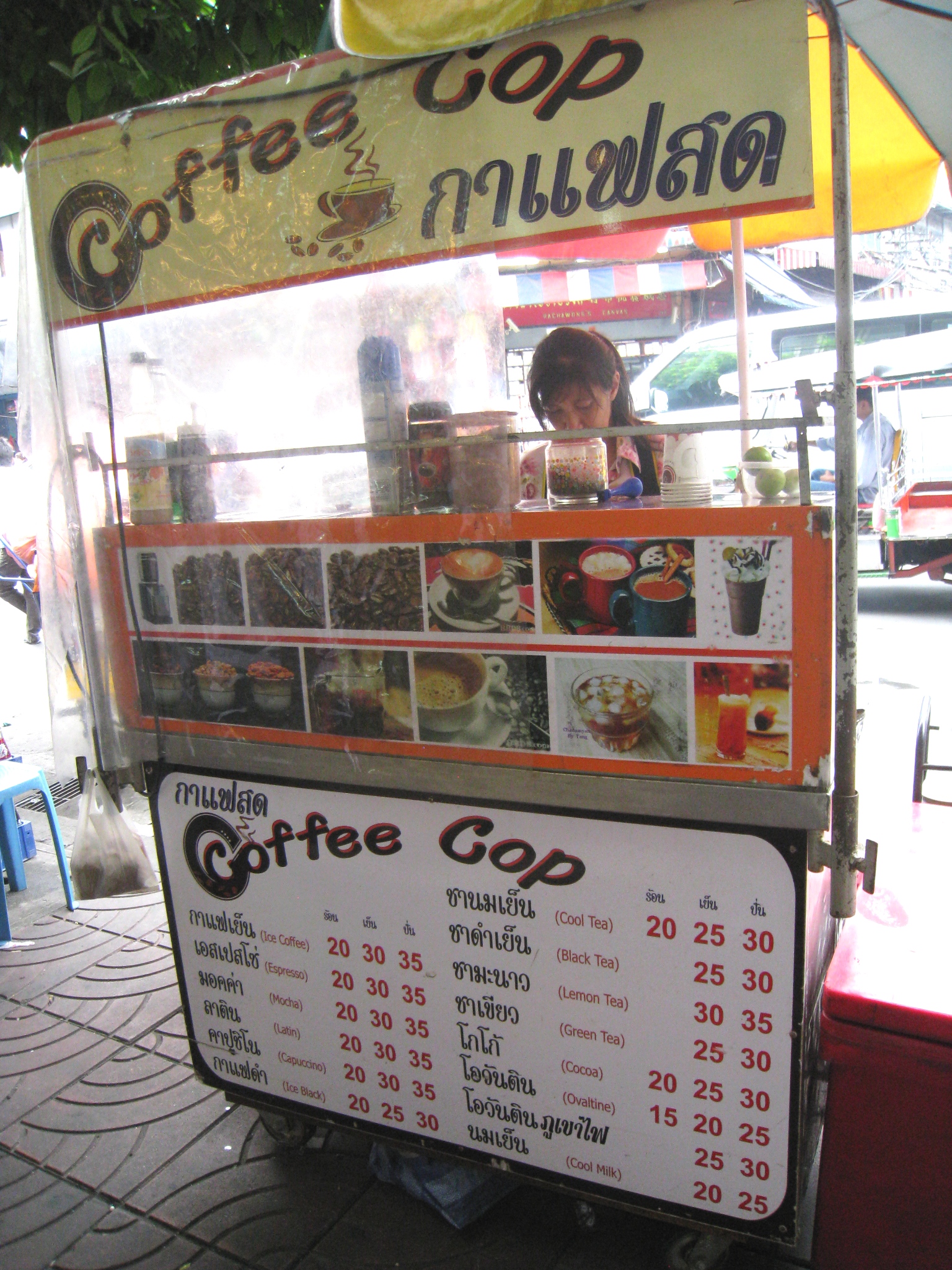
A typical Chaa Yen is an uber-sweet, red, spiced Thai tea with condensed milk. The best Thai iced tea we had was in Chinatown in Bangkok from a mobile coffee stand called Coffee Cop on Rachawongse. The proprietor could not be nicer and the Chaa Yen was amazing! Back home, we have tried to recreate the recipe, with varying success. Thai tea is somewhat difficult to get in the US, so we have had some luck using Vanilla-flavored Rooibos instead.
Filed under Tea, World Eats
Southeast Asia: The Mighty Durian
Until this trip we had never tasted Durian before. Its reputation as a horrendously stinky yet somehow delectable fruit, along with its spiky appearance, intrigued us. I mean, Durians are banned on the subway in Singapore, how could we not be intrigued?

Our first real experience with a Durian was at a hawker market in Singapore’s Chinatown. The whole bottom floor of the hawker market was dedicated to produce. At one stall there was a woman carefully cutting and slicing bits of a Durian, with its signature spiky skin and yellow fruit. Curiously, there was no smell as we approached. We steeled ourselves and bought a small section of Durian for a few cents. The flavor itself was nutty, creamy and papaya-like (almost). We were surprised to say we pretty much liked Durian!

Our second experience with a Durian was in Malaysia – we were at a big glossy mall in Kuala Lumpur and Durian gelato was for sale at a stand. However, we did not have the same experience as in Singapore – and this second Durian product had a knock-out aftertaste and a garlicky flavor. So our experience with the Durian was mixed, don’t know if we’ll be up for a third round – maybe the next time we are in SE Asia.
Filed under World Eats
Classic Singaporean Food: Kaya Toast
In a nation obsessed with food – one of the more iconic Singaporean dishes is Kaya Toast. Kaya Toast, coconut jam (kaya) on bread is peddled in most coffee shops, and make an awesome pick-me-up or a classic Singaporean breakfast. Kaya has a creamy consistency and is typically made with coconut milk, eggs and pandan leaves. Chain specializing in Kaya Toast have even sprung up over the years, the most famous being Ya Kun Kaya Toast, founded in the 1940s.

We got this Kaya Toast at Nanyang Old Coffee in Singapore’s Chinatown, along with an iced coffee and an iced milo (a chocolate malt milk drink – M’s favorite). The coffee shop also boasted a little museum dedicated to the history of coffee in Singapore. Kaya is even easy to make at home: check out these recipes from Susan Feniger and Chubby Hubby.
Filed under World Eats
Baguettes in Cambodia

 It’s Bastille Day today – and that means ETW is going to be featuring some French food. But this year how about something a bit different in terms of Gallic cuisine? When we were in Cambodia a few weeks ago we were struck by the sheer amount a baguettes for sale. Yeah, French baguettes piled precariously high on nearly every food cart! Cambodia, along with Vietnam, was part of French Indochina until the 1950s, and the French seem to have left behind a culinary legacy – at least in terms of omnipresent baguettes.
Filed under World Eats
Eating…North Korea?
In honor of April fools day here’s something from our “strange but true” file. So as everyone knows North Korea is a totalitarian regime that is nearly closed to outsiders. So how can it be that there are North Korean restaurants dotted across Asia? It turns out these restaurants are in fact run by the government itself and used as a tool for North Korea to acquire foreign currencies. Seriously. Not a joke. The restaurants are called Pyongyang, after the North Korean capital city.
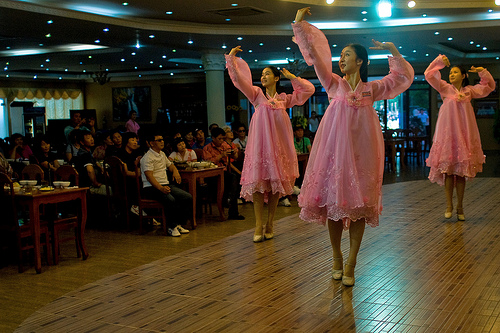 Pyongyang restaurant in Siem Reap by lecercle
Pyongyangs are staffed by North Korean waitresses and feature a variety of Korean foods, including some basics like bibimbop and kim chee and also some unique/bizarre North Korean dishes like noodles served in a block of ice. There is no overt propaganda, but there is also a song-and-dance-laden dinner show that accompanies some meals. When we are in SE Asia this June we just might have to go! There are locations in Siem Riep, Cambodia and in Kuala Lumpur.
Filed under World Eats
Eating Bahia: Moqueca

Moqueca by Rude Nugget
 We are Brazilophiles here at ETW, and one of our favorite parts of Brazil is Bahia, a state in the Northeast. Our goal is to get there by next summer, but in the meantime we will cook up some Bahian flavors here in the Windy City. Seafood, coconut milk and palm oil (dende) are all staples of Bahian cuisine – a dish that combines them all is Moqueca, a well-beloved Bahian fish stew. I’ve found a few recipes for Moqueca recently, includeing one on the ever-reliable Simply Recipes. Another version comes from Global Gourmet.
Filed under Recipes, World Eats
Annual St. Joseph’s Day Post
 Zeppole by Caleb Lost
 We here at ETW do a St. Joseph’s Day post every year, mainly as a reason to feature zeppole, a delicious custard-filled doughnut. Currently I (L) am in a location where the zeppole landscape is unknown to me, so I’ll be up bright an early to see if I can find any at the local bakeries. But in the meantime here’s a recipe from Giada.
Filed under Finer Things Club, Holidays, World Eats
Canadian treats for the Olympics: Nanaimo Bar

 We don’t often feature foods from Canada on ETW, but it’s not for a lack of variety. With the Winter 2010 Olympics (we are both big Olympics fans) being held in Vancouver we decided that we wanted to feature Canadian food more prominently for the duration of the games. So to start off, with we have a Vancouver original with a perplexing name, the Nanaimo bar. Named after a town in British Columbia, the Nanaimo bar is a no-bake dessert with vanilla custard filling, a cookie crumb base and a coating of chocolate. Yum! The Nanaimo bar seems pretty simple to make, but there are certainly many permutations. Chowhound put out a call for the definitive Nanaimo recipe and a recipe from Closet Cooking came out on top.
Filed under Recipes, World Eats
World Eats: Jaffa Cakes from the UK
 Jaffa Cake by Stuart Bryant
A co-worker recently got back from the UK and brought back a dozen boxes of Jaffa cakes, specifically McVitie’s, the producers of the original Jaffa Cake in 1927. Jaffa cakes are a soft cookie with a layer of apricot/orange jam on one side, covered in dark chocolate. I am all for the flavor combo of orange and chocolate so these are right up my alley. However, that’s not all there is to the Jaffa cake story, apparently every British snack food maker has their own version of the cake. And moreover, there was some scandal over if they were proerly classified as “cakes” or “cookies” because in the UK cookies get taxed much more steeply than cakes. McVities even went to Inland Renvue to claim their status as ‘cakes.’
Filed under World Eats
Coming in June… Asia Tour 2k10
L and M head to Singapore, Malaysia, Thailand, and Cambodia.
We’re excited.

Filed under Note, Quest, World Eats
Feast of the 7 Fishes
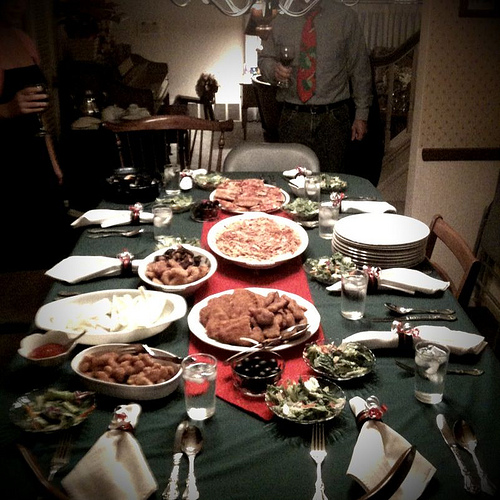 Feast of the Seven Fishes by Austin Kleon
Have a Merry Christmas this year – and especially a Merry Feast of the Seven Fishes.
Filed under Holidays, World Eats
Sweden: Sweet treats for St. Lucia’s Day
It’s that time of year again – St. Lucia’s Day. Up here in Madison the weather has been particularly chilly and snowy – no wonder Scandinavian immigrants were able to thrive here! Reading Sweden’s official website – it was quite entertaining to hear Sweden described as “a culture of food storage.” I guess that makes sense, given the generally inclement weather. If you’re house-bound like us, baking some sweet treats for a traditional St. Lucia’s day feast is a fun way to get into the holiday spirit. The Thrifty Fun site has some recipes for Braided St. Lucia’s Day Bread, Pepparkakor and Julglogg. Perhaps the most iconic treat for St. Lucia’s day is Lussekatter, saffron-scented rolls.

Pepparkakor by ProBonoBaker
Filed under Holidays, Recipes, World Eats


 Eating The World