Oil Down / Oildown: The National Dish of Grenada

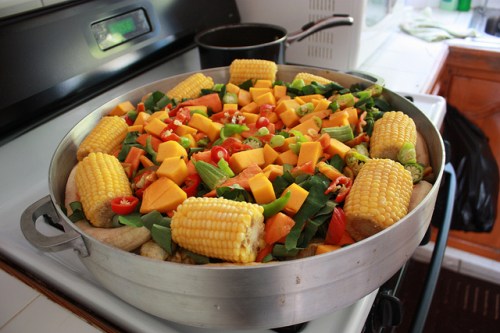
Kirani James of Grenada delivered his country’s first gold in medal in style with what looked like an effortless win in the 400 meter dash. Though we are fans of Caribbean cuisine, tiny Grenada tends to fly under the radar of other larger nation’s cuisines like Trinidad and Jamaica. The national dish of the country is the colorfully-named Oildown or (Oil Down), a fact even corroborated by the government of Grenada. Oildown is a stew made with coconut milk with a variety of salted meat or fish, dumplings,  saffron, dasheen (taro leaves), breadfruit and whatever veggies may suit your fancy. At its core, oildown seems to be a cousin of the Brazilian moqueca, another stew with a coconut milk base.

Oildown in Production by SnarkleMotion

So where does it get its name? According to popular legend, the name of oildown comes from the cooking of the veggies in the coconut milk, where most of the milk gets absorbed, leaving the oil behind. Like any good dish, the best oildown is made by everyone’s grandma or mom, and in a tradition we quite enjoy, it is best enjoyed when made on the beach.  Not to be confined to the borders of Grenada, there are even Trinidadian versions of Oildown.

1 Comment

Filed under World Eats

Chicken Tikka Masala: National Dish of Britain

Mughal_Empireunited_kingdomIndia Flag

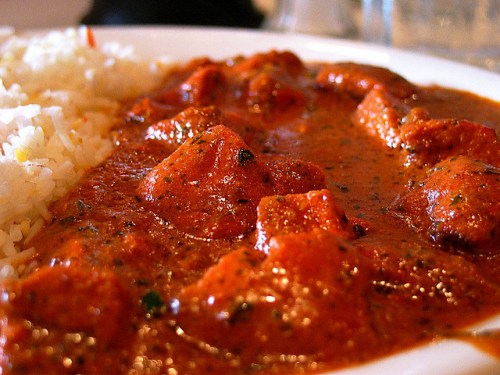
Until about a week ago, Team GB had all but struck-out in the medal department at their home Olympics. Fast forward half a fortnight, and their 16 golds places them third on the overall list, as well as garnering them today’s national dish highlight at ETW – chicken tikka masala. Wikipedia offers this succinct definition: “Chicken tikka masala is chicken tikka, chunks of chicken marinated in spices and yogurt, that is then baked in a tandoor oven, [and] served in a masala (‘mixture of spices’) sauce.” The recipes variations are as wide-ranging as its origin histories, but nothing obscures its popularity. Recently Robin Cook, the British Foreign Secretary, declared chicken tikka masala as the new national dish of the United Kingdom. Today, 1 in 7 of all curries sold in Britain are tikka masala, and it is the most popular restaurant dish in the country. But while tikka masala is unquestionably popular in Britain, and has been declared the national dish, its transnational origins reveal a fascinatingly complex and controversial history.

Chicken Tikka Masala at Akbar’s Indian Restaurant in Santa Monica, CA.

Continue reading

10 Comments

Filed under Uncategorized, World Eats

Pabellón criollo: National Dish of Venezuela

Pabellón Criollo from Wikipedia

Many congratulations to fencer Rubén Limardo, winner of Venezuela’s first Olympic gold medal since the 1968 Mexico City games. In honor of this achievement, it’s time for some Venezuelan food! When we think of Venezuelan cuisine what immediately comes to mind are arepas – filled pockets of corn dough that strike the perfect carb-to-filling ratio. Though arepas are popular – the quintessential Venezuelan dish is Pabellón criollo (which translates roughly to “Creole Flag”) – a comforting dish of rice and beans with shredded beef. Similar variants of the mother dish of rice and beans are popular throughout South and Central America, as well as the Caribbean. Fried plantains are also an essential component of Pabellón criollo and for a variation, you can get your dish served with a fried egg, which is called a caballo (“on horseback”). The secret to the dish, however, is in the sofrito, the fragrant triumvirate of bell pepper, onion and garlic.  What’s for Eats has a delicious-sounding recipe as does Venezuela cooking (with each component broken into a separate recipe)– seems like good party food!

2 Comments

Filed under World Eats

Beshbarmak: National Dish of Kazakhstan

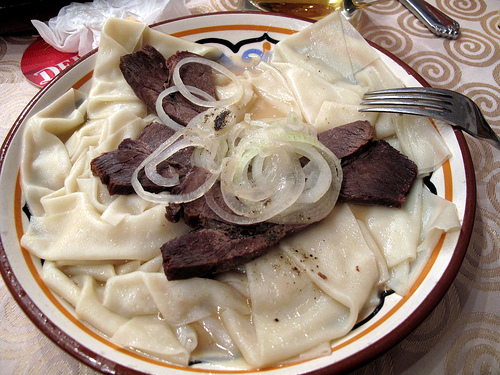
Beshbarmak photo from PeretzP

In the early morning hours on the first full day of the 2012 Olympics we saw Kazakh athlete Alexandr Vinokurov win the men’s cycling road race. In honor of this feat we decided to do a little feature on Kazakh food, especially the national dish, Beshbarmak. The name means “five fingers,” and as this implies, the dish is usually eaten by hand, and is a favorite for special events like weddings. It is usually made with horse meat (owing to the traditionally nomadic nature of the country), potatoes, onions and very wide noodle sheets. The dish is also popular in Kyrgyzstan, where it is also claimed as a national dish.  Foodista has a recipe for Beshbarmak using the more conventional for western tastes choice of lamb.

1 Comment

Filed under World Eats

Switzerland’s Röstigraben: Culinary Divide Between West and East

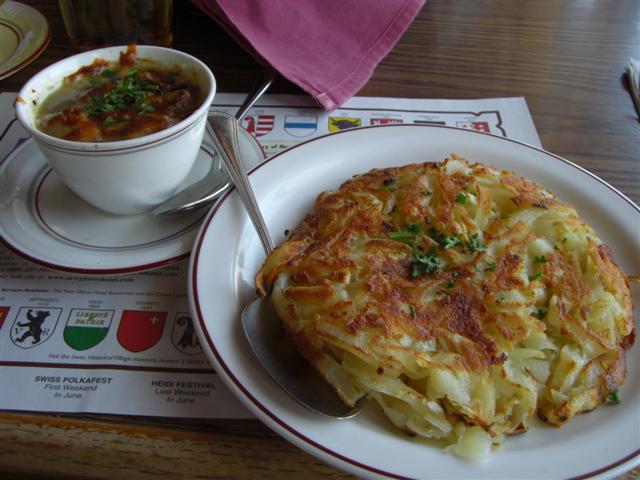
We here at ETW love the Olympics, so we are excited to cover some international cuisine as it relates to this very international sporting event. An important spot for the Olympics is Lausanne, Switzerland, home of the International Olympic Committee. An awesome Swiss Geopolitical and food related concept (how fun!) is that of the Röstigraben. It garners its name from the grated potato dish Rösti, which originated in Bern and is popular in the Swiss German areas. We were first introduced to the Röstigraben through the Strange Maps blog, and it is a strange map, represented above by Switzerland in the shape of a Rösti. The Röstigraben is the divide between the cultural areas of eastern German and western French Switzerland, which is further described in this National Geographic article. Lausanne, as it so happens is on the Western side of the Röstigraben.  Well west of the Röstigraben, we enjoyed some very nice Rösti in the heavily-Swiss New Glarus, Wisconsin. Yumblog has a recipe for Rösti, which looks easy as pie.

Rösti in New Glarus, Wisconsin

Leave a comment

Filed under World Eats

The Olympics (of Food)

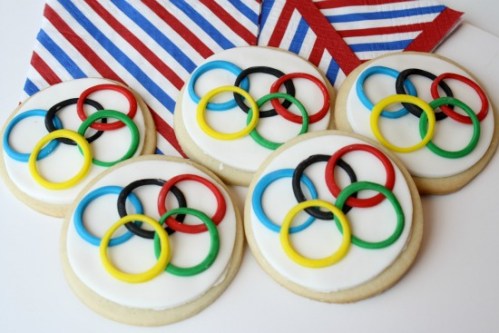
Olympic Cookies from Papery and Cakery

The Olympics are on – one of our favorite times! In honor of the event we are going to be covering the national dishes of Gold Medal winning countries, along with other Olympic-related foodie tidbits. Let the games begin. If you’re feeling extra festive, why not whip up a batch of Olympic cookies.

Leave a comment

Filed under Note

The Olympics and British Cuisine

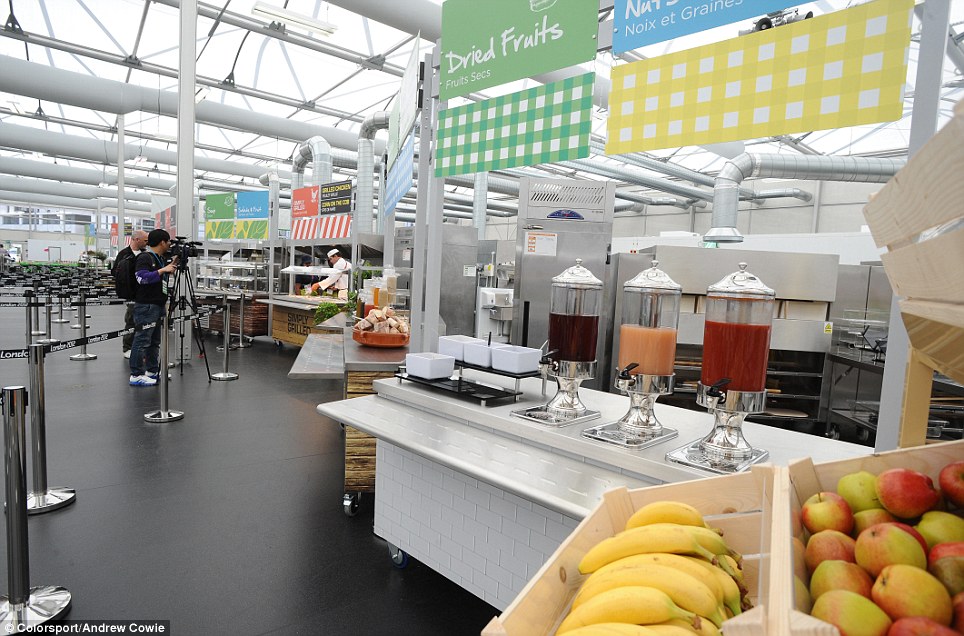
A view inside the Olympic Village Dining Hall – courtesy of The Daily Mail

The 2012 Olympic Games begin today in London, and Britain is using the international exposure to rebrand its still paltry international culinary reputation. Of course, anyone who still believes Britain has terrible food has either not visited London in the past ten years or, if they did, managed to have their heads stuck in the Underground for too long. As Henry Chu of the LA Times noted, London is a very different place from when it last hosted the Olympics (1948), and Londoners today are used to having the world at their doorstep. But just in case you missed the memo, here’s some light reading to catch you up: The New York Daily News is asking whether or not the Olympics can put British cuisine back on the menu, noting that the Olympic Village’s main dining hall contains a number of different culinary zones highlighting the international influences that make up the British culinary menu, including “Best of Britain; Europe, the Americas and Mediterranean; Asian, and Afro-Caribbean” cuisines. Meanwhile, Gavin Cleaver at An Englishmen in BBQ Sauce (he’s a Briton writing in Dallas – get it?) has a celebration and occasional loathing of British cuisine, dishing out gold, silver, and bronze medals (try the curry!) in an Olympics of British food. Lastly, Katrina Heron at The Daily Beast outlines how, as spectacular as the Beijing Olympics were overall, they were an unmitigated culinary disaster, with terrible food that kept running out. Instead, in London, they are trying to launch a “culinary revolution,” insisting that this Olympics presented “an unprecedented opportunity to look at our diets and our health, at our catering industry, at the state of our farms, and to commit to a long-term plan for good food and environmental stewardship.” Internationally diverse, readily available, locally sourced, delicious food? London, we wish we were there too.

Leave a comment

Filed under Reviews

Spaghettieis: Ice Cream that looks like pasta?

Spaghettieis from Wikipedia

It’s going to be another hot day in Chicago (seems like we’ve been saying that nearly every day this month) so we figured it was time for another ice cream post. This one is a little more surreal than usual. We saw a link on Boing Boing about Ice-cream that looks like spaghetti – spaghettieis. and we were thoroughly intrigued. Apparently this confusing German treat is composed of vanilla ice cream extruded through a Spaetzle Press/Pasta Extruder/Play-dough mold to look like spaghetti. To complete the spaghetti-dinner look, the ice cream is topped with some sort of red berry sauce, and finally covered in coconut shavings. Since its invention in the 1960s, spaghettieis has become something of a national dish in Germany. For more proof of its popularity, check out the huge amount of spaghettieis documentation of Flickr. We’re pretty impressed at the verisimilitude!

Leave a comment

Filed under World Eats

Stunning International Restaurant Interior Design

The British website We Heart is arbiter of all things design-related, and we have always been impressed by their coverage of international restaurant design. Though most of the restaurants we frequent are of the hole-in-the-wall variety, we always appreciate some elegant design, and judging by the coverage on We Heart, there are some pretty innovative ideas out there. The photo above is from an ultra-modern, stark-white Cioccolato a chocolate shop/bakery in Mexico City. Another futuristic design is presented by the monochromatic Arthouse Cafe in Hangzhou, China. For a more industrial look, check out this Philly-style diner, Pat’s, in Melboourne, Australia. The photo below is of Nando’s Ashford in Kent, UK, a sister restaurant in the Nando’s chain M visited in Washington D.C. More photos of the Ashford Nando’s are available at Design Milk. For even more cool restaurant designs, check out the Lifestyle section of We Heart. For those who want to delve deeper, Dwell Magazine has an interesting post about the history of restaurant design.

Leave a comment

Filed under Design and Photography, Links

An Illustrated Trip (To Brazil, Thailand and Beyond)

I recently came across the blog, An Illustrated Trip, which has amazing illustrations of a French couple’s globe-trotting tour of Argentina, New Zealand, Nepal, India, Thailand and Brazil (plus a few more countries). The illustrations are great, and lucky for us, many of them are food-related. I especially love thir Brazil illustrations because they remind me of some of the food finds that surprised me – such as learning that the Cashew nut is only part of a much larger fruit. They recently returned from their trip, but browsing through the archives gives a wealth of images.

Leave a comment

Filed under Design and Photography, Links

Chickpea flatbread from France: Socca

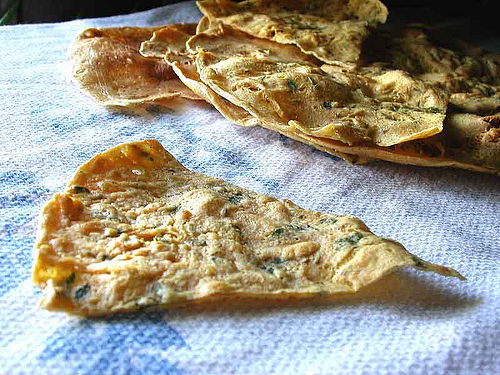
Socca by Chotda

We searched high and low yesterday for food related to Bastille Day, but the consensus seemed to be that pretty much anything goes. That gives us licence to highlight one of our favorite lesser known French street foods, Socca. Socca, originating in Nice, France is a flatbread made out of chickpeas. Since Nice is so close to the Italian border it is no surprise that there is an Italian version of Socca, called Farinata that is nearly identical. Given the Sicilian proclivity to chickpeas and our love of street food, it is no surprise that we are big fans of Socca. Socca is simply made out of chickpea flour and olive oil, and can be made very thin and crispy, as seen above, or can be much thicker, with toppings like a pizza. However, according to purists, in order to properly make a Socca, you need a special copper pan and a wood-burning oven.  Fortunately The Minimalist assures us that making Socca at home isn’t really too daunting of a task, and the homemade result can be as good as what you find on the streets of Nice. The ingredients really are just that simple, and Lottie and Doff ups the ante a little with the addition of rosemary. As the Kitchn points out, it is also naturally gluten-free!

1 Comment

Filed under Reviews

Mexico: Huaraches Dona Chio

Huaraches Dona Chio
1547 W. Elmdale Ave.
Chicago, IL

When we got back from Brazil we went straight for the food we craved most – in our case, BBQ and Mexican food. Fortunately, Chicago is more than overflowing with Mexican eateries, so we decided to try someplace new. Huaraches Dona Chio had a reputation for being difficult to find, but the big awning meant we did not have any trouble.  On a chilly and blustery day, there could be nothing more comforting than some fresh Mexican food. Inside, the welcoming yet spartan space provides a few tables and an open view of the small kitchen where Dona Chio herself was busily at work preparing the food for the night. Her specialty? Huaraches, a type of thick, open-face masa tortilla from from Mexico City. Huarache toppings provide an almost endless variety, and HDC did not disappoint.

You can get the regulars at HDC: the usual tacos and burritos, and quesadillas. But you come for the huaraches. Naturally, we selected two huaraches as our entree (at only $6.50 each, how could we not)? L got the tinga (it came highly recommended) and M picked the huitlacoche (still his favorite from his time in Mexico). Tinga was by far our favorite. The huitlacoche was topped with both mild green and spicy red salsa, black beans, corn, white onions, cotija cheese and cilantro. The tinga, shredded chicken marinated in chipotle sauce,  was topped with white onion, cilantro and a hearty helping of cotija cheese. We’ve tried a few places around town and also in other cities and these were definitely the best huaraches we’ve had. The masa was not soggy (a problem we encountered elsewhere), and the toppings were extremely generous.

Our dining companion went a more conservative route and got a plate of tacos ($2.50), noting they were excellent as well. To finish up the meal M ordered a banana chocolate smoothie. With our time in Brazil, we will never take for granted the great Mexican food selection in Chicago again (side note: We met up with a friend from Guatemala in São Paulo, who is planning on starting a Mexican food distribution business in Brazil. We hope he succeeds!). Huaraches Dona Chio is one of the fine examples: small, family-run, and serving up great regional Mexican dishes to a small but discerning clientele.

Tinga huarache, we miss you already!

Leave a comment

Filed under Reviews

A New Place for Falafel: Falafill

Falafill
Various Locations in Chicago, IL

The Eaters – especially L – are pretty particular about falafel. It’s no exaggeration to say we make a point to try falafel in pretty much every city we go to. In all our travels, a few places stand out above the rest. Pita Inn in Skokie has some of our favorite falafel in Chicagoland; while the expanding fast-food joint Maoz remains our all-time favorite, owing to their great falafel and toppings. Maoz’ Philadelphia location remains the standard by which L judges all other falafel, a shining beacon of perfection on the Delaware River, never to be equaled….Until today.

We like the logo!

Falafill, a brand-new falafel lunch spot in the Loop, may have perhaps the best topping bar we have ever encountered, and while its falafels may not be as good as Maoz, the topping bar and the excellence of the falafel otherwise may actually put this place over the top in L’s rankings. Falafill starts out appealingly, with a sleek and appealing dining area decorated with falafel witticisms perfectly suited to the Facebook generation. On the food side, the simple menu is complemented by an impressively wide range of sodas and juices: M got a mango yogurt drink , while our old salty yogurt favorite Ayran was also available. The menu is simple. Pick your falafel (classic, curried, or seasonal – all with fries)  in a pocket or a bowl ($5.95/$7.95). The seasonal falafel when we visited was white bean, and we heard from our dining companions that it was out of this world. L opted for some classic falafel and M for the curried, and a side of some sweet potato fries ($2.95).

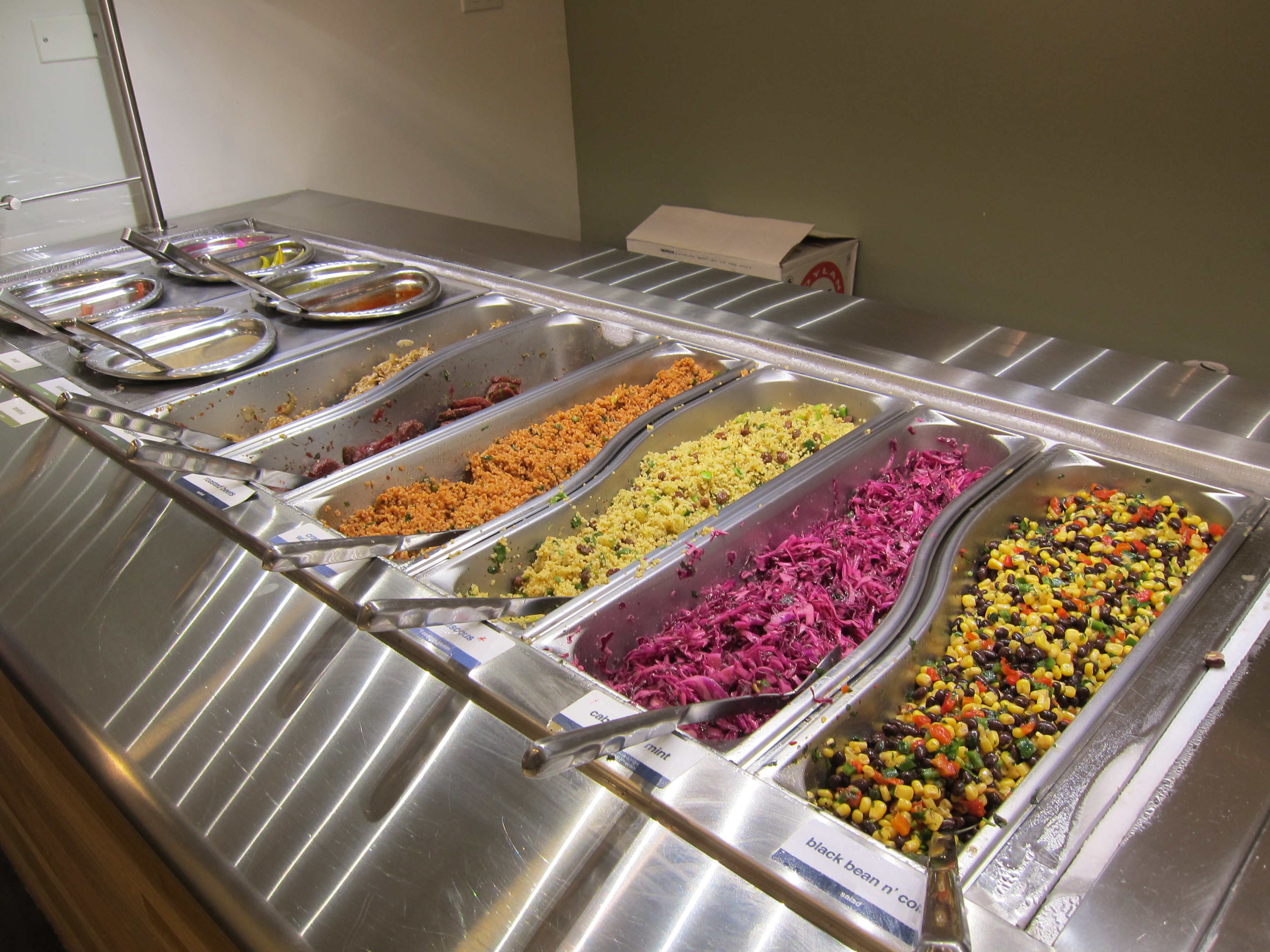
The toppings bar at Falafill. Amazing.

Both falafels, curried and classic, were cooked to order, and perfectly spiced.  L’s classic had the hallmark appealing green color that means there ‘s fresh parsely and cilantro inside. Yum! The fries were also tasty and crisp, not soggy like many other sweet potato fries. Yet what REALLY sets Falafill apart is the Mezza bar, where you can select all the toppings you want for your falafel. As expected, the salad bar contained hummus, baba ghanouj, lentils, tatziki, harissa tabbouleh, all middle eastern standards we love. In addition, we were really excited to see some awesome new flavors at the bar, including cracked wheat with pomegranate, beets, toum (garlic sauce), zough (jalapeno sauce) black bean and corn salad, and cabbage and mint. Each order of falafel includes a trip to the salad bar, and there is no limit to how many toppings you can add. For those who are obsessed, you can order simply a bowl ready to fill with mezza toppings ($6.95). All in all, for under 8 dollars you can create an out-of-this-world falafel experience with a wide variety of contrasting flavors that will have you full for days. Falafill is now one of our go-to Loop lunch spots, and like L has sacrilegiously stated: if not her favorite falafel place in the United States, it is definitely giving Maoz a run for its money.

Comments Off on A New Place for Falafel: Falafill

Filed under A New Place, Reviews

The Renaissance of the French Baguette

Image
Image: Afar Magazine

When one thinks of French bread, artistry, tradition and quality probably come to mind. However, we were very surprised to learn that in Post War France, quality bread was hard to come by. Quelle horreur! Afar Magazine has a fascinating article about the fall and rise of bread in France, and how the writer apprentices with one of the current arbiters of the artisanal bread tradition.

In 1987 a cultural critic writing in the French newsmagazine Le Nouvel Observateur proclaimed that the baguette had become “horribly disgusting.” It was “bloated, hollow, dead white,” he said. “Soggy or else stiff. Its crusts come off in sheets like diseased skin.” Renowned French baking professor Raymond Calvel mused that the best baguette might soon be made in Tokyo. What had brought this on? And how was quality bread revived in the 1990s? The answers to these questions lay in Paris, which is what brought me to the door of Boulangerie Arnaud Delmontel at three that morning last February.

Leave a comment

Filed under Links, World Eats

American Independence Day…in the UK

We cover a lot of international holidays and festivals on ETW, but that got us thinking, in every other country American holidays are international. So what kind of recommendations would those in other countries give to celebrate the American holidays (if we could find such sites)? We did some scouting, and came up with some international, specifically UK, sites that had recipes to celebrate July 4th at home. We noticed a trend toward BBQ, which makes sense given the cookout tradition of the 4th. The Good Food Channel in the UK suggested Cherry Pie and Pork Ribs. The BBC went even more BBQ heavy with pulled pork and a few varieties of ribs. It’s interesting to see some of the other recipes the BBC has in the “American” section, like fluffy American pancakes.

Leave a comment

Filed under Holidays, Links, World Eats

Dondurma (Turkish Ice Cream) on a Hot Day

On a hot summer’s day there is nothing better than some ice cream, and given this current heat wave (seems like Brazil in Chicago here today with the humidity) we could use a LOT of ice cream. One of our favorite ice cream permutations is Dondurma, a stretchy and pliable ice cream from Turkey. Dondurma has a texture unlike any commerical American ice cream (almost like taffy), and is flavored with mastic and thickened with salep, a type of flour made from orchids. If you have an ice cream maker, here is a recipe for DIY dondurma. However, part of the fun of dondurma is watching the dondurma sellers prepare the ice cream – we saw them all over Istanbul – check out the video of a seller below.

Leave a comment

Filed under World Eats

Origin of the Taco

Chorizo Taco from Carniceria Guadalajara in Chicago

They may be wildly popular in Mexico, the US and…pretty much everywhere else, but what is the exact origin of the taco? We can assume they are from Mexico, but what beyond that? Though somewhat shrouded in mystery, this Smithsonian Magazine interview with Mexican food expert Jeffrey M. Pilcher, professor of history at the University of Minnesota, talks about the history of the taco.

The origins of the taco are really unknown. My theory is that it dates from the 18th century and the silver mines in Mexico, because in those mines the word “taco” referred to the little charges they would use to excavate the ore. These were pieces of paper that they would wrap around gunpowder and insert into the holes they carved in the rock face. When you think about it, a chicken taquito with a good hot sauce is really a lot like a stick of dynamite. The first references [to the taco] in any sort of archive or dictionary come from the end of the 19th century. And one of the first types of tacos described is called tacos de minero—miner’s tacos. So the taco is not necessarily this age-old cultural expression; it’s not a food that goes back to time immemorial. [Read more here].

Leave a comment

Filed under World Eats

A guide to street food in Sicily

After our visit to Next Sicily we have Sicily on the brain. We visited the real Sicily last fall on our honeymoon, and we loved the food there (no surprise). What we especially loved was the abundance of cheap, tasty street food. Palermo in particular is a street food mecca – with fast and delicious morsels being sold from stands or tiny storefronts on almost all corners. When we were headed to Palermo we shortlisted a few types of street food we had to try while there, and fortunately we were not disappointed. We set out right away to start sampling street food, and made a beeline to the markets, where street food is king. Below are the favorite street foods we sampled (and one even we were not brave enough to try). So let’s go to Palermo….

Panelle – Panelle is a riff on a falafel – and is composed of chickpea flour fried up on a hot griddle. It is then served in a pita or eaten alone. One wouldn’t think that this carby concoction would work, but it is actually quite delicious (fans of falafel will approve). We had some handmade Panelle griddled up for us at the bustling Ballarò market, a cool food market with a lot of awesome African stalls.
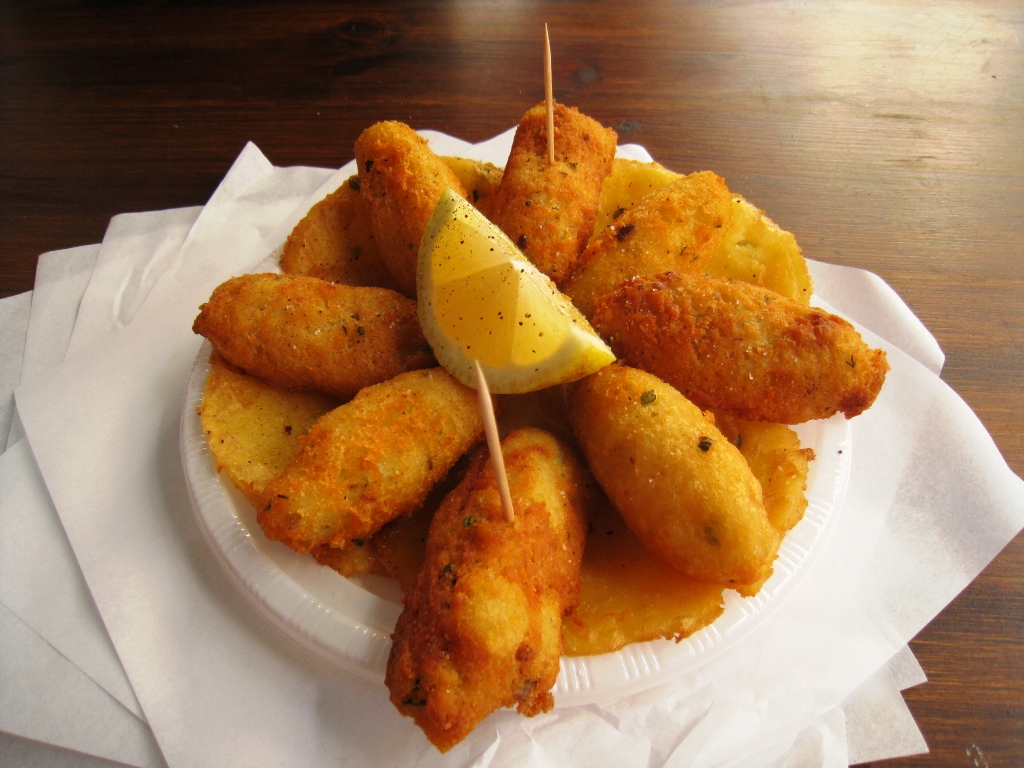
Crocchè – We dodn’t even realize our Panelle would be coming with a special topping – crocchè- a little fritter made of mashed potatoes and parsley. Think of them as the most delicious tater tots you will ever have. The crocchè are the top layer of the snack below, and panelle is the bottom layer. Don’t forget to add a squeeze of lemon to help cut through all of the starch.


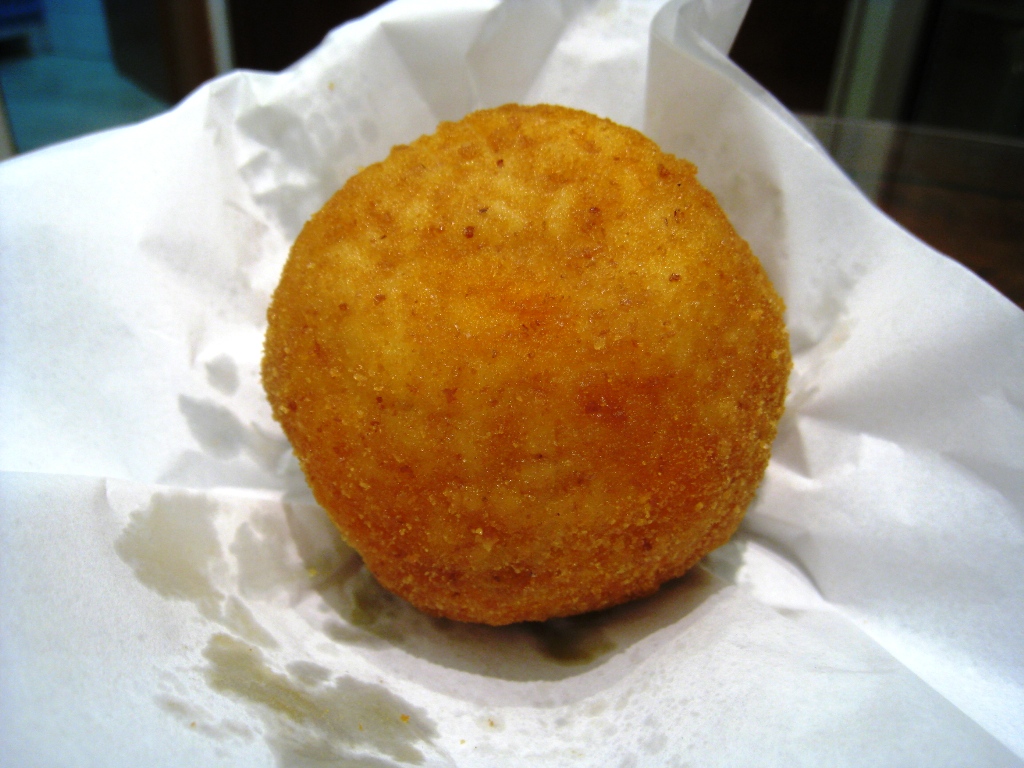
Arancini – The humble arancine is basically a fried dough ball filled with cheese and meat. However, the beauty of the arancine lies in its proper execution. If done wrong, an arancine is a gelatinous mealy blob that settles into a leaden ball in the pit of your stomach. Yes, we’ve had a few of those. However – when done right – the arancine is a warm gooey mess that does not leave you feeling like you ate a cannonball. Let’s just say – we had both varieties for Arancini on our Sicilian adventure. Arancine were found in pretty much every snack shop in Palermo, and one, Bar Touring, even specializes in giant arancini.


Pane cà meusa – Pane cà meusa is for braver stomachs than ours, and this street food dish consists of boiled calf spleen served in a roll. When happening across a pane cà meusa stall, you will usually find a hot bubbling cauldron of spleen. While its sheer popularity leads us to believe it is probably decently good, we would much rather take gelato in a brioche, thanks.
Gelato con Brioche – Saving the best for last, Gelato con Brioche is perhaps the most epic street food we have ever encountered in all of our travels. It is exactly what it sounds like, amazing gelato stuffed in a split brioche roll. Think of it as an ice cream cone carried to its next logical extreme. The first gelato in brioche we had even helped us get over the gruesome sites at the Convento dos Capuccinos in Palermo.

1 Comment

Filed under World Eats

We eat the menu at Mercat a la Planxa

Mercat a la Planxa
638 S. Michigan Ave.
Chicago, IL

One of the best things about tapas restaurants is the huge variety of food options, however, it is also the worst things since there is never any way to try all of the enticing options. So when we had the occasion to go out in a group of four we figured a tapas restaurant would be perfect, thereby upping everyone’s chances of enjoying as many dishes as possible. Mercat a la Planxa, helmed by Jose Garces, has been open since 2008, and specializes in Barcelona-style tapas. The menu changes frequently and has a rotating selection of traditional and more avant-garde tapas, as well as fish and meats “a la planxa” (“grilled”). We went to Mercat with quite an appetite, so we were excited to sample the extensive tapas menu. You’ll find what we had below, along with menu descriptions. As you might notice, all of the dishes have Catalan names – very Barcelona!

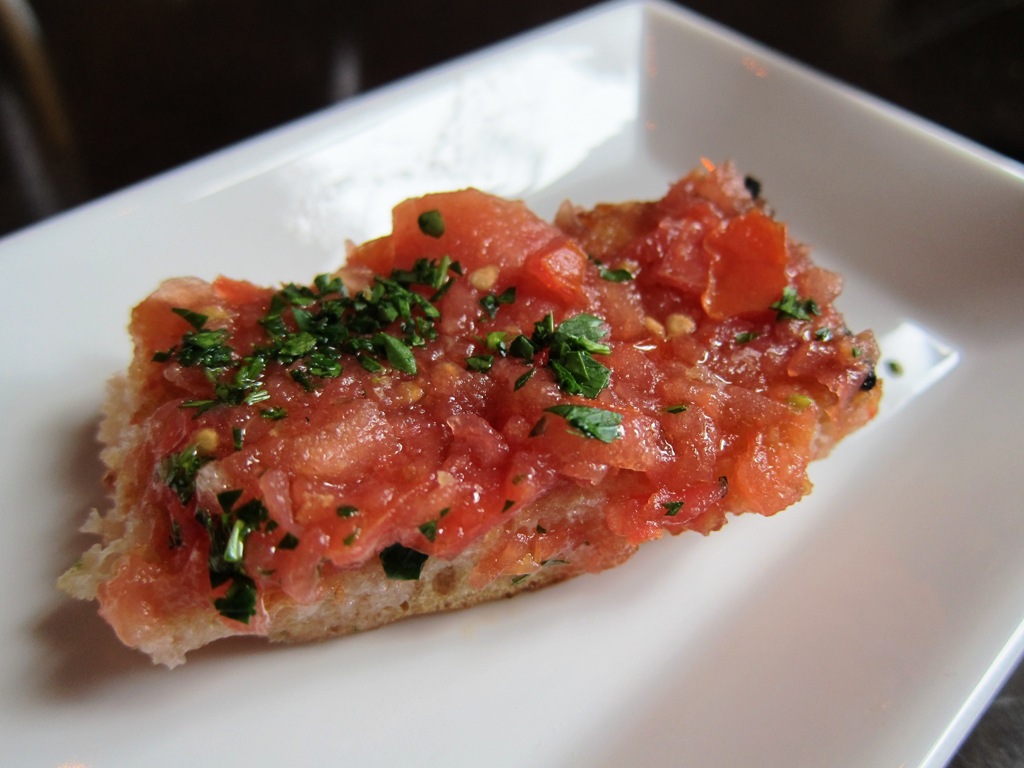
At the start of the meal we were presented with the house Pa amb tomàquet, a kind of riff on bruschetta. Typically,  Pa amb tomàquet is typically a lot lighter on  tomato, but we liked this non-traditional take as well. Next, we picked from the Spanish cheese selections, and tried La Peral, a Cow’s Milk Cheese with Apricot-Cider Mustard ($9) and Garrotxa, a Goat’s Milk cheese, roasted garlic dulce de leche ($8). Garrotxa is one of our favorite cheeses, and it paired perfectly with the dulce de leche, the Peral was good, but less memorable. Next, we had an order of Gambas al ajillo – Garlic Shrimp ($10) – a classic tapas dish, perfectly executed, though the portion was a little small.

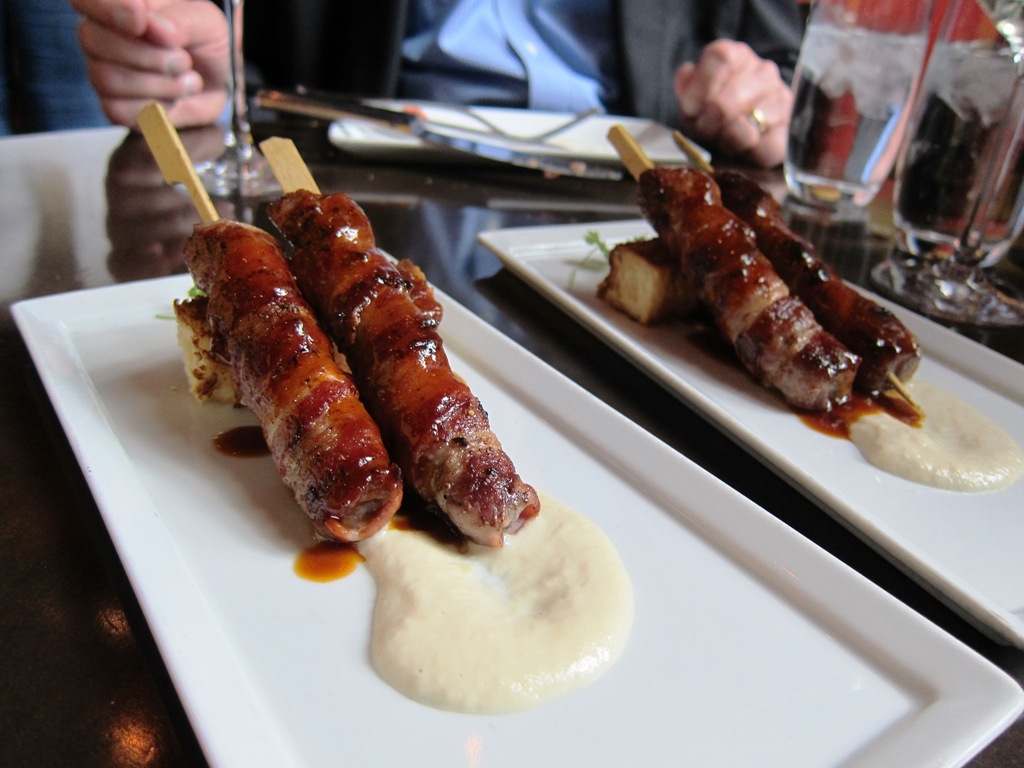
Pintxos Muranos – Lamb brochettes wrapped in bacon with a lamb jus ($14). Another classic tapas dish, this one was M’s favorite, which was not surprising, given the wrapped in bacon. Since the brochettes were served on skewers, they were a little hard to share, so the two non-bacon lovers ceded their portions.

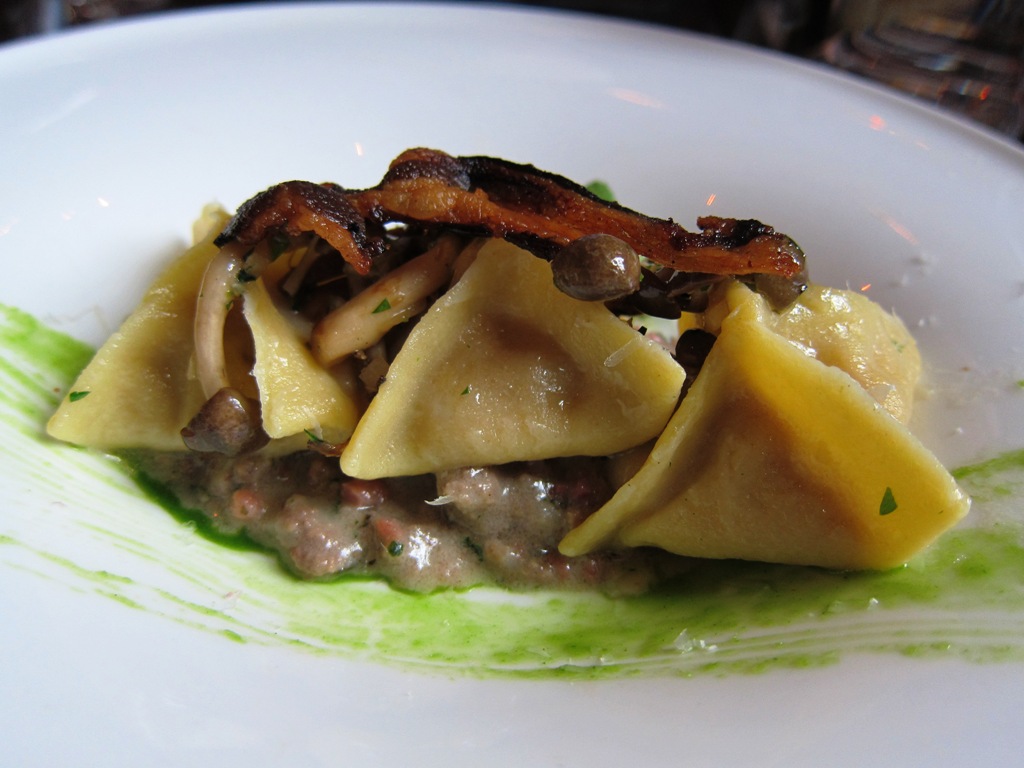
Next were the Pelotas de calabaza y cordero, Butternut squash dumplings, lamb ragout, beech mushroom escabeche and black truffle ($11). What looks like fried bacon in the photo above was in fact mushroom, which had an amazingly earthy flavor. The dumplings were more like squash-filled ravioli, and were tasty, though the lamb ragout definitely stole the show.

Black Angus Rib Eye – 12 oz. ($42). The steak was good, but probably nothing we would really get again at a tapas restaurant, good for the two major carnivores at the table, though. Looks like we forgot to get a photo…oops.

Mar i Muntanya (“Sea and mountain”)- Serrano-wrapped yellow fin tuna, potato croquette, foie gras torchon, pickled pearl onion. The yellowfin tuna was wonderful, but we’re not sure it needed the foie gras on top, maybe we aren’t just big foie fans though. The pickled pearl onions provided an unexpected tangy zip, and the potato croquettes were both substantial and flavorful. We also appreciated the beautiful presentation.

Gratin de Escalivada (“Grilled Gratin”) – Oven baked roasted red peppers, tomato, eggplant & cipolini onions with goat cheese and grilled sourdough ($10). There needed to be more goat cheese with this dish (as with any dish), the grilled veggies were fine, but nothing to write home about on their own.

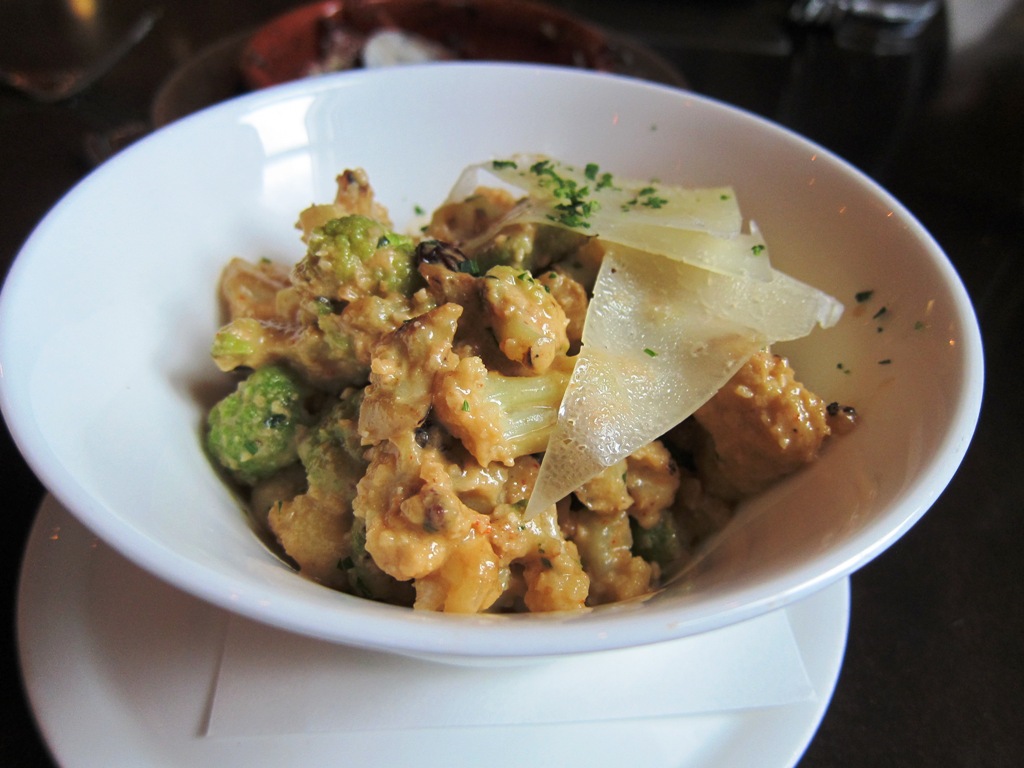
Coliflor amb Xato – Roasted cauliflower with currants, padron peppers, truffled tarragon xato and shaved manchego cheese ($13). Despite never ordering cauliflower out on a regular basis, we found this take on caulifower was unexpectedly delicious, and perfectly complemented by the spicy xato sauce (Xató sauce is made with nuts, vinegar, garlic and nyora pepper). This was L’s pick out of the tapas we ordered.

Patatas Bravas – Spicy potatoes with spicy paprika aoili ($5). This is an item we always have to order at a tapas joint. As you can see from the presentation above, this is more of an avant-garde take than the usual haphazard potato cubes, with each potato being formed into a little fried cake, topped with a dollop of spicy sauce.

Plantain empanada – Spinach, Manchego & Piquillo artichoke escabeshe ($10). Though it arrived with our savory foods, the empanada provided a hint of plantain sweetness. The piquillo pepper was a nice contrast to the somewhat-rich empanada.

Horchata Bon Bon – Horchata ice cream, dark chocolate, cinnamon, puffed rice, coconut crema and marcona brittle ($3.50). The bon bon was filled with ice cream – and the combination of flavors was absolutely perfect! The Spanish horchata flavor (made from Tiger nuts)  was rich and almond-y, and worked perfectly with the cinnamon and coconut flavors. The marcona almond brittle was also a nice touch.
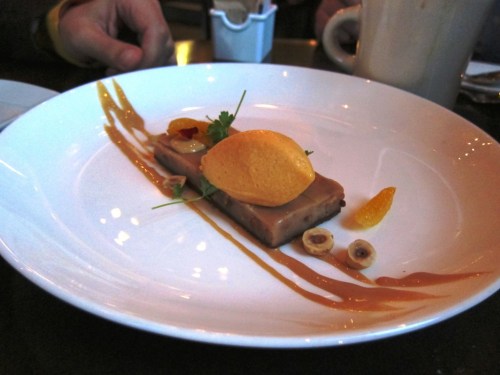
Our final dessert was the Pastissos d’Avellana (“Hazelnut Cake” – sounds better in catalan, no?) Hazelnut Mascarpone gateux, apricot, dulce de leche, salted hazelnuts, apricot sorbet ($12). This was a very successful take on cheesecake, with a rich hazelnut flavor. The apricot sorbet was also delicious, and tasted exactly like biting into a fresh apricot.

We enjoyed Mercat a la Planxa, and we were happy to try both the traditional and nouveau tapas dishes. We think the new takes on tapas were really Garces’ forte, and our favorite dishes were the more unusual ones. We were pleased with our choices – but there was one item we really were coveting – we noticed a party table next to us getting a suckling pig (cochinillo asado), which looked absolutely fantastic ($220 for half, $440 for a whole). However, you have to order the pig 72 hours in advance, so you can’t order it on the fly. Maybe next time… thanks also to our dining companions, who helped us sample this veritable feast!

Leave a comment

Filed under Reviews

Rick Bayless Teaches Us To Make Guacamole

“Everything is better with bacon.” – Rick Bayless

We were lucky enough to catch Chicago’s own Rick Bayless at a cooking demonstration during the Printer’s Row Lit Fest a few weeks ago. Originally we had considered not even going – too hot, too crowded, we thought – but were shocked when we arrived just a few minutes early to find a few open seats. Stay we did, and we are glad, because over the next fifteen minutes Rick Bayless absolutely blew our minds making a simple bowl of guacamole. Here’s some of his key thoughts, which we have already started incorporating into our home-made guacs:

1. Avocados are amazing. Use Hass avocados – they were bred specifically for guacamole-like uses. They are one of the few fruits that does not ripen on the tree. Amazingly, if picked and left at below 50 degrees, they will never ripen. What this means is that when you buy them at the grocery store they have been pre-refrigerated, and so will not ripen for another 3-5 days. The takeaway: you cannot use an avocado the day you buy it. When buying an avocado, check to make sure the stem is still intact (it will be brown inside otherwise), and afterwards you can store them up to a year in the fridge and they will never go bad. They are ripe when you have left them out for 3-5 days and the top by the stem is squishy.

2. Lime juice and avocado pits: you’re using too much! Leaving avocado pits in the fruit or in guacamole does not help them stay fresh. Neither does adding lime juice. And adding too much of either makes the guacamole taste less like avocado and more like something else. To keep it fresh, only temperature matters. And getting rid of the rumors helps you highlight the other ingredients.
3. Use white onions. They taste better, they are crispier, and it is a sin against cooking to use red or Spanish ones. He said this and he meant it. If you are concerned about them being too overwhelming in the dish, here is how to fix it: Cutting white onions causes chemicals in two different sections of the membrane to interact, producing a kind of sulfuric acid. To stop the reaction, just run them under cold water – this is called “deflaming” the onion in Mexico. It is for this reason…

4. Do not make guacamole in a molcajete! Crushing the onions with the stone mortar and pestle will just re-break the onion membrane and thus ruin all the good washing work you did. Better to make the guacamole in another bowl (mixing it), and then serve it in a molcajete for maximum classiness.

5. Guacamole is largely an American invention, as the USA is largely, as Mr. Bayless put it, “a chip-and-dip culture.” Mexican guacamole is very simple: avocado, garlic, a little lime juice, and perhaps salt and pepper. That’s because it is meant to be used on foods in concert with other accompaniments: fresh cilantro, salsas, etc. When you realize how American guacamole is, you realize that you don’t have to be dependent on stereotypically Mexican ingredients, which brings us to point 6….

6. Avocados are adaptable. They go with sweet, sour, and savory, and do it well. Americans tend to be too limited in how they use avocados, and they tend to not be particularly knowledgeable about the ones they are using. Rick Bayless made a salsa with tomatoes, cilantro, chipotle peppers in adobo sauce, and – wait for it – bacon. (He even held up a piece of bacon and said “everything is better with bacon.”) Another great combination he recommended: watermelon cubs, habaneros, and mint. Mangoes are great as well in guacamole. Most of us don’t think to use these ingredients, but trust us, they are killer.
You’re welcome!

1 Comment

Filed under Note, Recipes