The National Dish of Cameroon: Ndolé

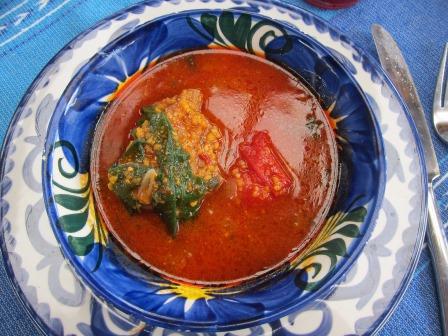
CameroonCameroon is playing its second match in the World Cup today so we thought we’d do a little research into the country’s cuisine, which is characterized by indigenous ingredients and a prevalent French influence. Ndolé is the national dish of Cameroon, it consists of ground nuts, ndolé leaves (aka bitter leaves – which give the dish their name) and either fish or beef. You can even add some shrimp, which seems appropriate since that is where the country got its name, from them Portuguese word for shrimp – Camerões! Sounds delicious! African Bites has a great recipe for Ndolé, and if you are unable to find Ndolé leaves you can use spinach or kale, as in this beautifully-illustrated Wandecrush recipe.

Ndole in Cameroon

Ndole in Cameroon by Joel Abroad

Leave a comment

Filed under World Eats

Brazil: All About the Cafezinho

brazilWith the important World Cup match-up between Brazil and Mexico today, it seems appropriate to talk about a topic near and dear to both country’s hearts. Coffee-time is something of a ritual in Brazil, where people have their daily cafezinhos. Coffee in Brazil does not simply mean drip coffee, as we are accustomed to having in the US. Instead, you brew a cafezinho through a cloth filter with boiling water, at least if you are doing it traditionally. A cafezinho in Brazil, no matter where you get it, tends to be sweet and strong and served in absolutely tiny cups (typically plastic). People often drink it at a counter standing up in the morning, as a welcoming gesture for guests, or after meals (sometimes it is free, sometimes it is not…). Flavors of Brazil has a guide on how to Order Coffee in Brazil, you can get a wide variety of permutations, but be prepared – everything comes with sugar! Though the traditional cafezinho reigns supreme, cafes with Italian espresso style coffee and drinks are getting more popular, definitely in São Paulo, which has always had an Italian heritage, and in Rio, too.

IMG_3020

Cafezinho by Erica Pallo

Leave a comment

Filed under Coffee, World Eats

Portuguese Pastry Post-Doc for the World Cup: Queijadas from Sintra

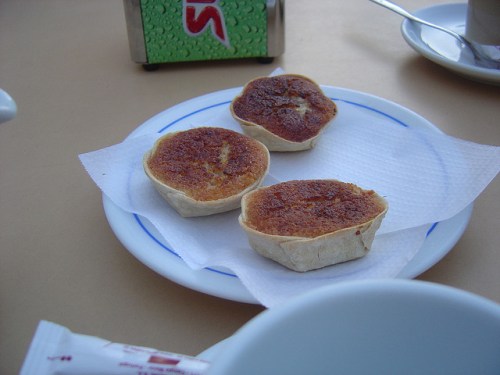
Portugal received a trouncing today by Germany in the World Cup, so if you are a Portugal fan, why not drown your sorrows in some delicious Portuguese pastry? One of the most emblematic pastries in Portugal is the Queijada / Queijadinha (simply, “little Queijada”), which is a sweet, baked cheese and egg tart from picturesque Sintra. It is actually kind of hard to describe since “cheesecake” in the USA conjures up memories of cool, creamy New York-style slices. Instead, the filling of a queijada is more solid and granular – not “cheesy” at all! But don’t let that dissuade you – they are delicious and unique in their own right. For the real deal, the best place to get queijadas in Sintra is the Piriquita Cafe/Bakery (Rua das Padarias, 1 – Sintra), a store that has been turning out the delicacies for over a century. If you are not in the vicinity of Lisbon, Honest Cooking and The Age have recipes to make your own sweet treats to smooth over any world cup moodiness.

Queijada

Queijadas at Piriquita by Sandra Rosa

3 Comments

Filed under Pastry Post-Poc

As the World Cup opens, we celebrate Croatian Pršut!

Flag_of_Croatia.svgIn just a few hours, the 2014 World Cup will open in São Paulo as the heavily favored Seleção take the field against Croatia. Over the next month, we will be highlighting some of our favorite Brazilian dishes and food experiences, as well as stories from some of the competing nations. But today, we felt it appropriate to pay a small homage to Croatia, Brazil’s sacrificial ham (get it?) Italian prosciutto, born just across the Adriatic sea, is beloved in Croatia, where it is known as pršut. Of course, Croatians have put their own unique spins on the classic delicacy. Native to the western Croatia region of Istria, which is near the Italian border, pršut is generally similar to Italian preparations, but Istrians remove skin and fat, and replace it with salt, spices, and other herbs. But go further down the Dalmatian coast, and pršut – shock of shocks – is generally not dried but smoked, with the flavor accented by the air from nearby mountains and fields. Having never been to Croatia, and of course being big fans of dried cured ham, we would love to try both varieties. Maybe the Croatian national football team will bring some to their match in a few hours? The afterparty would be fun!

Dalmatinski pršut (Dalmatian prosciutto) on racks. Via vvv

Dalmatinski pršut (Dalmatian prosciutto) drying after being smoked (Via Diaspora Diaries)


Leave a comment

Filed under World Eats

Getting ready for the Copa do Mundo / World Cup!

The World Cup is almost here! In honor of this global event, we are looking forward to cheering on the Brazil and US teams and sharing some of our favorite stories and dishes from around the globe. Also look for special coverage about the food scene in Brazil, we still have a lot to cover from our time there! 719px-WC-2014-Brasil.svg

Leave a comment

Filed under Note, World Eats

Agua y Sal: Adventures in Mexico City’s Best Ceviche

Agua y Sal Cebicheria
Campos Elíseos 199-A
Polanco C.P. 11560
Mexico, D.F., Mexico

Mexico FlagAgua y Sal (“Water and Salt”) is widely acclaimed as one of the best seafood restaurants, if not one of the best restaurants in general, in Mexico City. We wasted little time in placing it on our list of “must-trys” in Mexico City. While (as will be demonstrated in forthcoming posts), we really came to the D.F. for street food and markets, the lure of some of the best ceviche in a great ceviche country was too much to pass up. And Agua y Sal delivered: from flawless Mexican service, to adventurous and innovative ceviches, to the fresh seafood necessary to pull them off, this was a treat well worth the high (by Mexican standards), but not unreasonable, price.

???????????????????????????????

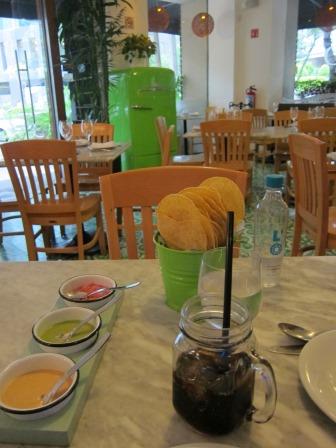
We walked to Agua y Sal following a day of wandering through Chapultepec Park (and taking it all the sites at the very impressive National Anthropology Museum). Located just north of the park, in Mexico City’s swanky Polanco district, Agua y Sal presents an initially surprising first impression: a marriage of upscale ambiance and casual dining. A green 1950s refrigerator and hipster-style mason jar serving glasses would be much more at home in Wicker Park than Mexico City’s version of the Chicago Loop; but somehow it all works. Less surprising is that the service at Agua y Sal is flawless: attentive without being overbearing, quick but not rushed, and, like any good non-US restaurant, they let you linger without the check long after you’ve finished eating. Our waiter, whose name we sadly didn’t write down, was the best we’ve had in some time. On his and our recommendation, we decided to start and finish with the Cebiches Tasting Menu, a selection of four of the restaurant’s [supposedly] finest ceviches, priced at 185 pesos (about US $15). Check out the photos and descriptions of each below.

???????????????????????????????

Agua y Sal places an emphasis on fresh and unique flavor combinations, while paying homage to the classics. Take a look at the menu, and you can see the restaurant emphasizes its particularly impressive array of sea salts to be paired with each of its ceviches. As we learned during our time in Portugal, sea salt can make or break the dish, bringing out certain flavors while diminishing others. They certainly did on our first course, the Atun. An interesting ceviche of tuna in a tamarind sauce, the tamarind is well balanced with accompanying cucumber, red onion (always), avocado, and cuaresmeño chiles (a variety similar in spice to a jalapeño, but with milder flesh like a poblano). Using this chile instead of the jalapeño is a smart choice against the powerful tamarind, and all the flavors were brought together by their other smart choice of a little black Hawaiian sea salt. While this was not our favorite ceviche of the evening, it could have gone terribly awry in less competent hands.

???????????????????????????????

Our second ceviche was the restaurant’s namesake, Agua y sal. One of our constant problems with Mexican ceviches in the past has been their overall lack of leche de tigre, but at Agua y Sal in general, we were pleased to see them using classic Mexican and tropical flavor profiles without sacrificing the precious liquid that makes ceviches of all kind such a treat. The Agua y sal showcases fresh shrimp and chopped mango in a sauce of pineapple and cuaresmeño chiles. Add red onion, peanuts, sesame seed oil, and a bit of Maldon sea salt flakes, and this is a great dish to showcase Mexican ceviches alongside a readily drinkable leche de tigre.

???????????????????????????????

At this point it is difficult to make a classic Peruano ceviche that really impresses Matt, so Agua y Sal can be forgiven for not blowing us away with its rendition of the coastal Peruvian classic. But they did a very good job. Halibut always seems to be a better choice than tilapia, and their choice was soft and spot-on. Red onion, cuaresmeño chiles, and cilantro accompanied the ubiquitous cancha (Peruvian corn nuts), corn kernels, sweet potato, and Peruvian Andean sea salt. Rarely do the corn kernels and nuts make their way into the ceviche proper, but we were interested by this technique of adding a little liquid to the typically dry corn nuts. A very solid rendition.

???????????????????????????????

But the big winner and unexpected star of the night was the Veracruzano. Arguably the simplest ceviche of the bunch, this one packed bold and sophisticated flavors that married perfectly together. Grouper – an odd and excellent choice of the main fish – balanced against a sauce of cilantro,  jalapeño chiles (for extra flavor), cucumber, red onion, and sea salt from Guerrero Negro in Baja California. The sweetness and refreshment of the cucumber was a great complement to the peppers and sea salt. This was a big winner, and we would order it for our main appetizer next time!

Overall, we would highly recommend Agua y Sal to anyone in for some ceviche in the notoriously landlocked and smoggy Mexico City. Refreshing, light, and airy, you can linger here for a while; and when you are done, spend some time in Chapultepec or the gorgeous branch of the Pendulo bookstore in Polanco. We’ll be back on our next trip to the D.F.


Leave a comment

Filed under Reviews

The World Cup of Sausages

The World Cup is only just a few days away. Of course, we will use this global event as yet another way to highlight some of the lesser-known and more delicious foods from all around the globe. For a first little taste, why not check out Bon Appetit’s list of top sausages from every country represented in the cup, from Croatia’s ćevapi to Mexico’s chorizo to Algeria’s merguez!

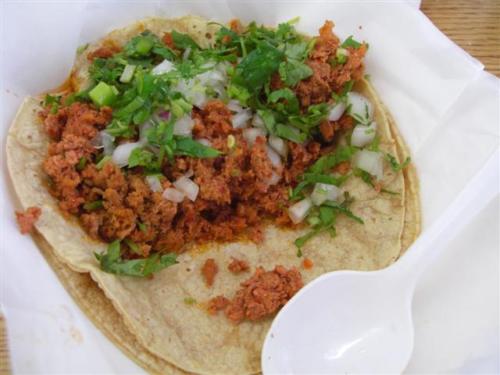
chorizo taco

A chorizo taco in Chicago

Leave a comment

Filed under Reviews

Zapotec Cooking in Oaxaca with Reyna Mendoza

Zac xtili! Reyna Mendoza had carefully explained to us how to say “Good morning” in the Oaxaca valley dialect of Zapotec only ten minutes before, but we were still having problems. Luckily Reyna, a native speaker of both Zapotec and Spanish, did all of the talking. On this day, our last in Oaxaca, we were lucky enough to be the only two participants in a cooking class with Reyna. A widely-known authority on the cuisine of this region, and a spectacular chef in her own right, Reyna has spent the past nine years hosting cooking classes that showcase what she terms El Sabor Zapoteco – “Zapotec Flavor.” A lifelong resident of Teotitlán del Valle, a small town outside Oaxaca City primarily known for its families of tepate weavers, Reyna takes her students through the sites and sounds of the local market – where valley Zapotec is spoken almost exclusively – as well as the careful preparation of some classic Oaxacan ingredients using traditional methods. In this context, “Zapotec” flavors does not necessarily connote pre-Hispanic dishes – the majesty of Oaxacan cuisine in general comes from its careful negotiation across Spanish and indigenous ingredients and techniques – but rather largely pre-Hispanic preparations. The jaw-dropping numbers of different molcajetes, earthenware comales, and stone metates in Reyna’s kitchen alone emphasize her insistence on using ancient preparation techniques to impart flavors one cannot get with other preparations. One then leaves her class with a quite different relationship to the food.

???????????????????????????????

Class starts at the local market, which showcases meat and produce from the immediate valleys, as well as more exotic imports like apples (shipped in from Washington state). As is true throughout most of Mexico, it is considered very rude to take photos of locals, so we stuck to shots of food while using the three Zapotec words we learned.

???????????????????????????????

No Oaxacan meal is complete without quesillo, a soft white cheese that can be crumbled on top of, or stuffed inside of, seemingly anything you want. Its mild flavor pairs well with many stronger ingredients. Packed hand-made fiber wheels and wrapped in string, this cheese has evolved over the centuries from when the Spanish first brought cheesemaking to the Americas. On this day, we would use a small wheel of it in preparing flores de calabaza rellenas de queso – squash blossoms stuffed with cheese.
???????????????????????????????

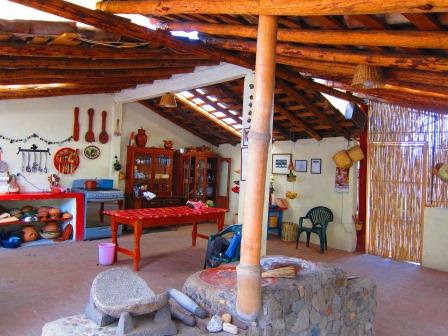
Having picked up our ingredients at the market, Reyna brought us back to her absolutely spectacular kitchen. Half outdoors, bright and colorful, boasting a set of kitchenware to make anyone jealous, and to this day the only kitchen we’ve seen that incorporates two hammocks (for when you pass out after a big meal), it is our dream space. Swoon.

???????????????????????????????

No cooking before chocolate! Oaxacans do love coffee, but historically, and to a large extent still, they begin their days with a cup of chocolate prepared in a green-glazed cup, and then frothed with a molonillo, a type of wood whisk that can be easily purchased in any Oaxacan market for between one and two dollars. Making the chocolate usually involves breaking pre-made bars into hot water or milk, and then frothing it with the molonillo. The chocolate bars used for our drink were made, by hand, by Reyna’s mother.

???????????????????????????????

Some of the slew of ingredients for our day of cooking. Dried ground corn; coarse sugar and cinnamon sticks; dried red pasilla chiles; purple tomatillos; tuna fruits, the product of the nopal cactus; garlic; cilantro; small Oaxacan avocados (there are many different cultivars, each with their own flavors – the photo actually shows two different types); and a side view of a concha, a classic Mexican pastry always paired with morning chocolate.

???????????????????????????????

Even more of our prep table: sea salt; the quesillo we purchased from the market; ground bread crumbs; a bundle of fresh squash blossms (widely used in Oaxacan cooking), and at the far right you can see a peak of epazote, a very distinctive green herb, and some guajillo chiles.

???????????????????????????????

This area makes us jealous as well. Reyna’s kitchen features two large clay comales, a type of shallow cooking surface used in this region for centuries. Reyna’s are heated manually using a local type of bamboo. You can use the comales for any variety of uses: heating up tortillas, roasting dried chiles, or toasting dried corn. At right, a stone metate will eventually be used for grinding toasted dried corn.

???????????????????????????????

Reyna showing off her very impressive metate skills. Reyna’s kitchen had at least ten different metates, each one with a different use. While the one she is using in this photo is for corn, the smaller (and exuberantly decorated) one at left is used for preparing chiles that have been dried, smoked, and then soaked in water. Note how the corn one has a very rough surface, while the chile one is both smaller and smoother.

???????????????????????????????

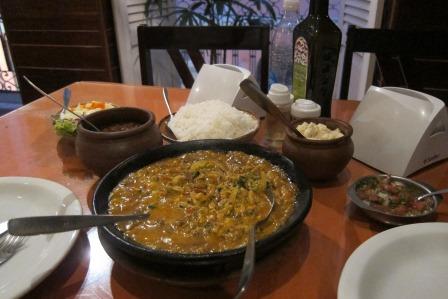
So, we made the executive decision not to show you, or describe to you, much more of the cooking preparation. On one hand, arriving at around 10am, we cooked for a few solid hours to make a four-course meal that left us completely stuffed. It would just be too much to show! But at the same time, we don’t want to share the recipes. While Reyna does give out small recipe booklets to everyone who takes her classes, you really should go to Oaxaca and experience it for yourself; indeed, some of the dishes simply cannot be made without the methods and materials Reyna uses. If nothing else, go for the table preparation: somehow while we were cooking, Reyna and her sister magically set up this lunch table for us. Already on the table are a roasted pasilla and guajillo salsa, and a very refreshing cold drink of tuna juice, the aforementioned cactus fruit that is a popular flavoring throughout the Oaxaca valley. We were also served some very fine, very smooth, and very strong mezcal, paired with orange slices and spicy salt.
???????????????????????????????

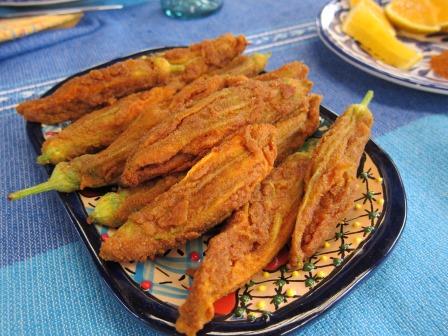
Appetizer one: Flores de calabaza rellenas de queso – fresh squash blossoms stuffed with quesillo and fried. These are simple to make, but by no means easy.
???????????????????????????????

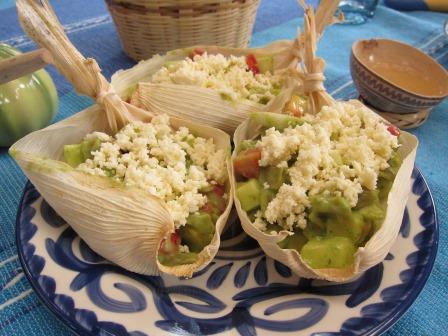
Appetizer two: Ensalada de noplaes – a salad of tomatoes, jicama, nopales, and onions in a dressing made with avocados, limes, and cilantro, all topped with quesillo and served in a dried corn husk. Our favorite dish of the day. Simple to prepare, fabulous presentation, and bold, balanced flavors.
???????????????????????????????

Main dish: Zegueza. Boiled chicken served in a sauce of specially-prepared corn (trust us, no way to make this at home), guajillo chiles, tomatoes, and onions, served with some leaves of hierba santa.

???????????????????????????????

Dessert: Reyna’s favorite dish, nicuatole. In its simplest preparation (the white part in this photo), this dish only contains corn, water, sugar, and cinnamon. Yet making it is quite complex, involving a series of different processes and waiting that adds up to between four and twelve hours of prep time. One eventually arrives – very surprisingly – at a consistency like jello or pudding. Some then top the mixture with a sauce made from tuna fruits. Here, Reyna made a special sauce from sugar and cochineal, a small insect that lives in nopal cacti, and whose red dye is frequently used as a coloring ingredient. An astoundingly unique dish, and one that will be very difficult to re-create in Chicago.

Overall, this cooking class was an awesome experience. Even with all the time we spent cooking, Reyna had been preparing many of the ingredients for the dishes the day before. Indeed, our greatest experience from this class was the amount of concentrated effort and love labors put into this food: how the effort at grinding salsas by hand in a molcajete imparts a different (and better!) flavor than just putting them in a blender; how grinding corn in a metate that has been used for years creates a unique texture necessary for a any good zegueza. We highly encourage you to check out Reyna’s class the next time you are in Oaxaca; or, failing that, to check out her family’s restaurant: Tlamanalli. You won’t be disappointed!

3 Comments

Filed under Reviews

Headed to Mexico City and Oaxaca!

Mexico FlagThe eaters are headed to Mexico on a culinary adventure! We start out in Oaxaca, where we plan to enjoy the slower pace of life while enjoying our fill of moles and chocolate. We are even signed up for a cooking class just outside of Oaxaca! Next, we are off to Mexico City where we plan to eat as much street food as possible, and perhaps soak in a little cafe culture. We are excited to share our newly-found foodie knowledge with you when we get back. Any last minute suggestions are also welcome.

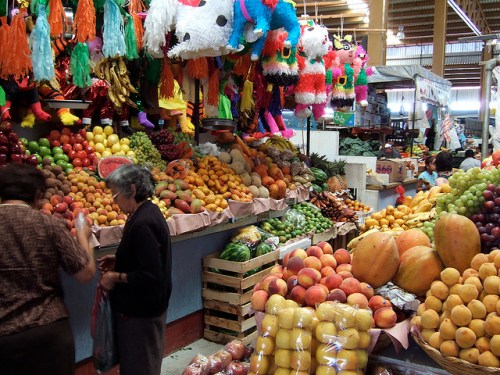
Oaxaca Market

Oaxaca Market by Nunavut

Leave a comment

Filed under Note

What is Tepache?

Mexico FlagWe recently covered a video series, Thirsty for…, that covers nothing but unique and emblematic non-alcoholic beverages from around the world. We recently discovered a unique drink that would be a perfect fit for the series: Tepache. We first spotted tepache alongside the more familiar jamaica and horchata drinks in our favorite taqueria. So…what IS tepache? Tepache is a drink native to Jalisco, made from both the flesh and the rind of pineapples and sweetened with brown sugar/piloncillo. Usually we stick to our favorites, but we decided to go for the unknown and try some Tepache. It was extremely refershing, sweet and slightly carbonated, due to the fermentation. It doesn’t seem that hard to make (recipe here) but the trick is waiting for it to ferment instead of enjoying the pineapple juice!

tepache

Tepache at a street stall by Y!Musica

1 Comment

Filed under World Eats

Jimmy’z Kitchen: Mofongo in Miami

Jimmy’z Kitchen
Several locations – we visited 2700 N. Miami Ave.
Wynwood, Miami, FL

Flag of Puerto RicoWe first had mofongo in Puerto Rico in 2008, and haven’t had it many times since. So when our Miami local friend suggested a good place to get mofongo in Miami, we were sold. Jimmy’z (named after proprietor Jimmy Carey), located in the trendy Wynwood neighborhood of Miami, is bright and modern with ample outdoor seating. The menu is a little more upscale and pricier than you might expect at a place where you order at the counter (some entrees over $20), and the food is later brought to your table. ???????????????????????????????

The menu at Jimmy’z has something for everyone. For a quick bite, there were a wide selection of panini and other sandwiches, including a cubano and seared ahi tuna. There are even substantial entrees covering both Latin and American cuisine like pollo guisado and cajun ribeye if you are really hungry, and a big range of salads if you are trying to be “good.” We had the tomato and mozzarella salad to offset our mofongo and it was delicious! However, what we had been hearing raves about was the mofongo, the quintessential dish of Puerto Rico made from mashed plantains and garlic. Honestly, we were a little skeptical since the restaurant seemed to be doing the whole Pan-Latin and euro sandwich thing. However, we were assured that the mofongo was the real deal. ??????????????????????????????? There were 6 kinds of mofongo available: mixed seafood, fresh fish, churrasco, pork in mojo sauce, chicken and shrimp. We ordered the pork mojo mofongo, since M can never pass up a roast pork dish, and split a little of the churrasco with our friends. The price, $17, was a little high, but it was more than enough to feed two hungry people. The pork was tender and flavorful and it was chock full of plantains. It was still had some substance to it, not too mushy. They weren’t lying, this mofongo was delicious.

???????????????????????????????

Everyone at our table got mofongo so it was fun to try all the different kinds, though we still think the pork mojo was our favorite. Contributing to the party atmosphere, there is also an ample beer and wine selection, including a lot of import bottles, which were a hit. On a nice night, the outdoor patio was particularly festive.  Jimmy’z was awesome for mofongo, and it gave us the hankering to go back to Puerto Rico, ASAP!

Leave a comment

Filed under Reviews

The Modern Art Cookbook

LeGourmetPicasso

Pablo Picasso “Le Gourmet”

[Via Brain Pickings] We are enthralled by Mary Ann Caws’ Modern Art Cookbook. It seems a little different than most cookbooks, and in this book you can find recipes, illustrations and stories, not only inspired by, but sometimes written by, famous contributors to the modern art world. We could certainly see ourselves making Kahlo’s Red Snapper, Veracruz style or Picasso’s Herb Soup.

Leave a comment

Filed under Books, Links

Jin Thai, superlative Thai in Chicago

Jin Thai
5458 N. Broadway
Chicago, IL 60640

thailandWe have been meaning to try Jin Thai FOREVER…well maybe not forever, but certainly sometime soon after they made it onto the Michelin Bib Gourmand list in 2012. Every time we go up and down Western we looked at the Jin Thai sign longingly. We finally made it there on a particularly blustery and cold night, and we were certainly glad we did. The place is tiny, and they don’t take reservations unless your party is more than 4 people (we had 4), so we waited about 20 minutes for a table to open up on a Friday night. There really is no room to wait, which made it a little awkward as we loomed over other tables. It is also BYOB and also does carry out, so keep that in mind if it is a particularly busy night.

JinIterior

Jin Thai’s menu hits all the classics while incorporating some less common dishes, enough to keep Chicago’s seasoned Thai food aficionados happy. A well-curated and manageable menu includes a set of highly recommended curries, as well as one of the best crab rangoon in the city. On this trip, we stuck to our favorites: Lindsay got her classic Pad See Ewe ($8.95), a  delicious version made better by the addition of a little something else in the sauce beyond soy. Maybe fish sauce? Whatever it was, it had a great depth of flavor. Matt got the Massamun Curry ($14.95), with chicken, potatoes, onions, pineapple, and peanuts. This was one of the more complex curries he had ever had. We also shared a plate of crab rangoon to start, and everyone agreed with the reviews:  one of the best in the city.???????????????????????????????

Everything at Jin Thai was delicious, and the flavors were slightly more complex and elevated than we expected. If we lived closer, this definitely would be our go-to place, though we plan to visit it whenever we are on that stretch of Western. Get there early so you can get a table!

1 Comment

Filed under Reviews

Farm Fresh in Naples: Agriturismo Tre Piccioni

Tre Piccioni
Via Tre Piccioni, 73
Pozzuoli, Italy

ItalyWe love going to countries and experiencing a wholly new restaurant genre. The kilo restaurant was one of our favorites in Brazil; but in Italy we first encountered the Agriturismo. Agriturismos are restaurants run by local farmers. Typically open only on weekends, their owners prepare fresh, ingredient-forward meals based on whatever is in season at the farm. You just sit back, tell the owner how many there will be in your party, and see what you get served.
Our friends Maya and Chris, temporary expats from the US, lived near agriturismo Tre Piccioni (“Three Pigeons”), in the town of Pozzuoli, just west of Naples proper. Definitely off the beaten tourist path, you can only get there by car, and if you blink you might miss it. Maya and Chris were also good friends with the amiable proprietor, Paolo. Paolo’s menu changes constantly, though it seems he puts it on the website as well. Maya and Chris warned us to come with a full appetite: Paolo typically serves an antipasto, a primo and segundo piatto, a dessert, coffee and a carafe of house wine – all for the very reasonable price of 20 euros a head.

???????????????????????????????

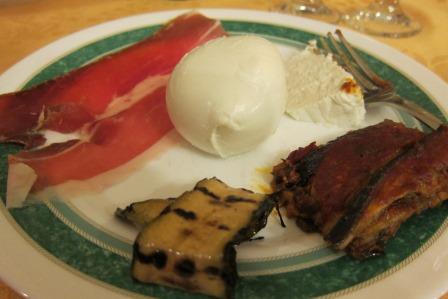
When we arrived we were heartily greeted by Paolo, who promptly given a  carafe of house wine, fresh bread and a fresh ball of mozzarella. The mozzarella was a show stopper, and we could have eaten 2 or 3 more. For our antipasti we were served sliced prosciutto, eggplant parmigiana, fried zucchini and chickpea flour fritters (crocche); a nice little taste of some of the street food we also enjoyed in Sicily.

???????????????????????????????

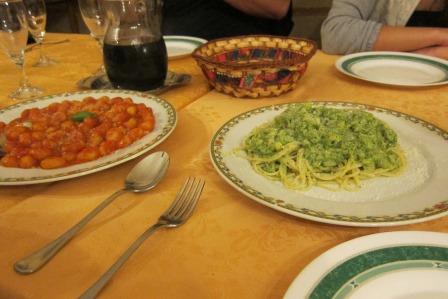
For our primi, we actually were served 2 pasta dishes for the table. First was gnocchi alla Sorrentina. This consisted of tiny gnocchi (much smaller than we had seen elsewhere) covered in a red sauce and sprinkled with cheese and a hint of fresh basil. We also enjoyed a pasta with broccoli sauce – a new dish we had never tried before. The pastas came out family-style on a big plate, but don’t worry, there was MORE than enough for everyone. However, we are still kicking ourselves for letting the waiter take away the gnocchi plate while there were still gnocchi to be consumed.

???????????????????????????????

For our mains we were served a hearty plate of pork cutlets and sausages, with a side of somewhat limp fries that we mostly picked over. There was also an unusual side salad seasoned only with salt, and accented with lime juice. Perhaps a little too much salt for L’s taste, but M enjoyed the simplicity. Either way, good to have some veggies!

???????????????????????????????

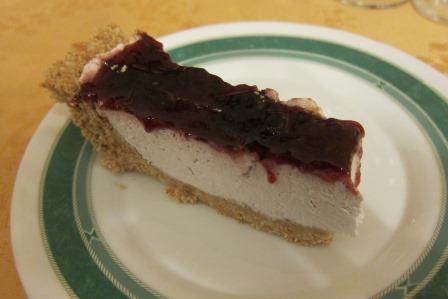
For dessert we had a light raspberry panna cotta, which was extremely tasty, though it almost pushed us over to the point of bursting. The meal was finished up with a glass of homemade limoncello (very strong), and tiny cups of espresso (what else?). We were so stuffed we couldn’t believe it! All this for 20 euros apiece. If we lived nearby there’d barely be reason to cook at home, since everything was nice and fresh, and just like eating at a friend’s house. Now let’s work on bringing some of these agriturismi to the US!

1 Comment

Filed under Reviews

Nutella Bar opens in NYC Eataly

With much fanfare, a Nutella bar has opened in the NYC Eataly. Well it isn’t quite a Nutelleria, but it is the closest thing to one on US shores. The Chicago Eataly already has a lovely Nutella bar (which was around since the grand opening of Eataly, unlike the NYC outpost), but it appears to be on a slightly smaller scale than the NYC Nutella bar, which has a towering wall of Nutella on one side (that is where the gelato stand is in the Chicago Eataly). So what can you get at a Nutella bar? The menu is the same as in Chicago: pastries and bread slathered in Nutella, alongside Nutella crepes, ranging in price from $2.80 to $5.80. Without a doubt, the success of the Chicago Eataly’s Nutella bar was inspiration to Eataly impresarios Bastianich and Batali to transport the concept to NYC. After all, who doesn’t love Nutella!?

Image

Nutella Bar in NYC by Eater NY

2 Comments

Filed under Reviews

Cooking Terms Across the Atlantic

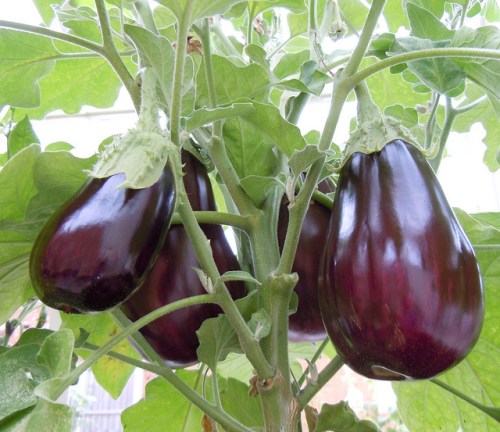
Learning food words is usually our first priority when learning a new language. But as it turns out, even the English terms for food are vastly more regional than we thought. So we knew that eggplant is “Aubergine” in the UK and cookie is “biscuit”… but that’s only just the start. This post on Stack Exchange has a long thread about translating cooking terms between the UK, the US and Australia. One of the most interesting facts we learned was that snow peas are called “mange tout” in the UK, and when you get to jelly/jam/jello everything gets really confusing.


Leave a comment

Filed under Links

Classic Pho at Tank Noodle

Tank Noodle
4953 N Broadway
Chicago, IL 60640

vietnamPho Xe Tang, popularly known as Tank Noodle, is a staple of Chicago’s Vietnamese Argyle neighborhood and our go-to place for Vietnamese cuisine in Chicago. Though this area has no shortage of places that do pho very well – Pho 777 and Pho 888 spring immediately to mind – we always end up coming back to Tank Noodle (there is a fish tank in the corner, from which we suspect the restaurant gets its name). We have introduced many of our friends to Vietnamese food here, and everyone has come away happy. Be warned: the menu is, well, gargantuan. It is easy to feel overwhelmed by the seeming laundry-list of Vietnamese dishes, but we are still searching for something they don’t make well here, and there are options for every palette, from vegan to carnivorous and everything in between.  Of course, you will see most people ordering pho, though you can also get stone pot dishes, noodles, and bánh mì sandwiches.
Tank Noodle

Though it is easy to get bogged down in choices, we have a few go-to options to which we always return. Lindsay enjoys her lemongrass noodle bowl, a light cool dish that is especially good in summer months. Matt also enjoys #195, the the Hot and Spicy Sour Chicken Soup, which comes with an ingredient list that reads like a paragraph: “pineapple, lime leaves, hot pepper, tamarind, okra, Alocasia odora, culantro, sour bamboo, basils, rice paddy herb, dried onion, garlic pork oil.” The flavor combinations are exciting and seemingly unique to this dish. Spice it up with some chili sauce, peppers, and more lime juice, and it’s a great winter soup / full meal anytime. Get the “small” – at $12.95 it is enough food for two days. We don’t even want to know how big the large is ($18.95).

???????????????????????????????

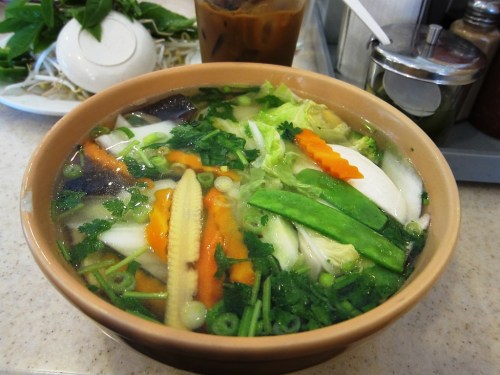
In the winter, however, you have to go with the pho. The most popular choice always appears to be beef pho. You can decide what kind of meat you want in the pho, ranging from sliced steak to tendons. While you can select to get a small or large size, much like with Matt’s soup, unless you are sharing with 3 other people (and maybe you are) the “small” is plenty large enough for even the biggest appetite. Though the broth is heavenly, our favorite part of pho is really the platter of garnishes that comes with it. On the plate you get Thai basil, culantro ( a fascinating herb that tastes like cilantro but looks like a stalk of grass), sprouts, lime wedges (cut the right way by taking out the white pith in the center) and hot peppers. Of course, to go the extra mile to make your pho spicy you can add some house-made chili sauce and fresh jalapeño peppers.

???????????????????????????????

If you have a large group, it is absolutely essential to have reservations, since this place can get packed to the gills, especially after 7pm on Fridays and weekends. It’s also fun to sit at the large table with the lazy susans. When we were there with a group of eight people on a Friday night, a huge line loomed behind us. Thank goodness for that reservation.

Leave a comment

Filed under Reviews

Our favorite moqueca in Salvador: Axego

Axego
Rua Maciel de Cima, 1,
Salvador, Bahia 40026-250, Brazil

Axego is the rare restaurant that we will go to TWICE in one trip. Though we rarely visit the same place, we loved Axego’s setting, the food and the warm service so much we decided to make it our last moqueca in Salvador. We also could not believe the extremly reasonable price. The menu at Axego is pretty varied and has all the typical Bahian dishes you may expect. However we were there for one thing alone – Moqueca. On our first visit we decided to branch out into a type of moqueca we had never tried before: Aratu Red Crab (R$48). This rounds out to about $25 US or less than $13 a person – good deal!

???????????????????????????????

Axego’s restored colonial interior.

Now we absolutely love moquecas, and over the past year or so have sampled enough so that we know exactly what we are looking for. First – it has to come to the table piping hot, preferably in or on a stone bowl. In terms of the moqueca itself: it has to have not too runny of a sauce , high quality protein, good dende flavor and a nice and varied amount of sides in non-stingy portions. M would also add that there has to be a spicy pepper sauce to spice things up. Never have all of these elements come together so well than as at Axego. The moqueca itself came our absolutely filled to the brim with Aratu, a strongly-flavored and tasty crab dish. No filler or watery  sauce here! On our second trip we went with our old standby – moqueca de camarao. Both were equally delicious, though the uniqueness of the Aratu gets our vote. We can get shrimp just as well in the US.

???????????????????????????????

Moqeuca de Aratu (red crab) – a rare treat even in Bahia.

On the last visit we made to Axego we were even lucky enough to hear a live Olodum concert while we were eating – not IN Axego, mind you, but rather in a largo right behind the restaurant. Dinner and a show all for the price of a few mediocre sandwiches back in the US. The space of the restaurant itself is very nice, in a restored colonial rowhouse. The inside is mostly wood, and an entire wall is dedicated to a a creatively-displayed selection of Bahian artifacts and art works.

???????????????????????????????

Music provided by Samba Chula de Sao Braz and Raimundo Sodre at Sankofa African Bar.

We highly enjoyed our moqueca at Axego, and we hope we are able to go back soon. Along with tasty food, Axego has all of the intangibles that we love in a restaurant, welcoming service, pleasant atmosphere and a good vibe.  If you are going to get one moqueca in Salvador, make it Axego!

1 Comment

Filed under Reviews

Fika – a Swedish coffee break in NYC

Fika
(Several locations)
41 W. 58th St.
New York City

sweden_flagWe wrote several years ago about the iconic Swedish coffee and snack break – the fika – including a mention for the Fika coffee shop in NYC. The post got us really hoping to visit Sweden to enjoy an authentic fika. A few weeks ago, we were excited to visit Fika and experience a tiny bit of Swedish coffee culture right here in the US. NYC’s Fika cafe is just how we would imagine a Swedish coffeehouse to be: tiny and immaculate with only room for about 10 people at tall tables inside (if you are lucky enough to get a seat). Compared to US coffeehouse, Fika had a rather small menu of coffees. The coffee served here is actually roasted in NYC, but in the Swedish style. L ordered a cappuccino and the caffeine-averse M ordered hot chocolate. The coffee was light and flavorful and the hot chocolate was pleasingly rich.???????????????????????????????

Even better, there is a very nice selection of pastries and chocolate, including a wide variety of truffles and chocolates. In fact, Fika has its own chocolatier and several pastry chefs, giving the shop a constant supply of tempting sweets. We got a Cardamom bun, one of the most popular items, which was a rose-shaped croissant with a heavy helping of one of Sweden’s favored spices (there were also cinnamon and vanilla versions for non-cardamom fans). Of the chocolates, we tried truffles with goat milk, which was surprisingly delicate.???????????????????????????????

However, the showstopper was the Prinsesstårta, aka Princess cake. On their website, Fika even advertises that they are the “home of the Princess Cake,” which is no small feat. We have written about the painfully complex Prinsesstårta before (to date it is the the only cake we have seen that requires a diagram to explain) but we have never actually tried it until now. The version at Fika had all the requisite layers: sponge cake, whipped cream, jam and green marzipan. It was really enjoyable, and a lot more filling than we expected.???????????????????????????????

We are so happy to have found Fika, a little taste of Sweden in the US. Incidentally, when we went on a weekday morning, the cafe was full of Swedes! If you are feeling especially nostalgic, you can also bring home boxes of the stores coffee, tea, and Swedish berry preserves for your own little fika at home.

2 Comments

Filed under Coffee, Pastry Post-Poc, Reviews

Oslo Coffee in Brooklyn

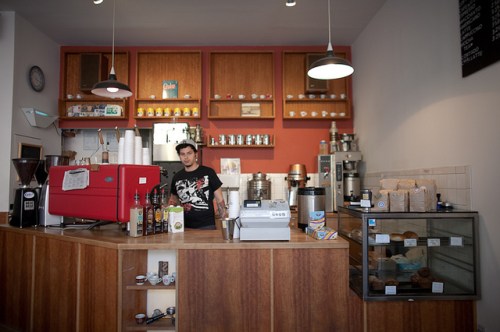
norwayTogether with Fika (review coming soon), Oslo Coffee represented our foray into Scandinavian coffee culture while in NYC. Oslo Coffee (328 Bedford Avenue, Williamsburg, Brooklyn) is super tiny, consisting of only a few tables, two benches outside and not even a public bathroom (we asked). The menu consists primarily of coffee or tea, and most people get it to go, though it seems like the other locations are a bit bigger and have more seating. However, despite the tiny size, the store is cute and welcoming. There are also some pastries on offer if you are feeling peckish. The coffee is specially roasted by the owners in New York City, but in the Norwegian Style, home of arguably the world’s most exacting coffee culture. There are 3 house coffee blends named after Norse gods: Odin (Espresso), Freya (Dark Roast) and Thor (house blend). We ordered an iced coffee made with Odin, and it was surprisingly smooth and mellow, and perfect for one of the first iced-coffee appropriate days of the year. They don’t take credit cards though, so remember your cash.
Oslo Coffee Company

Bedford Ave. location of Oslo Coffee Company by Protographer23


Leave a comment

Filed under Coffee, Reviews